


























Views
Downloads

Grade 5-7 5 Kingdoms of Life — Printable No-Prep Worksheet
Paste this activity's link or code into your existing LMS (Google Classroom, Canvas, Teams, Schoology, Moodle, etc.).
Students can open and work on the activity right away, with no student login required.
You'll still be able to track student progress and results from your teacher account.
This science worksheet helps students classify organisms into the five kingdoms of life by analyzing characteristics like cell type and nutrition. By evaluating visual clues and prompts, learners build foundational biology skills and distinguish between Animalia, Plantae, Fungi, Protista, and Monera.
At a Glance
- Grade: 5-7 · Subject: Science
- Standard:
MS-LS1-1— Identify that living things are made of one or multiple cells.- Skill Focus: Kingdom Classification
- Format: 2 pages · 12 problems · Answer key included · PDF
- Best For: Independent practice or review
- Time: 15–20 minutes
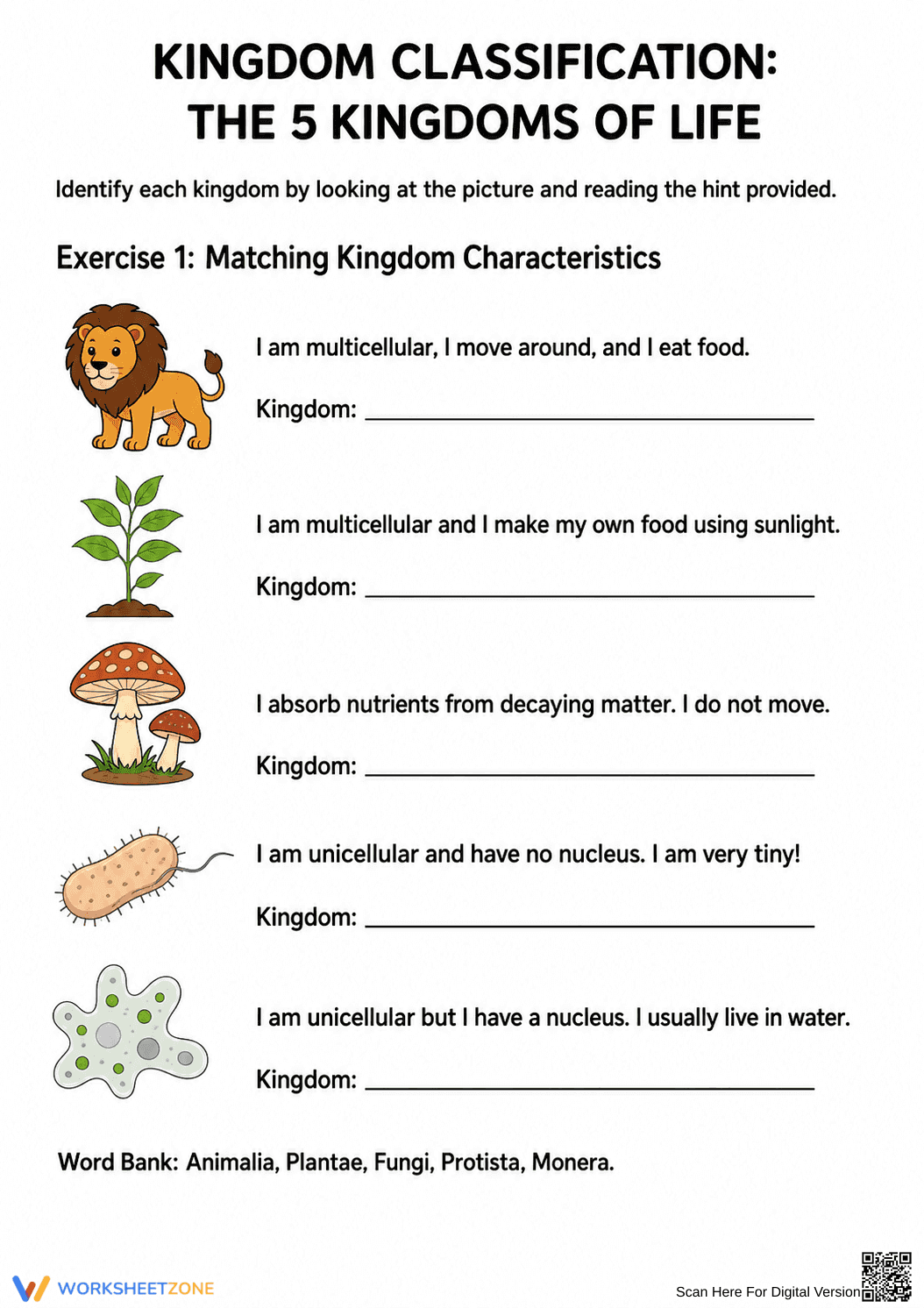
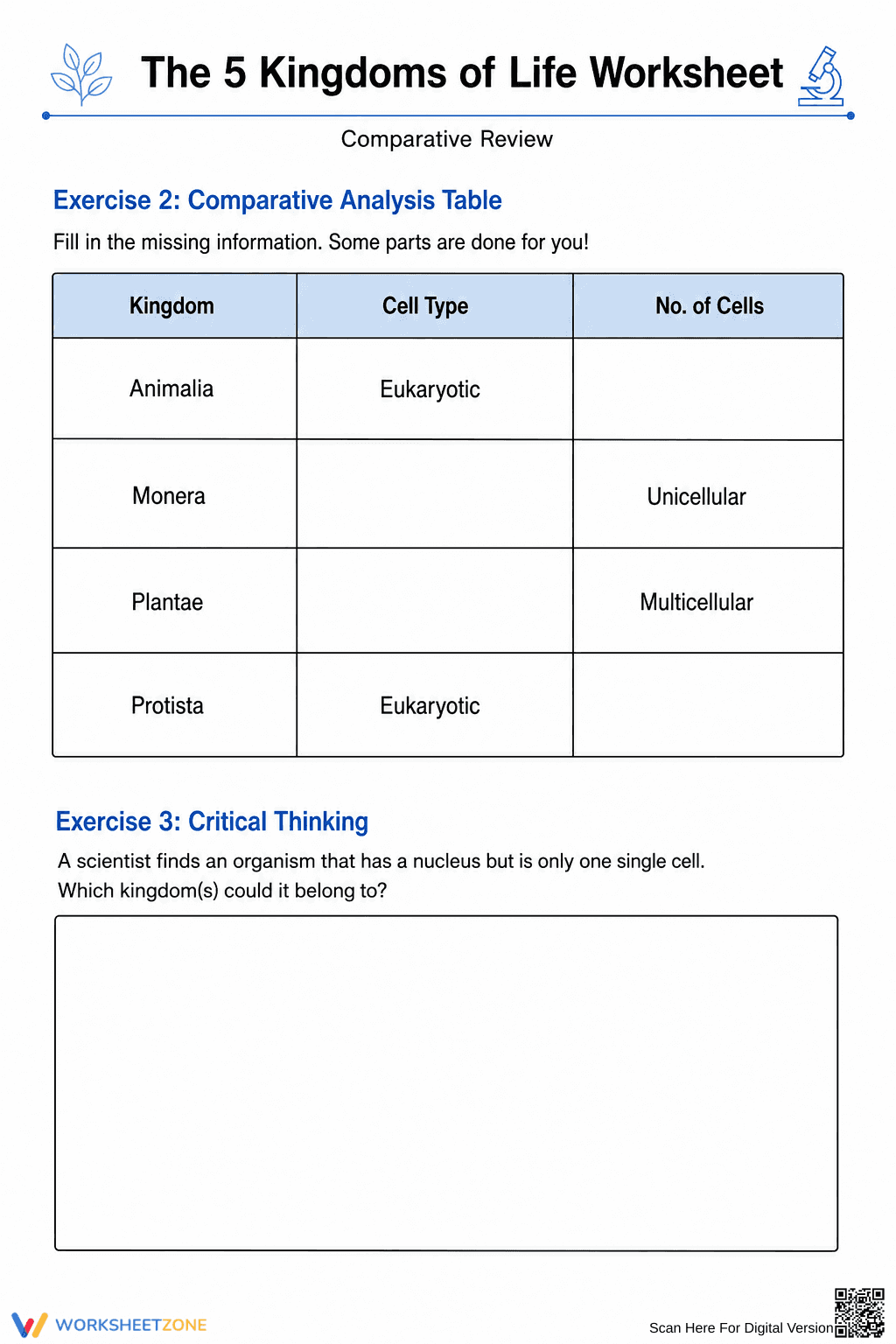
This two-page resource features a variety of task types to reinforce biological classification. The first page includes five matching questions where students use a word bank, illustrations, and descriptive hints to identify specific kingdoms. The second page challenges students with a comparative analysis table requiring them to fill in missing cell types and cell counts, followed by a critical thinking short-answer question about a newly discovered organism. An answer key is provided.
Designed for immediate classroom implementation, this resource requires virtually no teacher setup.
- Print (1 minute): The standard PDF format ensures crisp, clear printing of all illustrations and tables.
- Distribute (1 minute): Hand out the double-sided worksheet as a standalone assignment or sub plan.
- Review (3 minutes): Use the included answer key to quickly check student comprehension or facilitate a whole-class review session.
With a total prep time of under two minutes, this is an ideal zero-prep solution for busy science educators.
This worksheet is closely aligned with MS-LS1-1, requiring students to provide evidence that living things are made of cells, whether they are unicellular or multicellular. By categorizing organisms based on eukaryotic or prokaryotic cell structures, students directly apply this core scientific concept. Both standard codes can be copied directly into lesson plans, IEP goals, or district curriculum mapping tools.
Teachers can deploy this worksheet during the middle of a classification unit, right after direct instruction on the five kingdoms. It serves as an excellent independent practice activity to solidify new vocabulary. Alternatively, use it as a formative assessment tool at the end of the week. While students work, observe how they tackle the comparative analysis table; if they struggle to differentiate between Monera and Protista, it indicates a need to review the concept of a nucleus. Expected completion time is 15 to 20 minutes.
This resource is primarily designed for upper elementary and middle school students in grades 5 through 7. The clear visual scaffolds and word bank make it accessible for diverse learners, including those needing vocabulary support. It pairs perfectly with an introductory slide presentation on taxonomy or a classroom anchor chart detailing the differences between autotrophs and heterotrophs.
Aligning instructional materials with rigorous scientific frameworks is essential for developing robust biological literacy. This resource supports MS-LS1-1 by having students identify that living things are made of one or multiple cells, a foundational concept in life sciences. According to a ScienceDirect TpT Analysis, providing students with structured, visually supported classification tasks significantly improves their ability to retain complex taxonomic vocabulary and apply it to novel scenarios. By integrating clear illustrations with targeted descriptive prompts, this worksheet reduces cognitive load while maintaining high academic expectations. The inclusion of both matching exercises and comparative tables ensures that students process the information through multiple modalities, reinforcing their understanding of cellular structures and nutritional methods across the five kingdoms. This evidence-based approach fosters deeper conceptual mastery and prepares students for more advanced biological studies.


