


























Views
Downloads

Printable Kingdom Classification Worksheet | Grades 6-8
Paste this activity's link or code into your existing LMS (Google Classroom, Canvas, Teams, Schoology, Moodle, etc.).
Students can open and work on the activity right away, with no student login required.
You'll still be able to track student progress and results from your teacher account.
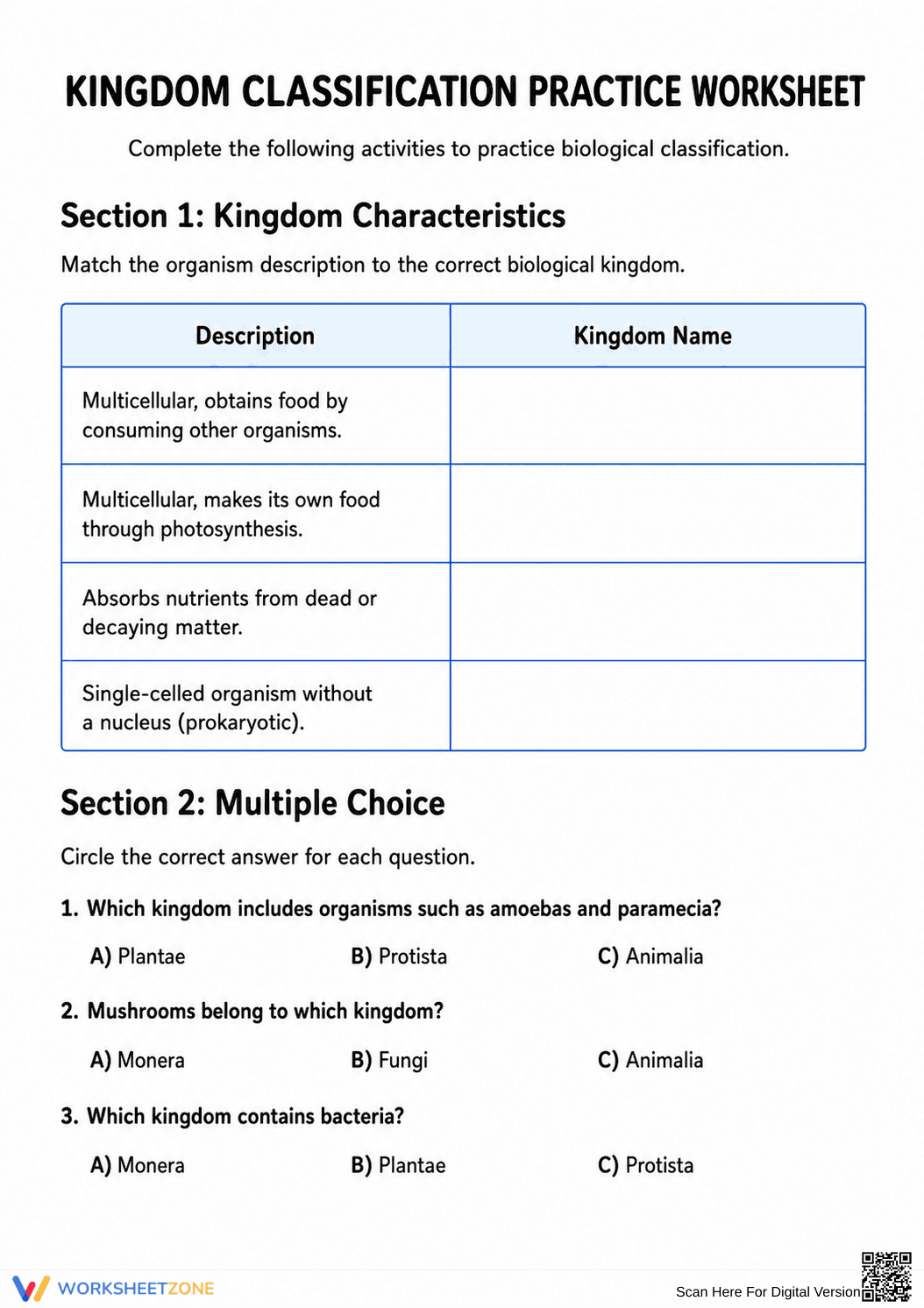
This comprehensive kingdom classification worksheet helps middle school students identify and categorize organisms based on fundamental biological traits. By analyzing cell types, nutritional needs, and energy sources, students will confidently distinguish between the five major kingdoms of life while reinforcing essential life science vocabulary.
At a Glance
- Grade: 6-8 · Subject: Science
- Standard:
MS-LS1-1— Identify basic cellular structures and organism traits- Skill Focus: Biological Classification
- Format: 2 pages · 16 problems · Answer key included · PDF
- Best For: Independent practice and review
- Time: 15–25 minutes
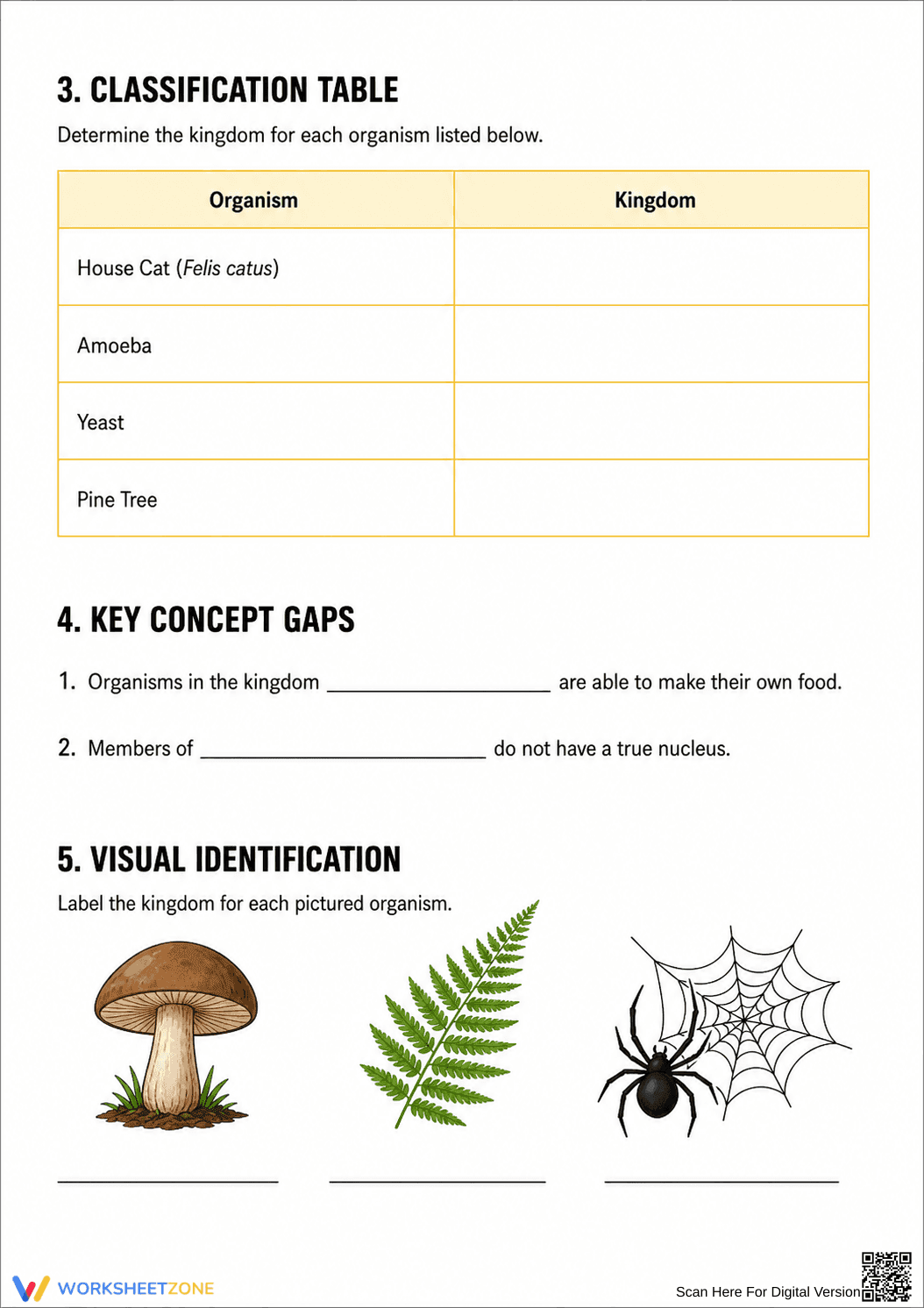
This two-page resource features a variety of question formats to thoroughly assess student understanding. It includes a four-part characteristic matching section, three multiple-choice questions, a classification table for specific organisms, two fill-in-the-blank concept gaps, and a visual identification section with three distinct biological illustrations. A complete answer key is provided to ensure accurate grading and immediate student feedback.
Zero-Prep Workflow
- Print (1 minute): Simply download the PDF and print double-sided for a complete, self-contained assignment.
- Distribute (1 minute): Hand out to students as a warm-up, in-class activity, or homework assignment with no additional materials required.
- Review (5 minutes): Use the included answer key to quickly grade submissions or guide a whole-class review session.
With under two minutes of total teacher prep time, this resource is an ideal addition to any life science unit or emergency sub plan.
Standards Alignment
This worksheet aligns with MS-LS1-1 by requiring students to understand that living things are made of cells, and distinguishing between single-celled and multicellular organisms. It also supports broader life science objectives regarding organism structure and function. Both standard codes can be copied directly into lesson plans, IEP goals, or district curriculum mapping tools.
How to Use It
Deploy this worksheet after direct instruction on the five kingdoms to solidify foundational concepts. It works exceptionally well as an independent practice assignment where students can apply their newly acquired vocabulary. For a formative assessment observation tip, monitor students as they complete the visual identification section; if they struggle to categorize the mushroom or fern, it may indicate a need to review the differences between Fungi and Plantae. Expected completion time ranges from 15 to 25 minutes.
Who It's For
This resource is designed for middle school life science students in grades 6 through 8. It offers built-in differentiation through its varied question types, allowing visual learners to excel in the illustration section while analytical thinkers tackle the characteristic matching. Pair this worksheet with a visual anchor chart detailing the traits of Animalia, Plantae, Fungi, Protista, and Monera for maximum instructional impact.
Effective science instruction relies on structured opportunities for students to categorize and analyze biological data. Aligning with MS-LS1-1, this resource requires students to identify basic cellular structures and organism traits to classify living things accurately. According to a ScienceDirect TpT Analysis, providing varied assessment formats—such as matching, visual identification, and multiple-choice—significantly improves vocabulary retention and conceptual understanding in middle school science classrooms. By engaging with multiple representations of biological kingdoms, students build a more robust mental model of taxonomy and cellular organization. This targeted practice ensures learners can confidently distinguish between complex organism groups, laying the essential groundwork for advanced high school biology concepts. Educators can utilize this comprehensive tool to bridge the gap between abstract taxonomic rules and concrete biological examples, ensuring long-term mastery.


