Soil Formation worksheets for 6th Grade
These soil formation worksheets for 6th grade target a concept students consistently underestimate — not because the science is too difficult, but because most students arrive already certain they understand soil. "It's just dirt" is the first response in almost every class, and that assumption shapes every misconception that follows. Each worksheet focuses on a distinct skill: labeling the horizons of a soil profile, sequencing the process from exposed parent rock to developed topsoil, matching soil-forming factors to their effects, or explaining in writing why soil development spans centuries rather than years. The set fits directly into a weathering or Earth systems unit with no additional prep required.
The Specific Skills These Worksheets Build
Sixth graders are expected to explain how soil forms, not just identify it on a diagram — and those are different tasks. A student who can circle "O horizon" on a labeled diagram may still write that soil appears when rock "breaks apart and becomes soft," which skips decomposition entirely. These worksheets move students from recognition toward explanation by requiring them to apply concepts in sequence. Across the set, students practice:
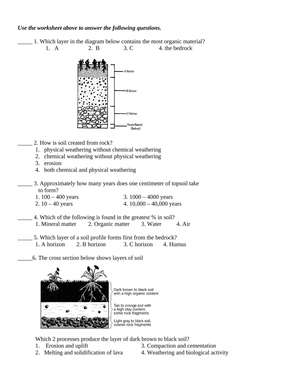
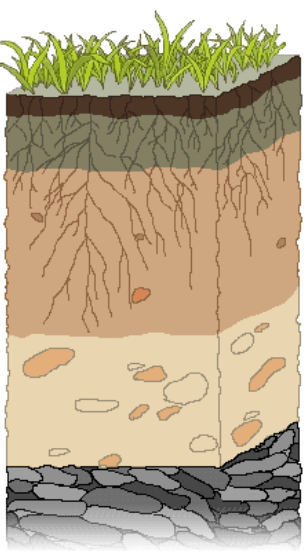
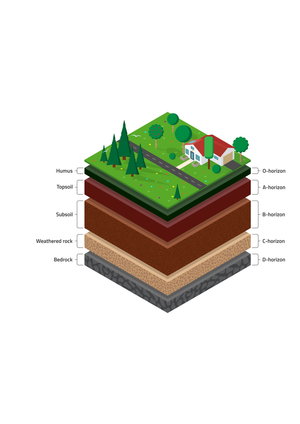
- Labeling O, A, B, C, and R horizons on a soil profile and connecting each layer to its formation conditions
- Distinguishing among physical, chemical, and biological weathering, and explaining how each contributes to breaking down parent material
- Naming and applying the five soil-forming factors — parent material, climate, organisms, topography, and time — with specific examples for each
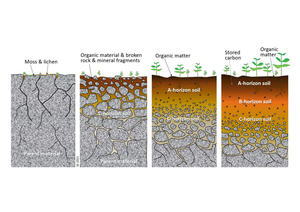
- Sequencing soil development from unweathered bedrock through early fragmentation, organic matter accumulation, and full horizon differentiation
- Using precise vocabulary — humus, leaching, permeability, decomposition, parent material — in constructed responses rather than in isolation
The vocabulary load in this unit is real. Terms like "parent material" and "horizon" carry precise scientific meanings that students regularly conflate with ordinary words. Each worksheet includes at least one task requiring accurate use of a key term in context, not just a definition match.
Student Errors That Show Up Consistently in This Unit
The most persistent misconception is that soil is a fixed, static substance rather than the product of an ongoing process. Students write things like "rock breaks into small pieces that become soil" — which collapses millions of years of decomposition, organism activity, and chemical change into a single implied step. Sequencing tasks confront this directly by forcing students to account for each stage separately before they can move on.
On horizon labeling tasks, a reliable error is inverting the B and C horizons — placing subsoil below weathered parent material rather than above it. The alphabetical labeling suggests depth order, but actual formation runs the other way: the C horizon develops first as parent rock weathers, and the A and B horizons accumulate above it as organic material builds downward from the surface. A brief annotation before students begin — something like "remember, A formed last but sits on top" — stops this error in most groups without turning it into a full re-teaching session.
Short written response tasks reveal a third consistent gap: students name "time" as a formation factor without explaining what happens during that time. They write "over time, soil forms" rather than specifying that continued weathering deepens the C horizon while organic accumulation gradually builds the A horizon above it. The constructed-response prompts in these worksheets push students to name the mechanism, not just the factor.
How to Build These Worksheets Into Your Lesson Plans
These resources belong at multiple points across a unit — not just at the end as review. A horizon labeling worksheet lands well as a formative check on the second day of instruction, right after students have seen and discussed a soil profile for the first time. Their errors on that task tell you immediately where direct instruction didn't stick. A sequencing worksheet fits better mid-unit, after students understand weathering well enough to put the formation steps in a meaningful order rather than guessing at sequence.
For a 45-minute period, one structure that consistently works: open with a photograph of a real road cut or exposed hillside — not a textbook illustration — and give students two minutes to record what they observe. That grounds the abstract diagram they're about to work with. Spend 15 minutes on direct instruction covering parent material and the three weathering types, then move into the worksheet for 15 to 20 minutes of partner or independent practice. Use the last 5 to 8 minutes for a quick whole-group review of the two or three questions where errors are most likely to cluster.
Pairing the soil formation worksheets for 6th grade with something students can actually observe nearby — a construction site cut, an eroded slope after heavy rain, the school garden's visible soil layers — closes the gap between diagram and reality. Students who connect the printed horizon labels to a real excavated wall are noticeably more accurate on explanation tasks than students who only ever reference a textbook image.
Adjusting the Worksheets for a Range of Learners
The science target stays the same across ability levels — what changes is the amount of language support and visual structure students receive. Using soil formation worksheets for 6th grade alongside annotated photographs or simplified side-by-side horizon comparisons extends access without changing what students are expected to understand.
For students who need more structured support, provide a word bank on vocabulary tasks, reduce the soil profile to four labeled zones rather than the full five-horizon model, and include sentence frames such as Soil forms when _____ and The difference between the A horizon and the C horizon is _____ because _____. For multilingual learners especially, pre-teaching terms like "parent material" and "decomposition" before the worksheet session prevents vocabulary gaps from blocking access to concepts students may already understand in their home language.
For students ready to go further, ask them to predict how formation rates might differ between a tropical rainforest and a high-altitude alpine meadow, using the five-factor framework as their analytical tool. No additional materials are needed — the extension draws on the same concepts already in each worksheet, applied to a new context. That kind of transfer reasoning also shows up directly on state science assessments.
Standard Alignment
These worksheets connect to NGSS disciplinary core idea ESS2.A (Earth's Materials and Systems), which addresses how Earth materials are shaped by weathering processes over time, and to performance expectation MS-ESS2-1, which asks students to model the cycling of Earth's materials — a framework that includes the weathering and decomposition processes that generate soil. At sixth grade, this content typically appears early in an Earth systems unit, before instruction shifts toward ecosystems and nutrient cycling addressed under LS2.B. Teachers who address soil formation here build a concrete reference point — the horizon model, the formation sequence, the five contributing factors — that students return to when decomposers and nutrient recycling enter the discussion later in the year. The labeling and sequencing tasks in these worksheets give students something specific to anchor that later connection.
Frequently Asked Questions
What should 6th graders be able to explain after completing these worksheets?
Students should be able to describe the sequence of events that produces soil from parent material, name and apply the five soil-forming factors with examples, identify the major horizons of a soil profile and explain what each layer contains, and distinguish among physical, chemical, and biological weathering. Explanation — not just identification — is the standard at this grade level, and the written response tasks in this set hold students to that bar.
Can these worksheets function as formative assessment, or are they practice only?
Both, depending on which worksheet you use. Labeling and sequencing tasks work well during instruction as practice. The short constructed-response prompts function more effectively as formative checkpoints — they reveal whether students can explain the formation process in their own words, which is a cleaner measure of understanding than a matching task alone. Collecting the response worksheets before a unit test helps identify which students need small-group reteaching on the sequence or the five-factor framework before the summative assessment.
How does this set handle soil horizons versus soil classification systems?
The set focuses on soil horizons — the vertical layers within a profile — rather than on USDA soil orders or other classification systems, which are appropriate for high school or introductory college coursework. This keeps the content aligned with what the soil formation worksheets for 6th grade standards actually require, without introducing terminology students won't be expected to use for years. Teachers looking for deeper soil science content will need to look beyond this set.
Clear All