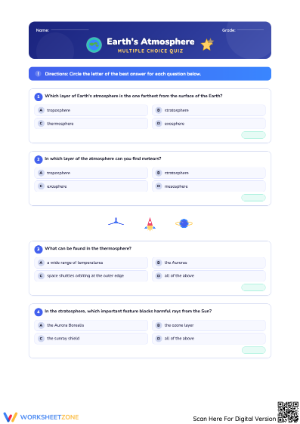
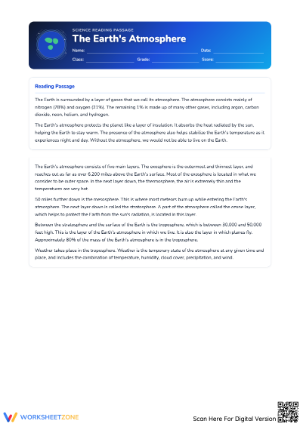
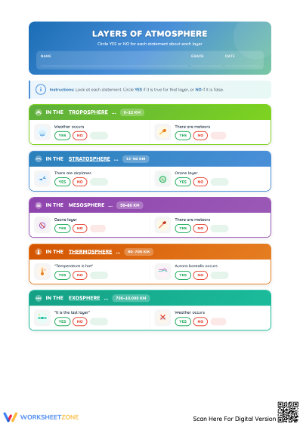
These atmospheric layers worksheets for 6th grade give teachers a focused set of practice activities built around the five main atmospheric layers and the features that distinguish each one. The resources span diagram labeling, layer sequencing, vocabulary matching, and short reading-response tasks — making them useful at multiple points in a unit rather than functioning only as an end-of-chapter review.
Misconceptions Worth Catching Before They Settle In
The most persistent error in this topic is the temperature assumption. Students enter the unit expecting temperature to drop steadily with increasing altitude — and that expectation holds in the troposphere, where temperature falls from roughly 15°C at the surface to about negative 57°C at the upper boundary. The problem is that most students apply the same logic to the stratosphere, marking it as even colder, when the reverse is true: ozone absorption of ultraviolet radiation causes temperatures to rise with altitude through that layer. A student who correctly identifies the temperature gradient in the troposphere will often draw the wrong arrow for the stratosphere, and that error rarely surfaces unless the set includes a basic temperature-altitude graph alongside the labeling task.
Layer order generates a second, more predictable mistake. Students frequently position the stratosphere above the mesosphere because "strato" sounds higher or more elevated. In sequencing tasks, this swap appears consistently enough across student work that it's worth addressing explicitly during instruction — not waiting for graded papers to reveal it. Brief attention to the prefix meso, meaning middle, resolves the confusion faster than reviewing the full sequence from scratch.
The thermosphere produces a third reliable misconception: if a layer is called "thermo," students assume it must feel warm, and some rank it as the hottest in a felt-temperature sense. The scientific reality — that temperatures in the thermosphere can exceed 1,500°C but that the extremely low air density means almost no heat would transfer to a human body there — requires direct explanation rather than a worksheet correction alone. Flagging this during the lesson introduction lets teachers build in the clarification before students encounter the worksheet, rather than addressing it only through written feedback.
What Each Worksheet Covers
The set builds five competencies that 6th grade Earth science instruction typically targets at this point in a weather and atmosphere unit:
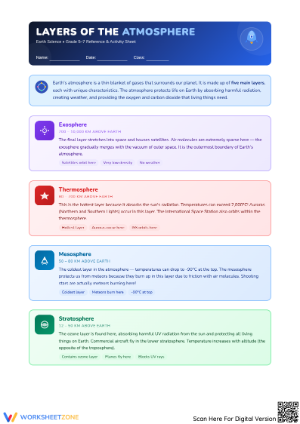
- Layer sequencing — placing the troposphere, stratosphere, mesosphere, thermosphere, and exosphere in correct order from Earth's surface outward
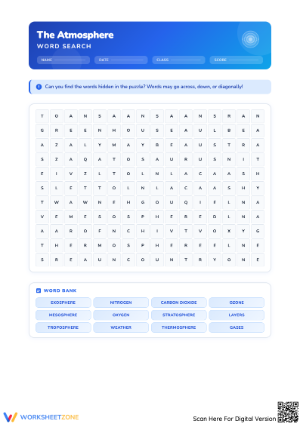
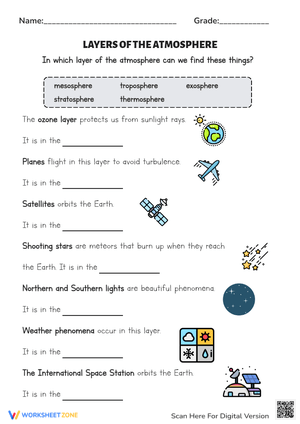
- Characteristic matching — pairing each layer with its defining feature: weather, ozone protection, meteor burn-up, satellite orbits, and the gradual atmospheric fade into outer space
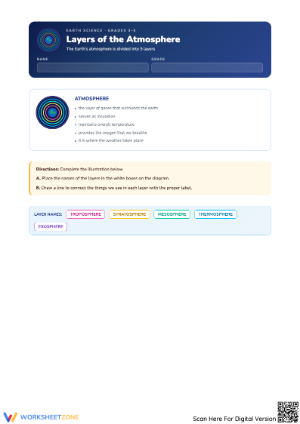
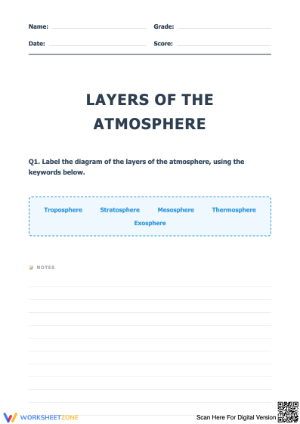
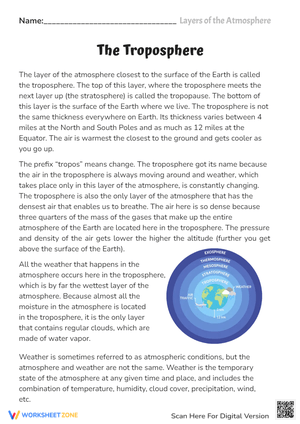
- Diagram labeling — reading an altitude diagram and annotating each zone by name and primary trait
- Vocabulary in context — using domain-specific terms correctly in short written explanations, not only in isolated fill-in-the-blank responses
- Temperature pattern reading — interpreting a basic altitude-temperature graph to identify which layers grow warmer and which grow cooler with increasing altitude
That last skill is where atmospheric layers worksheets for 6th grade earn their instructional weight. Most students at this level have not yet encountered a graph where a measured quantity alternates direction, and the atmosphere is one of the clearest scientific contexts for introducing that kind of data reading before it appears in more demanding analysis tasks in 7th or 8th grade science.
Building These Worksheets Into Your Lesson Sequence
A complete atmospheric layers worksheets for 6th grade set becomes most useful when teachers distribute the activities across several days rather than assigning everything at once. A practical sequence: use the diagram-labeling and sequencing worksheets during initial instruction, hold the vocabulary and short-response worksheets for a station rotation one or two class periods later, and save the temperature graph worksheet for pre-quiz review. Spaced exposure — even across just three days — produces stronger retention than compressing every task into a single session.
Opening with a prediction activity adds real value before the first worksheet reaches students. Project a blank diagram of Earth's atmosphere and ask the class to place weather, commercial aircraft, meteors, and satellites at whatever altitude they assume is correct. That five-minute investment transforms the labeling worksheet that follows into a genuine revision of ideas students already hold, rather than a task where students copy terms without any prior thinking to anchor them.
Consistent color-coding across every activity in the set reduces the cognitive demand of tracking both position and vocabulary simultaneously. If the troposphere is always blue, the stratosphere always green, the mesosphere always orange, the thermosphere always red, and the exosphere always purple, students carry that visual memory from worksheet to worksheet, into notes, and finally into quiz review. The payoff is most visible for multilingual learners and developing readers who are processing vocabulary and spatial relationships at the same time.
Station rotations work well for this content. One table handles layer sequencing, a second handles vocabulary matching, a third handles diagram labeling, and a fourth handles real-world examples — assigning phenomena like the northern lights, weather fronts, and GPS satellite signals to their correct atmospheric home. Six-to-eight minute rotations keep the work active without letting any single task wear thin.
Tailoring the Set for a Range of Learners
Students who need more support benefit from a word bank alongside a partially completed diagram — the layer names are available, but students still have to match each name to the correct position and record the defining feature themselves. That format keeps the cognitive demand on the science content rather than on spelling or unaided recall from memory. A labeled reference card during guided practice, removed before any graded task, adds additional support without doing the thinking for students.
Students who move quickly through the five-layer basics are well served by extension prompts that push into explanation: Why does weather occur in the troposphere and not the stratosphere? What would happen to life at Earth's surface if ozone concentrations in the stratosphere dropped significantly? These prompts don't require additional content knowledge — they ask students to apply what each worksheet already covers at greater depth. The written responses also make strong anchors for whole-class discussion and give fast finishers a meaningful task rather than busy work.
For enrichment, asking students to trace a meteor's path through all five atmospheric layers — naming what physically happens in each one — shifts the task from static labeling toward something closer to scientific modeling. That extension fits on the back of an existing worksheet and doesn't require a separate resource.
Standard Alignment
The content across this set aligns most directly to NGSS Disciplinary Core Idea ESS2.A: Earth Materials and Systems, which addresses how Earth's structural layers — including the atmosphere — function as an interconnected system. At the 6th grade level, this DCI connects to MS-ESS2-5, which asks students to collect and interpret evidence about how air mass interactions produce weather conditions. Knowing that weather is confined to the troposphere, and understanding why, is prerequisite knowledge for that standard — students who cannot correctly order the layers or identify the troposphere's defining role struggle to explain why weather systems behave as they do at lower altitudes.
The altitude-temperature graph work supports the NGSS Science and Engineering Practice of Analyzing and Interpreting Data. The diagram-labeling tasks align with Developing and Using Models. Teachers in states with adopted NGSS frameworks can use this set to address both content knowledge and science practice development within the same instructional unit.
Frequently Asked Questions
Are these worksheets meant to cover a single lesson, or do they span multiple class periods?
The set works best spread across several class periods. Using every worksheet in a single day reduces retention and removes the benefit of spaced review. The most effective approach is to use the sequencing and labeling worksheets during initial instruction, the vocabulary and matching worksheets during a mid-unit station rotation, and the temperature graph and short-response worksheets as pre-assessment review.
How can these be used effectively with students reading significantly below grade level?
The atmospheric layers worksheets for 6th grade set works for below-grade readers when teachers add a word bank, apply consistent color-coding across all diagram activities, and reduce written response length while keeping the five-layer science content intact. Maintaining the same content expectations — just with more visual support and vocabulary aids — keeps the learning target accurate even as the level of independent demand is adjusted.
Does atmospheric layers content appear on standardized assessments?
Atmospheric layer knowledge shows up on most state-level middle school Earth science assessments, typically as diagram identification, layer sequencing, or short-answer questions about each layer's defining feature. The altitude-temperature graph is also a recurring assessment format at this level — which is why the worksheet targeting temperature variation deserves direct instructional attention rather than being assigned only as independent practice.
How does this content connect to later science units in middle school?
The five-layer model reappears in weather and climate units (troposphere and air mass movement), environmental science discussions (stratosphere and ozone depletion), and space science units (thermosphere, satellite orbits, and the International Space Station). Framing the layers as a foundational reference — rather than a one-time vocabulary list — makes those later connections explicit when the topics resurface in 7th and 8th grade.












 Interactive Worksheet Maker
 Quiz Maker
 Word Search Maker
 Crossword Puzzle Maker
 Word Scramble Generator
 Sentence Scramble Generator
 Handwriting Worksheet Generator
 Name Tracing Generator
 Fill In The Blank Generator