6th Grade Rock Cycle Diagram Worksheets for Science Class
6th grade rock cycle diagram worksheets give students a concrete tool for working through one of Earth science's trickier conceptual challenges: that igneous, sedimentary, and metamorphic rocks are not fixed, separate categories but stages in an ongoing process driven by distinct geological forces. Most 6th graders can name the three rock types after initial instruction. Where they consistently get stuck is tracing the connections — explaining which process drives each transformation, in what direction, and why rocks don't all follow the same path through the cycle.
The Specific Skills These Worksheets Target
Each worksheet focuses on a manageable set of ideas rather than every geological detail. That's the right approach for 6th grade, where students are building their first real conceptual map of Earth systems. The core targets are:
- Rock types and key materials: igneous, sedimentary, and metamorphic rock, along with magma and sediments as the materials in transition between states
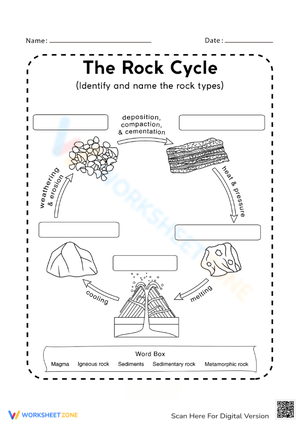
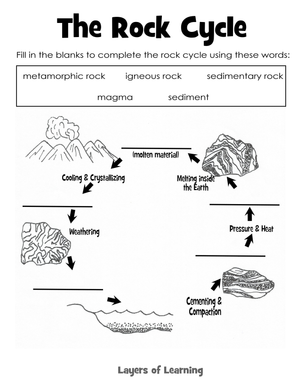
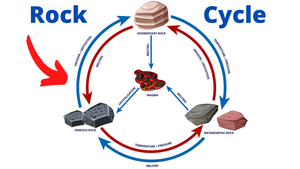
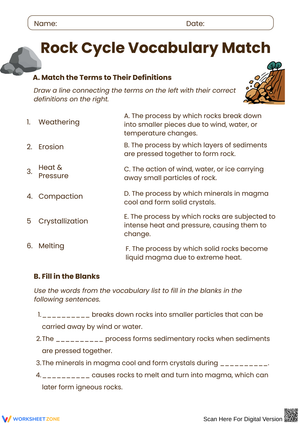
- Process labels: cooling, weathering, erosion, compaction, cementation, heat, and pressure — each tied to a specific arrow on the diagram
- Sequence reasoning: understanding that one change sets up the next, and that there is more than one valid path through the cycle
- Written explanation: producing a short constructed response using vocabulary from the diagram
The constructed response piece matters more than it might seem. When students only label a diagram, there's no way to know whether they understand why an arrow points in a particular direction. A prompt like Explain two ways a sedimentary rock could change into something else over time reveals whether the label was copied from a word bank or actually processed as meaning. 6th grade rock cycle diagram worksheets that include this kind of written prompt give teachers something concrete to act on during reteach — not a general sense that students are confused, but specific evidence of where the reasoning broke down.
Errors Worth Anticipating Before You Hand These Out
Rock cycle diagrams surface student confusion faster than almost any other format in Earth science — which is part of what makes them so useful. When a student places "heat and pressure" on the arrow between magma and igneous rock, you know exactly what went wrong. A few error patterns appear reliably enough that it's worth planning for them in advance.
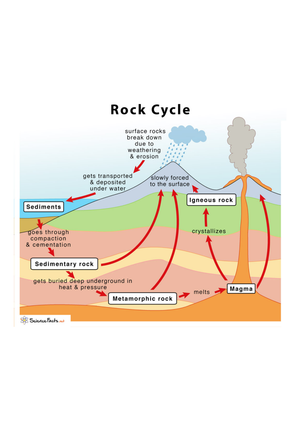
The weathering versus erosion distinction trips up nearly every class. Students use the terms interchangeably in writing, but on a diagram, where the labels belong on separate arrows, the problem becomes visible and specific. Weathering breaks existing rock into smaller material; erosion transports that broken material somewhere else. Those are two separate processes requiring two separate labels, and many students will try to cover both with one word.
Magma and lava present a different problem. For the standard 6th grade rock cycle diagram, keeping the label as magma and setting aside any discussion of lava for a separate lesson on volcanic activity reduces diagram errors significantly. Students who have encountered both terms will sometimes write "lava" on an arrow and then reason incorrectly about the direction of change — a small vocabulary issue that creates a larger conceptual one.
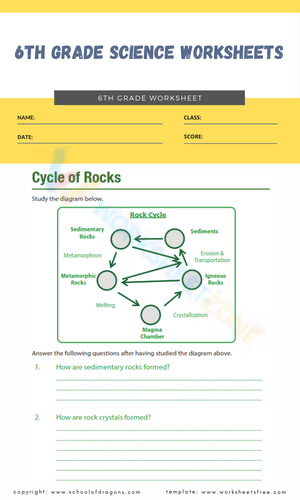
Perhaps the most instructive confusion is when students conflate the processes that form sedimentary rock — compaction and cementation acting on loose sediments — with those that form metamorphic rock — heat and pressure acting on existing solid rock. The diagram physically separates those two pathways. Walking through that visual split with the class before students work independently cuts this error rate noticeably.
Building These Worksheets Into Your Lesson Planning
A 30- to 35-minute sequence works well for introducing the diagram: spend 5 minutes reviewing the three rock types, model 2 or 3 arrows together with the class, give students 12–15 minutes to complete the worksheet independently or with a partner, then close with 5 minutes of whole-class error correction. That last step is often where the most learning happens — students who labeled an arrow incorrectly can revise in real time while hearing the reasoning explained.
These worksheets also work as bell-ringers. Projecting a partially completed diagram and asking students to supply one missing process label takes 6–8 minutes and primes the class for a deeper discussion without any setup. For stations, one group can work through the worksheet while another examines actual rock samples — the two activities reinforce each other because the physical specimens give students a reference point for the abstract diagram vocabulary.
Sub plans are a strong use case as well. Because the visual format carries much of the instructional load, students can complete meaningful science work without a teacher present, especially when a word bank is included. For interactive notebooks, a useful approach is to have students trace one complete pathway with a colored pencil before adding any labels — starting with magma, following the path to igneous rock, then to sediments, then to sedimentary rock. That step narrows the task, reduces the sense of overwhelm, and helps students see the cycle as a connected system rather than a disconnected list of vocabulary.
Adjusting Each Worksheet for a Range of Learners
The same diagram can serve very different students depending on how you frame the task. At the entry level, a cut-and-paste version where students sort and physically place vocabulary cards gives students who freeze in front of a blank page a way to engage with the material before writing anything. A partial diagram with some arrows already labeled is useful for guided practice and reteaching — not because it makes the task easier in a shallow way, but because it limits the number of decisions students must hold at once, which makes misconceptions easier to isolate and address.
For students ready to go further, remove the word bank and ask them to describe more than one pathway between the same two rock types. The open-ended question — Why is the rock cycle called a cycle if rocks don't all follow the same route? — pushes students to think about the system rather than just the labels. Assigning the same diagram with tiered response expectations works well in mixed-readiness classes: one group labels terms only, another writes one sentence per process, and a third traces a complete transformation sequence and explains the driving force at each step.
For struggling readers specifically, 6th grade rock cycle diagram worksheets with reduced surrounding text, clearly drawn arrows, and a visible word bank let students focus cognitive attention on the diagram itself rather than on decoding dense instructions. The visual format already does much of the heavy lifting at this level.
Standard Alignment
These worksheets align to NGSS MS-ESS2-1: "Develop a model to describe the cycling of Earth's materials and the flow of energy that drives this process." In classroom terms, this standard appears during the Earth Systems unit — typically in 6th or 7th grade depending on district sequence. The diagram itself functions as the model the standard references: students are not just reading about the cycle, they are building and annotating a representation of it. The process-labeling tasks address the "cycling of Earth's materials" language directly, while the written explanation prompts push toward the "describe" and "flow of energy" components. This makes the worksheets well-suited for both formative check-ins mid-unit and pre-assessment work before a unit quiz.
Frequently Asked Questions
What prior knowledge do students need before starting a rock cycle diagram worksheet?
Students should be able to name the three major rock types and understand at a basic level that rocks change over time. A short introduction to magma, sediments, and the main processes — cooling, weathering, erosion, compaction, cementation, heat, and pressure — is usually enough to begin. Students don't need to have memorized every term before starting; the worksheet works best when it's building that knowledge through active practice, not confirming what students have already fully mastered.
How do I use the diagram to teach the difference between the three rock types?
Connect each rock type to how it forms and tie that formation process to the relevant arrow. Igneous rock forms when magma cools. Sedimentary rock forms when sediments undergo compaction and cementation. Metamorphic rock forms when existing rock is subjected to heat and pressure. Keeping those three formation stories attached to the arrows — rather than just to the rock names — gives students a memory anchor that holds better than a list of definitions copied from a textbook.
How can these worksheets be used as a formative assessment tool?
A blank diagram used as an exit ticket gives quick data on which students can independently place the major processes and which are still confusing rock types or mislabeling arrows. Pair the diagram with one short written prompt — something like Describe one path a piece of granite could travel through the cycle — and you have both a visual check and a written check in under 5 minutes. 6th grade rock cycle diagram worksheets in a blank or mini format work especially well here because the visual structure is already familiar to students from earlier instruction, so the exit ticket doesn't feel like an entirely new task.
What extension activities work well once students can complete a diagram independently?
Narrative writing transfers the skill: ask students to write a short story from the perspective of a rock moving through the cycle, which forces them to sequence their understanding and use cause-and-effect language precisely. A crayon or candy model — breaking down, heating, pressing, and reforming material — connects the diagram vocabulary to a physical process students can observe directly. Showing photographs of real rock samples and asking where each one fits in the cycle moves the learning from diagram practice into applied reasoning, which is where the understanding becomes durable.
Clear All