


























Views
Downloads

Essential Grade 7 Math: Proportional Relationships Worksheet
Paste this activity's link or code into your existing LMS (Google Classroom, Canvas, Teams, Schoology, Moodle, etc.).
Students can open and work on the activity right away, with no student login required.
You'll still be able to track student progress and results from your teacher account.
This Grade 7 Math worksheet provides a comprehensive assessment of proportional relationships through 28 targeted problems. Students practice identifying proportional pairs, verifying proportions using cross-multiplication, and solving real-world scenarios. It is an essential tool for building foundational algebraic reasoning and ensuring students can recognize constant rates of change in multiple mathematical contexts.
At a Glance
- Grade: 7 · Subject: Math
- Standard:
CCSS.MATH.CONTENT.7.RP.A.2— Recognize and represent proportional relationships between quantities in ratios and word problems- Skill Focus: Testing for proportional relationships
- Format: 4 pages · 28 problems · Answer key included · PDF
- Best For: End-of-unit assessment or intensive skill practice
- Time: 45–60 minutes
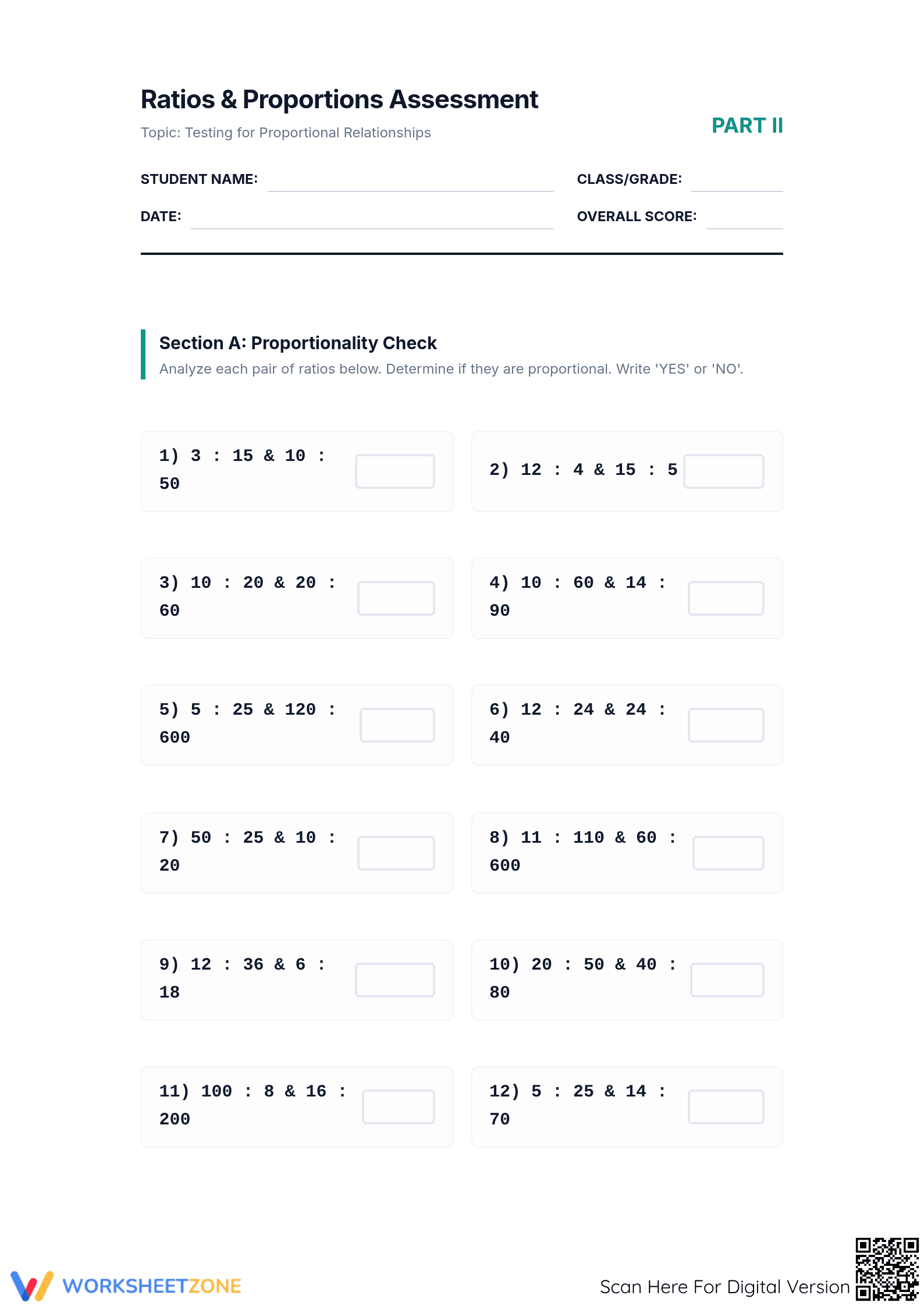
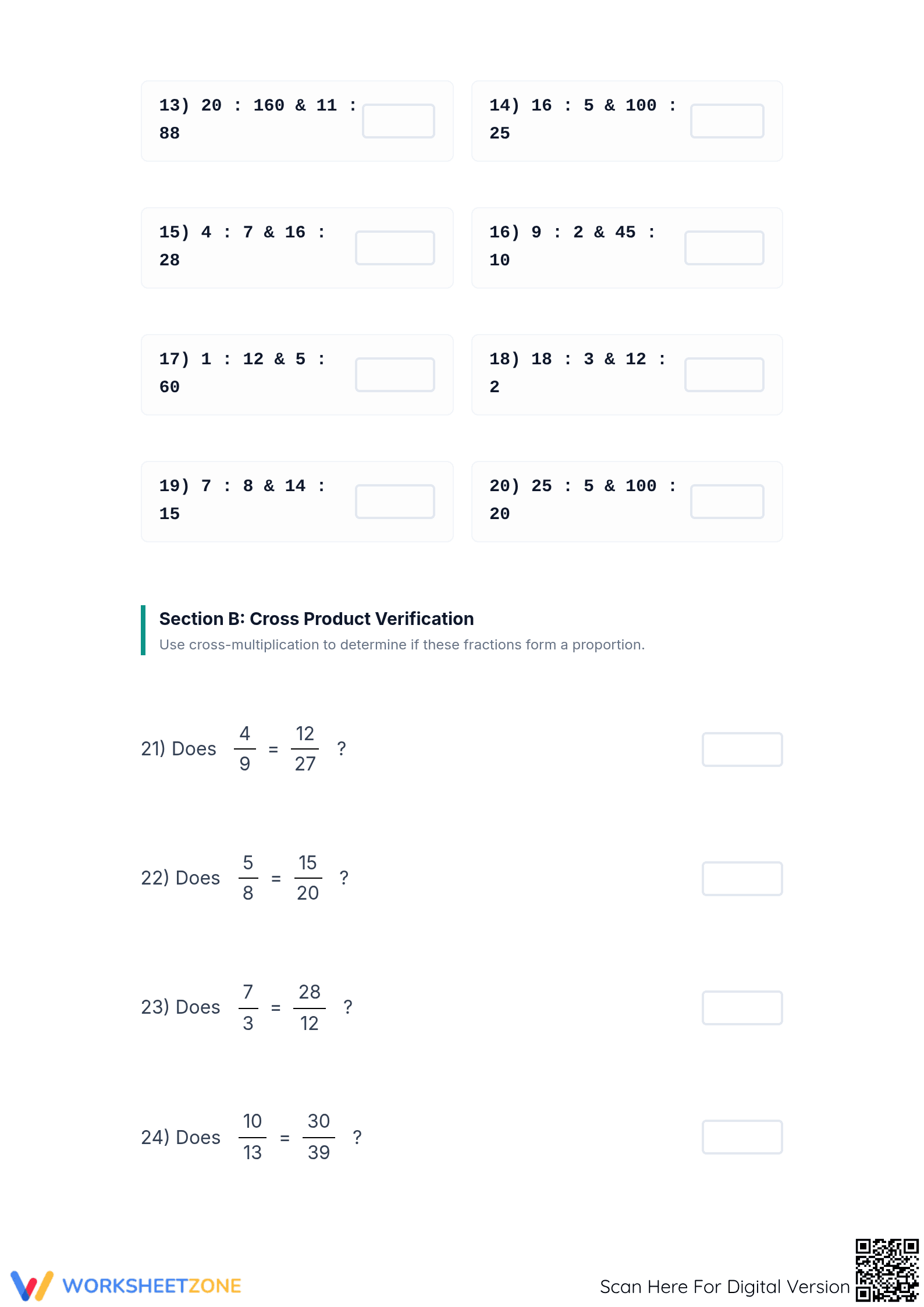
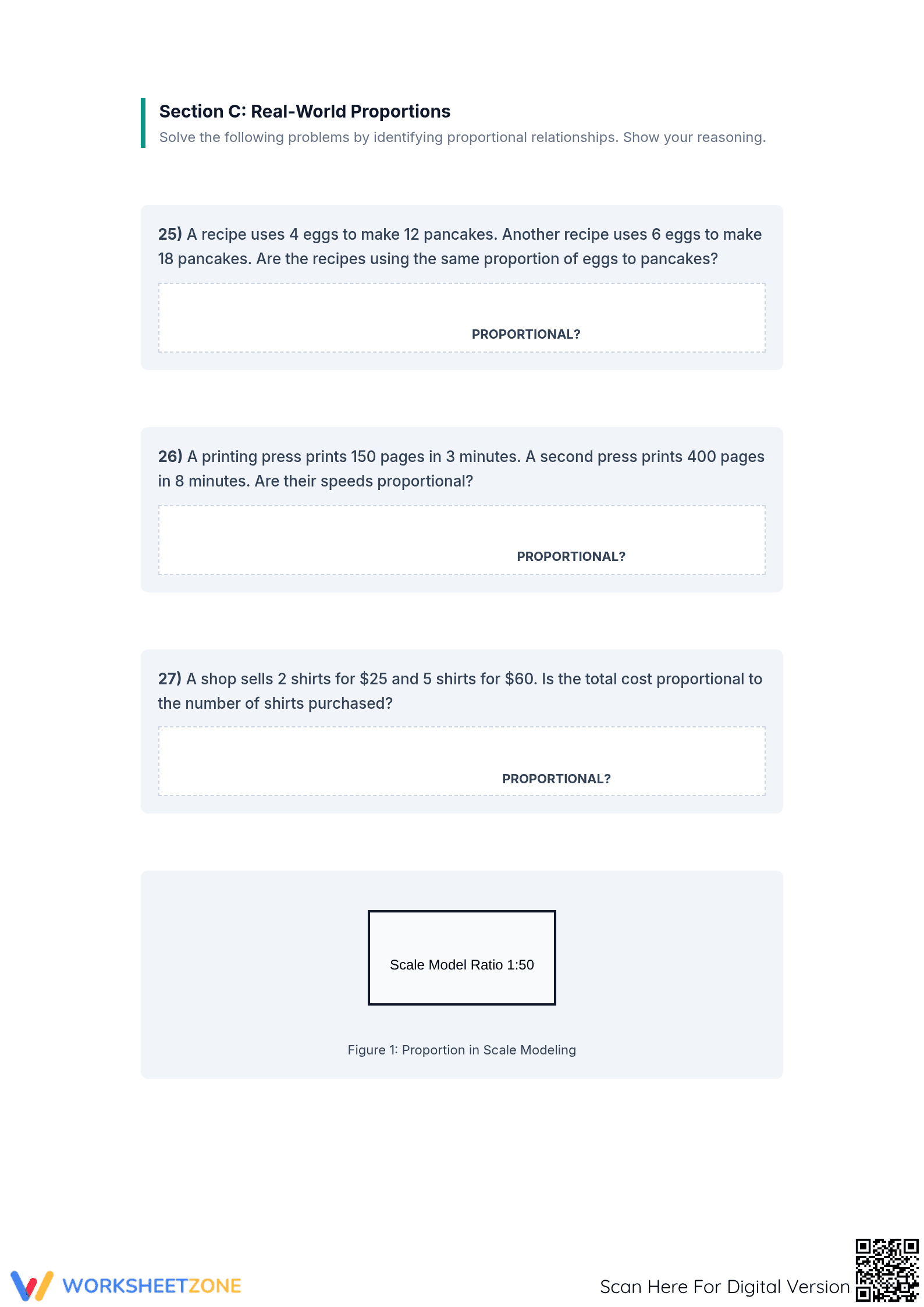
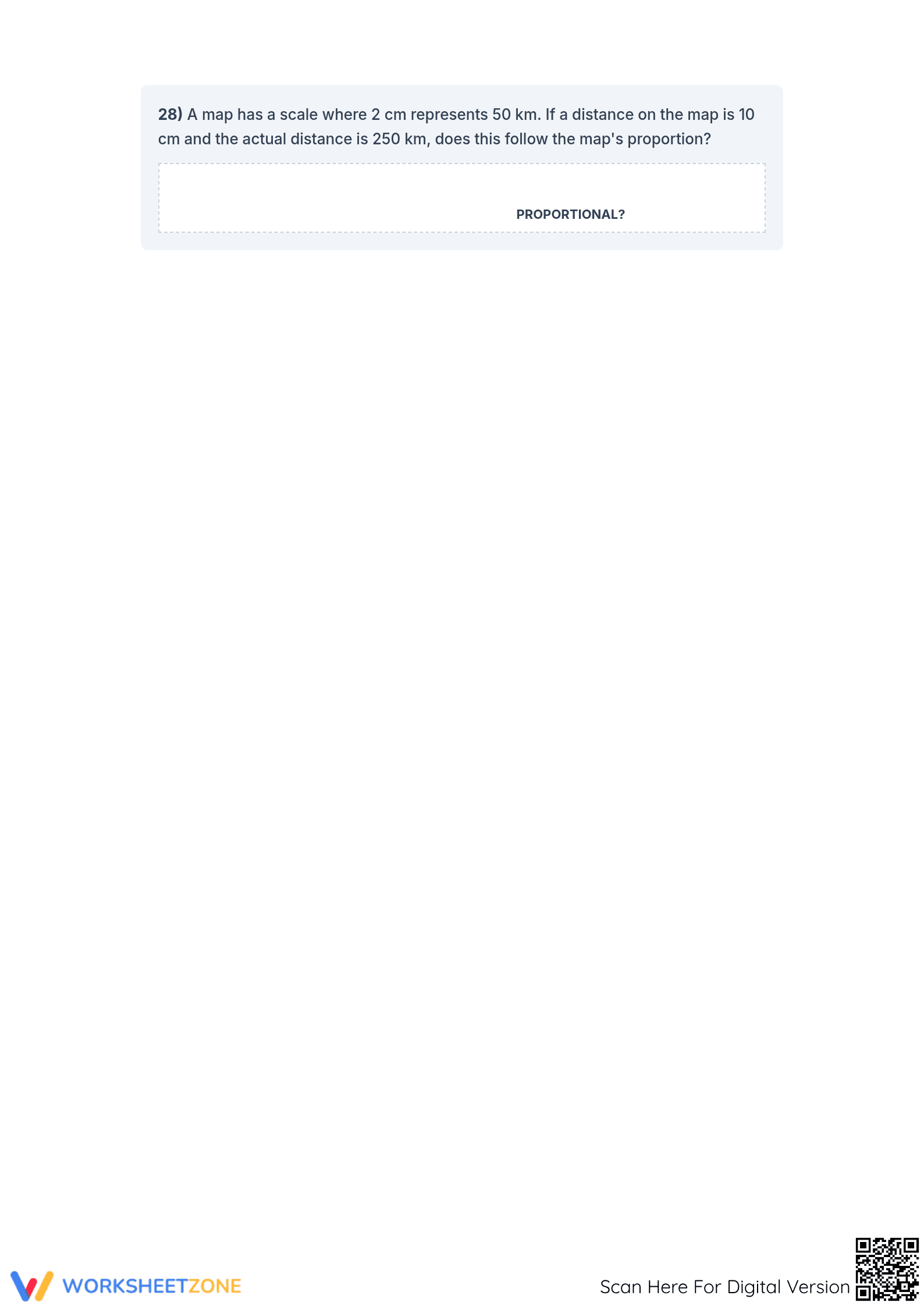
This 4-page printable PDF features three distinct sections designed to scaffold student understanding. Section A includes 20 ratio pairs where students must determine proportionality. Section B focuses on cross-product verification with 4 algebraic fraction problems. Section C presents 4 multi-step real-world word problems involving recipes, printing speeds, unit costs, and map scales. A complete answer key is provided for efficient grading.
Skill Progression
- Guided practice: The initial section provides 20 sets of ratios in a clear horizontal format, allowing students to identify basic relationships through mental math or simplification.
- Supported practice: Section B transitions to formal cross-multiplication, providing a structural bridge between simple ratios and complex equation solving.
- Independent practice: The final 4 problems challenge students to extract data from text and apply their knowledge to authentic scenarios like scale modeling and rate comparison.
This gradual-release model moves from recognition to application, ensuring students master the underlying mechanics before tackling word problems.
Standards Alignment
The primary focus of this worksheet is CCSS.MATH.CONTENT.7.RP.A.2, which requires students to recognize and represent proportional relationships between quantities. It specifically addresses sub-standards by having students decide whether two quantities are in a proportional relationship through testing for equivalent ratios. This standard code can be copied directly into lesson plans, IEP goals, or district curriculum mapping tools.
How to Use It
This resource is ideal as a summative assessment following a unit on ratios and proportions. Alternatively, use Section C as a high-interest cooperative learning activity where students must explain their reasoning for the word problems. Teachers can observe students during the cross-multiplication section to identify common errors in basic multiplication. Completion typically takes one full class period (45–60 minutes).
Who It's For
This worksheet is designed for Grade 7 general education students, but is highly effective for Grade 8 and 9 students requiring intervention or IEP goal reinforcement. It pairs naturally with a lesson on unit rates or an anchor chart demonstrating cross-multiplication verification methods.
Mastery of proportional reasoning is a critical milestone for middle school mathematics, serving as the gateway to linear functions and formal algebra. According to Fisher & Frey (2014), the use of scaffolded assessments that progress from procedural fluency to conceptual application significantly improves long-term retention of proportional logic. This worksheet aligns with CCSS.MATH.CONTENT.7.RP.A.2, ensuring students can identify equivalent ratios and apply cross-product verification to complex data sets. By integrating real-world scenarios—such as map scales and unit costs—the material mirrors the rigor found in NAEP assessments, preparing students for high-stakes testing while reinforcing practical numeracy skills. The inclusion of a 28-problem set provides sufficient data points for teachers to conduct meaningful error analysis and tailor subsequent instruction to specific student needs.


