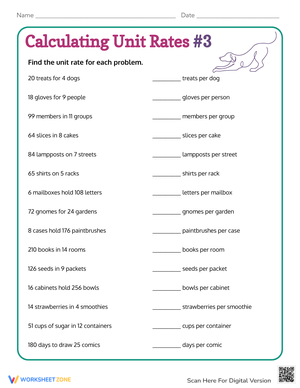
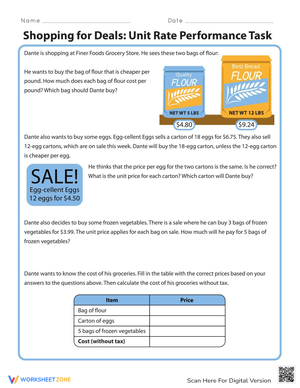
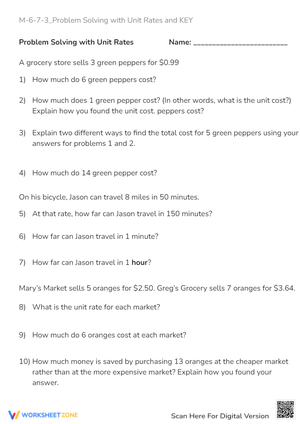
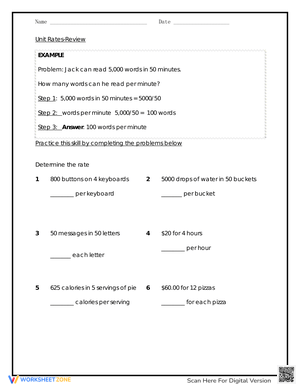
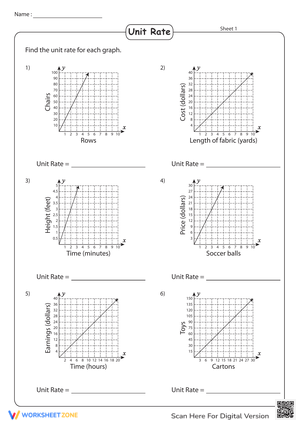
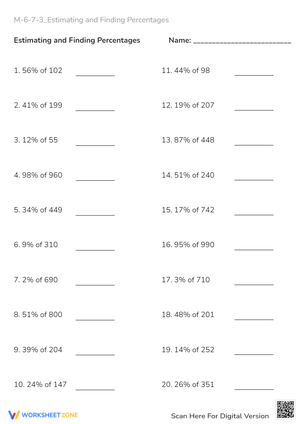
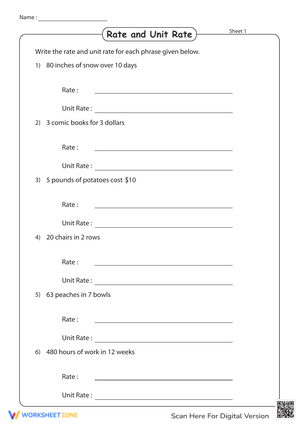
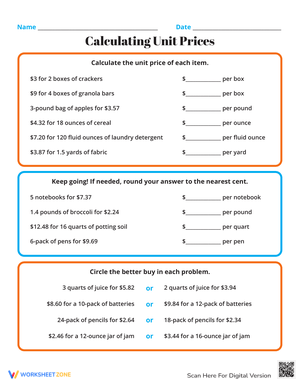
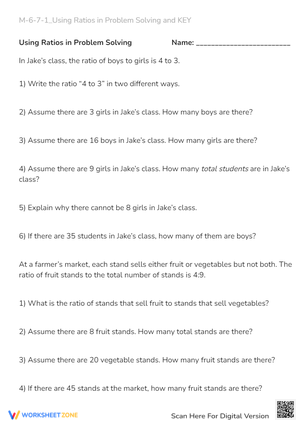
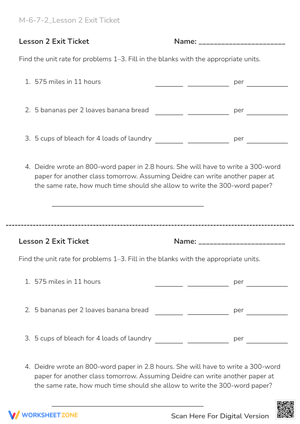
These 6th grade ratios and rates printable worksheets resources cover the full arc of 6th-grade ratio reasoning — from writing ratios in three notations through unit rate comparisons in multi-step word problems. Teachers get a set of standalone worksheets, each with an answer key, that moves from ratio language and visual models toward rates, unit rates, and real-world problem solving. The representations that matter most at this level — tape diagrams, double number lines, ratio tables — are built into the tasks as core practice, not treated as optional add-ons.
The Specific Skills Targeted
Ratio and proportional reasoning is the bridge unit in 6th grade. Students arrive comfortable with whole-number operations, and the work here pushes them toward multiplicative thinking — a shift that does not happen automatically and does not stick without repeated, structured practice. Each worksheet targets one part of that progression:
- Ratio notation: writing the same relationship as a fraction, with a colon, and in words — and explaining what each quantity represents
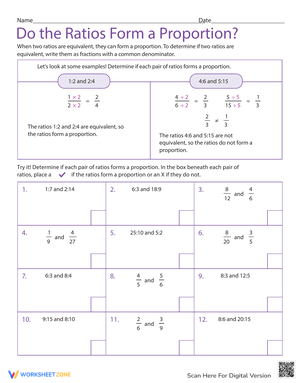
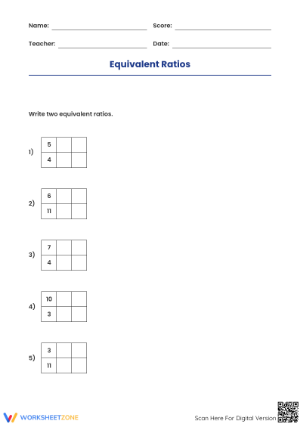
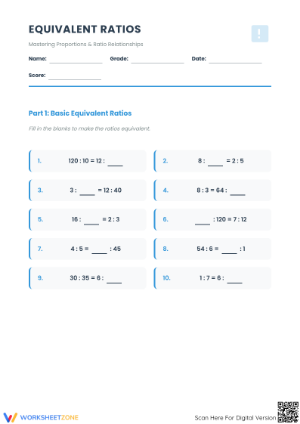
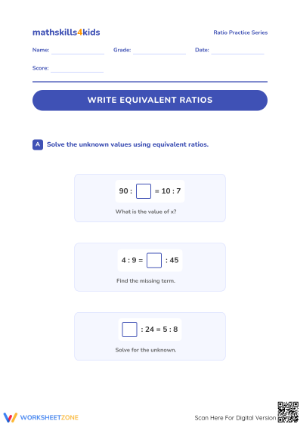
- Equivalent ratios: scaling up and down in tables using the multiplicative relationship, not by adding a constant
- Tape diagrams and double number lines: building visual representations from verbal descriptions and reading relationships off the model
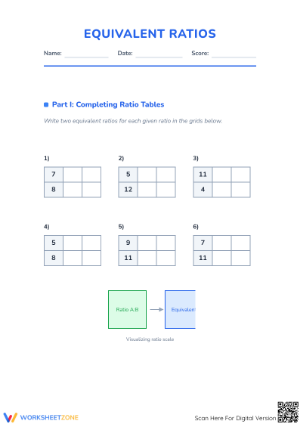
- Ratio tables: completing, extending, and analyzing tables to identify the constant factor
- Rates: distinguishing comparisons with unlike units — miles per hour, cost per item — from same-unit ratios
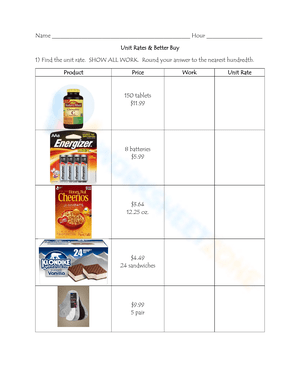
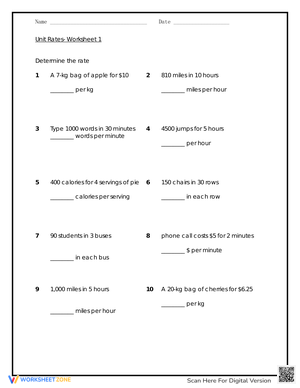
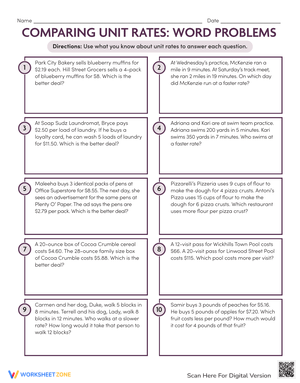
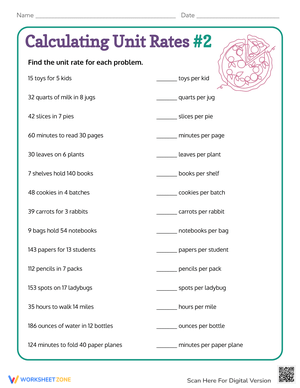
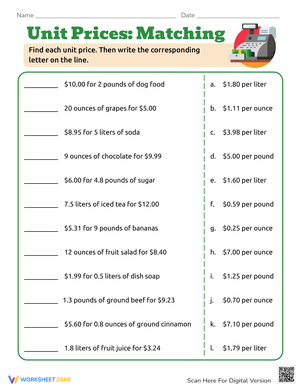
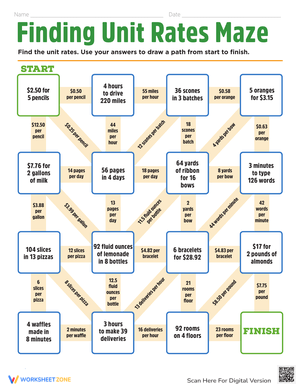
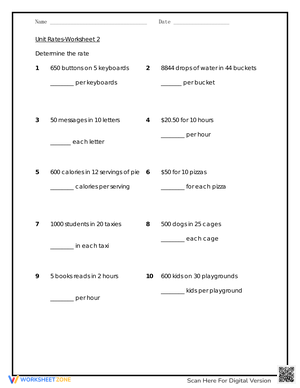
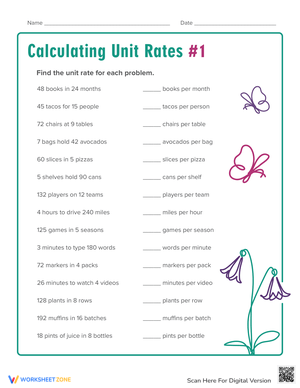
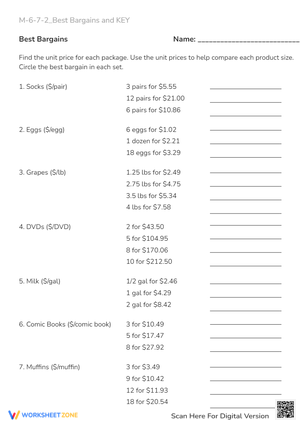
- Unit rates: dividing to find the per-one amount, labeling it with units, and using it to make comparisons
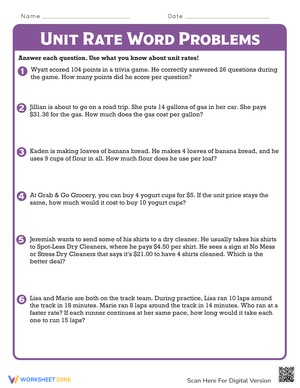
- Word problems: applying ratio and unit rate reasoning in contexts involving prices, recipes, distance, and classroom data
The task language across this 6th grade ratios and rates printable worksheets set keeps quantities tied to their labels throughout — students see 4 dollars per notebook and 15 students for every 3 tables, not bare numbers. That matters because the most persistent ratio errors begin the moment students drop the units and treat the comparison as a naked arithmetic fact.
Mistakes Students Make That These Worksheets Help You Catch
Ratio and rate is one of those topics where student work looks correct on the surface and falls apart under closer reading. The most common problem is additive thinking: a student who sees a ratio of 2:5 and needs to scale it for a first quantity of 4 will add 2 to each part, arriving at 4:7. The numbers look plausible; the answer is wrong. This error shows up consistently in 6th grade because students spent years building additive number sense, and the shift to multiplicative scaling is genuinely new cognitive territory — not a matter of carelessness.
Three other patterns appear regularly in the work:
- Reversed order: writing the ratio with quantities swapped because the student read left to right without tracking which label belongs to which number. A student who writes 5:3 instead of 3:5 gets full credit on bare computation and misses the meaning entirely.
- Confusing rate and unit rate: treating "60 miles in 3 hours" as already expressing a unit rate. Students write 60:3 as a final answer rather than dividing to get 20 miles per hour. Tasks that require labeling the answer with units force this distinction into the open.
- Scaling only one quantity: when completing a ratio table, multiplying the first value correctly but forgetting to apply the same factor to the second. This is especially common when the table jumps by irregular intervals rather than counting up by ones.
Worksheets that include a short written prompt — Explain how you know these ratios are equivalent or Write the unit rate using words and units — reveal these gaps far more reliably than a column of answer blanks. The explanation line is not extra work; it is the actual assessment.
Standard Alignment
These worksheets align to CCSS 6.RP.A — Understand ratio concepts and use ratio reasoning to solve problems. The cluster includes three standards: 6.RP.A.1 (ratio language and notation), 6.RP.A.2 (unit rate concepts), and 6.RP.A.3 (ratio and rate reasoning using tables, tape diagrams, double number lines, and the coordinate plane). In most 6th-grade pacing guides, this unit runs four to six weeks and sits early in the year because 7th-grade proportional reasoning — 7.RP.A, constant of proportionality, percent problems — builds on it directly. A student who leaves 6th grade unable to distinguish a rate from a unit rate will not have the footing for what comes next.
How to Work These Worksheets Into Your Unit Plan
These 6th grade ratios and rates printable worksheets resources fit naturally into the instructional sequences most teachers already run. During the first week of the unit, when students are still building ratio language and working with visual models, one focused worksheet per day keeps things manageable — notation one day, tape diagrams the next, double number lines after that. That pacing lets students work through initial concept introduction without being asked to juggle too many representations at once.
Once students move to equivalent ratios and ratio tables, pair independent worksheet practice with a brief whole-class debrief. Assign the worksheet on its own, then project two or three student responses and ask the class to explain which are correct and why. That ten-minute discussion is where additive-thinking errors become visible before they get locked in. Students who added instead of multiplied usually recognize the error immediately when they see it walked through by a peer.
For unit rates specifically, try this: give students two nearly identical rate problems — same numbers, different units — and ask which comparison becomes clearer after they find the per-one amount for each. Students who treat unit rate as just another calculation step cannot answer that clearly. Students who understand what the unit rate actually does explain it immediately. That question serves well as an exit check before moving into multi-step word problems.
Adjusting the Set for a Range of Learners
For students who need more support at the entry level, start with worksheets that address a single representation — ratio notation or tape diagrams alone — before expecting them to move across multiple forms in the same sitting. A partially completed ratio table with the first two columns filled in lets a struggling student focus on recognizing the multiplicative pattern without getting stuck on setup. Sentence frames beside word problem blanks (The ratio of ___ to ___ is ___) lower the language demand without simplifying the math.
Students who finish grade-level worksheets quickly benefit most from the unit rate and multi-step word problem tasks in the set. Push their thinking by asking them to write a second real-world scenario that produces the same unit rate, or to explain in writing why two different-looking ratios are or are not equivalent. These prompts require flexible reasoning — and they reveal whether a student has genuine conceptual understanding or is running a reliable calculation procedure without knowing why it works. That distinction matters for pacing decisions going into the second half of the unit.
Frequently Asked Questions
What is the difference between a ratio, a rate, and a unit rate — and do these worksheets cover all three?
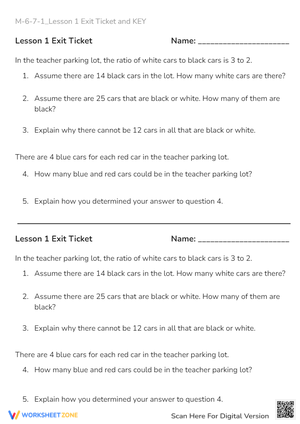
A ratio compares two quantities — 3 red tiles to 5 blue tiles. A rate compares quantities with different units — 45 miles in 3 hours. A unit rate simplifies that comparison to a per-one amount — 15 miles per hour. Each worksheet is labeled by concept, so teachers can assign them in sequence or pull specific ones based on where students are in the unit.
At what point in the unit should I introduce the unit rate worksheets?
Unit rate work lands best after students can write ratios in multiple forms and identify equivalent ratios with confidence. Most teachers reach that point by the end of the second week of the unit. Introducing unit rates too early — before students have stable ratio notation and scaling skills — means they calculate a correct quotient but cannot explain what the number represents or why finding it was useful.
Can these worksheets support intervention with students who struggled the first time through the unit?
The 6th grade ratios and rates printable worksheets set includes enough skill-specific options that teachers can isolate exactly where a student's understanding broke down — notation, scaling, unit rates — without assigning a full review packet. Short, targeted reteach on one concept at a time is more efficient than cycling through the whole unit again.
Do the worksheets rely on visual models, or is most of the work computation-based?
Each worksheet that covers equivalent ratios or rate relationships includes at least one visual representation — a tape diagram, a double number line, or a ratio table. Students complete those representations as part of the task. That structure makes it easier to identify errors in reasoning — like scaling only one quantity in a table — before they become ingrained habits that are harder to untangle later.













 Interactive Worksheet Maker
 Quiz Maker
 Word Search Maker
 Crossword Puzzle Maker
 Word Scramble Generator
 Sentence Scramble Generator
 Handwriting Worksheet Generator
 Name Tracing Generator
 Fill In The Blank Generator