


























Views
Downloads


Printable Missing Proportions Worksheet | Grade 7 Math
Paste this activity's link or code into your existing LMS (Google Classroom, Canvas, Teams, Schoology, Moodle, etc.).
Students can open and work on the activity right away, with no student login required.
You'll still be able to track student progress and results from your teacher account.
Mastering Proportions with Comprehensive Practice
This worksheet helps students master proportional relationships by moving from basic ratio equality to complex word problems. Students practice finding unknown values in balanced equations, building fluency for algebra. By solving 34 problems, learners develop a deep understanding of how ratios scale in various mathematical contexts.
At a Glance
- Grade: 7 · Subject: Math
- Standard:
CCSS.MATH.CONTENT.7.RP.A.2— Recognize and represent proportional relationships between quantities across various mathematical formats- Skill Focus: Solving Missing Proportions
- Format: 5 pages · 34 problems · Answer key included · PDF
- Best For: Independent practice and standards-based assessment
- Time: 45–60 minutes
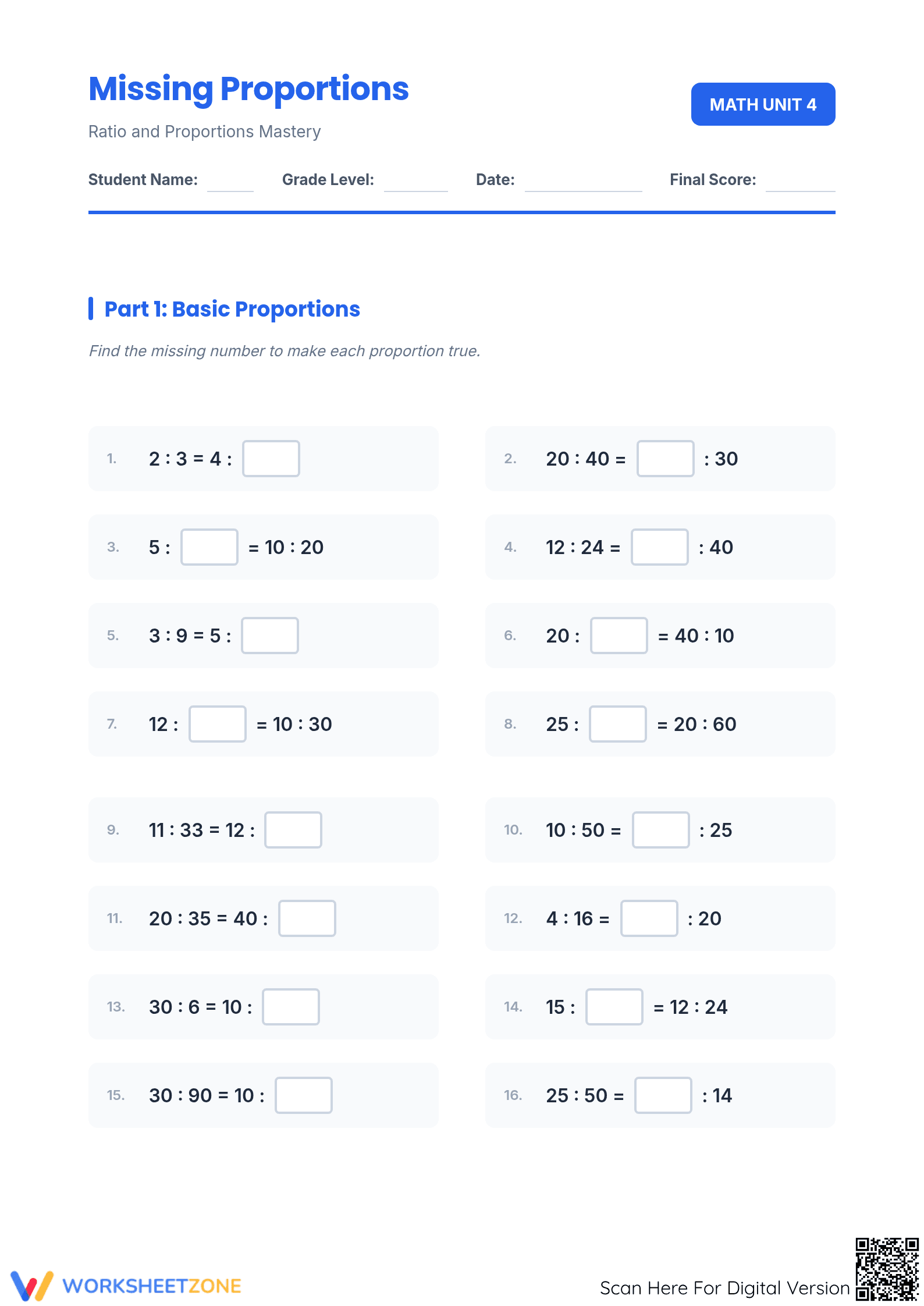
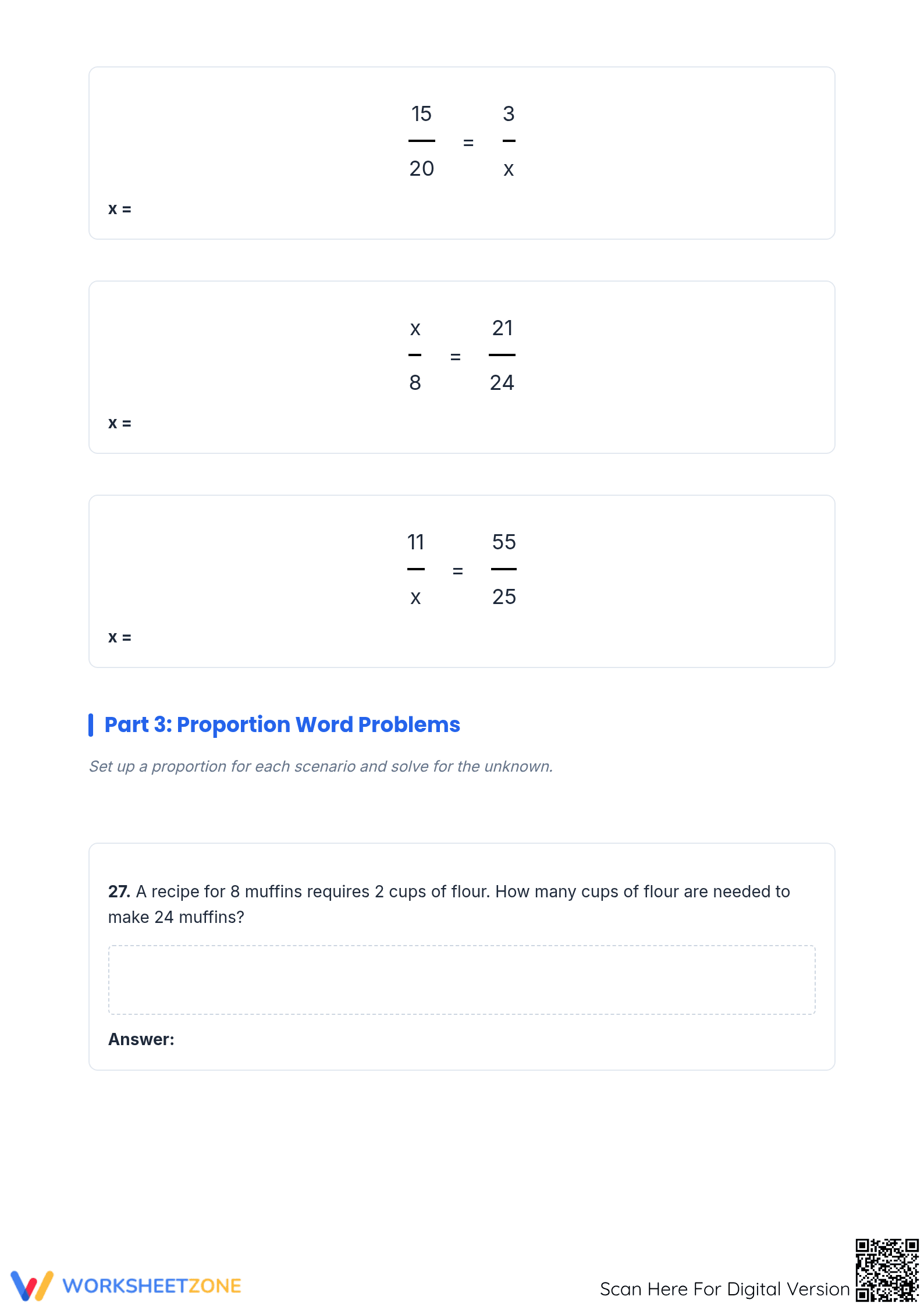
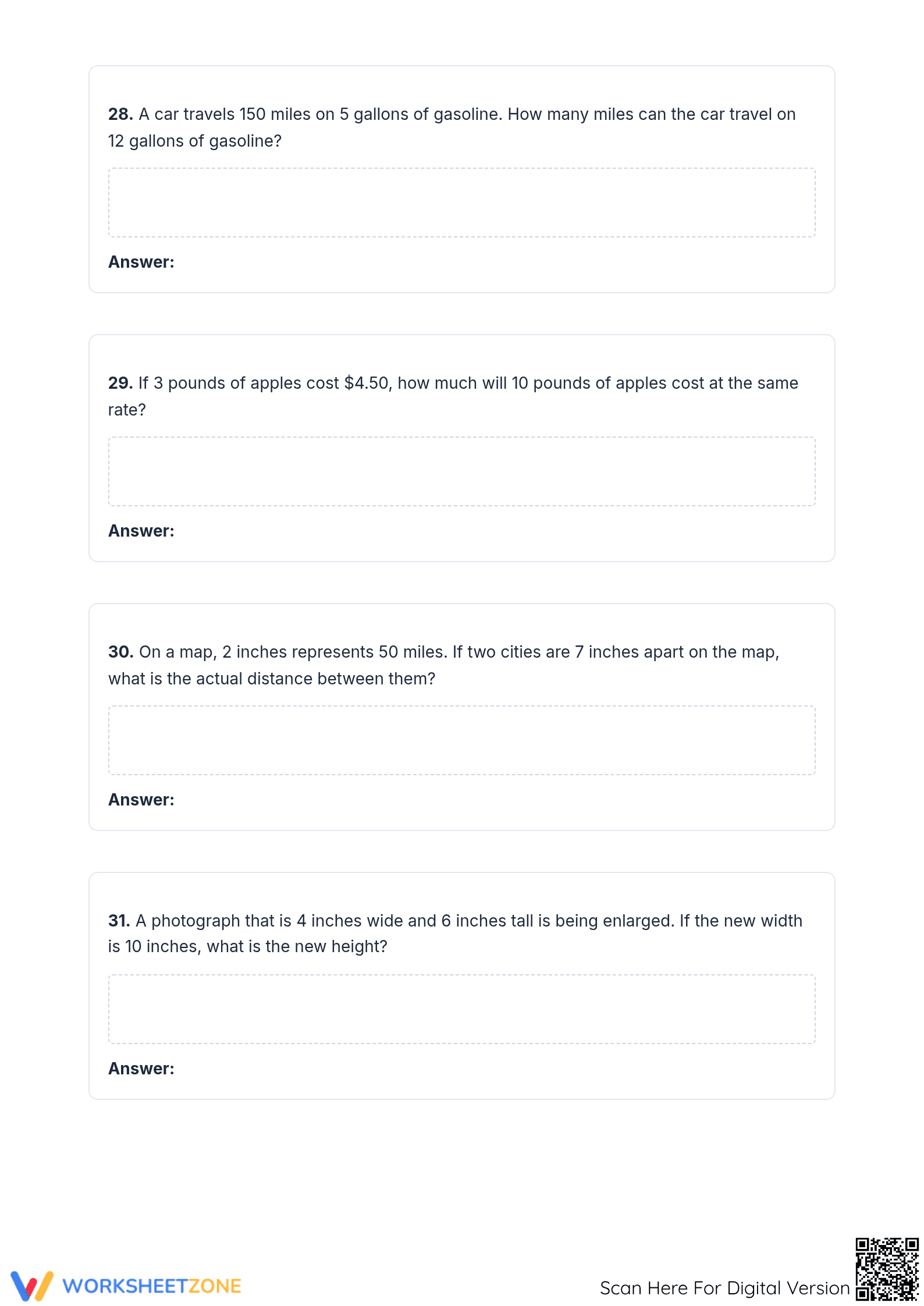
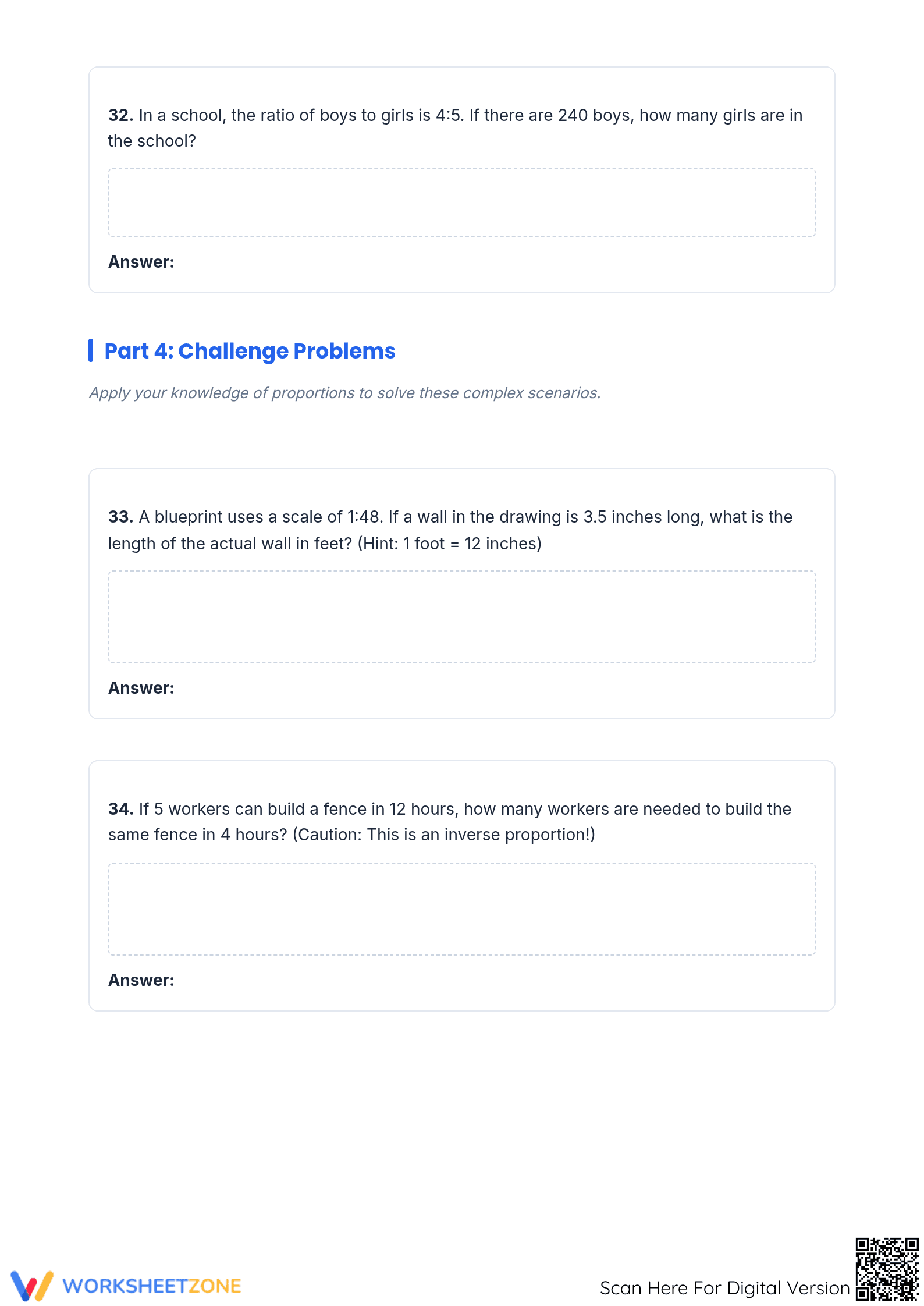
This 5-page resource features 34 problems divided into four segments: basic proportions, algebraic equations, word problems, and challenge tasks. A complete answer key is provided for immediate feedback and easy grading in any classroom setting.
Skill Progression and Mastery
- Guided Practice: 20 problems build mental math speed and introduce the concept of scaling factors.
- Supported Practice: 6 algebraic problems present proportions as fractions, requiring cross-multiplication or reciprocal operations.
- Independent Practice: 8 word problems and challenge tasks apply skills to real-world scenarios.
This structure follows a gradual-release model, ensuring students move from scaffolded calculation to independent application with confidence.
Standards Alignment
This resource is aligned to `CCSS.MATH.CONTENT.7.RP.A.2`: "Recognize and represent proportional relationships between quantities." It specifically targets the ability to solve for unknowns in proportional equations and apply these concepts to real-world word problems. This standard code can be copied directly into lesson plans, IEP goals, or district curriculum mapping tools.
How to Use It
Use this packet as a comprehensive unit review or a formal summative assessment after introducing ratio scaling. It works well as a self-paced station activity where students check their work against the answer key. During instruction, observe whether students are relying on mental math for basic sets or showing algebraic steps for fractional problems to gauge procedural fluency.
Who It's For
This worksheet is ideal for Grade 7 students, but also serves as strong intervention for Grade 8 or 9 learners who need to solidify algebraic foundations. It is best paired with visual aids like ratio tables or double number line diagrams to help students visualize the relationships before they calculate the missing parts.
According to the Fisher & Frey (2014) gradual release of responsibility model, instructional materials must transition from scaffolded calculation to independent problem-solving to ensure long-term mastery. This worksheet aligns with those findings by structuring the 34 tasks into four distinct phases of difficulty. Beginning with basic ratio equality and progressing to algebraic fractional forms, the resource provides the necessary repetition for students to internalize the logic of proportional relationships. The inclusion of complex word problems and inverse proportions meets the rigorous demands of CCSS.MATH.CONTENT.7.RP.A.2, requiring students to not only compute but also interpret mathematical scenarios. Research from EdReports (2024) suggests that high-quality math resources must bridge the gap between abstract calculation and concrete application. By providing a clear answer key and space for work steps, this packet supports formative assessment and allows teachers to identify specific misconceptions in ratio scaling or cross-multiplication strategies effectively.


