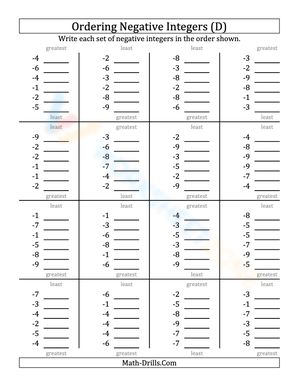
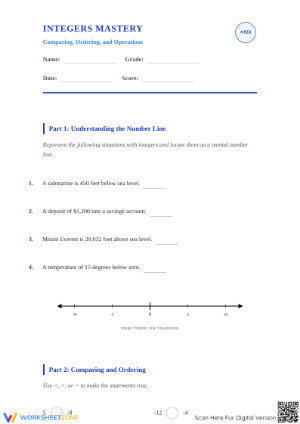
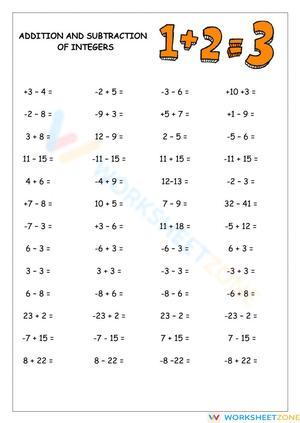
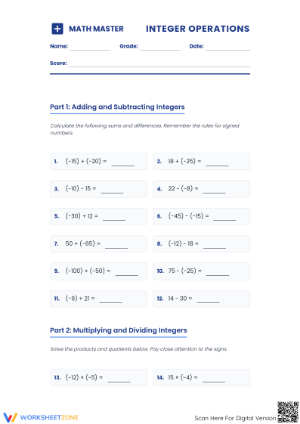
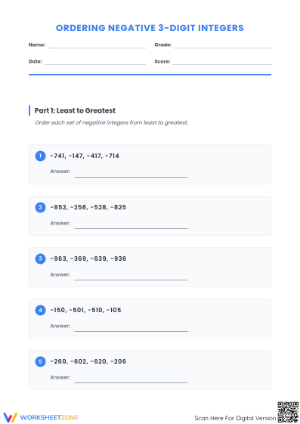
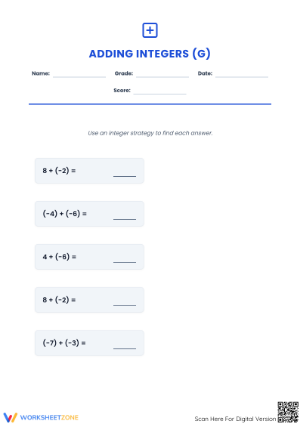
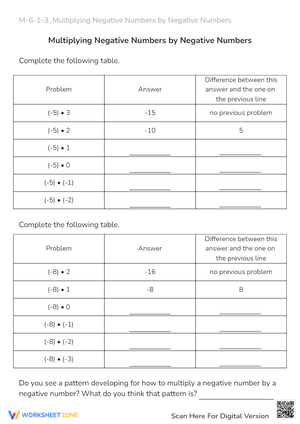
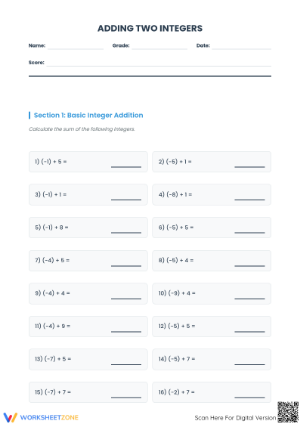
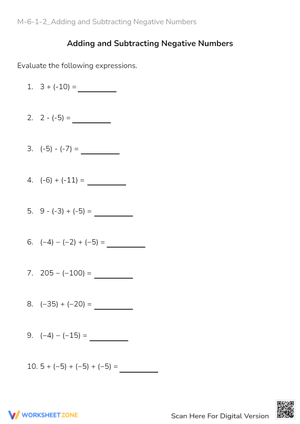
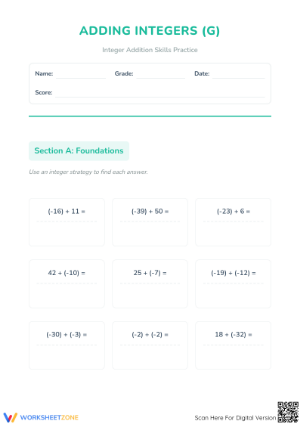
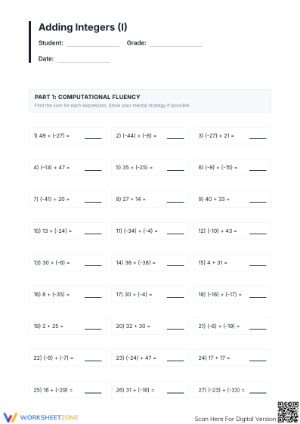
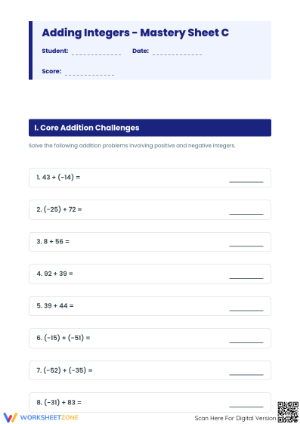
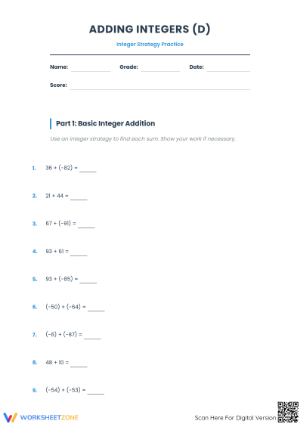
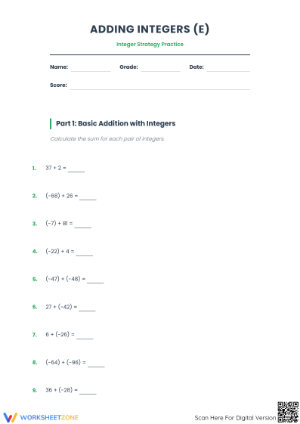
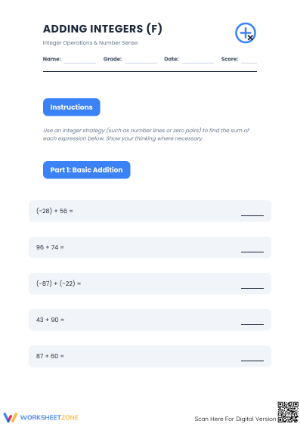
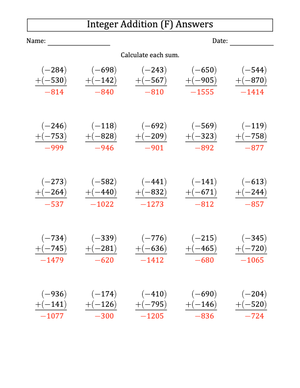
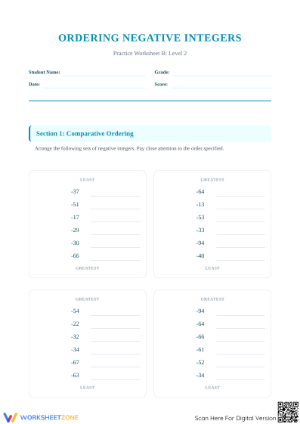
These operations with integers printable worksheets for 6th grade give teachers a focused set of resources for one of the trickiest conceptual transitions in middle school math — the shift from whole numbers into signed arithmetic. At this stage, students are not simply learning new rules; they are reconsidering how number operations work at a fundamental level. The set covers that full arc: four operations with positive and negative integers, mixed practice, word problems, and error analysis tasks that surface student thinking in ways that a string of computation problems cannot.
Skills These Worksheets Build
Each worksheet targets a specific slice of integer work, and the set moves from single-operation practice into mixed and applied tasks. Teachers can assign in sequence or pull individual worksheets to address a particular gap without working through the entire set in order.
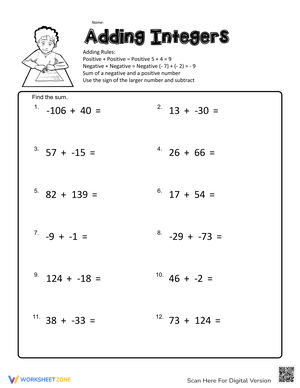
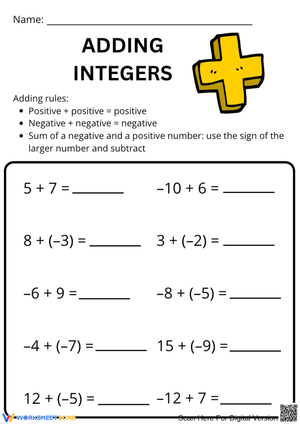
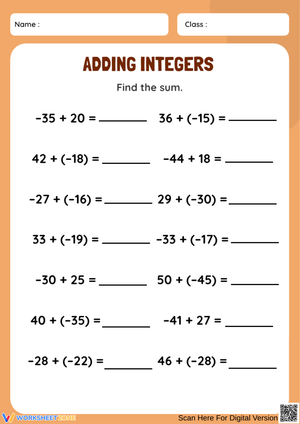
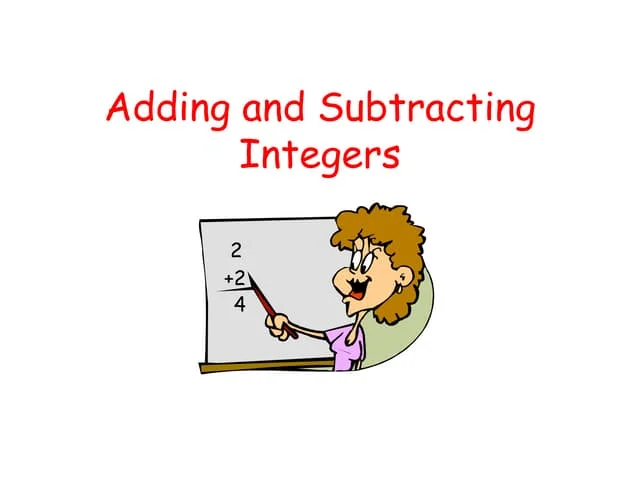
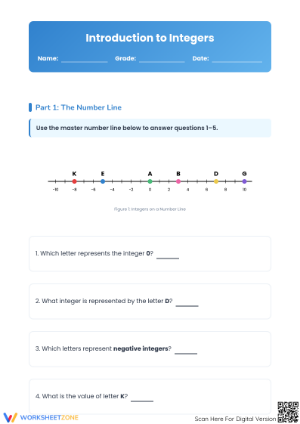
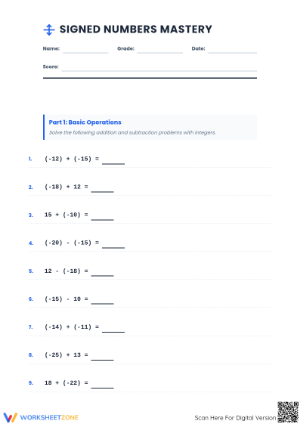
- Addition and subtraction with integers: Students rewrite subtraction as adding the opposite, work with number lines, and move toward abstract signed expressions. The format slows the transition so students are not just mimicking steps.
- Sign rules for multiplication and division: Repeated practice with all four sign combinations helps students recognize patterns before they are asked to memorize rules without context.
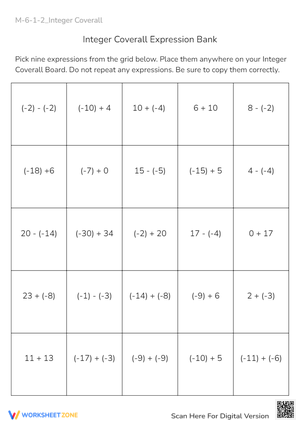
- Mixed operations: Problems that require students to identify the operation first, rather than follow a single repeated format across an entire worksheet. This is where rote pattern-matching breaks down and genuine understanding becomes visible.
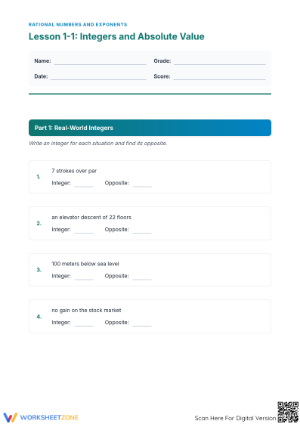
- Word problems with signed numbers: Temperature change, elevation gain and loss, debt and deposit, and game score comparisons. These contexts give students a reason to track direction, not just compute a result.
- Error analysis tasks: Students examine a worked example containing a sign error and explain in writing what went wrong. That writing step demands precision that circling a correct answer does not.
- Order of operations with integers: Mixed expressions combining multiple operations, assigned after students are stable with each operation individually.
The balance between computation practice and reasoning tasks matters here because students who only drill sign rules often produce correct answers on focused exercises and then fall apart on the first mixed-operation problem — they have never had to decide which rule applies. These worksheets build both layers deliberately.
Frequent Errors Students Make with Signed Numbers
Integer arithmetic produces a short, predictable list of errors that appear across almost every 6th grade classroom. Knowing them in advance lets teachers address them directly rather than waiting for quiz results.
The most consistent error involves the subtraction-as-opposite relationship. Given 5 − (−3), many students compute 5 − 3 = 2 instead of 5 + 3 = 8. The negative sign inside the parentheses and the subtraction symbol together look like a pattern they have already encountered — two negatives make a positive — but they pull a multiplication rule into an addition context. That transfer error only surfaces when the problem structure creates the specific ambiguity, which means it is invisible on focused addition-only practice.
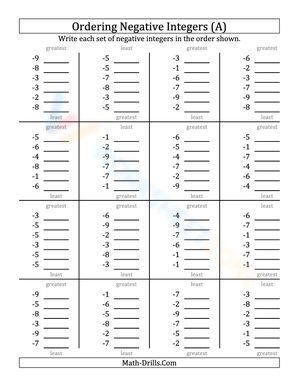
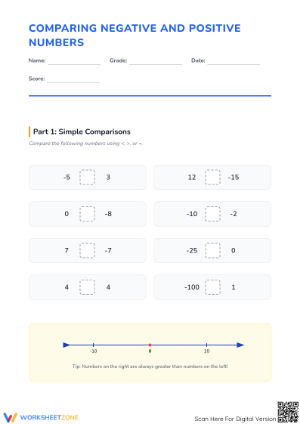
A second persistent error centers on absolute value and direction. Students correctly learn that the sum of two negative integers is negative, and then some generalize it: "the negative wins." When they encounter −8 + 12, they write −4 because "negatives dominate" has become a blanket rule rather than a description of direction and distance. The worksheets include problems designed to force that distinction, giving teachers a fast diagnostic moment before the misunderstanding gets reinforced through repetition.
In multiplication, the negative × negative case causes the most trouble under pressure. The procedural rule is easy to state and easy to forget. The error analysis tasks in this set ask students to locate where a sign flip was missed or wrongly applied — those tasks are worth assigning before a quiz, not as a post-mortem afterward.
Fitting These Worksheets Into Your Weekly Lesson Plans
Operations with integers printable worksheets for 6th grade fit into nearly any point in the lesson cycle, but they do different jobs depending on placement. The productive uses come from deciding the purpose before assigning, not after.
As a bell ringer, three to five integer problems — especially ones that mix addition and multiplication in the same short set — reactivate prior learning fast. The first six minutes of class are often absorbed by transitions; a short integer warm-up anchors students while attendance is handled. For teachers running a block schedule, bell ringers that return to integers two or three times a week outperform a single longer review session in terms of retention, because the spacing forces retrieval rather than recognition.
After a mini-lesson, a focused worksheet — addition and subtraction only, or multiplication and division only — gives students immediate practice while the modeled strategy is still fresh. Then the next morning, the same task without the hint box or number line shows whether students internalized the process or were following the teacher's moves during the lesson.
Math stations are where the leveled structure of this set does its clearest work. Placing a visual-support worksheet at one station and a mixed-operations worksheet at another lets a teacher pull a reteach group without the rest of the class sitting idle. The tasks look similar enough that no one is publicly sorted, but the support level differs in ways that matter.
Standard Alignment
The conceptual foundation for this work sits in CCSS 6.NS.C — Apply and extend previous understandings of numbers to the system of rational numbers. Standards 6.NS.C.5 through 6.NS.C.8 address understanding what negative numbers represent, placing them on a number line, comparing absolute values, and situating signed numbers in real-world contexts. These are the standards that establish what a negative number means before students are expected to operate with them reliably.
The four arithmetic operations with integers appear formally in CCSS 7.NS.A. However, many 6th grade curricula — particularly those bridging into 7th grade content — introduce integer arithmetic in the spring semester as a preview unit. These worksheets serve both teachers covering integer operations within a 6th grade framework and those using them as structured early exposure ahead of the formal 7th grade standard. Teachers in non-CCSS states where integer arithmetic is explicitly placed in grade 6 will find the full set aligned to their grade-level expectations without adjustment.
Adjusting the Set for Mixed-Ability Classrooms
Operations with integers printable worksheets for 6th grade lend themselves to level adjustment without requiring entirely separate materials. The goal is to keep the core skill consistent while changing the complexity or support level, so all students are working on integer operations during the same instructional window — just with different entry points.
- Students who need additional support: Use worksheets that include a number line across the top and a sign-rule reference box. Reducing visual clutter frees cognitive attention for the sign logic itself, which is the actual learning target.
- Students with math processing difficulties: Keep directions short and consistent across problems. Rotating among "evaluate," "find the value of," and "simplify" adds unnecessary reading load when the math is already demanding. Consistent phrasing lets the integer work be the hard part.
- On-level practice: Assign focused worksheets first, then a short mixed-review worksheet once each operation feels stable. Rushing into mixed practice before students are secure tends to erode confidence and push students toward sign-guessing rather than reasoning.
- Students ready for extension: Error analysis tasks and multi-step expressions with missing values move fluency into reasoning. Asking students to write an original integer word problem and swap with a partner is a ten-minute extension that surfaces depth of understanding quickly.
One structural move that removes the awkwardness of public sorting: print two versions of the same integer task — one with a hint box, one without — and let students self-select at the start of the activity. After the first week of integer work, most students make that call accurately, which tells the teacher something useful about student self-awareness as well as content confidence.
Frequently Asked Questions
Do these worksheets work for students who have never encountered integers before?
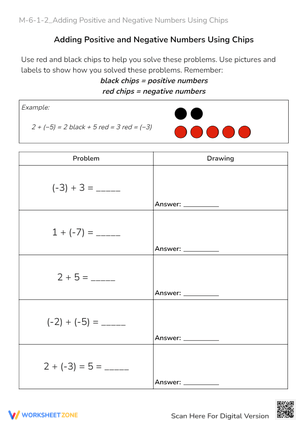
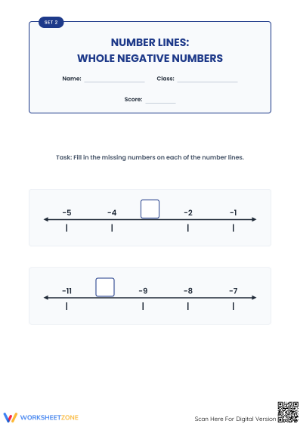
The earlier worksheets in the set use number lines and context-based problems, which makes them accessible for students meeting signed numbers for the first time. That said, a brief class discussion or concrete model — integer chips, a thermometer, a gain-and-loss table — before independent practice makes the written exercises stick better. These worksheets reinforce and extend understanding; they do not replace the initial teaching moment.
How long does each worksheet typically take to complete?
Time varies by task type and student level. A focused addition and subtraction worksheet usually takes on-level students 10 to 15 minutes. An error analysis or mixed-operations worksheet can run closer to 20. Teachers often assign one worksheet as practice and use the answer key for self-correction or small-group discussion rather than collecting and grading every set.
Can these be used for intervention with 7th or 8th graders?
Yes. Integer operations remain a persistent gap through middle school, and the operations with integers printable worksheets for 6th grade work just as effectively for reteaching at any grade where signed number fluency is the problem. A 7th grader who never fully grasped subtraction of negatives benefits from the same number-line-based, step-by-step format that works for a 6th grader — the mathematical content does not become age-inappropriate just because the student is older.
Is an answer key included with each worksheet?
Each worksheet in the set includes a corresponding answer key. These make it straightforward to use the worksheets for self-correction, peer review, or quick check-ins during independent work time without the teacher needing to mark every problem by hand.













 Interactive Worksheet Maker
 Quiz Maker
 Word Search Maker
 Crossword Puzzle Maker
 Word Scramble Generator
 Sentence Scramble Generator
 Handwriting Worksheet Generator
 Name Tracing Generator
 Fill In The Blank Generator