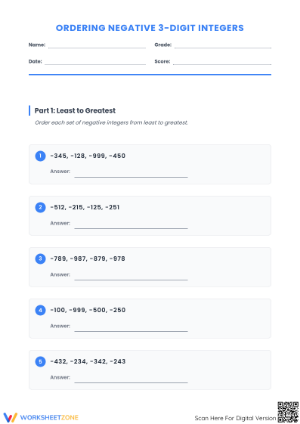
These comparing integers worksheets for 6th grade give teachers a ready-to-use practice set that moves students from basic positive-negative comparisons through ordering tasks and into short applied problems — all without requiring any materials beyond a printer and a pencil. The set covers the comparison work students need before rational numbers, coordinate planes, and one-variable equations come into the picture.
Skills Each Worksheet Targets
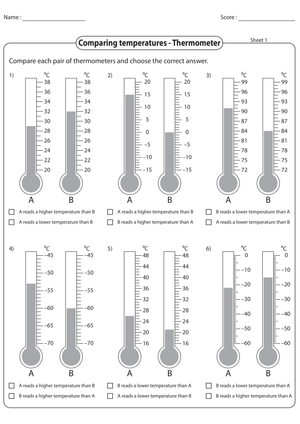
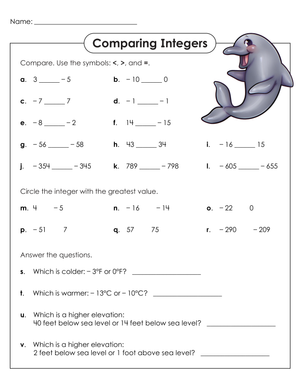
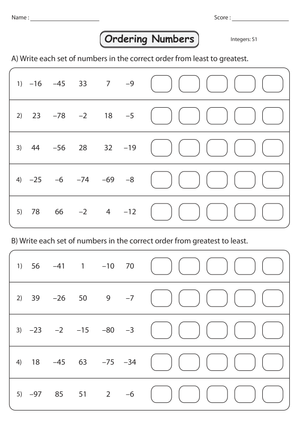
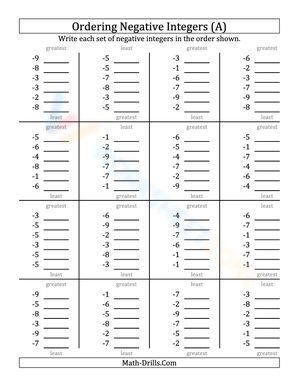
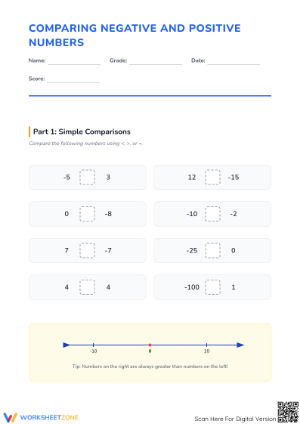
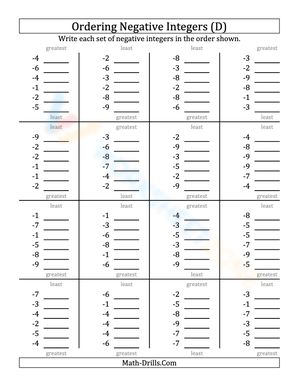
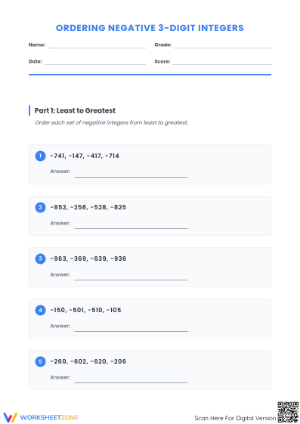
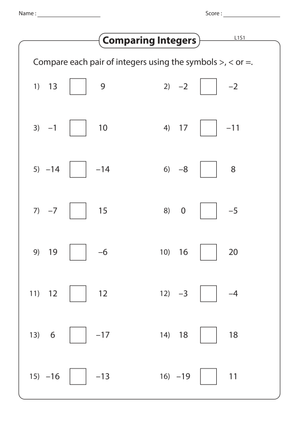
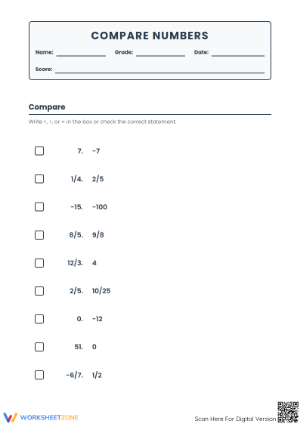
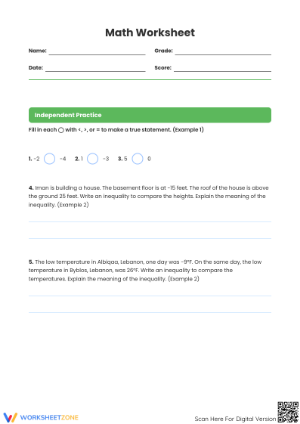
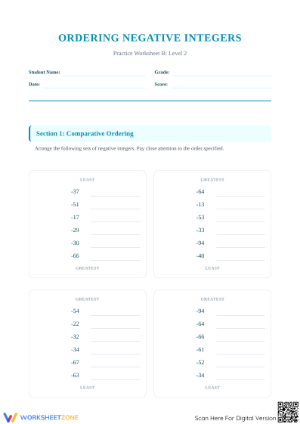
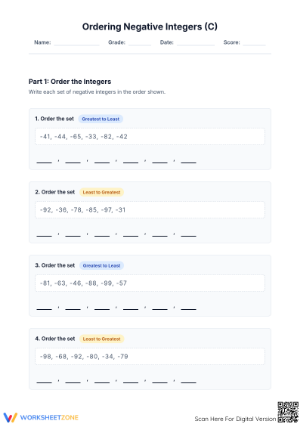
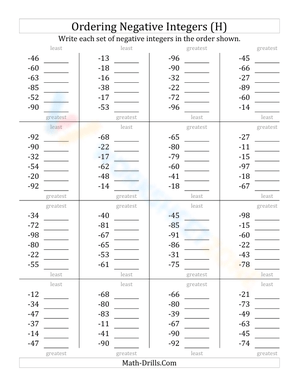
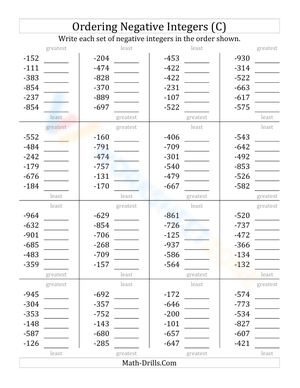
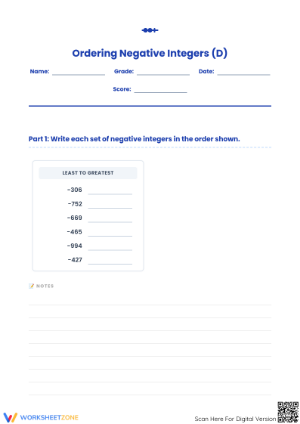
The comparison work builds in a deliberate sequence. Early worksheets ask students to compare two integers — one positive and one negative — by placing a "greater than," "less than," or "equal to" symbol between them. Later worksheets introduce pairs of negative integers, which is where understanding starts to separate students who are reasoning from students who are guessing. The final worksheets shift to ordering three to six integers from least to greatest or greatest to least, and they include brief real-world contexts: temperatures below freezing, sea-level elevations, and account balances.
- Compare a positive and negative integer using inequality symbols
- Compare two negative integers, identifying which sits closer to zero
- Place integers on a number line and read their relative positions
- Order sets of mixed integers in both directions
- Apply comparison reasoning to temperature, elevation, and financial contexts
- Explain a comparison in writing using number line position as support
Mistakes Students Make That These Worksheets Help You Catch
The most persistent error is treating absolute value as a proxy for magnitude. A student who correctly compares 3 and 8 will often write that negative 9 is greater than negative 2 because 9 feels larger than 2. They are not making a careless mistake — they are applying a whole-number rule to a system where direction matters as much as distance from zero. Number line items on these worksheets interrupt that logic before it hardens into a fixed habit.
Symbol reversal is a separate but equally common problem. Students sometimes identify the greater integer correctly but still record the wrong symbol — writing negative 3 as greater than 1 even when they can state the correct relationship out loud. Having students read each comparison aloud before writing the symbol ("negative 3 is less than 1, so the open end of the symbol faces 1") closes this gap more reliably than drilling symbol rules in isolation.
Zero causes its own trouble. Because it carries no sign, students regularly misplace it in ordering tasks — sometimes listing it as the smallest value in a set that includes negative integers. Comparison problems where zero sits between a negative and a positive integer, such as ordering negative 4, zero, and 2, give students a concrete anchor for what zero actually represents on the number line.
How to Build These Worksheets Into Your Lesson Plans
The comparing integers worksheets for 6th grade fit cleanly into the warm-up slot. Three to five quick comparison problems in the eight minutes before the mini-lesson activate number line reasoning without eating into instruction time. During the lesson itself, a worksheet that pairs number line visuals with symbol-writing tasks lets students connect the concrete representation to the abstract notation in real time, which cuts the guesswork that appears when abstract comparisons arrive too early.
For independent practice, a worksheet mixing pair comparisons and ordering sets gives teachers a fast accuracy check. Answer keys make it straightforward to pull specific problem types during a reteach block — if most students got the positive-negative pairs right but struggled with negative-negative comparisons, that narrows the next day's focus considerably. Exit ticket use works well with three targeted items: one positive-negative pair, one negative-negative pair, and one ordering set, so teachers walk away with actionable data without grading an entire worksheet.
One classroom move that consistently improves accuracy: before choosing "greater than" or "less than," have students physically point right for the greater number and left for the lesser one. It sounds minor, but connecting vocabulary to a physical direction reduces symbol reversal and gives hesitant students a repeatable strategy during independent work. For stronger retention across the week, vary the task format rather than assigning the same style every day — number lines on Monday, symbol comparisons on Tuesday, ordering sets on Wednesday, applied problems on Thursday, and a mixed-format worksheet on Friday as quick mastery evidence.
Standard Alignment
These worksheets align to CCSS 6.NS.C.7, which requires students to interpret statements of order for rational numbers in real-world contexts and to understand absolute value as distance from zero. The standard places integer comparison at the opening of the Grade 6 Number System domain because it supports every rational number skill that follows — including 6.NS.C.6, which extends comparisons to the full coordinate plane. Applied contexts involving negative temperatures, debts, and elevations appear specifically in the standard's language, which means the word problems here are directly aligned rather than loosely connected.
Adapting the Set for Different Student Levels
For students who are not yet secure with number line placement, worksheets that print a number line above each problem function as built-in reference tools. Teachers can assign only those worksheets first, then move those students to abstract comparison worksheets once they consistently identify which of two integers sits farther right. This matters because the comparing integers worksheets for 6th grade include both visual and abstract formats, so teachers are not locked into one type for the whole class at once.
Advanced students gain more from error-analysis tasks than from additional practice problems. Present a comparison such as "negative 6 is greater than negative 1" and ask students to explain in writing what is wrong and why. Students who can identify the error orally but cannot write the explanation reveal a gap worth addressing before the unit moves forward — that oral-to-written transfer often separates students who truly understand integer order from those who have memorized a procedure.
For intervention groups, sorting the worksheets by problem type rather than assigning them in sequence is the better move. Start with positive-negative comparisons, introduce negative-negative comparisons only after students are consistent, and hold ordering sets for last. That progression follows the natural developmental path instead of presenting all three types simultaneously before students have stable footing on any of them.
Frequently Asked Questions
What should students understand before working through these worksheets?
Students should recognize that integers include positive numbers, negative numbers, and zero, and that numbers increase in value as you move right on a number line. They do not need to have memorized inequality symbols first — the worksheets build that connection through visual tasks and repeated practice rather than assuming it as prior knowledge.
Do the worksheets include answer keys?
Each worksheet in the set comes with a corresponding answer key. Teachers can use them for quick grading, center self-checks, or sub plans paired with a brief review note — no additional prep required on either end.
How long does each worksheet take to complete?
Most 6th graders finish each worksheet in 10 to 15 minutes, which makes them easy to slot into warm-ups, independent practice blocks, or short intervention sessions without restructuring the surrounding lesson.
Can these work for students above or below grade level?
The comparing integers worksheets for 6th grade are written to CCSS 6.NS.C.7, but the skill transfers well in both directions. Advanced 5th graders introduced to integers as enrichment work well with the visual number line worksheets. 7th graders revisiting integers before rational number operations can use the abstract comparison and ordering worksheets as a focused review without the material feeling remedial.













 Interactive Worksheet Maker
 Quiz Maker
 Word Search Maker
 Crossword Puzzle Maker
 Word Scramble Generator
 Sentence Scramble Generator
 Handwriting Worksheet Generator
 Name Tracing Generator
 Fill In The Blank Generator