


























Views
Downloads

Printable Adding Integers Practice Worksheet | Grade 7 Math
Paste this activity's link or code into your existing LMS (Google Classroom, Canvas, Teams, Schoology, Moodle, etc.).
Students can open and work on the activity right away, with no student login required.
You'll still be able to track student progress and results from your teacher account.
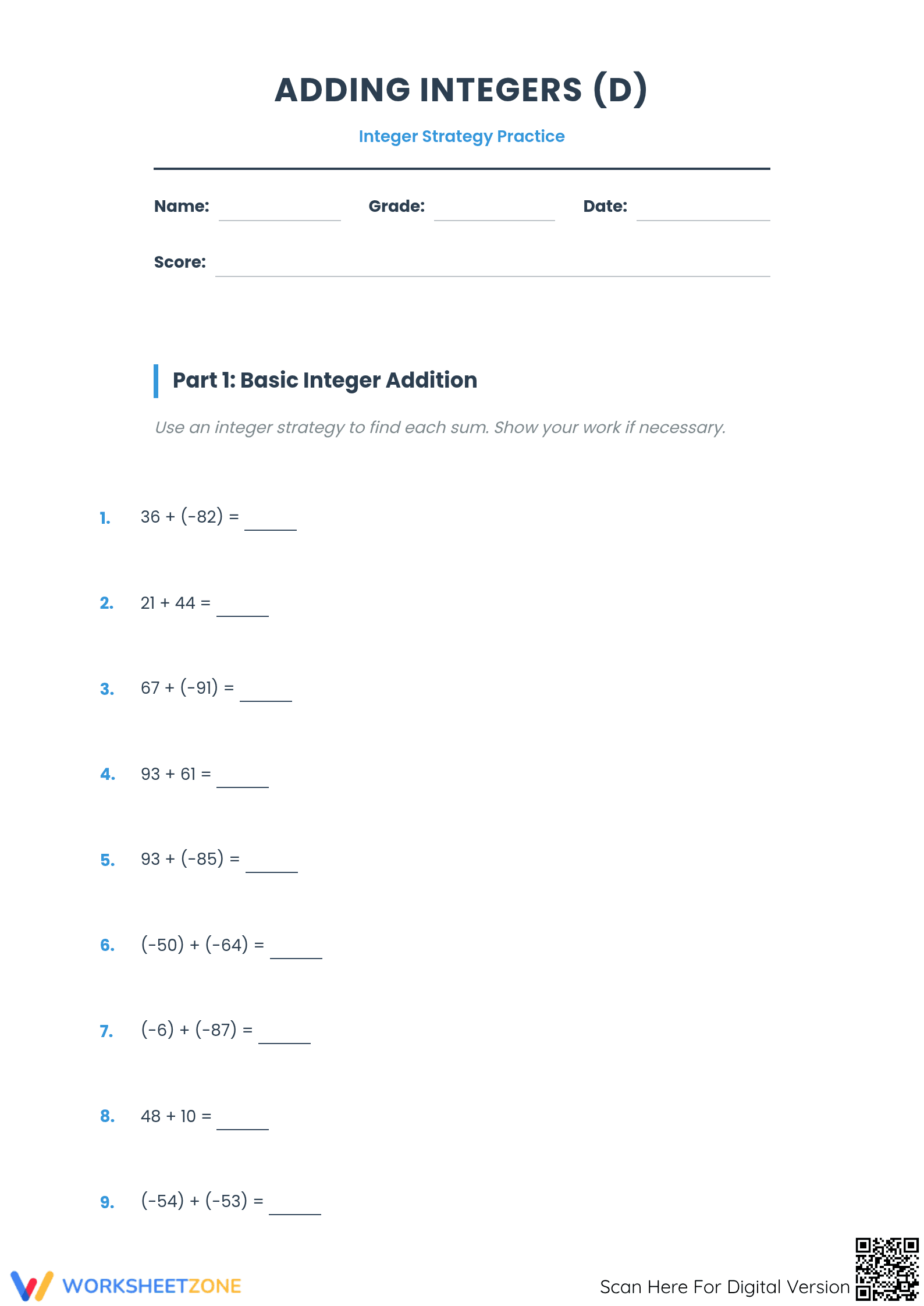
Adding integers with varying signs is a foundational algebraic skill that requires conceptual clarity and procedural fluency. This worksheet provides a systematic approach to finding the sum of two integers ranging from -99 to 99, including those formatted with parentheses for negative values. Students develop the ability to handle mixed-sign operations with confidence and precision.
At a Glance
- Grade: 5–8 · Subject: Math
- Standard:
7.NS.A.1— Apply understandings of addition to add rational numbers and represent them on diagrams- Skill Focus: Integer Addition (Negative Parentheses)
- Format: 5 pages · 48 problems · Answer key included · PDF
- Best For: Independent Practice and Strategy Reinforcement
- Time: 30–45 minutes
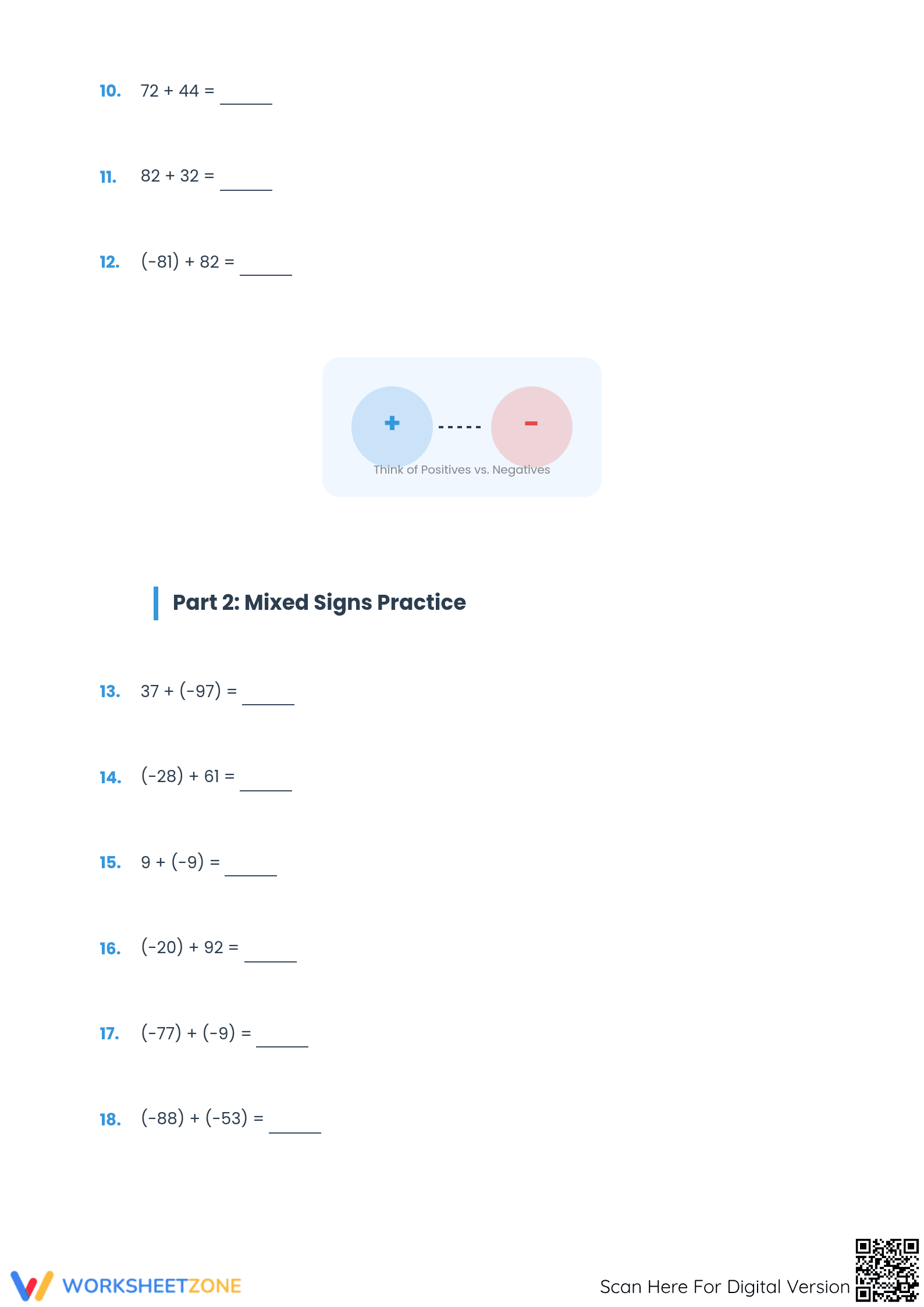
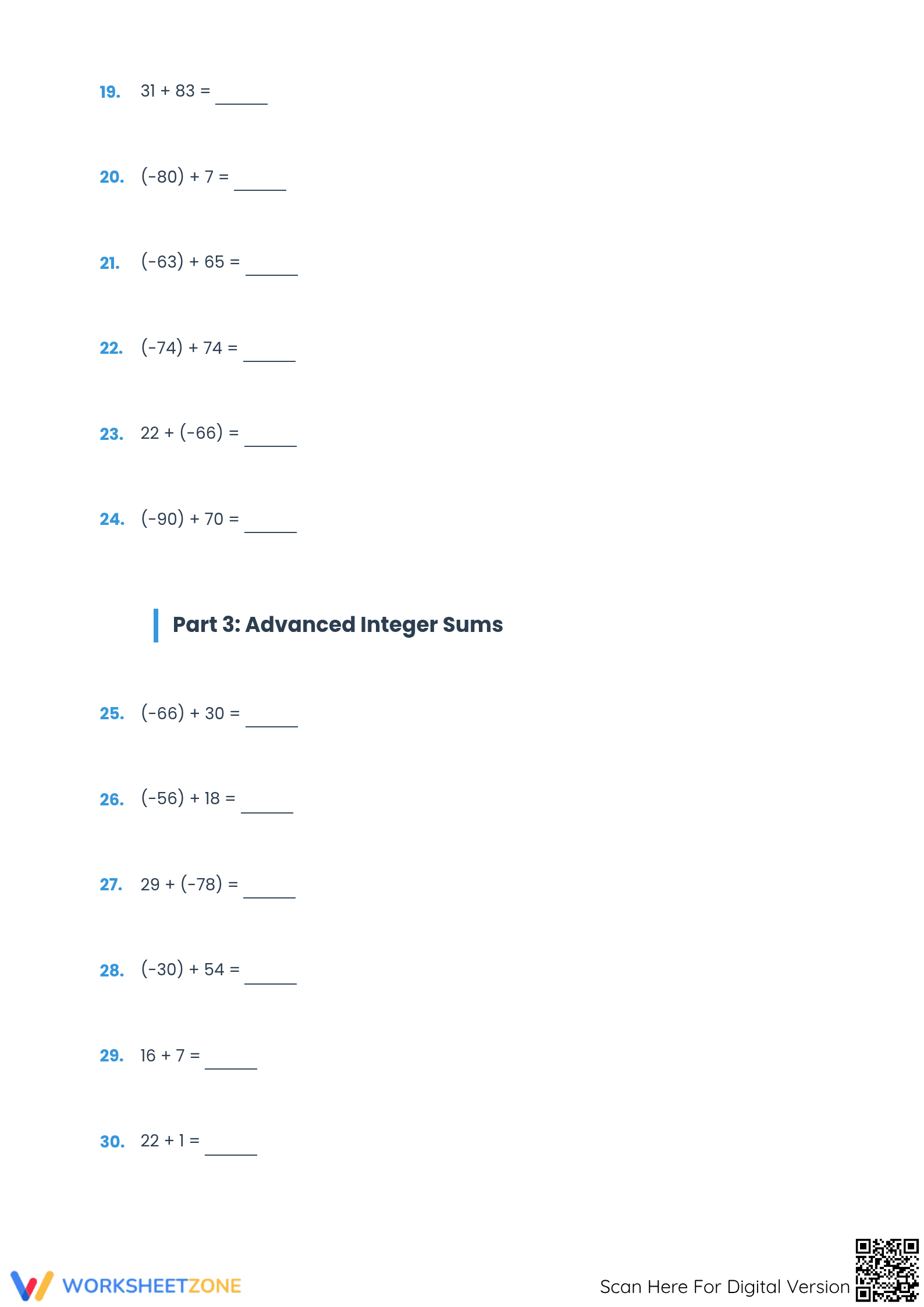
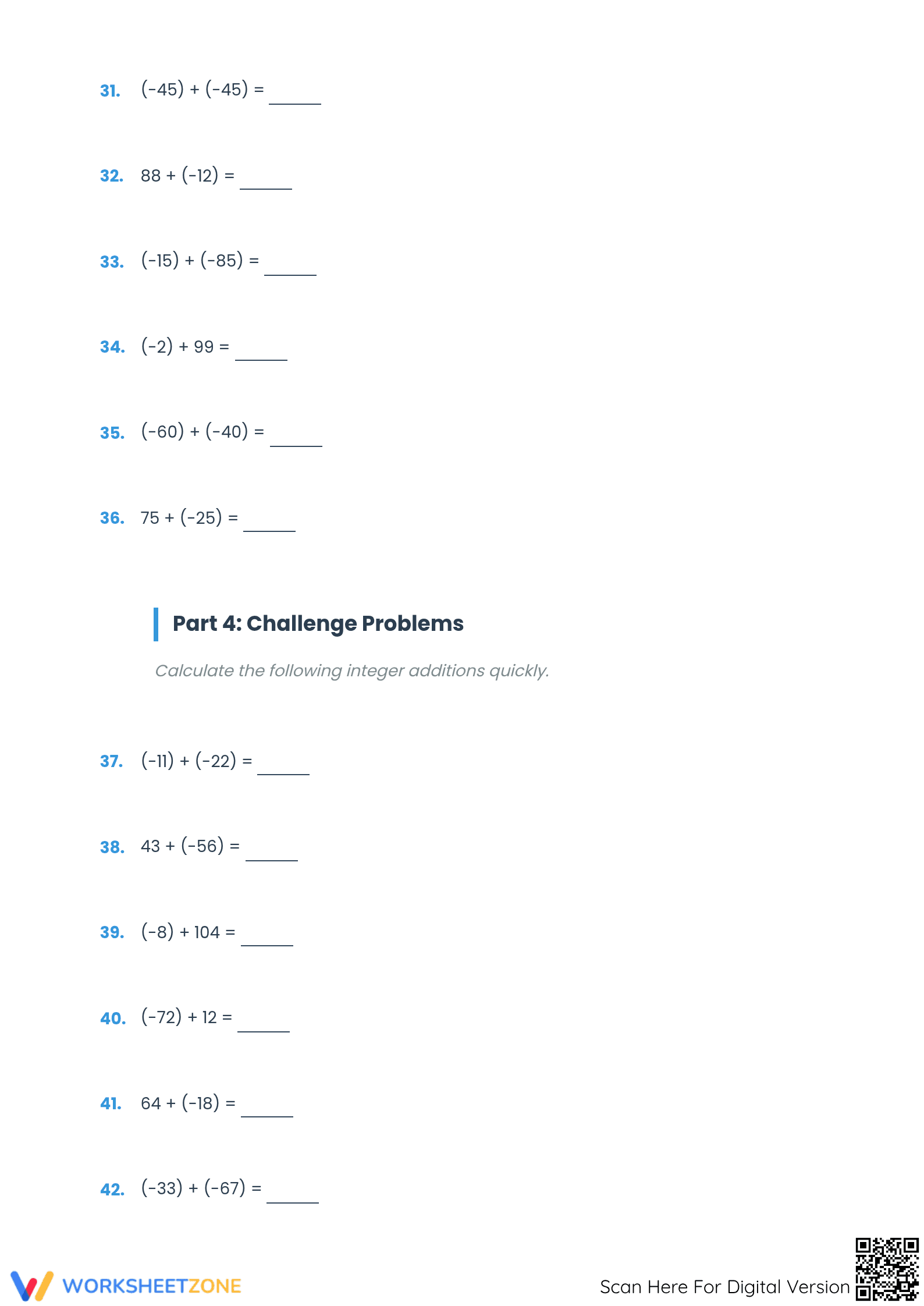
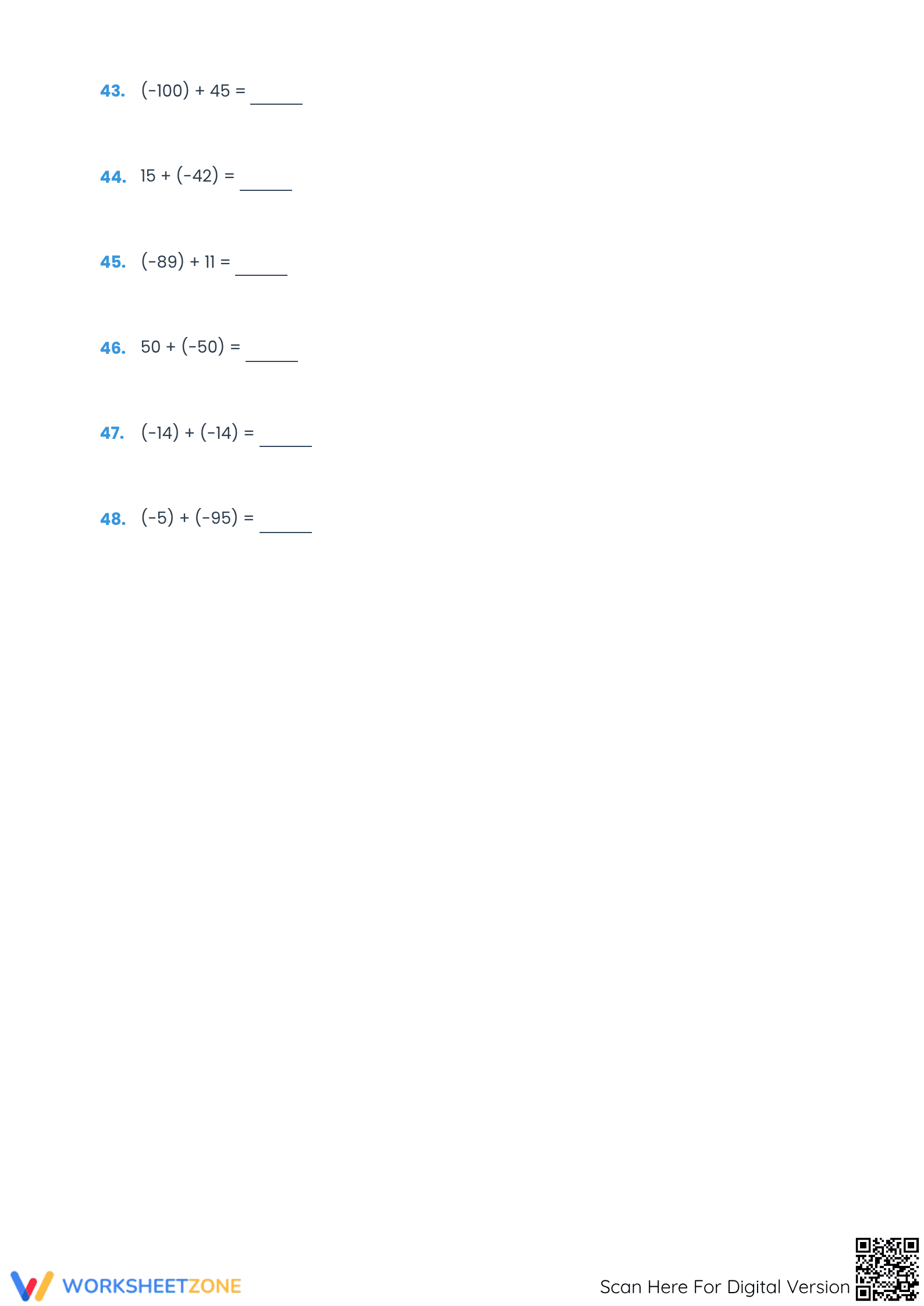
This comprehensive 5-page resource contains 48 addition problems designed to build mastery through variety. The first page introduces basic sums, while subsequent sections include mixed signs and challenge problems involving two-digit integers. A visual strategy prompt—reminding students to "Think of Positives vs. Negatives"—is included to support mental modeling. The clear layout ensures students have enough space to show their work.
Skill Progression
- Guided practice: Part 1 establishes the pattern of adding positive and negative values using parentheses across 12 introductory problems.
- Supported practice: Parts 2 and 3 offer 18 mixed-sign sums where students must independently decide which strategy to apply to achieve correct results.
- Independent practice: Part 4 provides 18 challenge problems using the full range of integers from -99 to 99 to test ultimate procedural fluency.
The structure ensures students move from basic computation to fluid application of integer rules using a gradual-release model.
Standards Alignment
This worksheet is strictly aligned to 7.NS.A.1, which requires students to describe situations in which opposite quantities combine to make 0 and to show that the distance between two rational numbers on the number line is the absolute value of their difference. Both standard codes can be copied directly into lesson plans, IEP goals, or district curriculum mapping tools.
How to Use It
Use this resource as a practice set following a lesson on integer addition rules. It is effective for small group intervention where a teacher can observe students' strategy use in real-time. For formative assessment, assign a single section as a "check for understanding" to see if students can accurately process negative-negative sums versus mixed-sign sums.
Who It's For
This resource is intended for middle school students in grades 6 through 8 who are mastering rational number operations, though it serves as an excellent challenge for advanced 5th graders. It pairs naturally with an integer number line anchor chart or double-sided counters to provide a concrete representation of the abstract arithmetic.
The mastery of integer operations is a critical gatekeeper for success in secondary mathematics. According to a ScienceDirect TpT Analysis, effective practice materials must provide structured opportunities for students to apply rules to varying sign combinations to achieve procedural automaticity. This worksheet addresses that need by presenting 48 unique problems that force students to distinguish between different scenarios, such as adding a larger negative to a smaller positive. By utilizing a progression from basic to challenge problems, the resource supports the developmental shift from concrete representation to abstract mental computation. The inclusion of parentheses for negative integers specifically prepares students for the notation they will encounter in high school algebra, ensuring they can correctly identify signs within complex expressions. This rigorous practice ensures that the foundational skills necessary for solving multi-step equations are firmly established before students transition to more complex topics.


