


























Views
Downloads

Essential Grade 7 Integer Addition Worksheet: CCSS 7.NS.A.1 Aligned
Paste this activity's link or code into your existing LMS (Google Classroom, Canvas, Teams, Schoology, Moodle, etc.).
Students can open and work on the activity right away, with no student login required.
You'll still be able to track student progress and results from your teacher account.
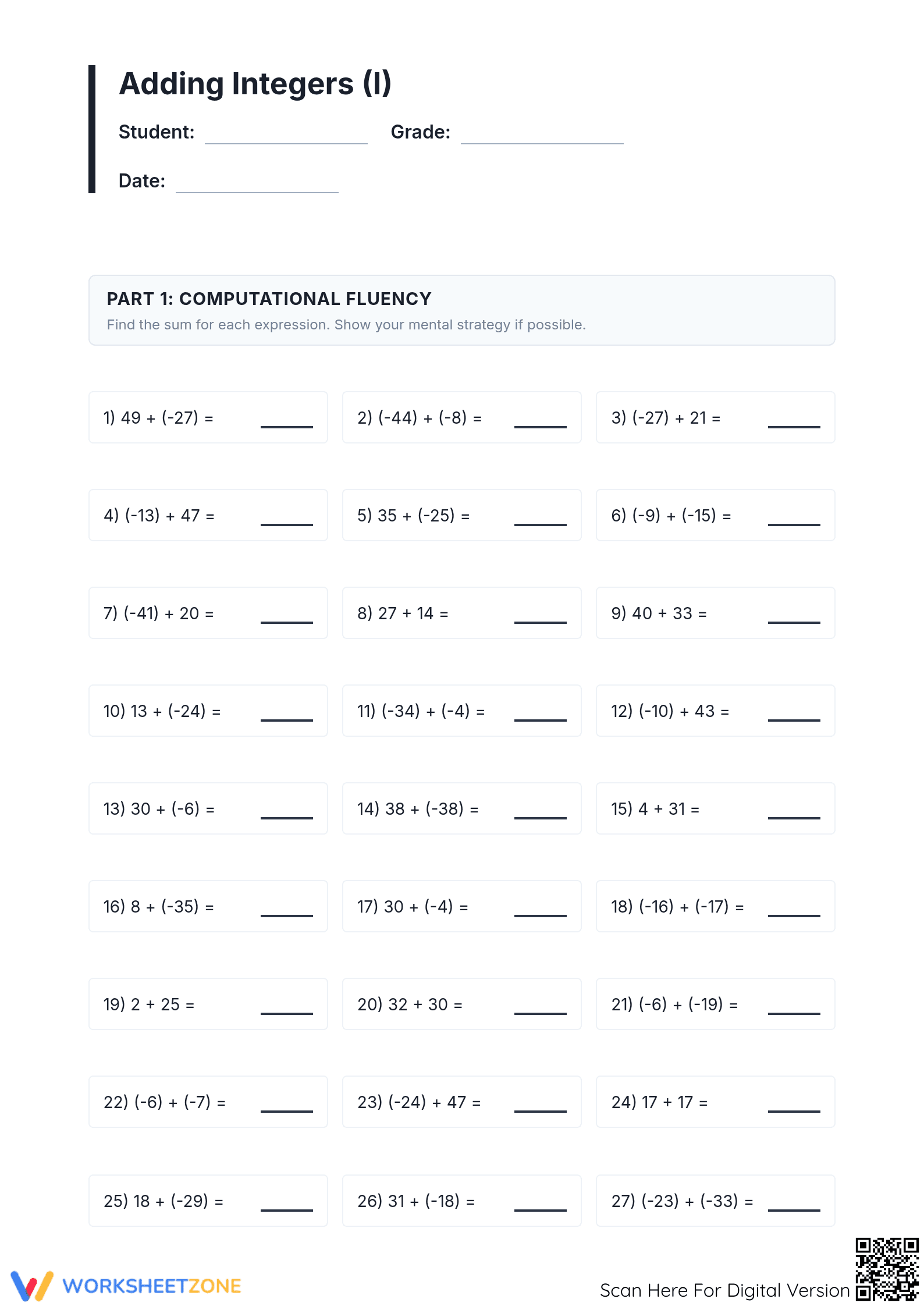
This printable math worksheet provides intensive practice for students to master adding integers through a multi-part progression. Students engage with negative numbers in parentheses across forty-eight distinct tasks, transitioning from computational fluency to complex contextual applications. By the final page, learners demonstrate a robust ability to calculate and interpret sums in real-world scenarios.
At a Glance
- Grade: 7 · Subject: Math
- Standard:
CCSS.MATH.CONTENT.7.NS.A.1— Apply understandings of addition to add rational numbers effectively- Skill Focus: Adding positive and negative integers
- Format: 3 pages · 48 problems · Answer key included · PDF
- Best For: Middle school integer operations mastery
- Time: 35–50 minutes
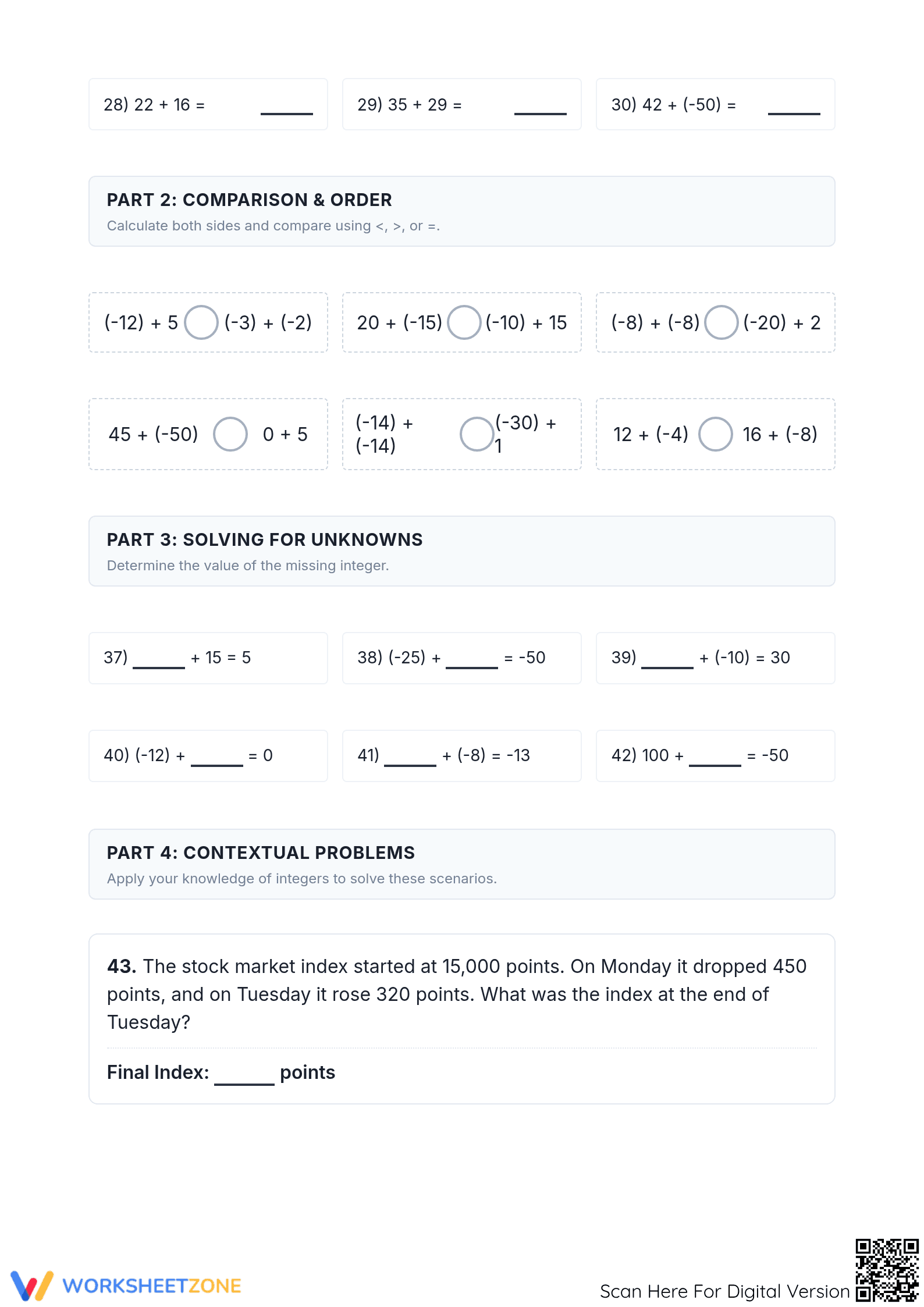
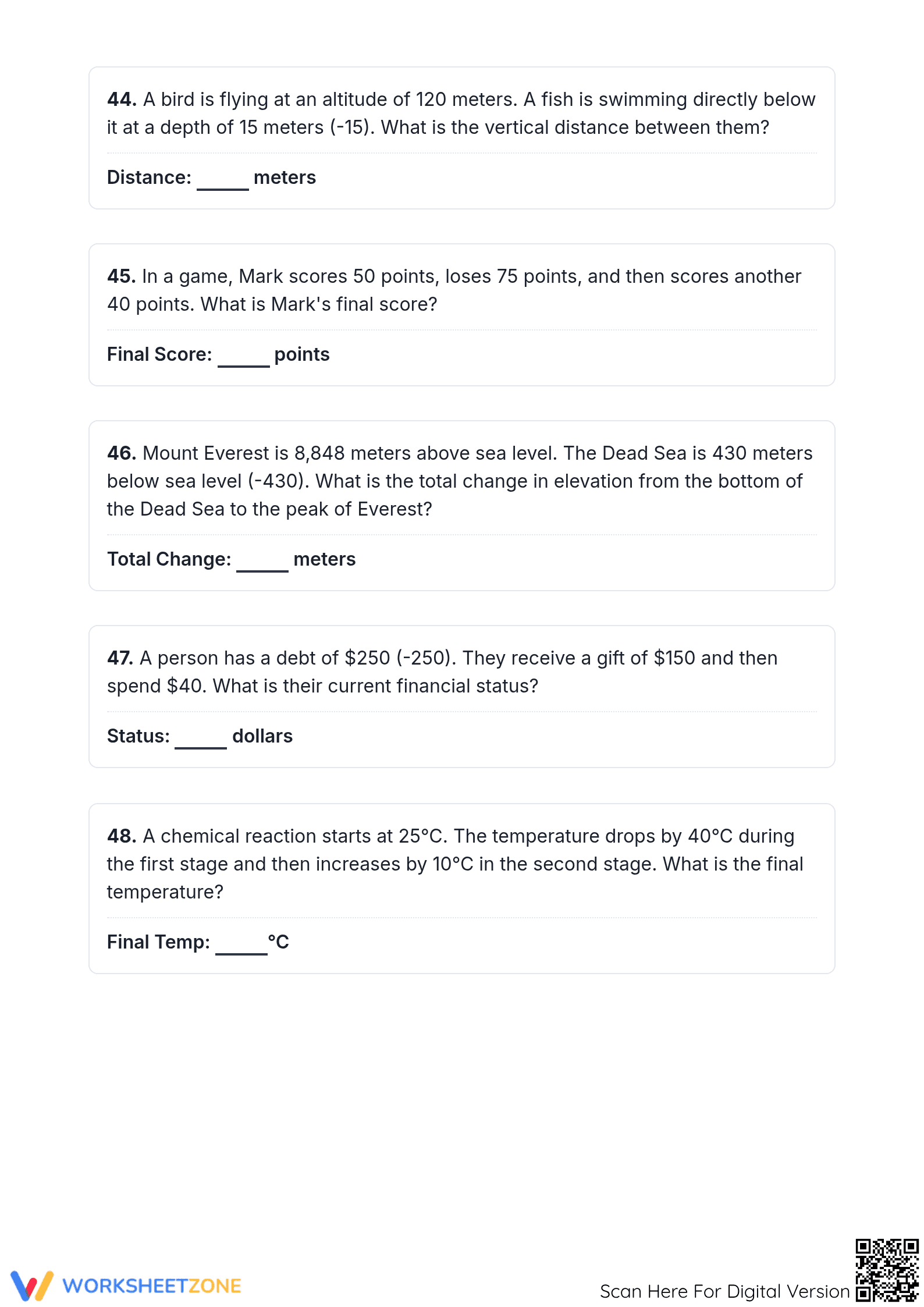
The three-page PDF packet contains forty-eight problems structured into four developmental segments. It begins with twenty-seven computational fluency expressions, followed by comparison tasks using inequalities. The set also features missing-addend algebra equations and six high-depth word problems. A complete answer key is provided to facilitate rapid grading and student self-correction during independent work periods.
Each section of this standards-aligned resource maps directly to proficiency tiers. Computational tasks measure basic fluency, while the comparison and unknown-value sections provide evidence of conceptual understanding. The final word problems serve as a performance assessment, requiring students to translate verbal scenarios into mathematical expressions. Educators can use these specific sections to identify whether students are approaching, meeting, or exceeding grade-level expectations.
The primary focus is CCSS.MATH.CONTENT.7.NS.A.1, which requires students to apply and extend previous understandings of addition and subtraction to add and subtract rational numbers. It specifically addresses the concept that the sum of a number and its opposite is zero. This standard code can be copied directly into lesson plans, IEP goals, or district curriculum mapping tools.
This resource is best utilized during the practice phase of a direct instruction lesson on rational number operations. Teachers can assign the computational fluency section as a primary task and the contextual problems as an extension challenge. For formative assessment, observe students working on Part 3 to see if they understand the inverse relationship between addition and subtraction.
Designed for seventh-grade students, this worksheet is also suitable for Grade 6 acceleration or Grade 8 remediation. It provides the necessary scaffolds for students who struggle with number line visualization by focusing on symbolic manipulation. It pairs naturally with an integer chips manipulative activity or a coordinate plane passage for a comprehensive unit.
Mastery of integer operations is a critical gatekeeper for high school algebra readiness, a finding reinforced by the NAEP results showing persistent gaps in middle-school rational number proficiency. According to research published by Fisher & Frey (2014) on the gradual release of responsibility, structured practice sets that move from simple fluency to complex problem-solving are essential for long-term retention. This worksheet employs that research-backed progression, ensuring that the 48 tasks provided are not merely repetitive but developmentally sequenced to build cognitive stamina. By integrating comparison tasks and missing-value equations alongside traditional word problems, the resource aligns with the RAND AIRS 2024 recommendations for multi-modal mathematical practice. This comprehensive approach ensures that students move beyond rote memorization of rules toward a deeper conceptual understanding of how positive and negative values interact in variable environments.


