


























Views
Downloads

Printable Adding Integers Worksheet | Grade 7 Math Practice
Paste this activity's link or code into your existing LMS (Google Classroom, Canvas, Teams, Schoology, Moodle, etc.).
Students can open and work on the activity right away, with no student login required.
You'll still be able to track student progress and results from your teacher account.
Master the complexities of integer operations with this comprehensive adding integers worksheet. Designed for middle school students, this resource focuses on adding positive and negative numbers with parenthetical notation. By working through diverse problem sets, learners build the conceptual fluency required for algebra and higher-level mathematics while developing a strong internal number line model.
At a Glance
- Grade: 7 · Subject: Math
- Standard:
CCSS.MATH.CONTENT.7.NS.A.1— Apply previous understandings of addition to add rational numbers on a number line- Skill Focus: Adding Integers with Negative Parentheses
- Format: 5 pages · 33 problems · Answer key included · PDF
- Best For: Guided practice and independent mastery
- Time: 45–60 minutes
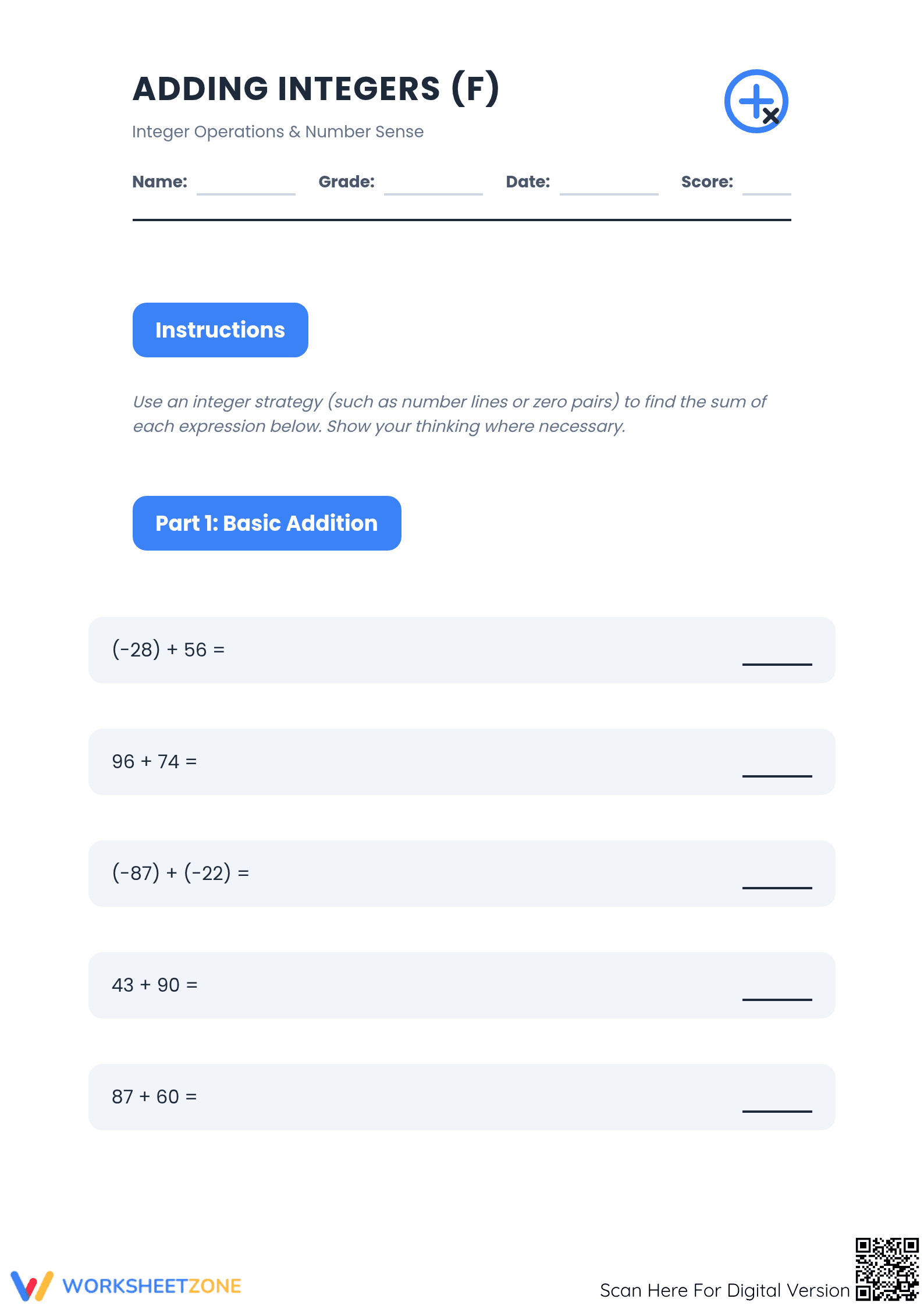
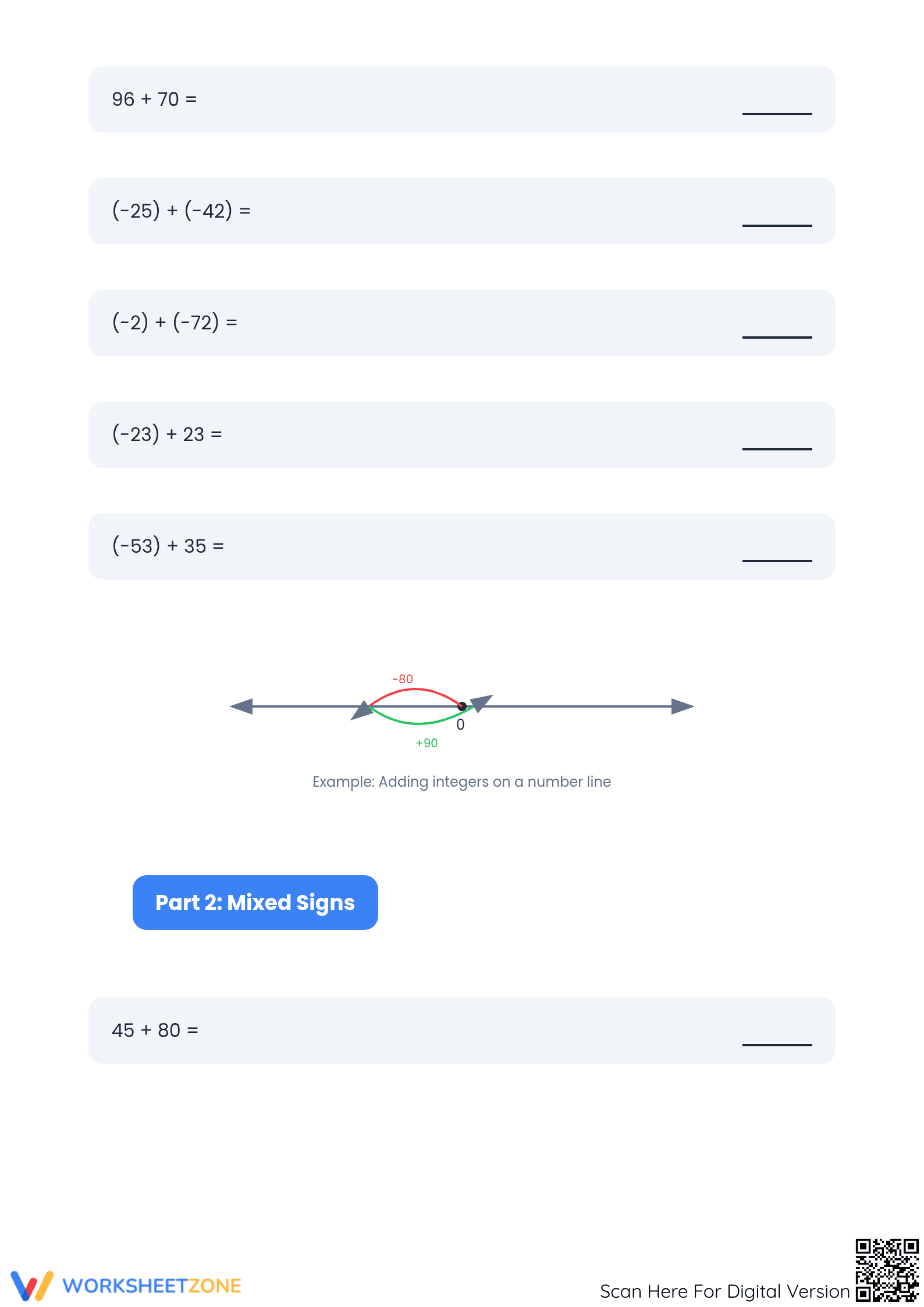
This 5-page PDF packet contains 33 carefully sequenced problems. The layout begins with basic two-digit integer addition and progresses to complex expressions featuring three terms. Each page includes clear instructional headers, organized workspace for students to show their thinking, and a visual example of an integer number line strategy. A full answer key is provided for immediate feedback and grading efficiency.
- Guided Practice: The first 10 problems focus on basic addition of two-digit integers from -99 to 99, establishing a baseline for signs and absolute values.
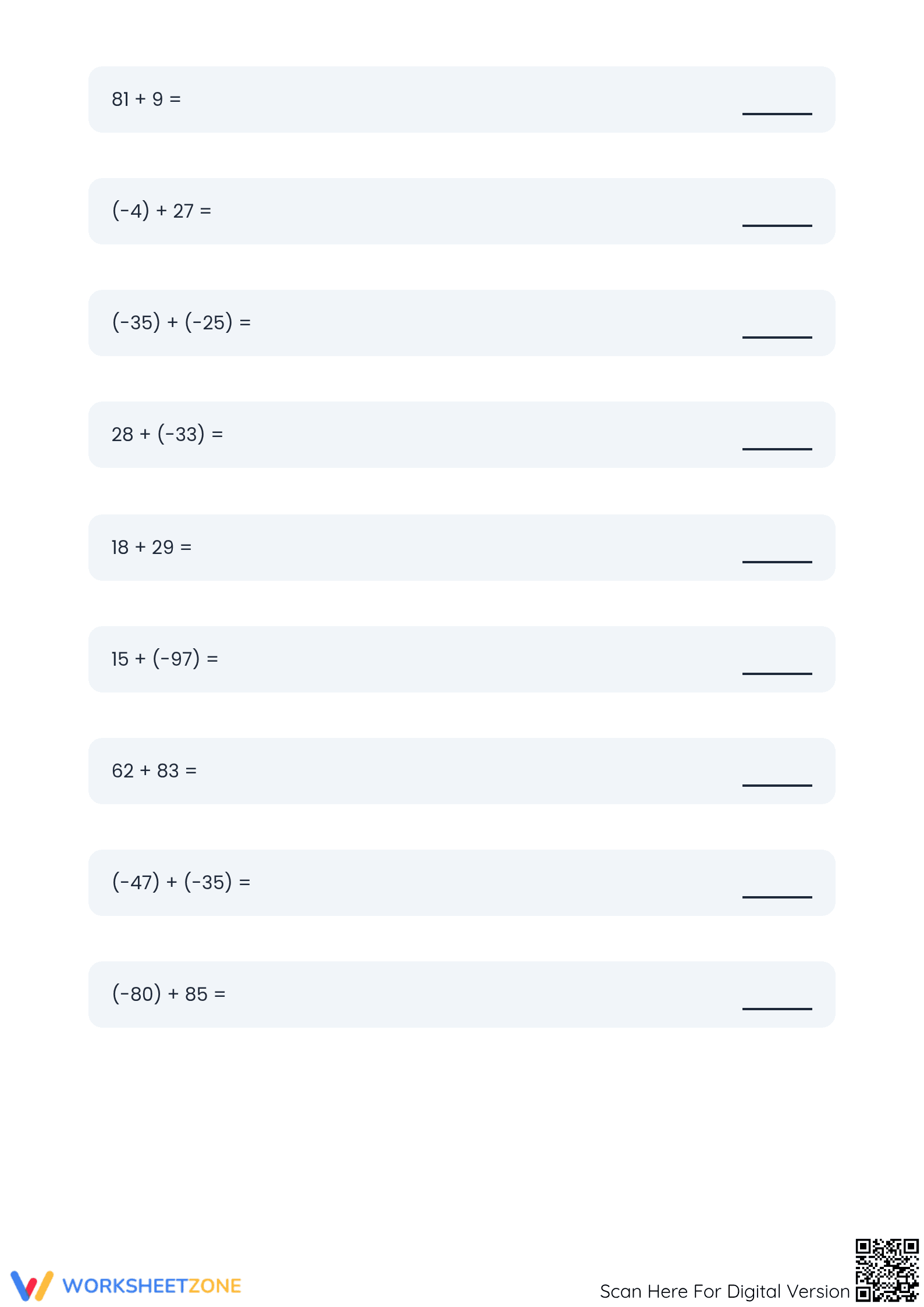
- Supported Practice: 10 mixed-sign problems challenge students to apply zero-pair strategies or number line shifts to reach a consistent sum.
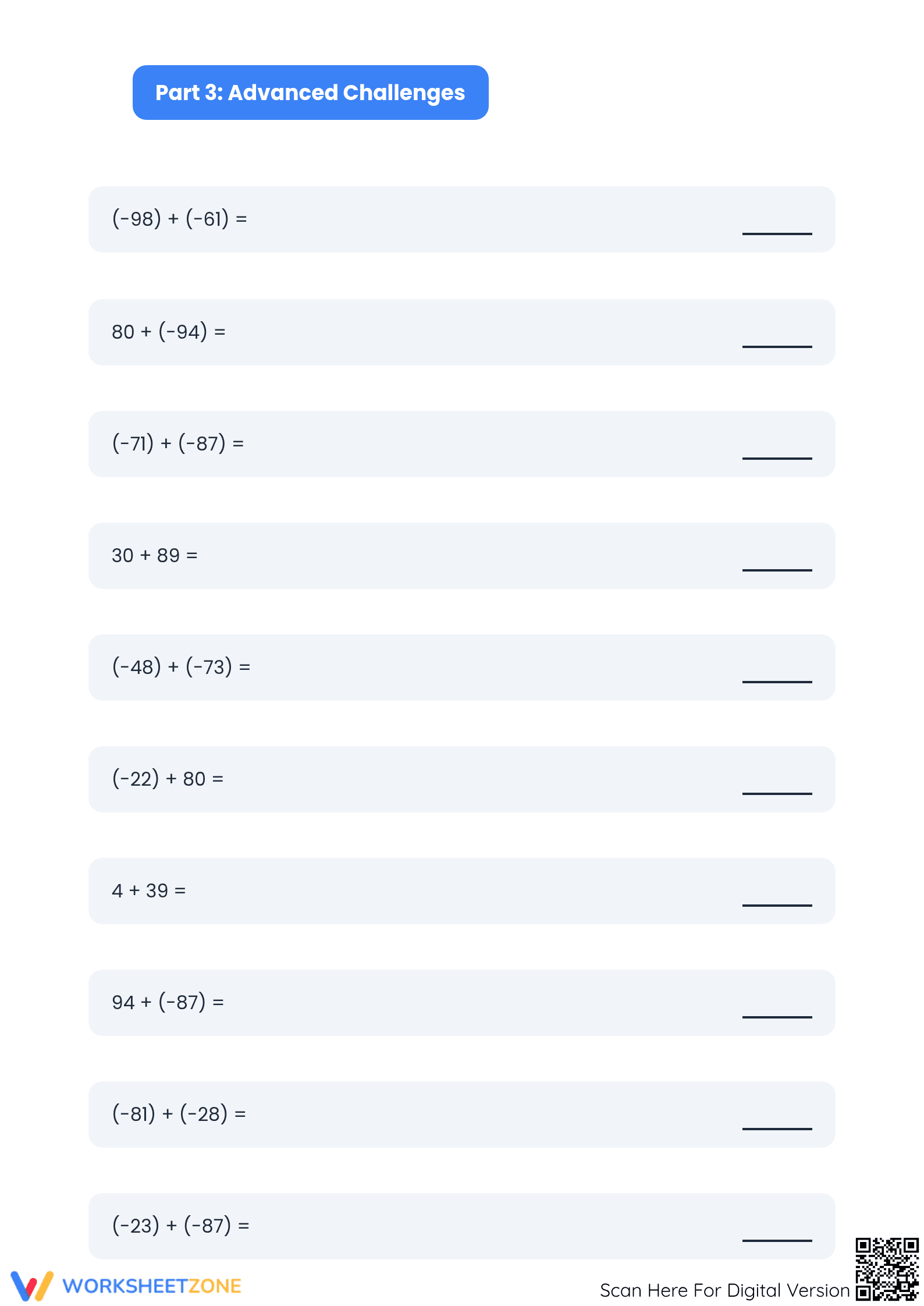
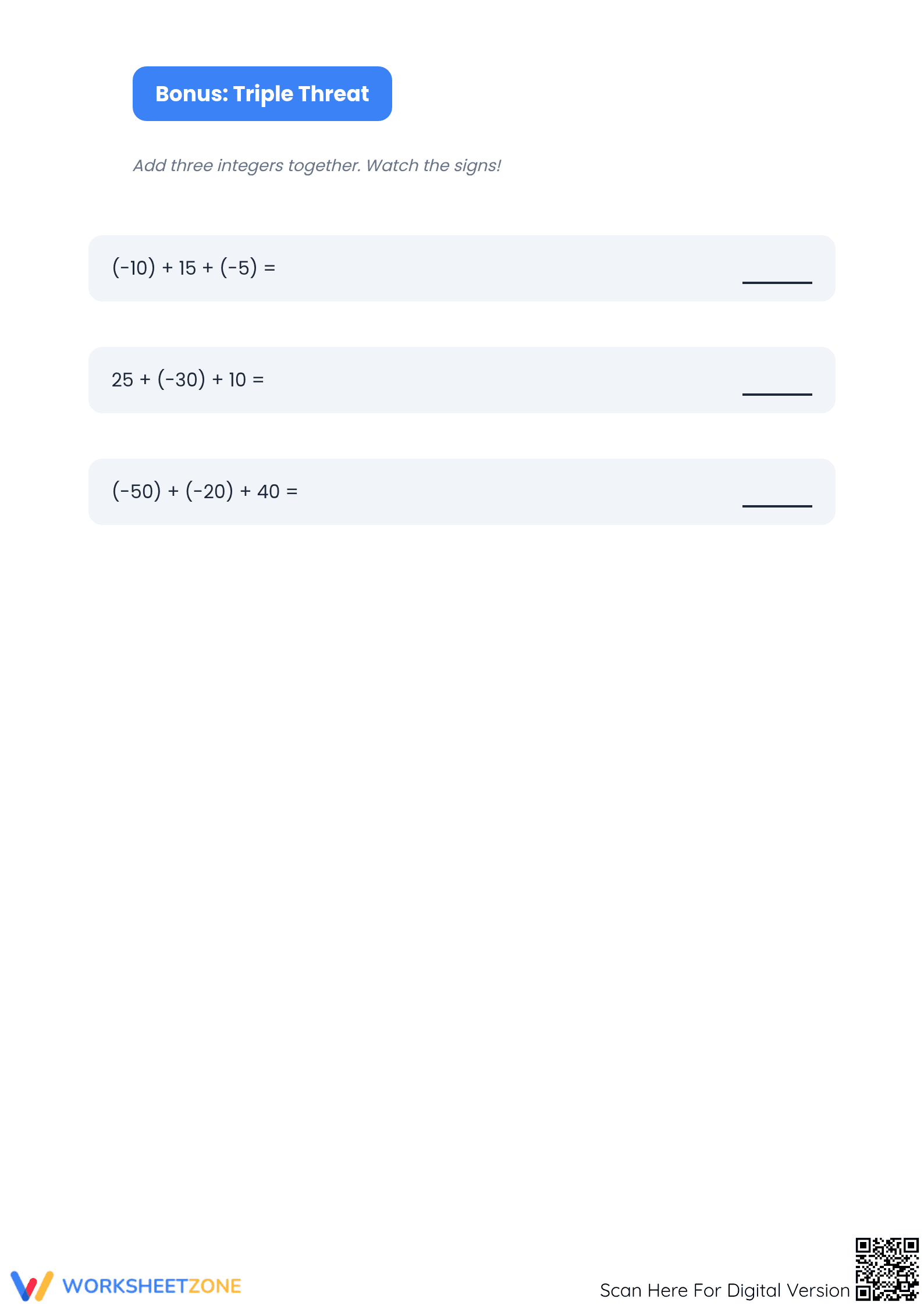
- Independent Practice: 13 advanced and bonus problems require students to synthesize their knowledge, including triple-term addition and high-value mental math.
This instructional sequence follows a gradual-release model, moving from structured identification of signs to independent student application in complex mathematical scenarios.
This resource is directly aligned to CCSS.MATH.CONTENT.7.NS.A.1. Students will apply and extend previous understandings of addition to add rational numbers and represent addition on a horizontal or vertical number line diagram. Both standard codes can be copied directly into lesson plans, IEP goals, or district curriculum mapping tools to ensure compliance with state and national frameworks.
Use this packet as a primary practice tool after a direct instruction lesson on integer rules. It functions well as a multi-day homework assignment or a comprehensive review before a summative assessment. Teachers should observe students during Part 2 to ensure they are correctly identifying whether the sum should be positive or negative before calculating. The expected completion time for all 33 problems is 45 to 60 minutes.
This worksheet is ideal for Grade 7 students meeting standard benchmarks, though it serves as an excellent challenge for Grade 6 or a remediation tool for Grade 8. It pairs naturally with a physical number line or a set of two-color counters. For students needing extra support, encourage the use of color-coded highlighters to distinguish between positive and negative values before beginning calculations.
According to the RAND AIRS 2024 analysis, systematic practice with integer operations is a critical predictor of success in early algebra. This worksheet targets the specific cognitive load associated with negative parenthetical notation, ensuring students move beyond rote memorization of rules to a deeper conceptual understanding of directional movement on the number line. By incorporating 33 distinct tasks across 5 pages, this resource provides the high-dosage practice necessary for long-term retention of CCSS.MATH.CONTENT.7.NS.A.1. Educators can utilize the structured progression to identify specific student misconceptions regarding absolute value and zero pairs. This evidence-based approach aligns with current instructional standards that prioritize mathematical fluency through varied task complexity. The inclusion of a "Triple Threat" bonus section further extends the learning by requiring students to manage multiple operational signs simultaneously, a key skill for secondary math pathways.


