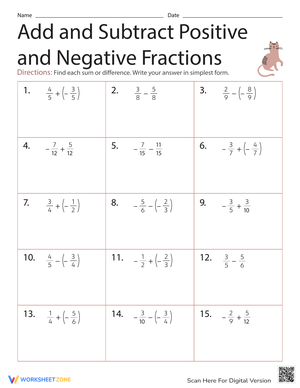
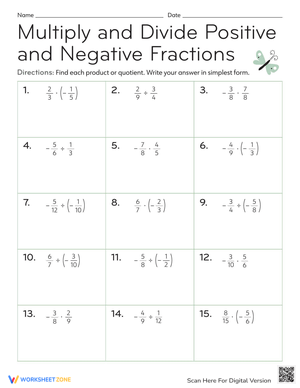
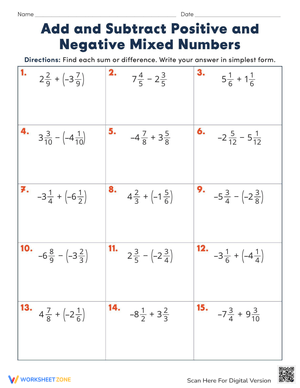
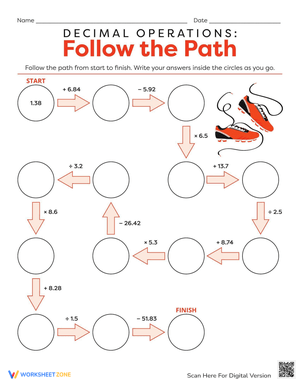
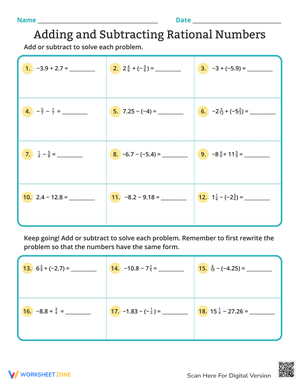
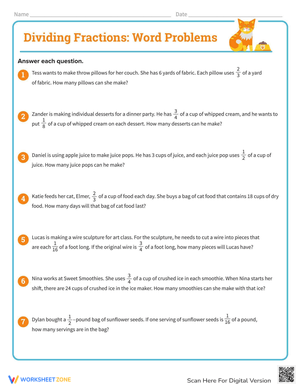
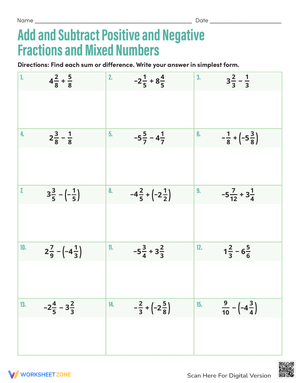
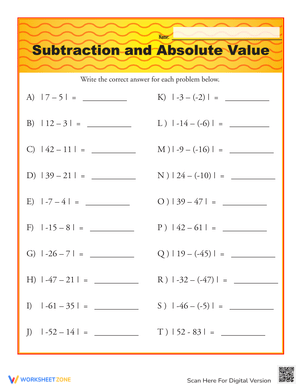
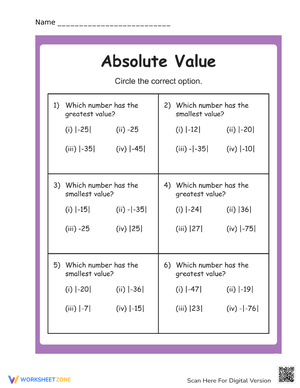
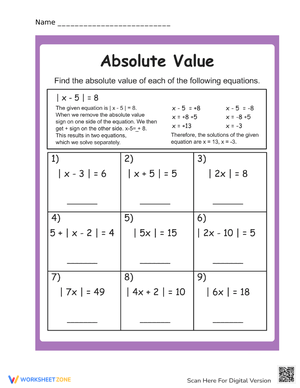
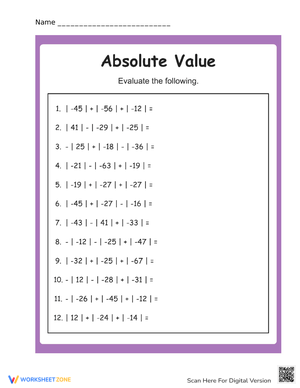
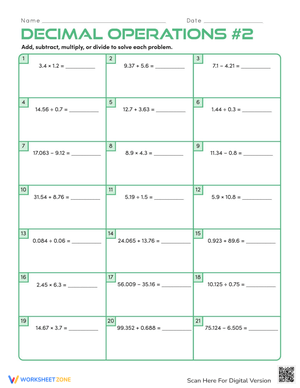
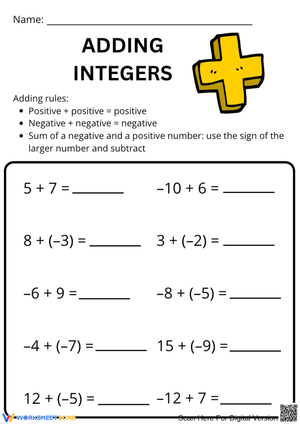
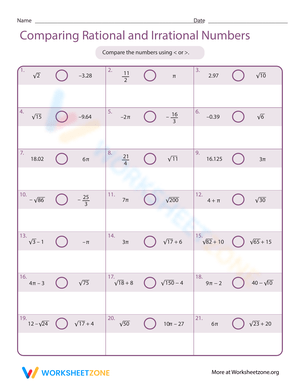
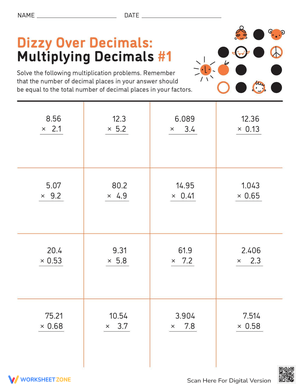
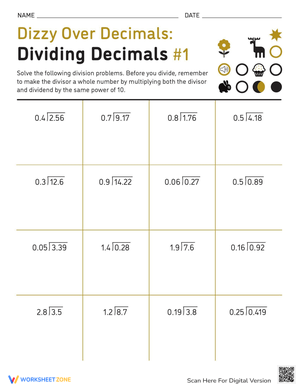
These 6th grade integers and rational numbers pdf worksheets give teachers targeted, printable practice for one of the most conceptually demanding units in middle school math — the stretch where negative numbers stop being a curiosity and students are expected to work fluently across integers, fractions, and decimals as a unified number system. The resources span number line placement, opposites, absolute value, comparisons, and ordering mixed rational numbers, with enough internal variety that the set carries a class from first exposure through cumulative review.
The Specific Skills Targeted
Sixth grade marks the first time most students encounter negative numbers as a formal, systematic topic rather than an aside. That makes the skill sequence here unusually tight — a student who cannot reliably read a scaled number line that extends left of zero will make consistent errors when comparing values, and a student who conflates opposites with absolute value carries that confusion into multiple problem types. Each worksheet in the set addresses one layer of this progression:
- Number line placement: plotting integers and rational numbers on scaled lines, and reading values from labeled points
- Opposites: identifying numbers equidistant from zero on opposite sides, including the case where the opposite of a negative is positive
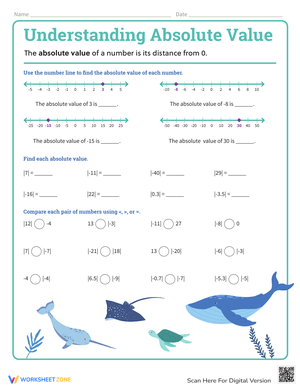
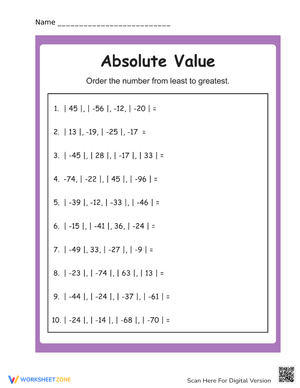
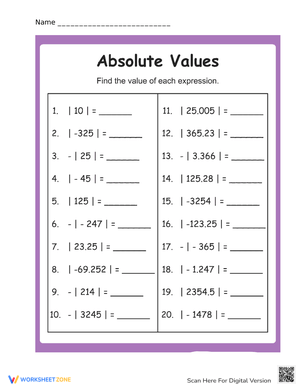
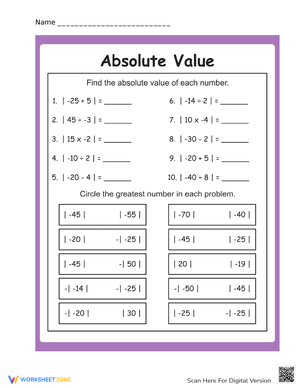
- Absolute value: interpreting distance from zero as a non-negative quantity — not as a rule about removing a minus sign
- Comparing integers: applying greater than, less than, and equal to correctly with negative values
- Ordering rational numbers: arranging mixed sets of integers, fractions, and decimals in ascending or descending order
- Mixed review: combining all of the above so students practice selecting the right approach for each item
The sequence moves from visual, concrete tasks into more abstract comparison and ordering, giving students reliable footing before the demands increase.
Error Patterns That Surface Reliably During This Unit
The most predictable error involves negative magnitude. Students who correctly identify 8 as greater than 5 will often write that negative 8 is greater than negative 5 — because they are comparing digits, not positions. They have spent years learning that a larger digit signals a larger value, and the reversal that happens on the left side of zero doesn't register intuitively yet. Number-line worksheets that require students to mark both values first and then write the comparison — rather than jumping straight to notation — make this habit visible before it calcifies.
Opposites and absolute value create a different confusion. The opposite of negative 4 is 4, and the absolute value of negative 4 is also 4. Students notice this coincidence and conclude the two operations must be equivalent. The tell is when they're asked for the absolute value of positive 3 and write negative 3, because they've decided absolute value means "change the sign." Worksheets that ask for both the opposite and the absolute value of the same number — including positive inputs — break that false equivalence apart quickly.
A third error appears when students compare rational numbers across forms. Given negative 0.3 and negative 1/4, many choose incorrectly because they compare the digits 3 and 4 rather than converting to a common form and thinking about position. Requiring students to place both values on a number line before writing the comparison symbol reduces guessing and builds the positional sense that makes later ordering problems tractable.
Standard Alignment
These worksheets align to the CCSS 6.NS.C cluster — "Apply and extend previous understandings of numbers to the system of rational numbers." Three specific standards anchor the work:
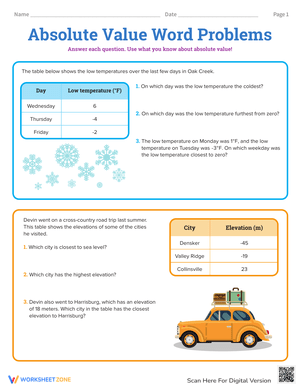
- 6.NS.C.5 — Understanding positive and negative numbers as quantities with opposite directions or values, typically introduced through real-world contexts like temperature below zero or elevation above and below sea level
- 6.NS.C.6 — Recognizing a rational number as a point on the number line, including fractions and decimals placed in relation to integers
- 6.NS.C.7 — Interpreting the ordering and absolute value of rational numbers, the standard most directly tied to end-of-unit assessments and state testing items
In practice, 6.NS.C.5 typically opens the unit with context-based problems, 6.NS.C.6 carries the number-line and plotting work through the middle, and 6.NS.C.7 represents the summative skill students need before moving into operations with rational numbers in 7th grade. The worksheets follow that same instructional arc.
Fitting These Worksheets Into the Week's Lessons
The most reliable integration pattern is pairing each worksheet with a short, focused teacher model — not a full re-teach, but two or three worked examples aimed at the session's most likely error. For an absolute value lesson, that might mean showing why both 7 and negative 7 have an absolute value of 7 before students pick up the worksheet. The 10 to 15 minutes of focused practice right after direct instruction is often the most productive window in this unit, especially for students who need repetition to consolidate a new idea before it slips.
Bell ringers are another consistent fit. Three to five items from a comparing or opposites worksheet — done in the first five minutes — activate prior knowledge before new instruction without pulling time from the lesson itself. Friday review blocks pair well with the mixed-review worksheets, which ask students to cycle through number line placement, absolute value, and ordering in one sitting. That kind of distributed practice, revisiting skills across several days rather than massing them into a single block, tends to improve retention more durably than repeated drilling of one concept at a time.
For sub plans, these 6th grade integers and rational numbers pdf worksheets hold up better than many alternatives because the directions are clear enough for students to work independently and the included answer key allows a substitute to confirm work during circulation — something that isn't always possible with open-ended tasks that require teacher interpretation to evaluate.
Meeting Different Readiness Levels With the Same Set
The 6th grade integers and rational numbers pdf worksheets in this set separate naturally by cognitive demand, which makes differentiation across a mixed-readiness class more manageable than it often appears. A worksheet asking students to plot integers on a labeled number line makes very different demands than one asking them to order negative fractions and decimals — both address rational numbers, but the level of abstraction is far apart.
Students who are still building foundational understanding work best with number-line worksheets that use a clearly labeled scale and focus on integers only. The visual structure carries most of the cognitive load while students practice reading direction and position without also managing fractional values. A middle tier introduces decimals and common fractions alongside integers — students compare pairs and order short sets, using the number line as a mental reference rather than an explicitly drawn aid. The most demanding worksheets ask students to order sets of four or five mixed rational numbers, sometimes including values like negative 5/4 and negative 1.3, and write a sentence explaining how they determined the order. That reasoning demand separates students who have genuine number sense from those who have memorized a comparison rule without internalizing what it means.
A quick diagnostic can save time before assigning middle-tier work: ask "Which is greater, 3/4 or 0.8?" A student who struggles here has a fraction-and-decimal fluency gap, not a negative number gap — and the right next worksheet for that student is different from the right next worksheet for someone who handles fractions and decimals confidently but loses track of direction when negatives enter the comparison.
Frequently Asked Questions
What should a strong 6th grade integers worksheet include to cover current standards?
At minimum: plotting integers on a number line, identifying opposites, interpreting absolute value as distance from zero, comparing integers using inequality language, and ordering sets of integers. A stronger collection brings in fractions and decimals so students practice across the full rational number system, not just whole-number negatives. That full range reflects what CCSS 6.NS.C.7 actually demands by the end of the unit.
Do these come as printable PDFs with answer keys?
Each worksheet downloads as a PDF and includes a corresponding answer key. Answer keys serve more than grading — they work as self-check stations during independent practice, partner-correction tools in pair activities, or starting points for a short class conversation about why a common wrong answer looks convincing. Students often learn more from examining a plausible incorrect comparison than from simply seeing a final score.
How do integer worksheets differ from rational number worksheets at this grade level?
Integer-only worksheets focus on whole numbers and their negatives — useful for introducing direction, opposites, and basic comparison. The 6th grade integers and rational numbers pdf worksheets in this set go further by incorporating fractions and decimals, asking students to work across all three forms within the same number system. Both types of practice appear in the set because most 6th grade units need both, and students who are solid on integers can still struggle when a fraction or decimal enters the comparison.
Can these worksheets support students who missed this unit or are revisiting it?
The number-line and opposites worksheets don't assume prior exposure to formal integer rules, which makes them workable for students returning from extended absence or encountering the material for the first time in 7th grade intervention. The most important thing is not skipping the visual work. Students who are behind in this area are usually missing the positional sense that makes comparison and ordering coherent — and jumping straight to abstract practice tends to lock in procedural rules without building that underlying understanding.













 Interactive Worksheet Maker
 Quiz Maker
 Word Search Maker
 Crossword Puzzle Maker
 Word Scramble Generator
 Sentence Scramble Generator
 Handwriting Worksheet Generator
 Name Tracing Generator
 Fill In The Blank Generator