


























Views
Downloads



Essential Ordering Negative Integers Worksheet | Grades 5-8
Paste this activity's link or code into your existing LMS (Google Classroom, Canvas, Teams, Schoology, Moodle, etc.).
Students can open and work on the activity right away, with no student login required.
You'll still be able to track student progress and results from your teacher account.
Help your middle school students master the often-confusing world of negative values with this comprehensive ordering integers worksheet. This resource focuses exclusively on 2-digit negative numbers, forcing students to reconcile absolute value with actual numerical value. By completing these exercises, learners develop a concrete mental number line and gain confidence in comparing non-positive rational numbers.
At a Glance
- Grade: 5-8 · Subject: Math
- Standard:
CCSS.MATH.CONTENT.6.NS.C.7.B— Write and interpret statements of order for rational numbers in real-world contexts.- Skill Focus: Ordering negative 2-digit integers
- Format: 5 pages · 132 problems · Answer key included · PDF
- Best For: Intensive practice and skill reinforcement
- Time: 40–60 minutes
What's Inside
This massive 5-page practice set contains 132 unique problems organized into five distinct sections. Each section presents four to six sets of integers that must be rearranged from least to greatest or greatest to least. The clean, distraction-free layout ensures students focus entirely on the numerical relationships. A full 5-page answer key is included to facilitate rapid grading or student self-correction.
Skill Progression
- Guided Practice: Initial pages focus on comparative ordering with clear LEAST and GREATEST anchors for 24 distinct sets.
- Supported Practice: Middle sections mix order directions to prevent rote completion and ensure active mental processing.
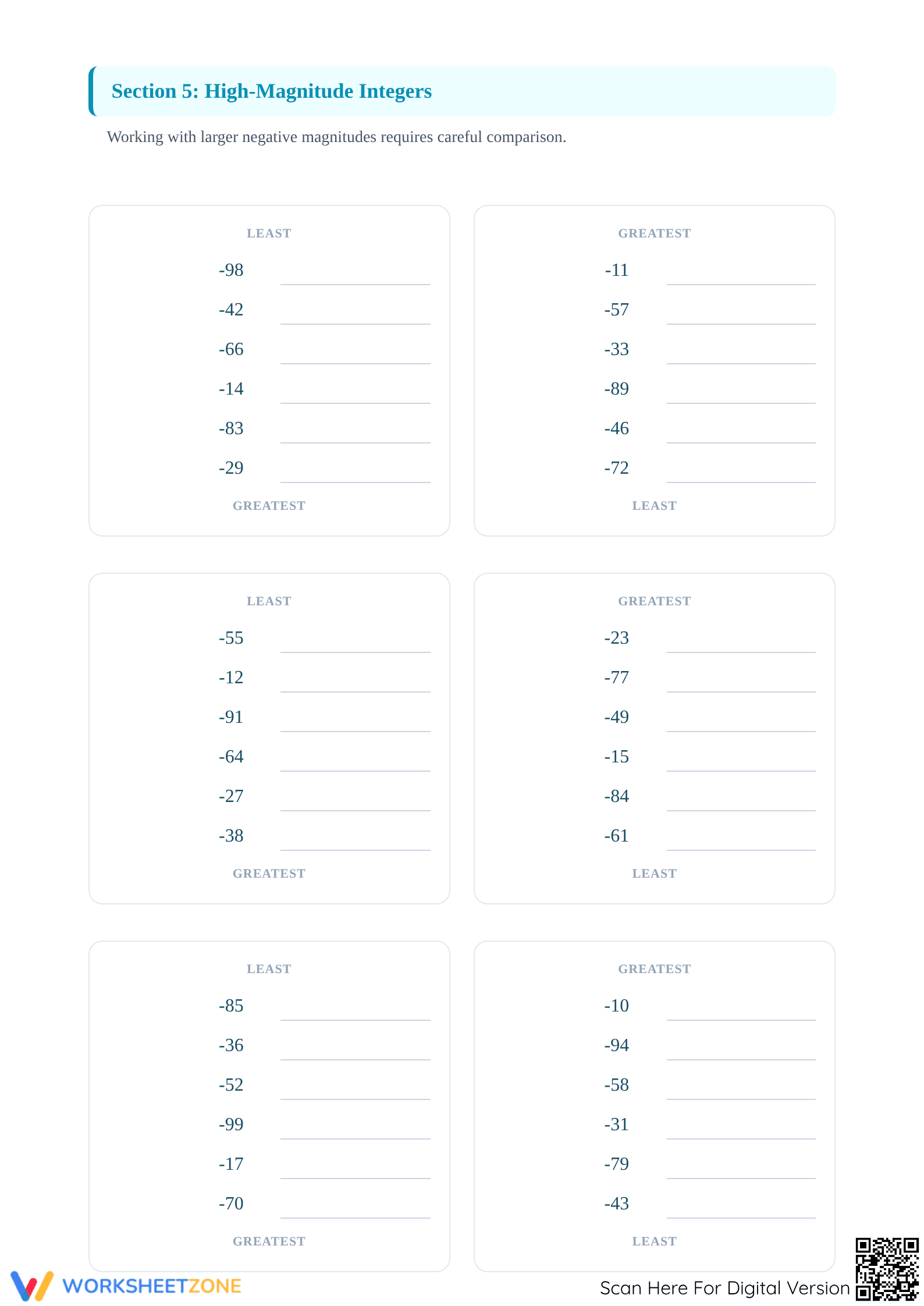
- Independent Practice: Final pages present high-magnitude integers near -100, where students must prove mastery of inverse value relationships.
This structured approach supports a gradual release of responsibility from initial identification to fluent sorting.
Standards Alignment
The primary standard addressed is CCSS.MATH.CONTENT.6.NS.C.7.B: "Write, interpret, and explain statements of order for rational numbers in real-world contexts." By ordering negative integers, students satisfy the prerequisite logic for comparing rational numbers and understanding coordinate planes. This standard code can be copied directly into lesson plans, IEP goals, or district curriculum mapping tools.
How to Use It
Use this resource as a post-instructional practice tool after introducing the concept of the negative number line. It works exceptionally well as a "station rotation" activity where students complete one page per day. For a formative assessment, observe students working on Section 5; if they struggle with higher magnitudes (e.g., -98 vs -11), they likely need a visual number line refresher. Expect completion in 45 minutes.
Who It's For
This worksheet is designed for Grade 5-8 students who have already been introduced to the concept of negative numbers but require high-volume repetition to achieve fluency. It is an ideal companion for a lesson using physical number lines or as a targeted intervention for students struggling with the inverse relationship between absolute value and negative magnitude.
The RAND AIRS 2024 report identifies high-volume practice in foundational number sense, such as ordering negative integers, as a critical predictor of algebra readiness. Students often struggle with the "inverse magnitude" of negative values—the common misconception that a larger digit implies a larger value. This worksheet directly combats this by providing 132 repetitions specifically targeting negative integers, aligned with standard CCSS.MATH.CONTENT.6.NS.C.7.B. Research from Fisher & Frey (2014) suggests that gradual release models, moving from structured ordering to high-magnitude challenges, allow students to internalize the mental number line without cognitive overload. By integrating this "Essential" resource, educators provide the repetition required to transition from conceptual understanding to procedural fluency. This practice set is optimized for both direct instruction and independent student mastery, ensuring that the fundamental logic of rational number comparison is deeply embedded before moving to complex expressions.


