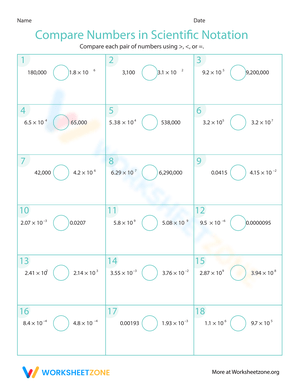
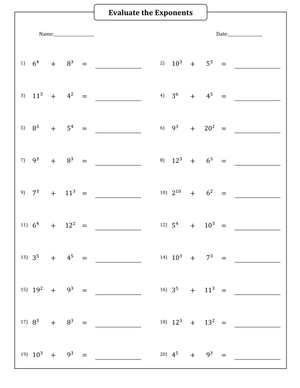
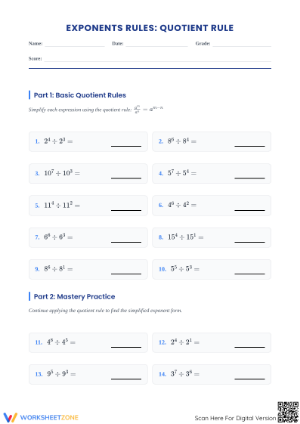
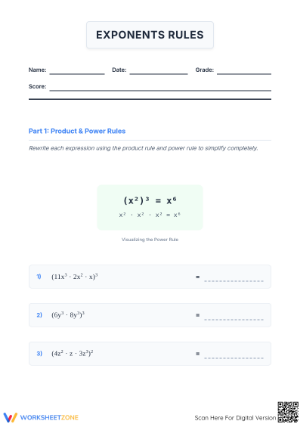
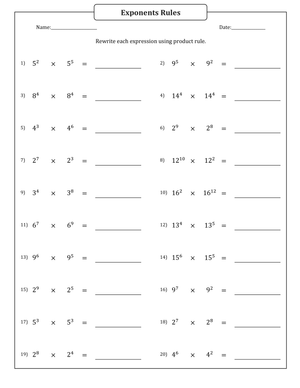
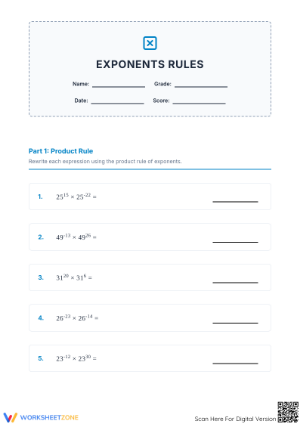
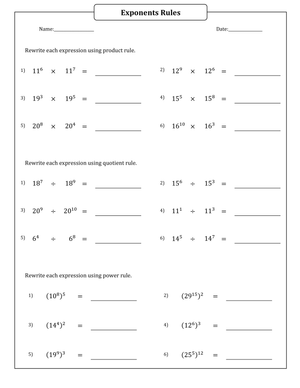
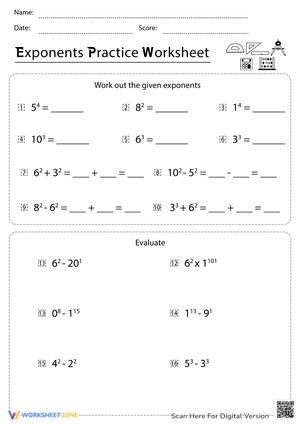
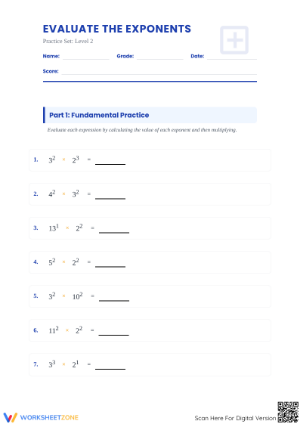
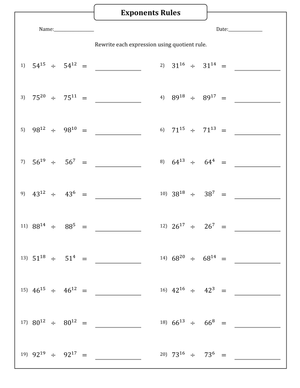
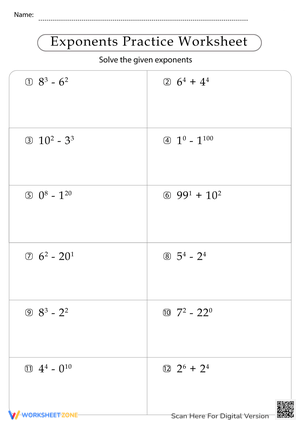
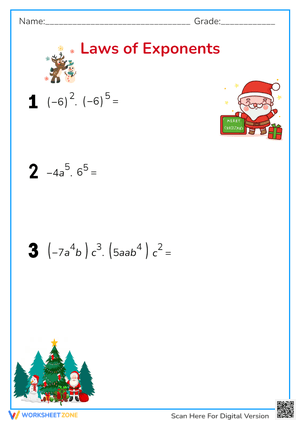
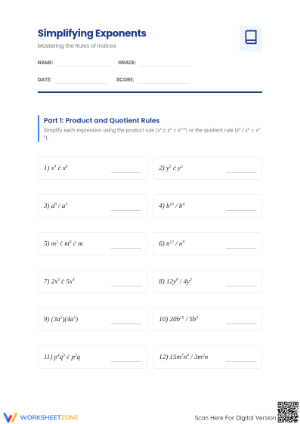
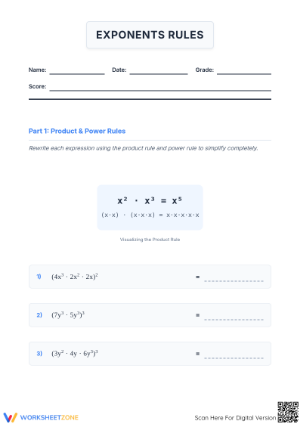
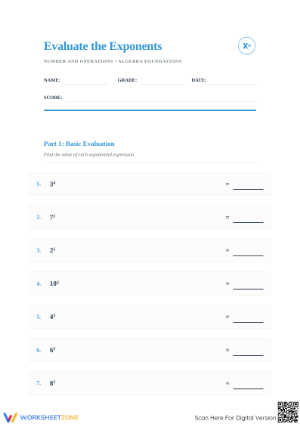
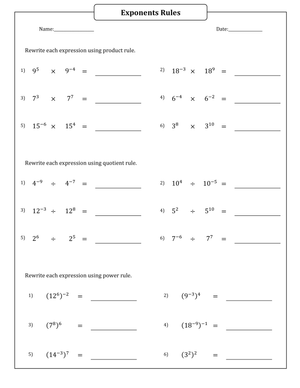
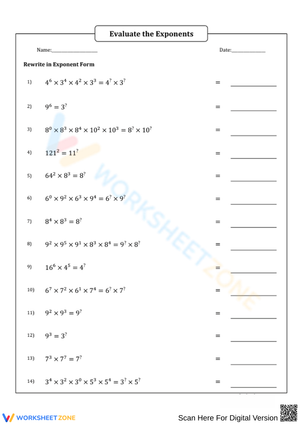
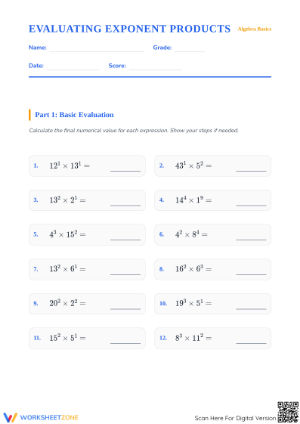
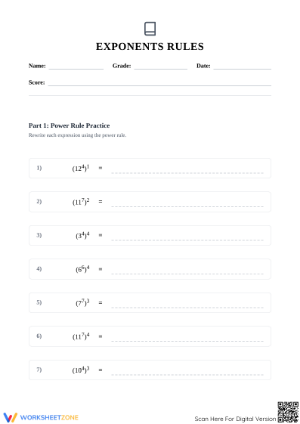
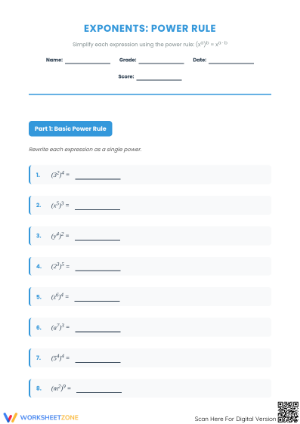
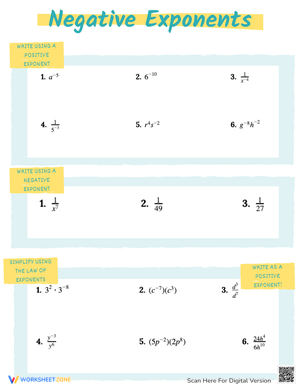
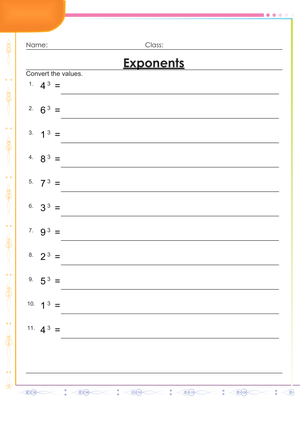
These exponents worksheets for 6th grade give teachers a sequenced set of printable resources that move students from recognizing exponent notation to accurately evaluating whole-number expressions. Each worksheet targets a distinct skill — naming the base and exponent, expanding powers as repeated multiplication, or computing a final value — so teachers can assign exactly the practice a group needs rather than working through a general review packet that mixes too much at once.
The Specific Skills Each Worksheet Builds
Sixth grade is where exponent notation enters the picture formally, and the gap between "knows what the symbol looks like" and "can evaluate correctly" is wider than it appears. The worksheets in this set address that gap by separating the concept into teachable pieces before bringing them together:
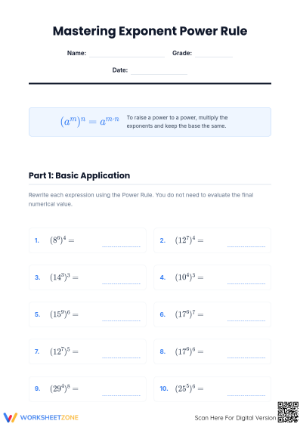
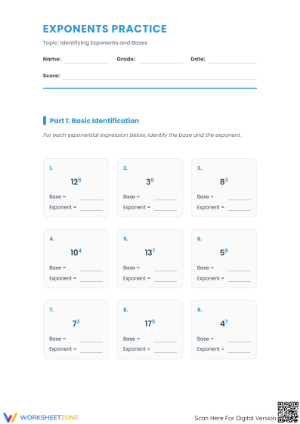
- Identifying base and exponent: Students name each part of expressions like 5⁴ or 9² — a step that sounds basic but catches a surprising number of students who have the two roles reversed in their heads.
- Expanding to repeated multiplication: Writing 7³ as 7 × 7 × 7 before computing it. Students practice in both directions — from exponential form to expanded form and back.
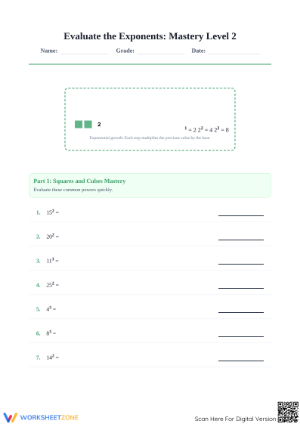
- Evaluating whole-number powers: Computing values like 2⁵ or 6². Early worksheets use small bases and exponents to keep the arithmetic from obscuring the concept.
- Reading and writing word form: Translating between "four to the third power," 4³, and 4 × 4 × 4 builds the vocabulary students need for later algebraic work.
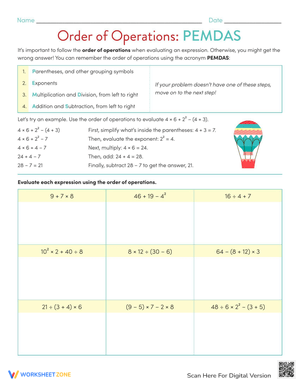
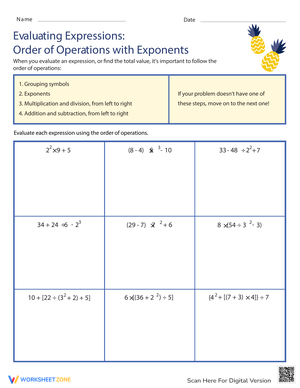
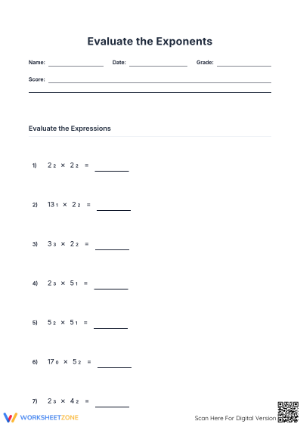
- Applying exponents in mixed expressions: After foundational skills are secure, one worksheet places exponents inside multi-step numerical expressions, giving students a preview of order-of-operations work.
This sequence matters. Students who jump straight to evaluating 3⁴ without ever naming what "3" and "4" each represent tend to guess at the procedure rather than understand it. The structured progression in this set keeps the concept visible at every stage.
Frequent Student Errors Worth Watching For and Correcting
The most persistent error at this level is multiplying the base by the exponent instead of using repeated multiplication. A student who sees 2³ and writes 6 isn't making a random mistake — they're applying the most familiar operation they know. This error is sticky precisely because the answer looks like it came from a real calculation. The best time to address it is before students have practiced the wrong procedure long enough to automate it, which means catching it on the first or second worksheet rather than at a quiz.
A second pattern worth watching: students who correctly expand 4³ as 4 × 4 × 4 on paper will still compute 4 × 4 as 12 because they've defaulted to addition. They know the structure but lose the arithmetic in the middle step. Having students show their work across two lines — first the expansion, then the computation — makes this slip visible immediately during circulation.
A third issue surfaces when exponents appear inside longer expressions. Students who have no trouble evaluating 3² in isolation will treat it as optional in a problem like 5 + 3² × 2, folding the exponent into a vague multiplication without applying it first. An exit ticket that includes one expression with an embedded exponent reveals this misconception far earlier than any end-of-unit test would.
How to Work These Worksheets Into Your Math Block
These worksheets fit naturally into the ten minutes between a mini-lesson and independent work. One productive structure: model two examples aloud, then give students the notation-identification worksheet to complete during the first half of independent work while you pull a small reteach group. The worksheets stand alone well enough that a substitute can run the rotation without a detailed lesson plan, and the included answer keys let students self-correct in centers without waiting for teacher review.
For spiral review — which matters at sixth grade because exponents reappear constantly in order-of-operations and eventually in algebraic contexts — consider placing two or three exponent items on a Monday warm-up for several weeks after the unit ends. Spaced retrieval at this scale doesn't require new materials; the evaluation worksheets from the initial unit work fine in a different slot. The exponents worksheets for 6th grade set includes enough variety across skill types that no two warm-up sessions feel like a repeat.
A sorting strategy that saves reteaching time: organize the worksheets by the kind of thinking required rather than by the order you assigned them. One stack for notation reading, one for expansion, one for evaluation, one for mixed expressions. When an exit ticket reveals a specific gap, you can pull the matching worksheet immediately instead of rewriting practice problems from scratch.
Standard Alignment
These worksheets align to CCSS.MATH.CONTENT.6.EE.A.1, which calls for students to write and evaluate numerical expressions involving whole-number exponents. In classroom terms, this standard sits at the opening of the Grade 6 expressions-and-equations unit — it's the first time most students encounter formal exponential notation, and it sets up the order-of-operations work that follows immediately. Teachers who use these worksheets early in the unit build the vocabulary (base, exponent, squared, cubed) that students need the moment PEMDAS enters the conversation.
Differentiating These Worksheets Across Ability Levels
Students who are new to the concept benefit from worksheets that separate reading from computing. An item asking a student to circle the base, underline the exponent, and then write the word form before doing any arithmetic reduces the number of things competing for attention at once. Keeping the numbers small — bases of 2, 3, or 4 with exponents no greater than 4 — means arithmetic fluency doesn't interfere with learning what the notation actually represents.
On-level students do best with alternating item types: identify the parts, then expand, then evaluate, then circle back to identify. That back-and-forth forces students to shift between representations instead of pattern-matching through a column of identical problems. It's also a more accurate model of how exponents show up on assessments, where the format changes from item to item.
Students who are ready to move ahead can work through the mixed-expression worksheet, which places exponents inside multi-step problems and demands attention to operation order. The goal stays squarely within Grade 6 — whole-number exponents, no negative or fractional bases — but the context is more demanding. For these students, the exponents worksheets for 6th grade set offers enough challenge through expression complexity rather than requiring a separate resource.
Frequently Asked Questions
What exponent skills does this set cover?
The set covers identifying base and exponent, writing expressions in exponential form, expanding powers as repeated multiplication, evaluating whole-number powers, and applying exponent expressions within multi-step numerical problems. All skills align with the Grade 6 expressions-and-equations standard for whole-number exponents (6.EE.A.1).
Can these worksheets be used for homework as well as in-class practice?
Yes. Each worksheet uses clear, student-friendly directions and focuses on one skill type, which means students can work through it independently without needing teacher explanation mid-problem. Answer keys allow for quick self-correction or parent review at home, and the focused format keeps homework from turning into a guessing exercise.
How do these worksheets connect to order-of-operations instruction?
One worksheet in the set places exponent expressions inside multi-step numerical problems, giving students direct practice applying what they know about powers before formal PEMDAS instruction begins. Teachers typically assign this worksheet after students have shown accuracy on the foundational notation and evaluation worksheets — not as an introduction to either skill.
Are these worksheets appropriate for intervention or reteaching?
The notation-identification and expansion worksheets work well for reteaching because they address the exact steps where misconceptions form. A student who keeps multiplying base by exponent benefits from returning to the expansion worksheet — writing out every factor explicitly — before being asked to evaluate again. The exponents worksheets for 6th grade set includes enough skill-specific practice that targeted intervention doesn't require building new materials from scratch.













 Interactive Worksheet Maker
 Quiz Maker
 Word Search Maker
 Crossword Puzzle Maker
 Word Scramble Generator
 Sentence Scramble Generator
 Handwriting Worksheet Generator
 Name Tracing Generator
 Fill In The Blank Generator