


























Views
Downloads

Essential Evaluating Exponent Products Worksheet | Grade 6-8
Paste this activity's link or code into your existing LMS (Google Classroom, Canvas, Teams, Schoology, Moodle, etc.).
Students can open and work on the activity right away, with no student login required.
You'll still be able to track student progress and results from your teacher account.
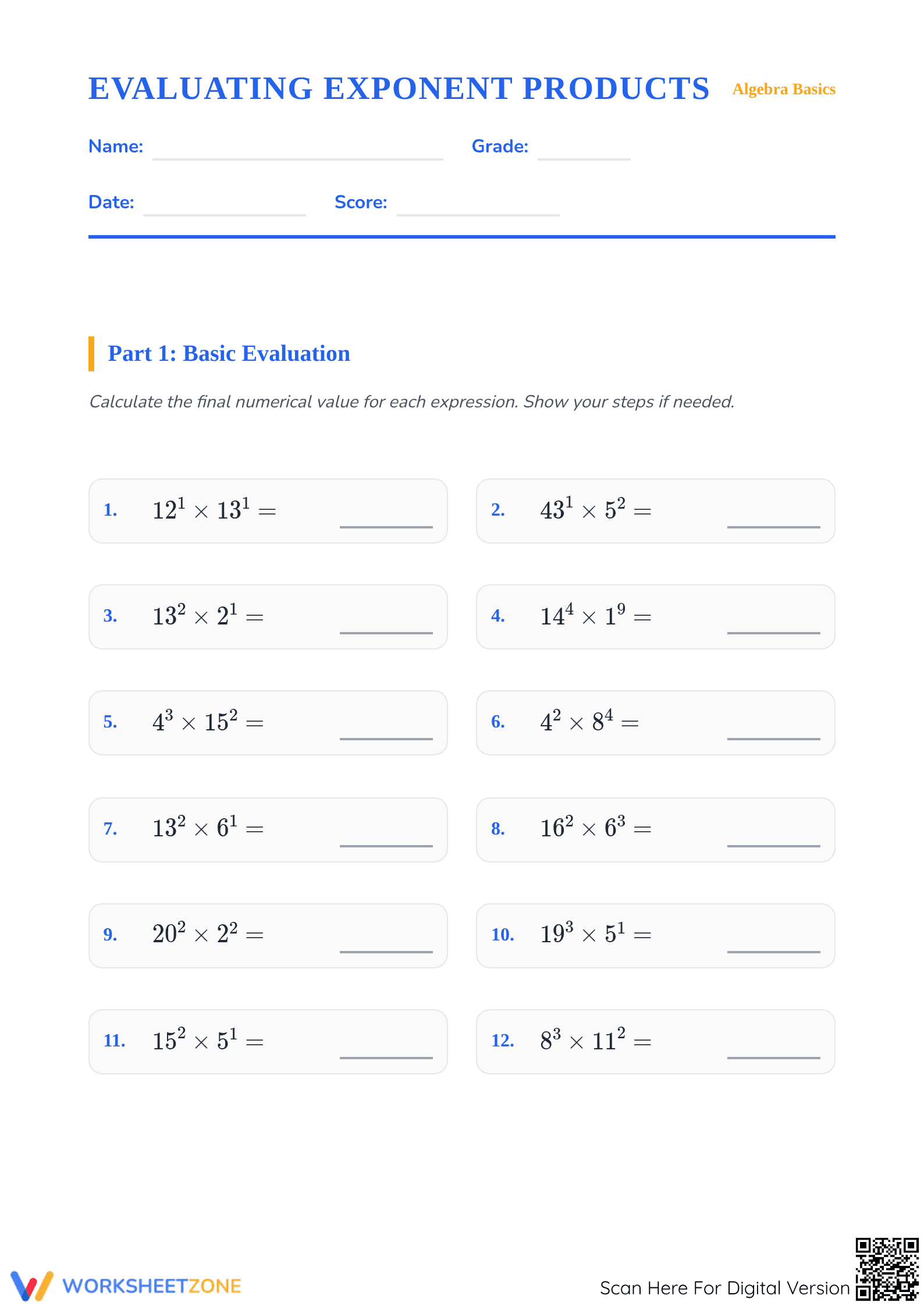
This essential worksheet helps middle school students master exponent multiplication by evaluating numerical expressions across three progressive stages. Students move from basic products to high-intensity challenge problems and real-world applications. By calculating final numerical values, learners bridge the gap between abstract power notation and concrete arithmetic results, ensuring foundational algebraic fluency for higher math.
At a Glance
- Grade: 6–8 · Subject: Math
- Standard:
CCSS.MATH.CONTENT.6.EE.A.1— Write and evaluate numerical expressions involving whole-number exponents- Skill Focus: Numerical evaluation of exponent products
- Format: 3 pages · 32 problems · Answer key included · PDF
- Best For: Homework, independent practice, or assessment
- Time: 30–45 minutes
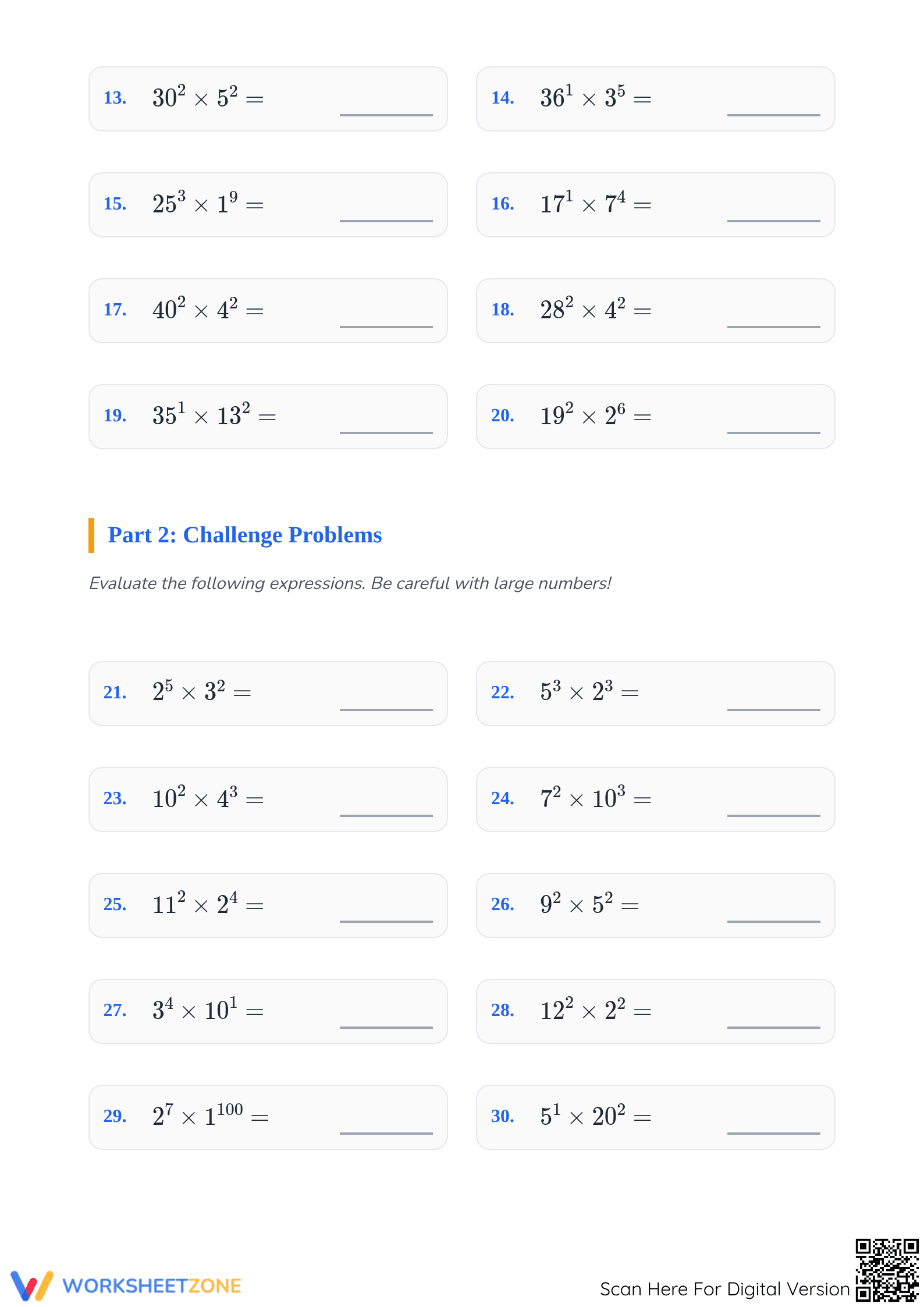
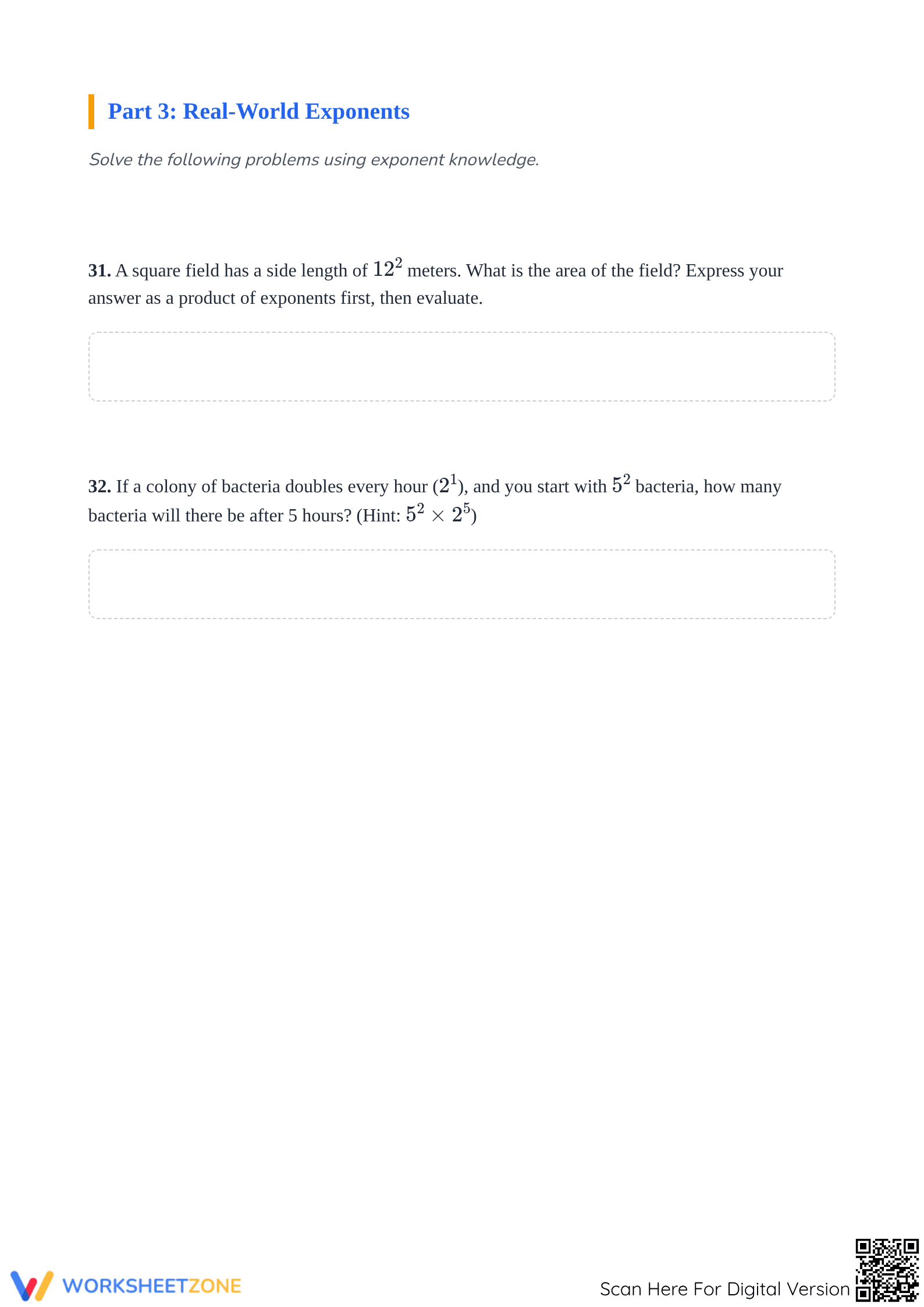
The worksheet contains 32 problems designed to build confidence and procedural precision. Part 1 features 20 basic evaluation tasks focused on fundamental products. Part 2 introduces 10 challenge problems with larger bases and exponents to test computational endurance. Part 3 provides 2 word problems applying exponents to area and biology contexts. A full answer key is included for easy grading.
Skill Progression
- Basic Evaluation: 20 entry-level problems focus on multiplying powers with small bases to build confidence and procedural accuracy.
- Challenge Problems: 10 rigorous tasks introduce larger numerical values, requiring students to carefully manage multi-step calculations.
- Real-World Application: 2 complex scenarios require students to translate situational text into exponent expressions before evaluating for a final answer.
This gradual-release approach ensures students move confidently from guided computation to independent problem-solving.
Standards Alignment
This resource is strictly aligned to CCSS.MATH.CONTENT.6.EE.A.1, which requires students to write and evaluate numerical expressions involving whole-number exponents. The tasks also support 8th-grade property mastery by providing concrete numerical evidence for how base and exponent interactions result in specific products. Both standard codes can be copied directly into lesson plans, IEP goals, or district curriculum mapping tools.
How to Use It
Assign as a culminating homework task after teaching the laws of exponents to verify students can perform the final numerical evaluations accurately. Alternatively, use Part 2 and Part 3 as a formative-assessment extension for early finishers to observe their ability to handle large-scale calculations and word problem translation. Expected completion time for the full set is 40 minutes.
Who It's For
Designed for Grade 6-8 students in general education or pre-algebra tracks. The scaffolded sections make it ideal for differentiation, allowing teachers to assign specific parts based on student readiness levels. This printable PDF pairs naturally with an anchor chart on the laws of exponents or a direct instruction lesson on power notation.
Research from RAND AIRS 2024 emphasizes that procedural fluency in evaluating numerical expressions is a critical prerequisite for success in algebraic manipulation and higher-order functions. This worksheet specifically addresses CCSS.MATH.CONTENT.6.EE.A.1 by requiring students to calculate 32 distinct numerical values, moving beyond simple recognition to active computation. The inclusion of challenge problems and real-world word problems aligns with Fisher & Frey (2014) recommendations for scaffolded instructional design, which suggests that gradual complexity increases help solidify the transfer of mathematical concepts to novel contexts. By providing structured practice that culminates in application, this resource ensures that Grade 6-8 learners develop the precision required for high school mathematics. The provided answer keys facilitate self-monitoring, a key component of effective math pedagogy. This evidence-based approach makes the worksheet a reliable tool for classroom teachers and tutors seeking to improve student outcomes in exponent evaluation through targeted, repetitive practice.


