


























Views
Downloads




Printable Evaluate the Exponents Worksheet | Grades 6-8 Math
Paste this activity's link or code into your existing LMS (Google Classroom, Canvas, Teams, Schoology, Moodle, etc.).
Students can open and work on the activity right away, with no student login required.
You'll still be able to track student progress and results from your teacher account.
Strong mathematical foundations begin with a clear understanding of exponential notation. This comprehensive worksheet allows students to master evaluating exponents through a structured, four-part progression. By calculating values for various bases and powers, learners bridge the gap between simple multiplication and algebraic fluency, ensuring they are ready for complex equations and scientific notation.
At a Glance
- Grade: 6–8 · Subject: Math
- Standard:
CCSS.MATH.CONTENT.6.EE.A.1— Write and evaluate numerical expressions involving whole-number exponents- Skill Focus: Evaluating whole-number exponents
- Format: 4 pages · 32 problems · Answer key included · PDF
- Best For: Middle school algebra readiness and review
- Time: 30–45 minutes
This four-page instructional resource is organized into distinct sections that gradually increase in complexity. Students begin with single-digit bases and progress toward double-digit powers and challenge questions. The layout provides ample white space for student work, and the final page includes a complete answer key for rapid grading or self-correction, making it an ideal tool for independent study.
- Guided practice: Part 1 presents 8 basic evaluations to establish the procedural "I Do" phase, focusing on common squares and cubes like 3 to the 4th power and 7 squared.
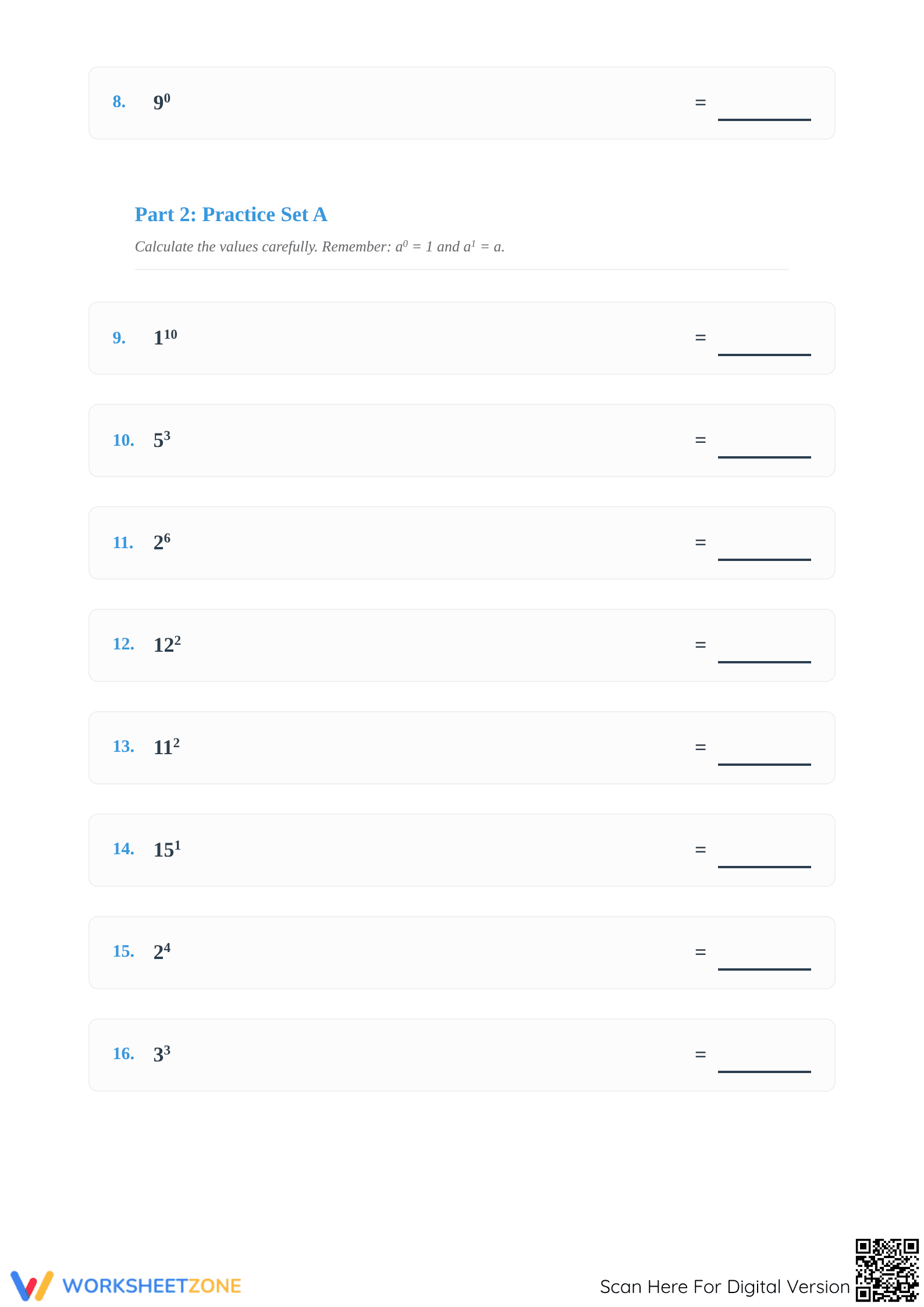
- Supported practice: Parts 2 and 3 introduce 16 problems with zero and identity exponents, reinforcing conceptual rules during the "We Do" phase of learning.
- Independent practice: Part 4 concludes with 8 challenge questions requiring higher-order calculation, representing the "You Do" phase of mastery for advanced students.
This scaffolding ensures students build confidence through a gradual-release model before tackling large-value calculations.
This resource aligns directly with CCSS.MATH.CONTENT.6.EE.A.1, focusing on evaluating numerical expressions with exponents. It also supports higher-grade foundations in CCSS.MATH.CONTENT.8.EE.A.1 regarding properties of integer exponents. Both standard codes can be copied directly into lesson plans, IEP goals, or district curriculum mapping tools to streamline teacher documentation and reporting.
This worksheet is highly effective during the "during instruction" phase as a structured practice tool. Teachers can assign Part 1 as a warm-up and Part 4 as an exit ticket to gauge understanding. For formative assessment, observe students during Part 2 to see if they correctly apply the zero-exponent rule ($a^0=1$). Most middle school students will complete the entire 32-problem set within 40 minutes of focused class time.
Designed for Grade 6, 7, and 8 students, this resource is perfect for those beginning their algebra journey. It offers sufficient differentiation for struggling learners through its clear sectioning while providing extensions for advanced students in the challenge block. Pair this worksheet with an exponent anchor chart or a digital graphing calculator session to deepen the visual understanding of exponential growth.
Effective mathematics instruction requires a balance of procedural fluency and conceptual understanding, a principle emphasized in the Fisher & Frey (2014) gradual release of responsibility framework. This worksheet applies that research-backed model by transitioning students through four distinct levels of difficulty in evaluating exponents. By providing 32 structured opportunities for practice, the resource addresses the CCSS.MATH.CONTENT.6.EE.A.1 requirement for evaluating numerical expressions. Research from ScienceDirect TpT Analysis suggests that high-quality, printable materials with clear sectioning reduce cognitive load for middle school learners, allowing them to focus on the specific logic of exponentiation rather than complex formatting. The inclusion of a comprehensive answer key further supports the self-regulation skills necessary for mastery in pre-algebraic topics. This document serves as a durable instructional asset for any curriculum focused on building strong numerical and operations foundations, ensuring students achieve the automaticity required for high-school level algebraic expressions.


