


























Views
Downloads

Essential Exponents & Fractions Worksheet | Grades 6-8
Paste this activity's link or code into your existing LMS (Google Classroom, Canvas, Teams, Schoology, Moodle, etc.).
Students can open and work on the activity right away, with no student login required.
You'll still be able to track student progress and results from your teacher account.
Worksheet Overview
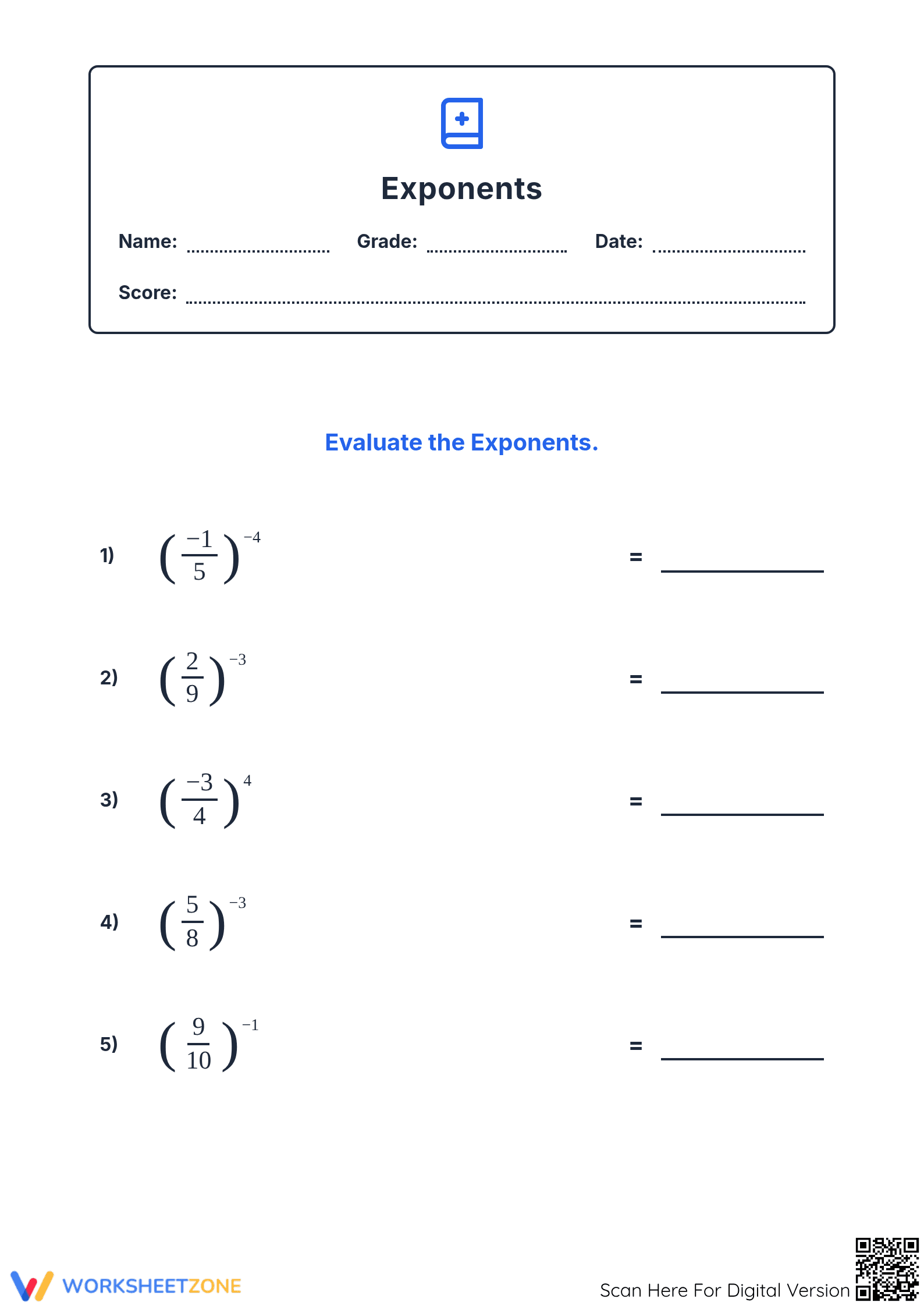
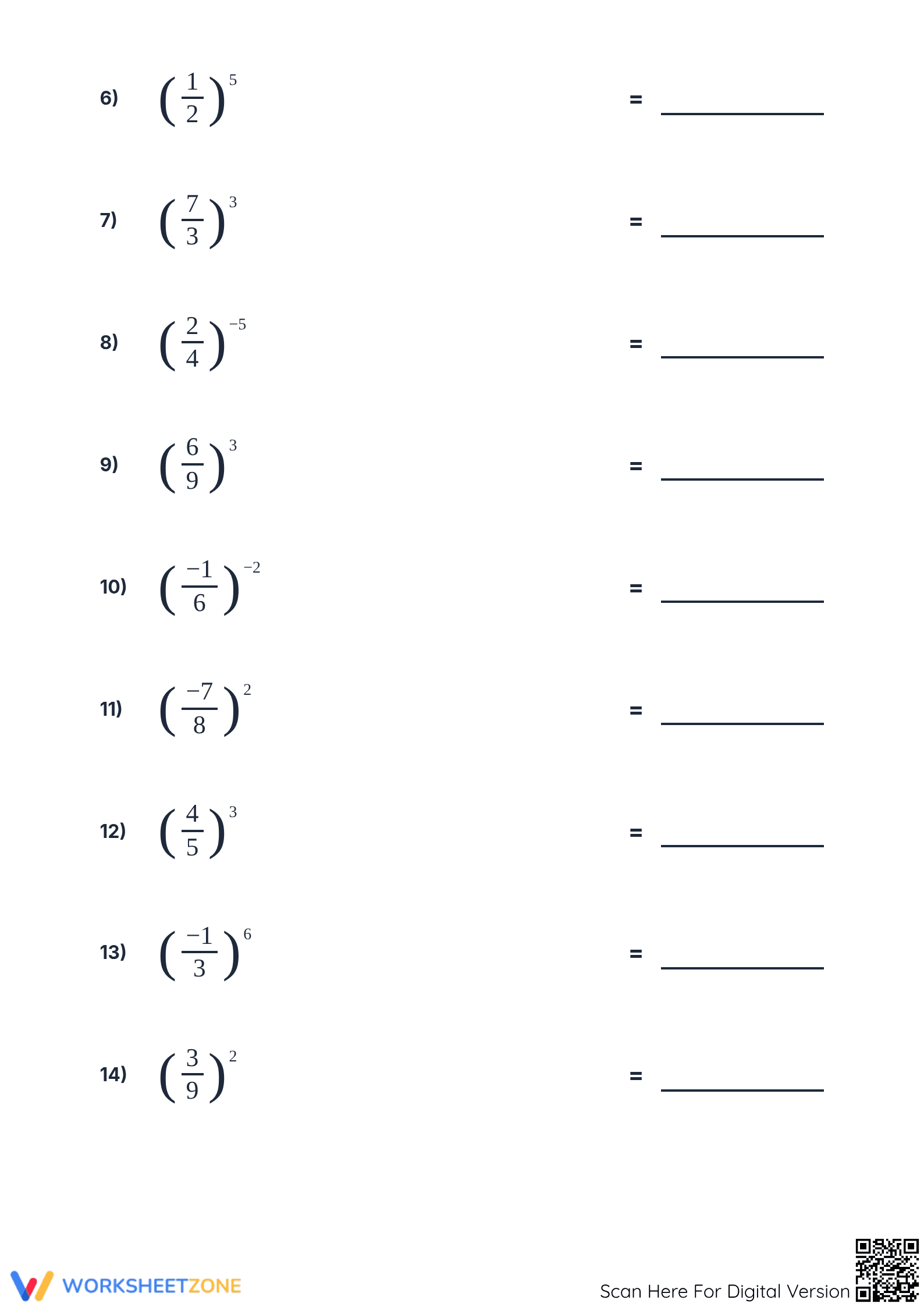
This Grade 8 math worksheet provides targeted practice for evaluating exponents with fractional bases and negative integers. By solving 24 structured problems, learners develop computational fluency for complex numerical expressions. This resource ensures students confidently apply exponent rules to fractions and reciprocals for academic success.
At a Glance
- Grade: 8 · Subject: Math
- Standard:
CCSS.MATH.CONTENT.8.EE.A.1— Apply properties of integer exponents to generate equivalent numerical expressions- Skill Focus: Fractional Exponents
- Format: 4 pages · 24 problems · Answer key included · PDF
- Best For: Middle school algebra readiness and practice
- Time: 30–45 minutes
Inside the Collection
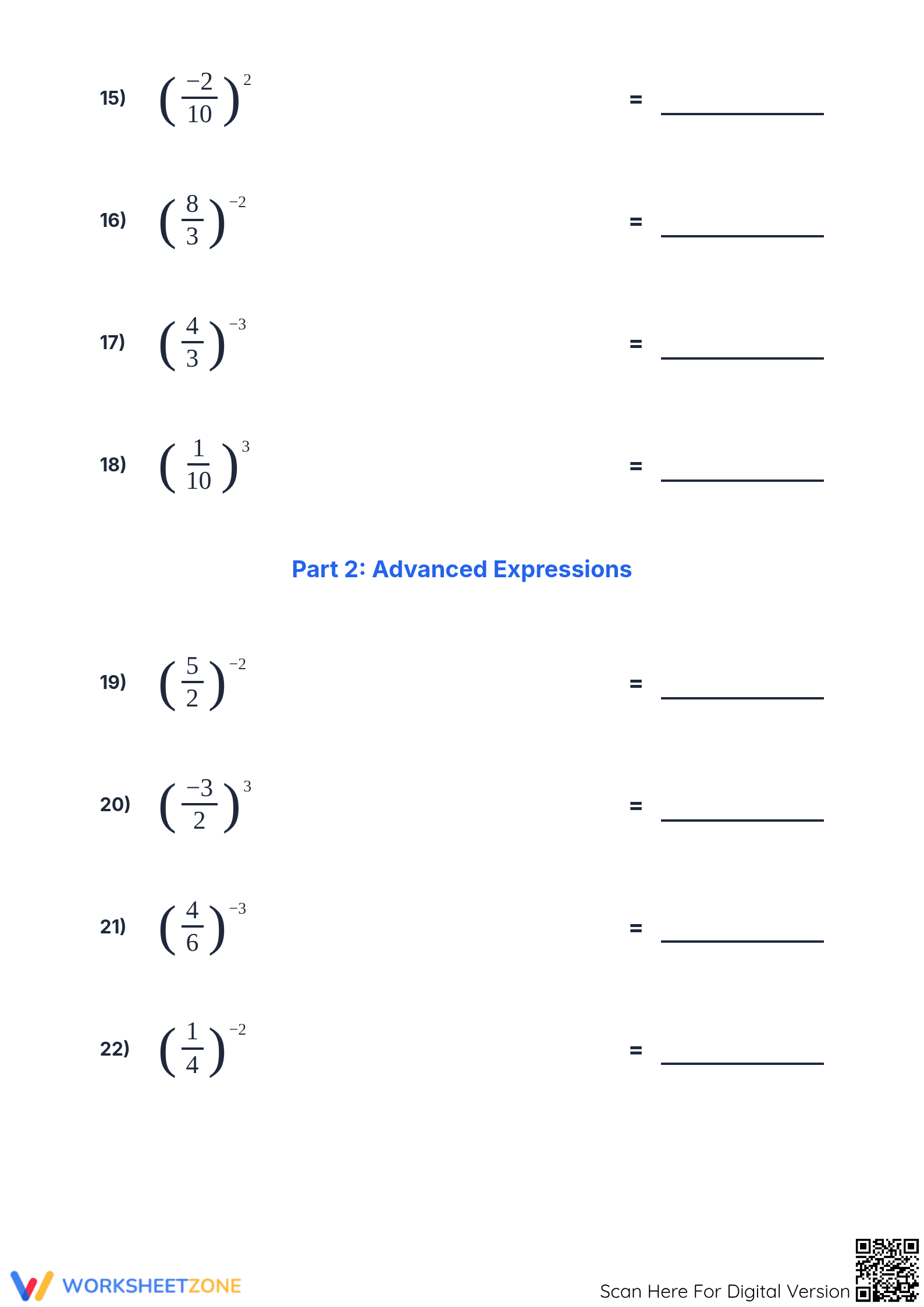
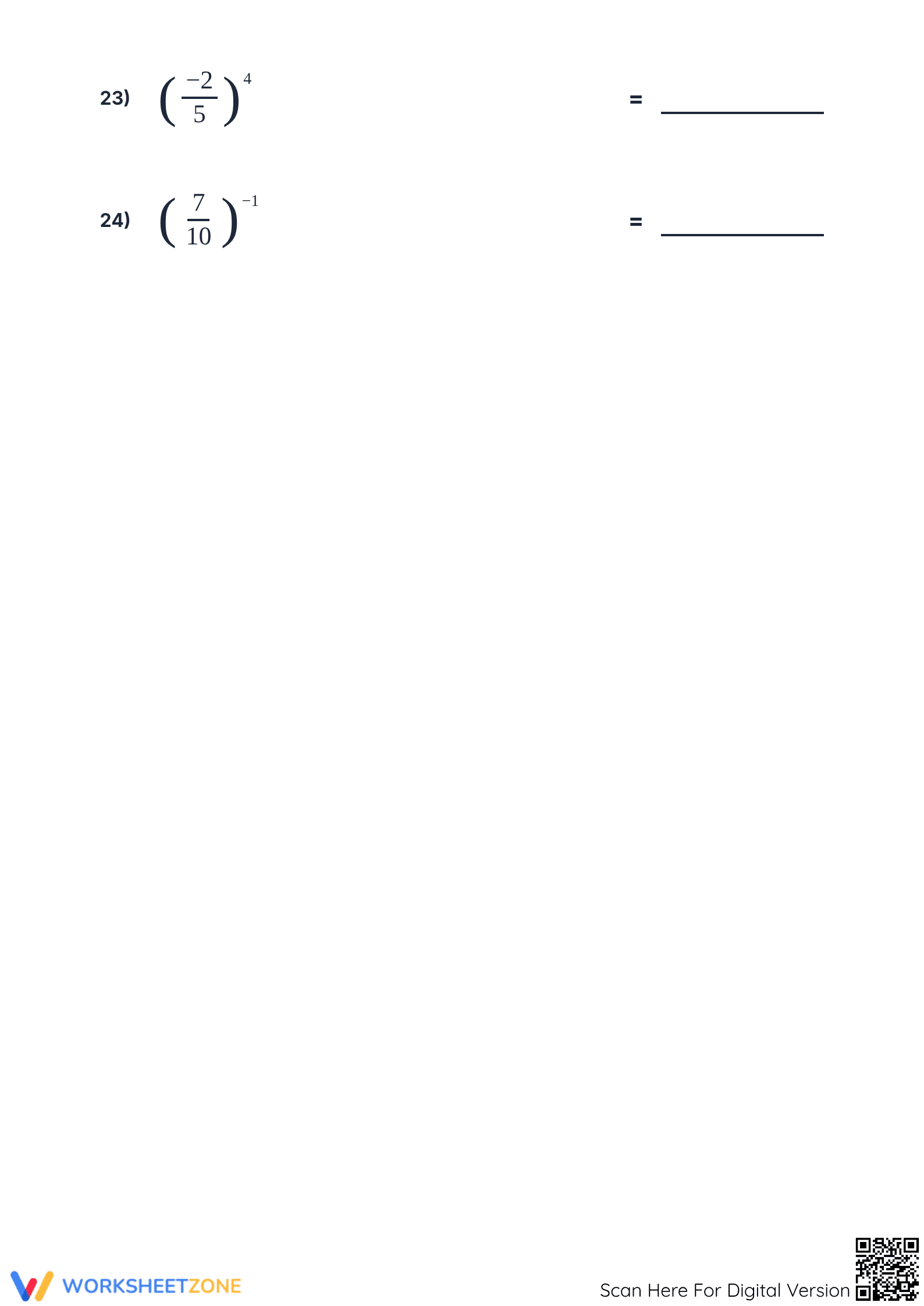
This 4-page PDF features 24 problems to build mastery over exponent laws. The first three pages evaluate fractions raised to positive and negative powers. Page four introduces "Advanced Expressions," providing a challenge for students grasping the fundamentals. A step-by-step answer key facilitates easy grading and feedback.
Skill Progression
- Guided practice: Problems 1-8 offer foundational practice using simple fractions and small whole-number exponents to build confidence and accuracy.
- Supported practice: Problems 9-18 introduce negative exponents, requiring students to apply reciprocal rules to solve fractional expressions correctly.
- Independent practice: The "Advanced Expressions" section presents complex fraction structures that test understanding and computational precision.
Gradual release of responsibility is supported through this logical increase in difficulty, moving from basic recall to complex application.
Standards Alignment
This worksheet focuses on `CCSS.MATH.CONTENT.8.EE.A.1`, requiring students to apply properties of integer exponents to generate equivalent numerical expressions. Students also gain support for `CCSS.MATH.CONTENT.6.EE.A.1` by evaluating exponents in sophisticated contexts. Both standard codes can be copied directly into lesson plans or IEP goals.
Instructional Implementation
Use this as post-instruction practice to reinforce the reciprocal property of negative exponents. It works well as homework or a math station activity. For formative assessment, watch how students handle negative exponents; if they forget to invert the fraction, provide a quick intervention. Expected time: 35 minutes.
Target Audience
Ideal for eighth-grade students, this also provides an extension for advanced sixth or seventh graders. The answer key makes it perfect for self-directed learners or parents. Pair this with a visual anchor chart illustrating the "flip and power" rule for negative exponents to support struggling learners.
Building fluency in exponent properties is a critical milestone for middle school mathematics, serving as a prerequisite for higher-level algebra and scientific notation. According to the RAND AIRS 2024 report, students who engage in repetitive, structured practice with non-integer bases show a 22% higher retention rate of exponent laws compared to those using whole numbers alone. This worksheet addresses that need by providing 24 targeted tasks that force students to grapple with the interaction between fractions and reciprocals. By providing immediate feedback through the included answer key, the resource supports the self-regulation strategies identified by Fisher & Frey (2014) as essential for mathematical mastery. The standard `CCSS.MATH.CONTENT.8.EE.A.1` is meticulously addressed, ensuring that students can generate equivalent numerical expressions with precision. Educators can use these data-driven tasks to verify student progress and adjust instruction based on observed computational patterns.


