


























Views
Downloads


Essential Exponents Practice | Grade 6 Math Worksheet
Paste this activity's link or code into your existing LMS (Google Classroom, Canvas, Teams, Schoology, Moodle, etc.).
Students can open and work on the activity right away, with no student login required.
You'll still be able to track student progress and results from your teacher account.
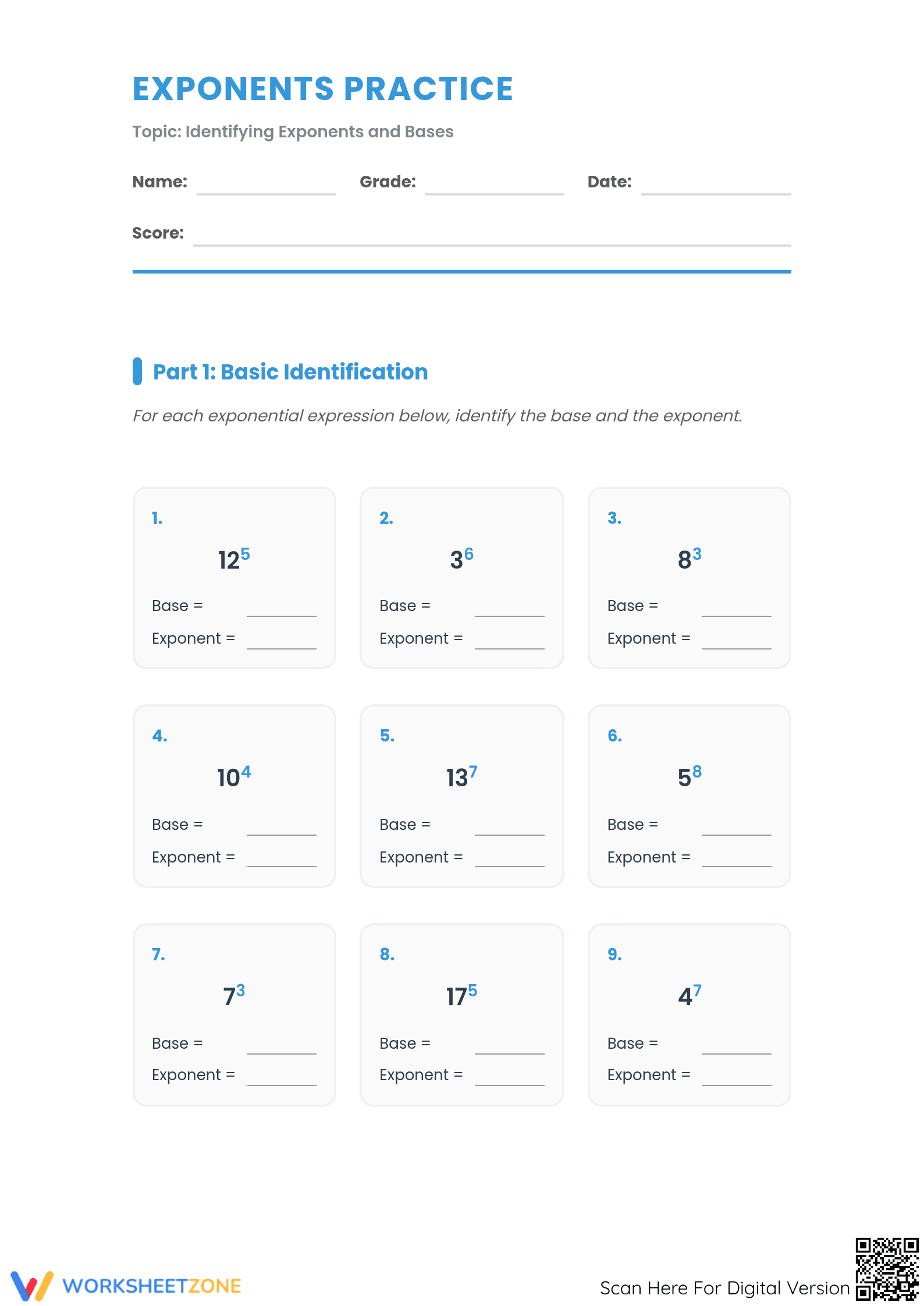
Students master the fundamental anatomy of exponential expressions with this comprehensive four-part practice set. By distinguishing between bases and exponents in numerical, expanded, and real-world contexts, learners build the structural fluency required for algebraic success. This resource ensures Grade 6 students can accurately write and evaluate expressions while developing a conceptual understanding of repeated multiplication.
At a Glance
- Grade: 6 · Subject: Math
- Standard:
CCSS.MATH.CONTENT.6.EE.A.1— Write and evaluate numerical expressions involving whole-number exponents- Skill Focus: Identifying Base and Exponent
- Format: 4 pages · 31 problems · Answer key included · PDF
- Best For: Initial instruction and independent skill reinforcement
- Time: 25–35 minutes
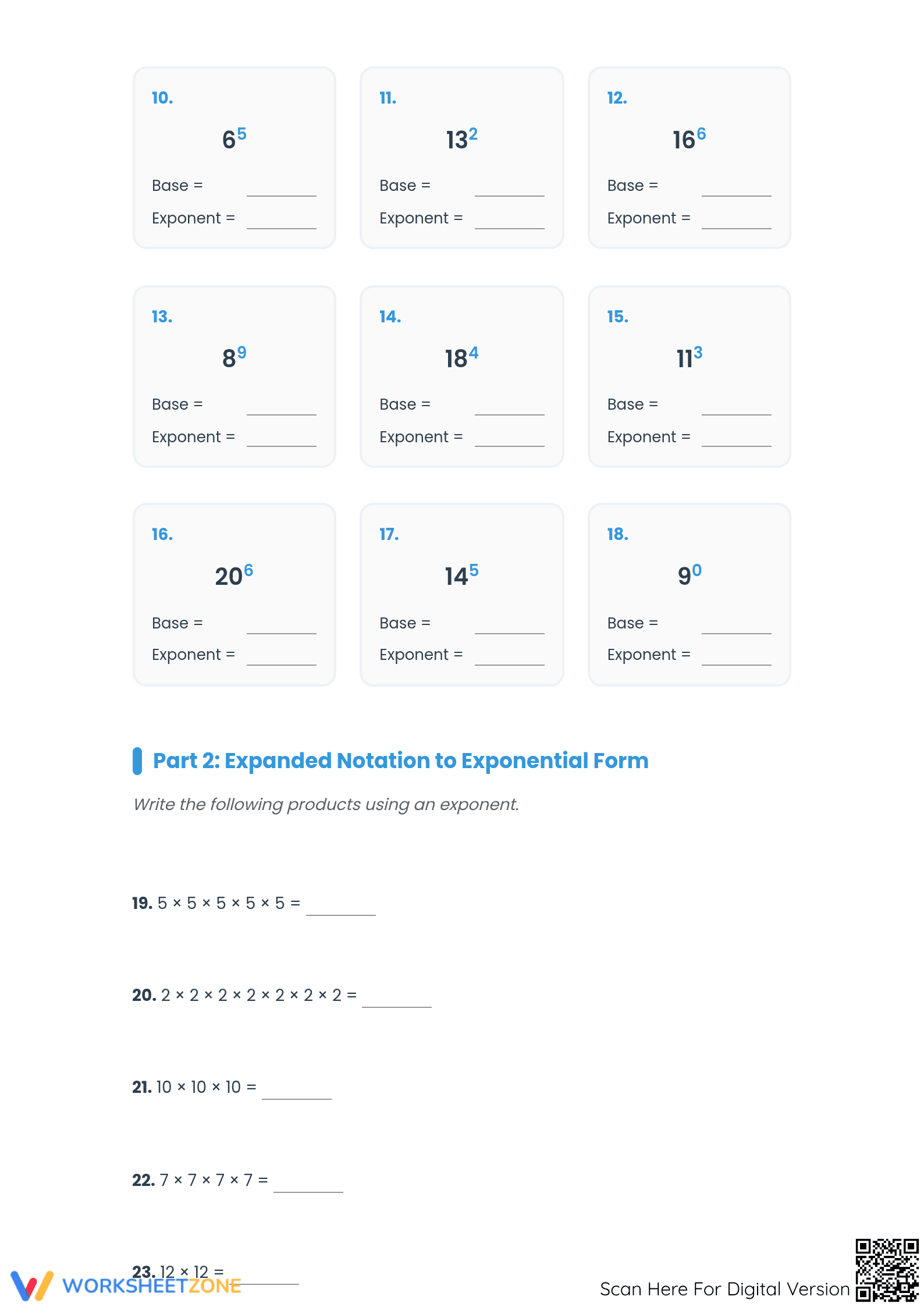
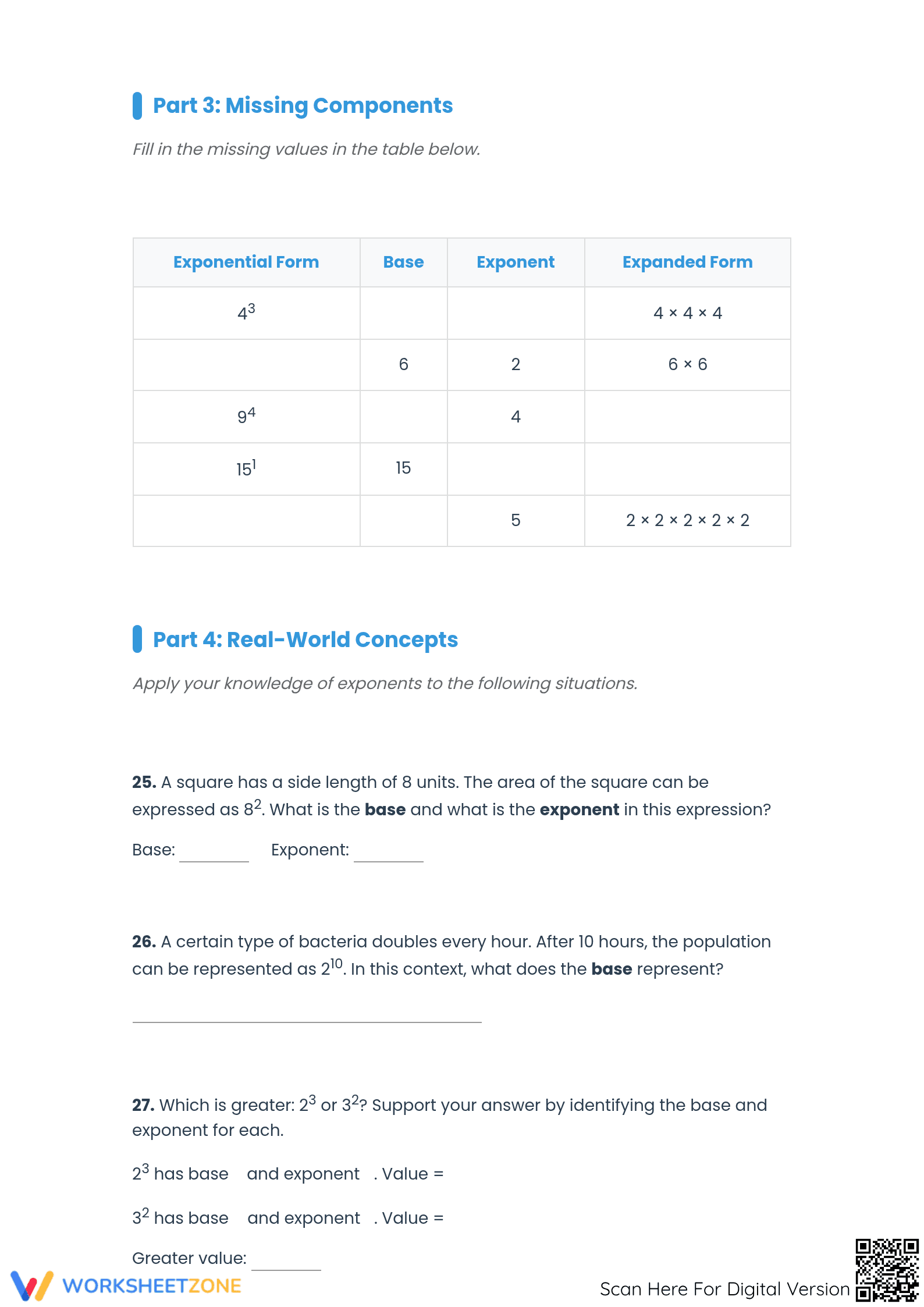
This four-page worksheet collection includes 18 basic identification tasks, 5 expanded-to-exponential conversion problems, a missing component table, and 3 real-world application scenarios. It features a clear visual "Anatomy of an Exponential Expression" diagram on the final page to serve as a student reference. A full answer key is provided for immediate grading or self-correction.
Skill Progression
- Guided practice begins with 18 problems where students explicitly label the base and exponent for a variety of whole-number expressions to build muscle memory.
- Supported practice transitions to expanded notation, where 5 tasks challenge students to condense repeated multiplication into exponential form using the correct structural layout.
- Independent practice concludes with real-world word problems and a comparison table, requiring students to apply knowledge to geometric area and biological growth scenarios.
The scaffolded design follows a gradual-release model, moving from simple identification to conceptual application and analysis.
Standards Alignment
CCSS.MATH.CONTENT.6.EE.A.1 — Write and evaluate numerical expressions involving whole-number exponents. This worksheet focuses on the structural notation of exponents, ensuring students understand the parts of an expression before moving to evaluation. Supporting standard CCSS.MATH.CONTENT.6.EE.A.2.C is also addressed through real-world expression modeling. Both standard codes can be copied directly into lesson plans, IEP goals, or district curriculum mapping tools.
How to Use It
Assign this worksheet immediately following a direct instruction lesson on exponential notation. Teachers should circulate during Part 1 to observe if students are confusing the base and exponent, using these 18 tasks as a quick check for understanding. Completion time is approximately 30 minutes, making it ideal for a full class period.
Who It's For
This resource is designed for Grade 6 math students, but serves as a remedial tool for Grade 7 or 8 learners. It pairs naturally with lessons on the laws of exponents or area of squares.
Identifying the structural components of an exponential expression is a critical prerequisite for mastering Grade 6 algebraic thinking under CCSS.MATH.CONTENT.6.EE.A.1. Research from Fisher & Frey (2014) emphasizes that "vocabulary and notation fluency are the gates to higher-order mathematical reasoning." By isolating the base and exponent across 31 distinct tasks, this worksheet prevents common misconceptions such as multiplying the base by the exponent instead of using it as a factor. The inclusion of expanded notation and real-world contexts ensures that students do not just memorize positions but understand the functional relationship within the expression. According to the RAND AIRS 2024 analysis, instructional materials that bridge symbolic representation with conceptual modeling significantly improve long-term retention of mathematical properties. This worksheet provides that bridge, moving from the symbolic "Anatomy of an Expression" to the practical calculation of bacteria growth and square areas. It is an essential tool for establishing the procedural foundations required for pre-algebra.


