




























Views
Downloads
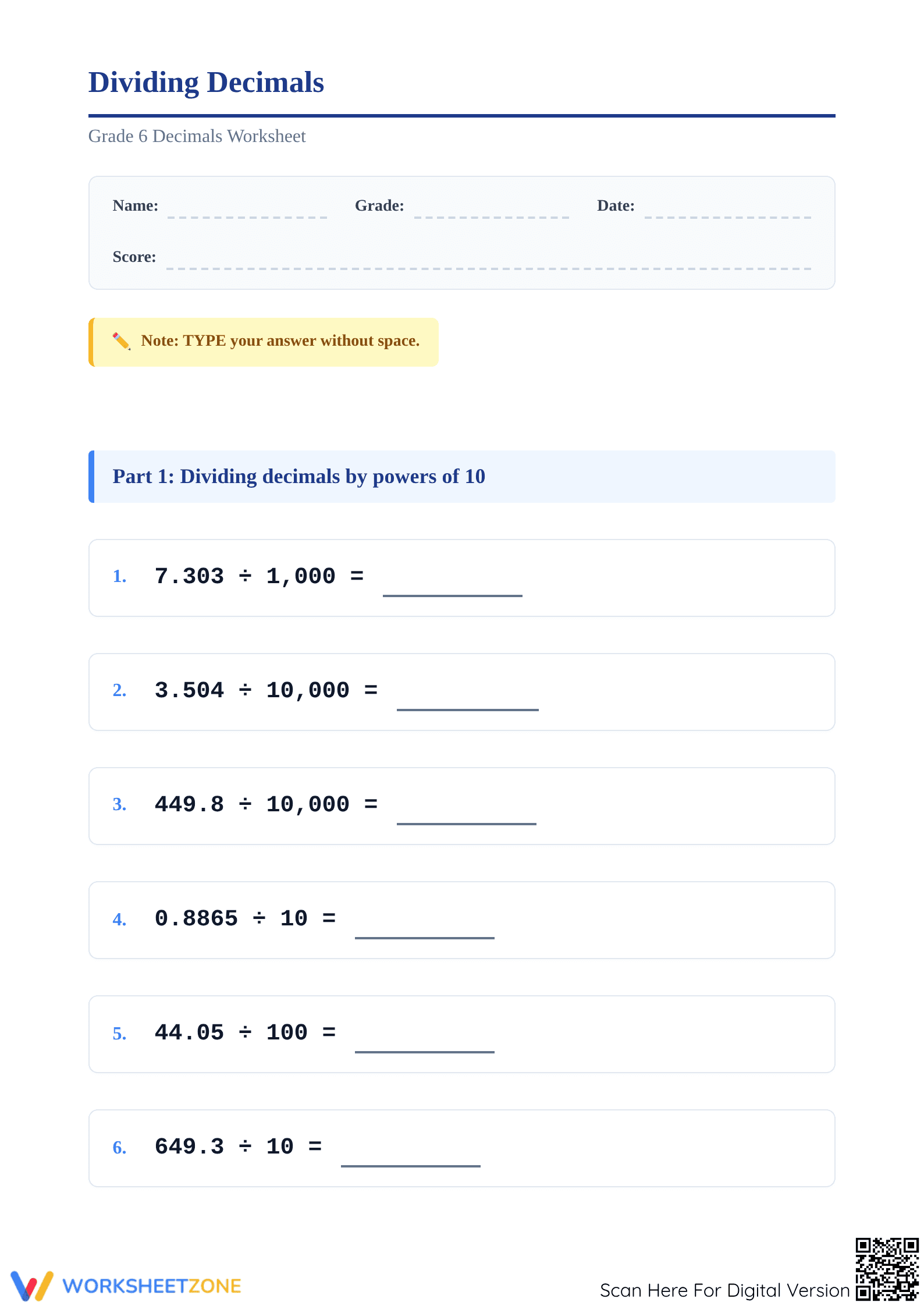
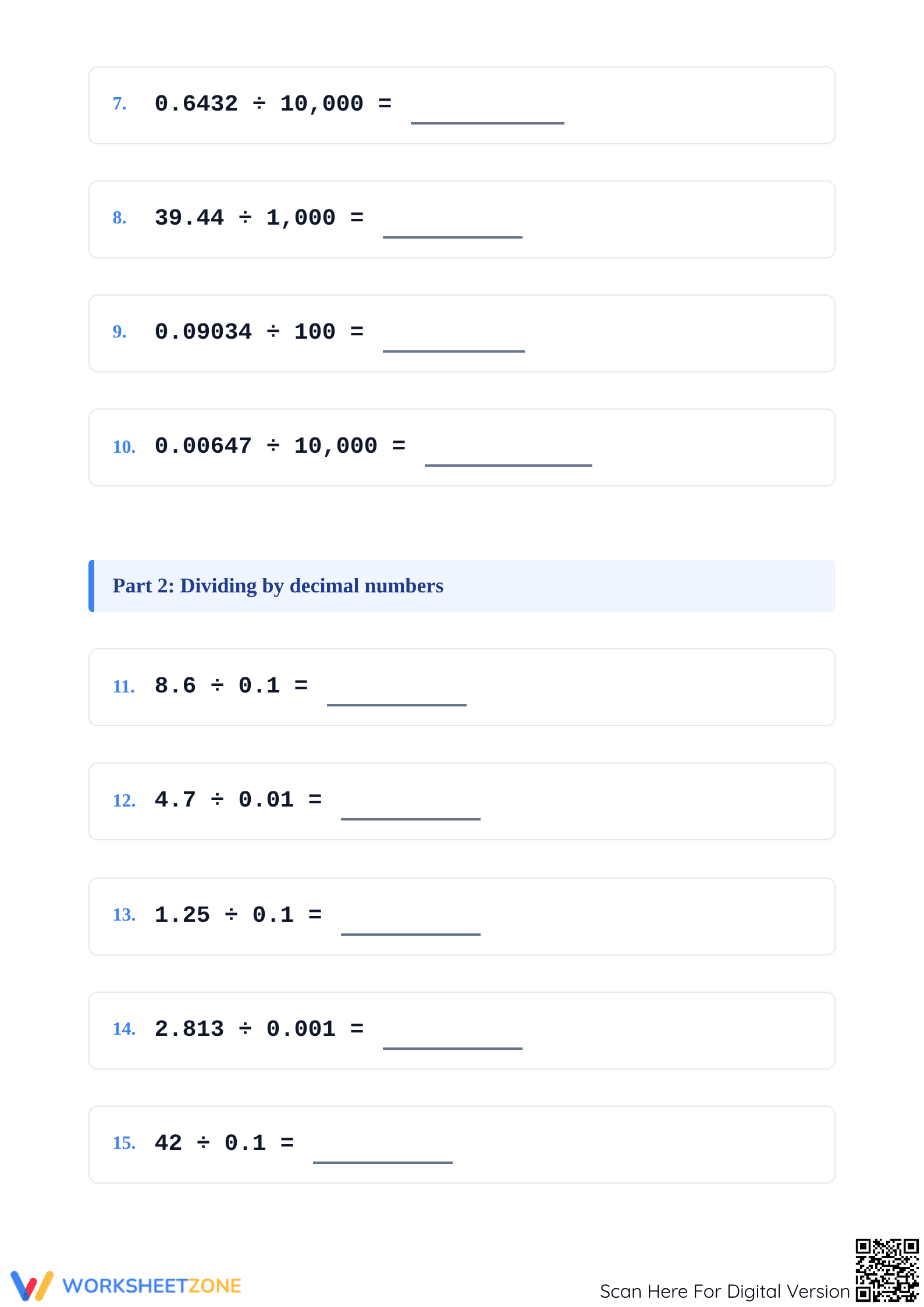
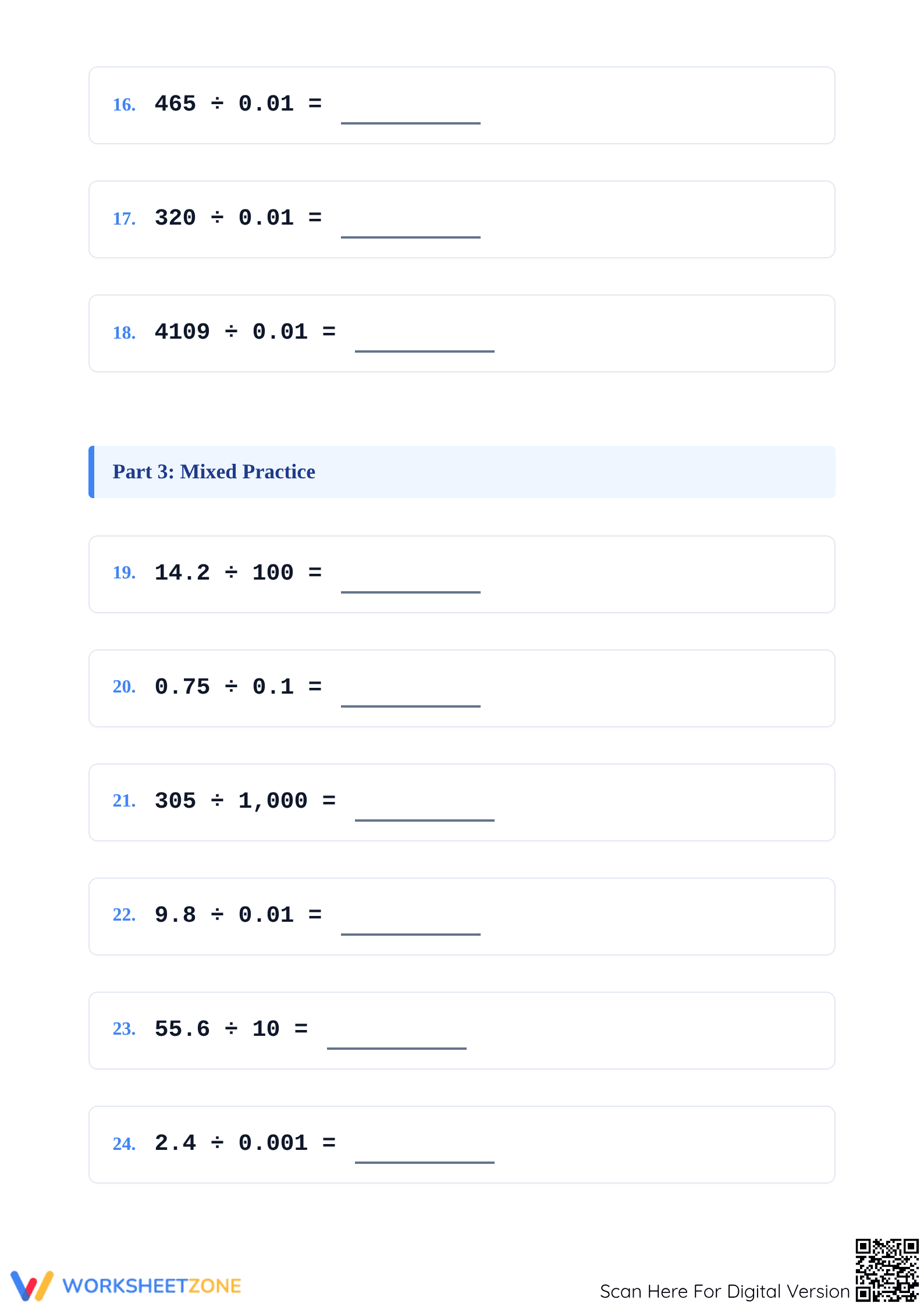
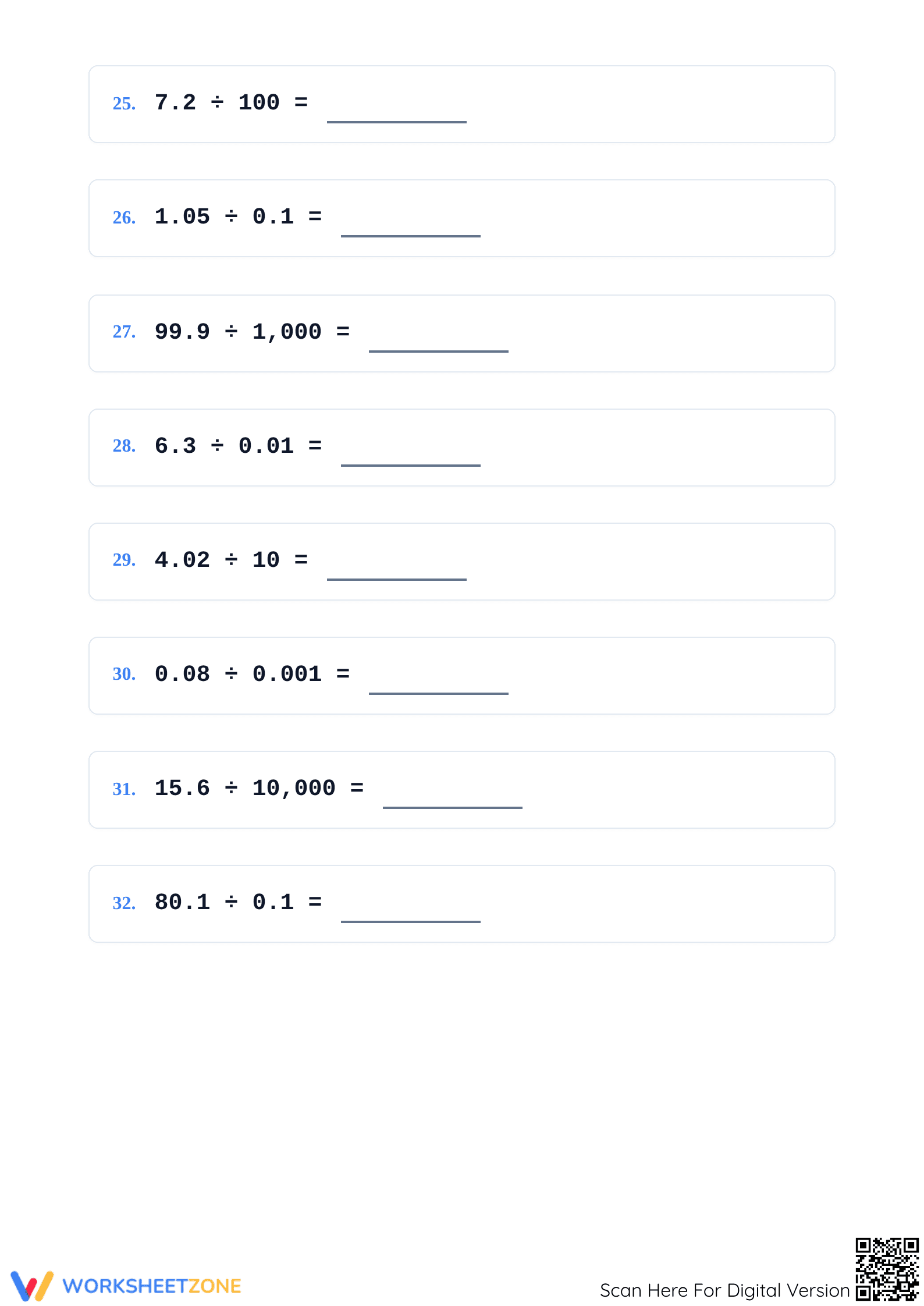

Printable Division of Decimals by Powers of 10 | Grade 5-7

Paste this activity's link or code into your existing LMS (Google Classroom, Canvas, Teams, Schoology, Moodle, etc.).
Students can open and work on the activity right away, with no student login required.
You'll still be able to track student progress and results from your teacher account.
This resource helps Grade 5, 6, and 7 students master dividing decimals by powers of 10 and 0.1. Focusing on decimal point placement patterns, students build fluency for complex equations. The structured layout aids in internalizing the relationship between place value and decimal movement without confusion.
At a Glance
- Grade: 5-7 · Subject: Math
- Standard:
CCSS.MATH.CONTENT.5.NBT.A.2— Explain patterns in the placement of the decimal point when divided by a power of 10- Skill Focus: Decimal division by 10, 100, 1000, and 0.1
- Format: 4 pages · 80 problems · Answer key included · PDF
- Best For: Independent math center practice or homework
- Time: 25–40 minutes
This pack offers four pages with eighty unique division problems, each with a clean, vertical layout for clear answers. The first two pages cover division by 10, 100, and 1000; later pages introduce division by 0.1 and 0.01 to challenge mental shift logic. A complete answer key is included for quick grading or self-check.
Skill Progression
- Guided practice: The initial 20 problems use basic decimals and division by 10 to help students visualize the single-place shift to the left in a controlled setting.
- Supported practice: The middle 40 problems expand to division by 100 and 1000, requiring students to manage placeholder zeros and larger place value shifts accurately.
- Independent practice: The final 20 problems introduce 0.1 and 0.01 as divisors, forcing students to reconcile the inverse relationship between decimal divisors and quotient magnitude.
This sequence follows a gradual-release model, transitioning from basic pattern recognition to sophisticated mental manipulation of numerical values across multiple place values.
Standards Alignment
Aligned with `CCSS.MATH.CONTENT.5.NBT.A.2`, this worksheet helps students explain decimal point patterns when dividing by powers of 10. It also supports `CCSS.MATH.CONTENT.6.NS.B.3` for fluency in multi-digit decimal division. Both codes are ready for lesson plans, IEP goals, or curriculum mapping.
How to Use It
Assign during independent practice or as a formative assessment. Observe student understanding of decimal point movement. With an estimated 35-minute completion time, it's ideal for a 'Do Now' or focused homework after direct instruction on decimal mechanics.
Who It's For
Designed for upper elementary and middle school students building numeracy, this resource benefits those struggling with decimal movement logic. Pair with a decimal place value anchor chart or digital demonstration for maximum impact in small group interventions.
Leveraging research on mathematical retention, this worksheet provides eighty targeted repetitions to help students recognize decimal division patterns and reduce reliance on rote memorization. By isolating divisors as powers of ten or a tenth, cognitive load is reduced, allowing focus on decimal shift mechanics. This approach aligns with pedagogical frameworks that improve confidence. The answer key provides immediate feedback on procedural accuracy, ensuring learners can explain the `CCSS.MATH.CONTENT.5.NBT.A.2` skill of moving a decimal point left when dividing by powers of ten.


