


























Views
Downloads

Division of Decimals Worksheet | Grade 6 Math Essential
Paste this activity's link or code into your existing LMS (Google Classroom, Canvas, Teams, Schoology, Moodle, etc.).
Students can open and work on the activity right away, with no student login required.
You'll still be able to track student progress and results from your teacher account.
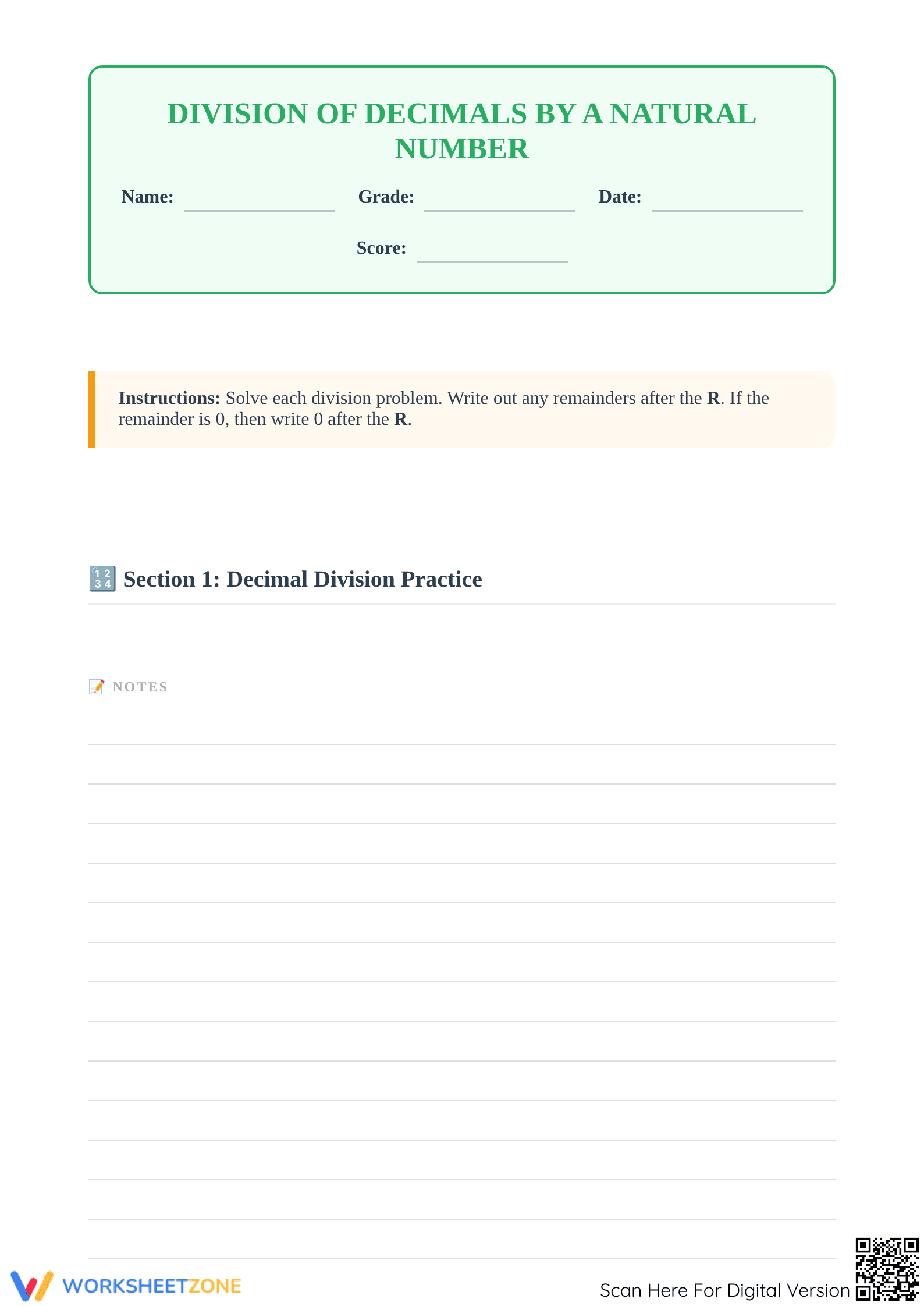
Mastering decimal division is a critical milestone for middle school mathematicians. This comprehensive 4-page worksheet guides students through dividing decimals by natural numbers, transitioning from basic calculation to real-world application. By completing these 30 problems, learners will build the fluency and confidence needed for advanced algebraic operations and everyday financial calculations.
At a Glance
- Grade: 6 · Subject: Math
- Standard:
6.NS.B.3— Fluently divide multi-digit decimals using the standard algorithm- Skill Focus: Division of decimals by natural numbers
- Format: 4 pages · 30 problems · Answer key included · PDF
- Best For: Mastery practice and formative assessment
- Time: 45–60 minutes
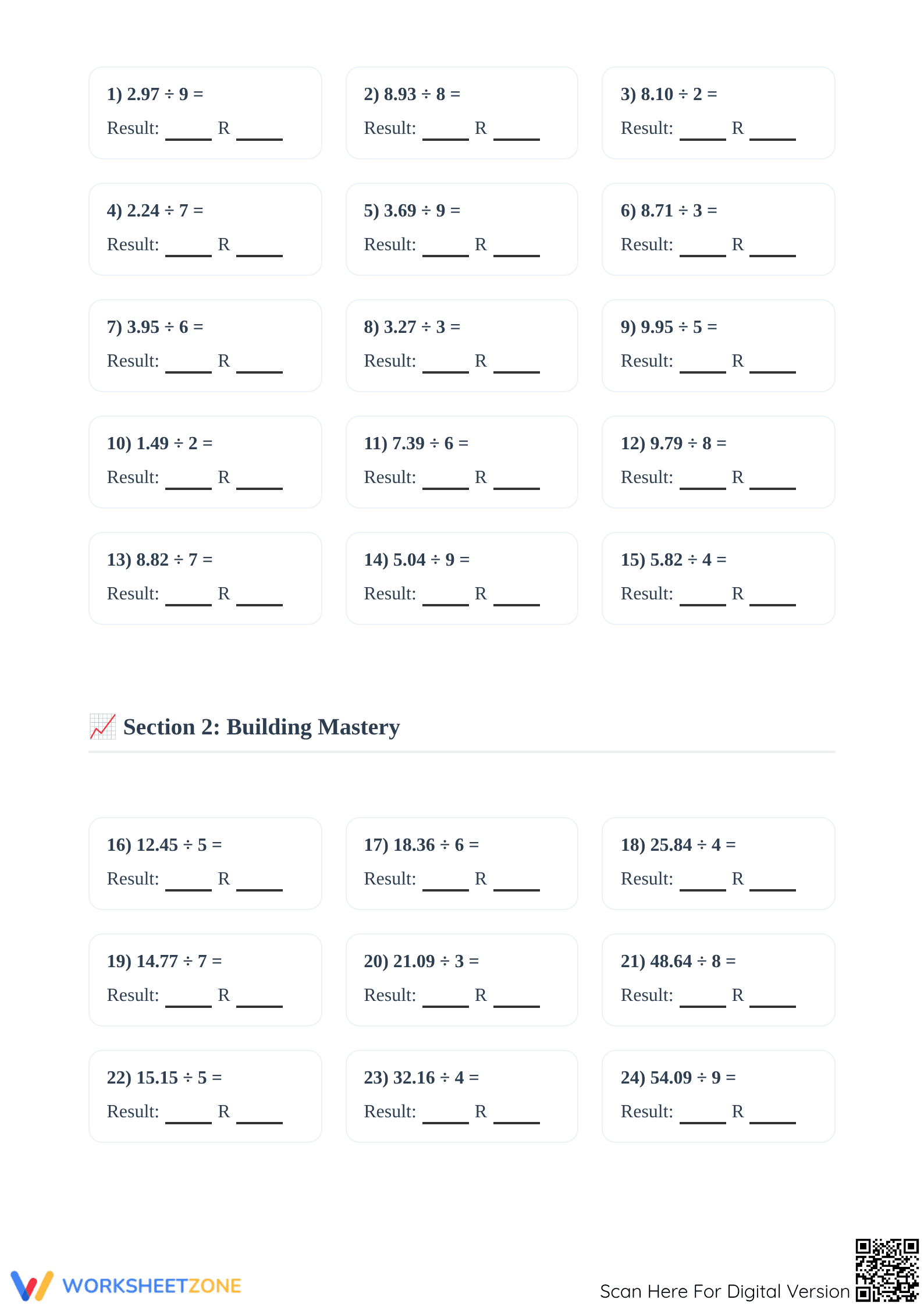
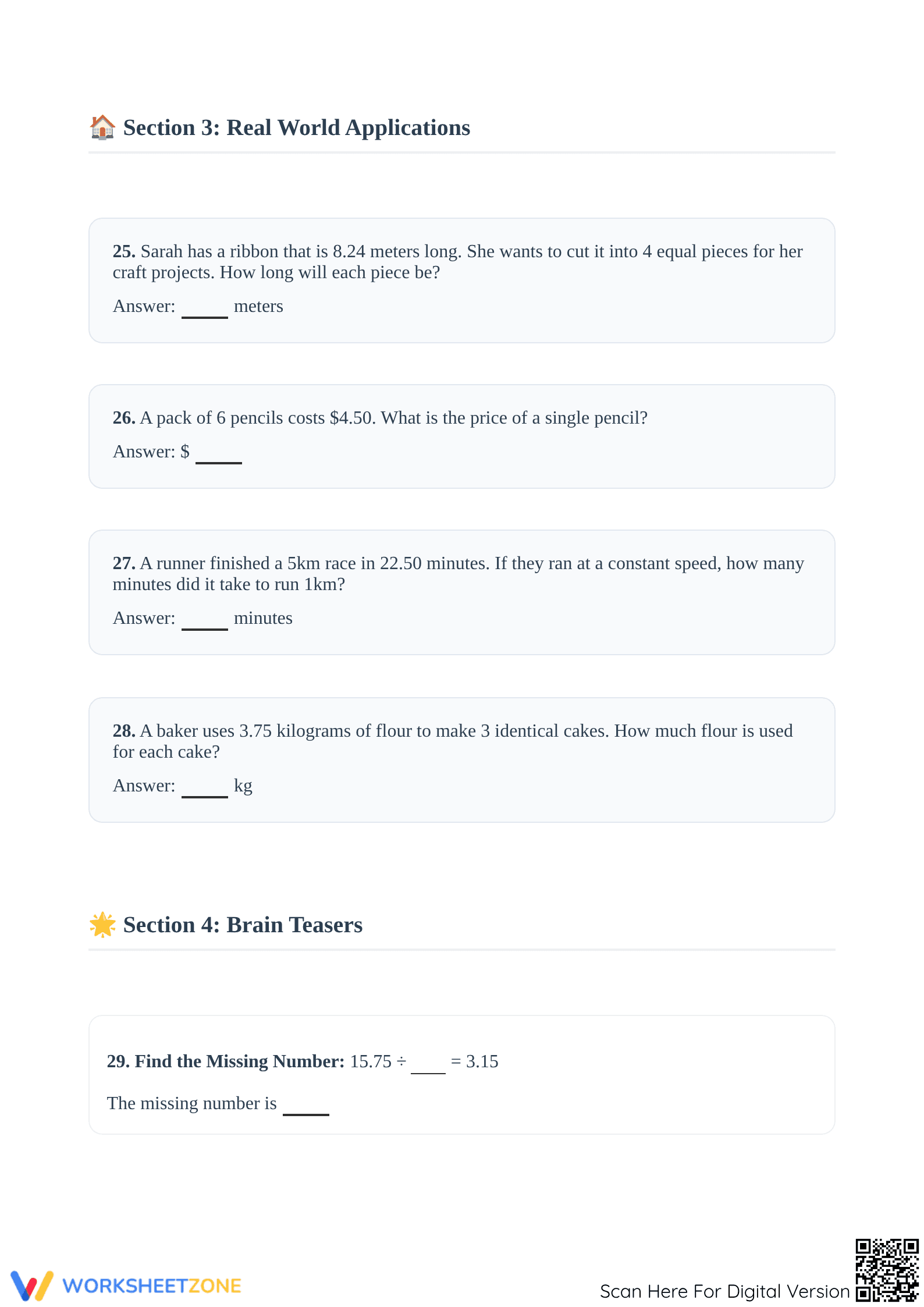
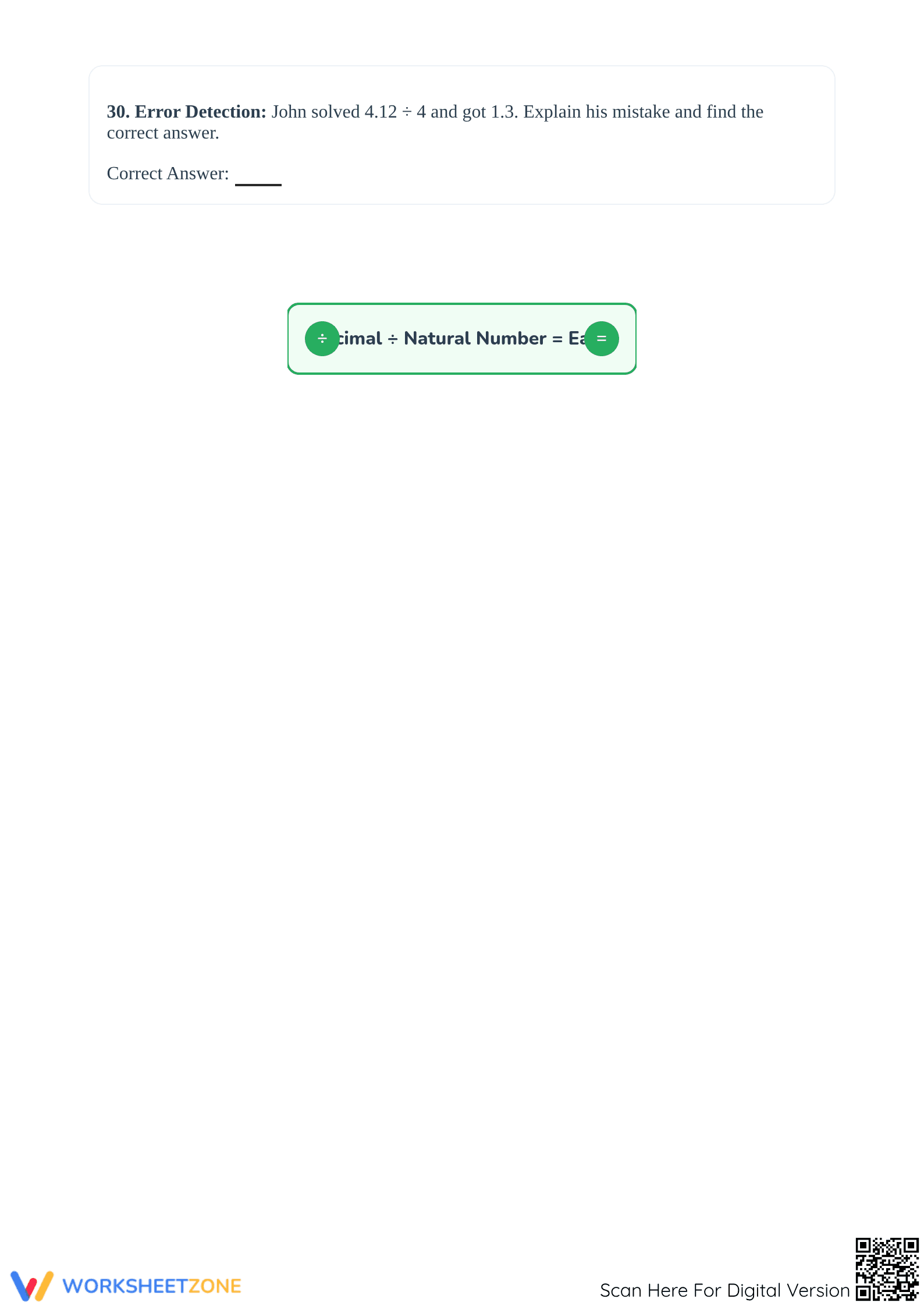
This resource includes four printable pages with 30 tasks total. Section 1 features 15 direct division problems, followed by 9 mastery-level problems in Section 2. Section 3 introduces word problems involving measurement and currency, while the final sections provide brain teasers and an error detection task. A full answer key ensures efficient grading and immediate feedback.
Skill Progression
- Guided Practice: 15 problems offer consistent practice with the standard algorithm, ensuring students correctly place decimals in the quotient.
- Supported Practice: Problems 16-24 increase complexity without extra scaffolds, solidifying calculation accuracy and precision.
- Independent Practice: Real-world word problems and error detection tasks challenge students to apply knowledge to non-routine scenarios and justify their results.
This gradual-release model supports student movement from basic recall to higher-order analysis, following the established I Do, We Do, You Do instructional framework.
Standards Alignment
This worksheet aligns with 6.NS.B.3, which requires students to fluently divide multi-digit decimals using the standard algorithm. It also supports 5.NBT.B.7 by emphasizing place value and relationship between numbers during the division process. Both standard codes can be copied directly into lesson plans, IEP goals, or district curriculum mapping tools.
How to Use It
Use this worksheet as a summative assessment after direct instruction on decimal operations. It helps identify common misconceptions in decimal placement or remainder handling. Alternatively, assign the first two sections during class and use the real-world applications as an exit ticket to gauge conceptual transfer before moving to complex decimal divisors.
Who It's For
Designed for Grade 6, this resource also suits Grade 5 advanced learners or Grade 7 students needing remediation. It pairs well with place value anchor charts or long division organizers to support students requiring additional scaffolds, visual cues, or extended processing time during independent practice.
Research by Fisher & Frey (2014) emphasizes the importance of a gradual release of responsibility in mathematics, a principle directly embedded in this worksheet's structure. By transitioning from direct calculation to critical error analysis, the resource fosters cognitive flexibility. According to the NAEP framework, the ability to fluently manipulate decimals is a key predictor of success in early algebra, as it reinforces the base-ten system and proportional reasoning. This worksheet addresses these needs by providing 30 high-quality tasks aligned to 6.NS.B.3 that span the Depth of Knowledge spectrum. The inclusion of real-world scenarios ensures that students see the utility of mathematics beyond the classroom, while the error detection task specifically targets the justify reasoning requirement of modern standards. This multi-faceted approach ensures that students do not just memorize a procedure but develop a robust, transferable understanding of decimal operations in various contexts.


