


























Views
Downloads

Printable Expository Writing Worksheet | Grade 6 ELA
Paste this activity's link or code into your existing LMS (Google Classroom, Canvas, Teams, Schoology, Moodle, etc.).
Students can open and work on the activity right away, with no student login required.
You'll still be able to track student progress and results from your teacher account.
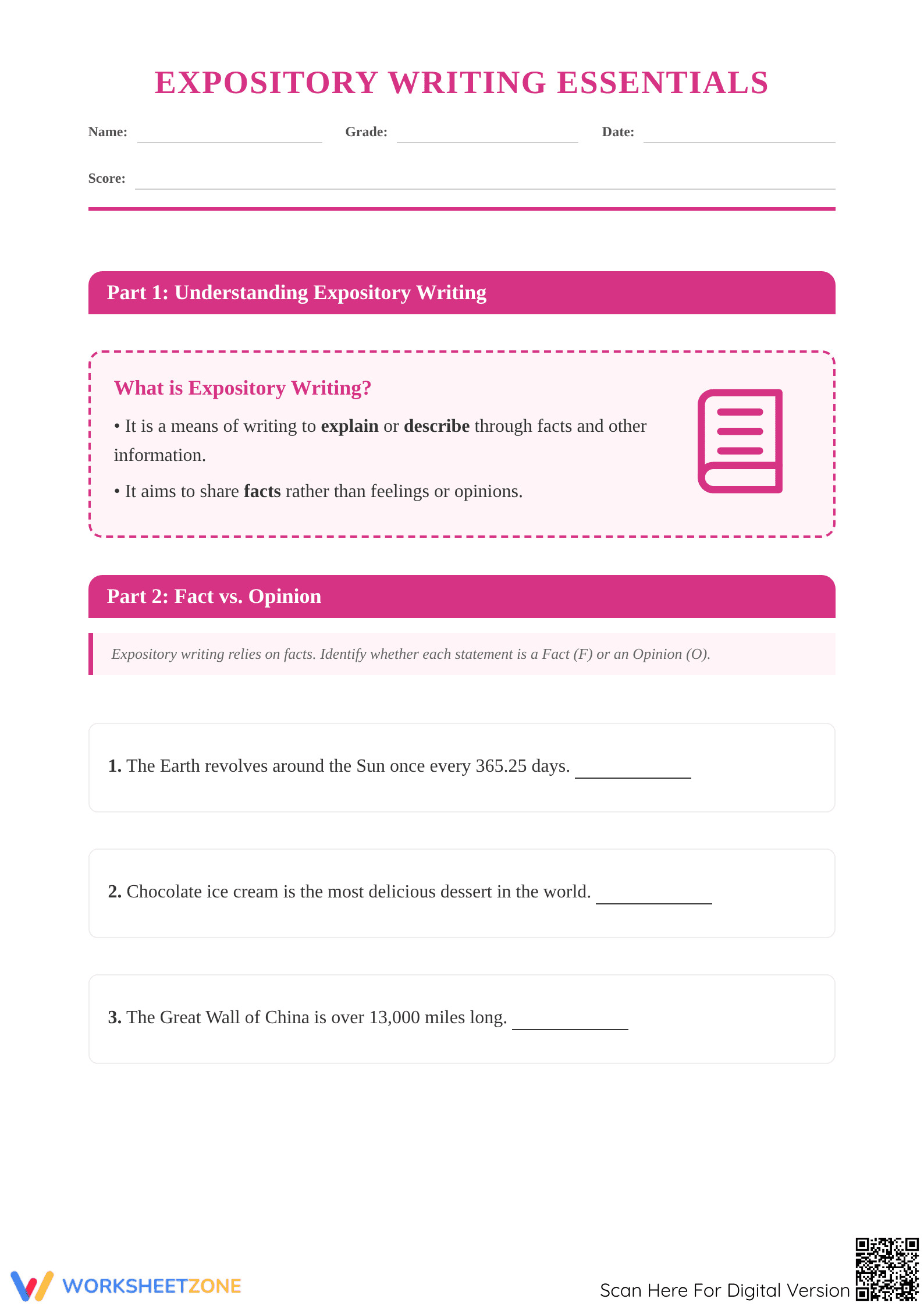
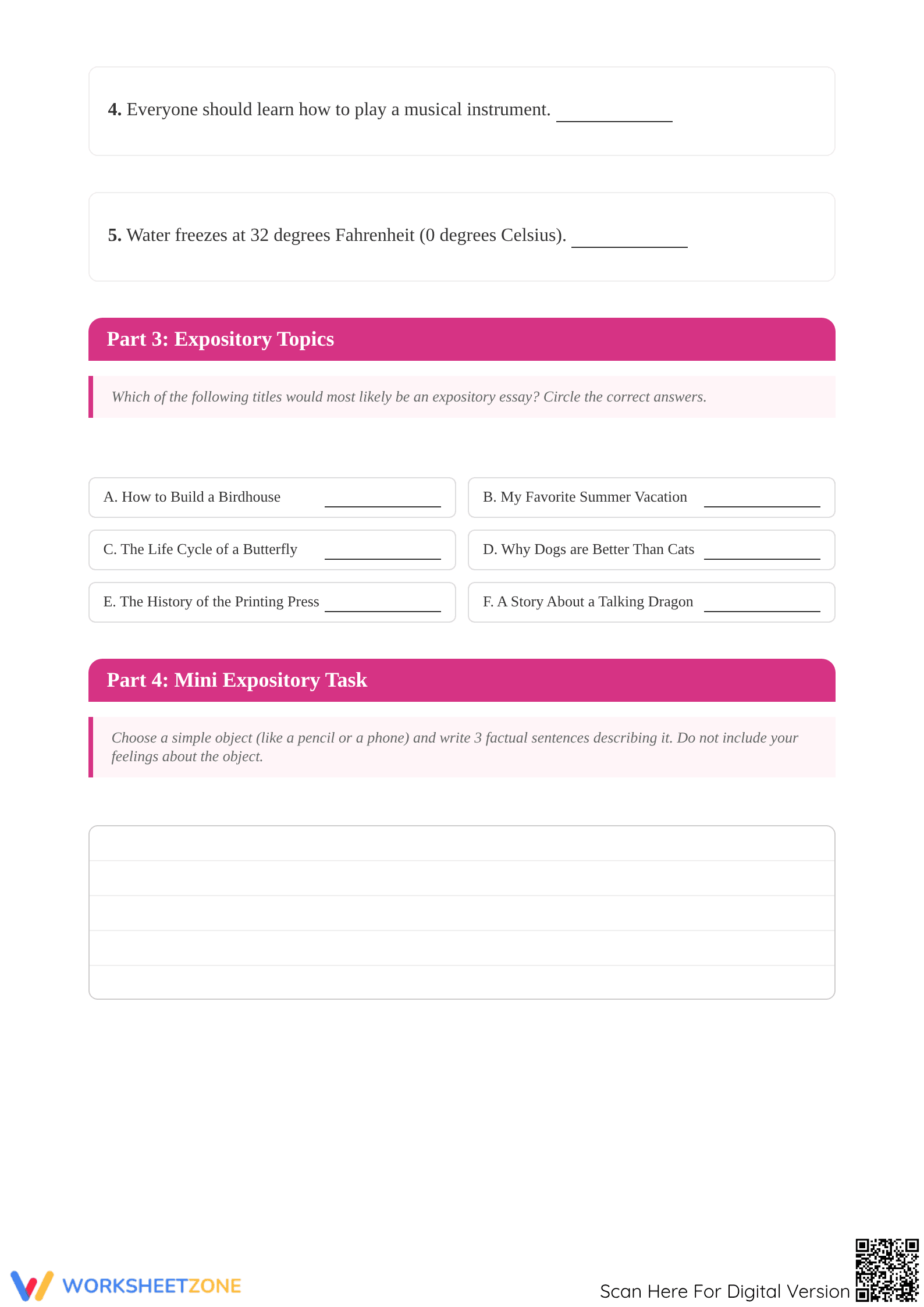
This Grade 6 expository writing worksheet introduces students to the fundamentals of informative texts. By distinguishing between facts and opinions, identifying appropriate essay topics, and drafting factual sentences, students build a strong foundation for objective writing. The structured format ensures learners grasp the core purpose of explaining information without personal bias.
At a Glance
- Grade: 6 · Subject: ELA
- Standard:
CCSS.ELA-LITERACY.W.6.2— Write informative texts to examine a topic.- Skill Focus: Expository Writing
- Format: 2 pages · 12 problems · Answer key included · PDF
- Best For: Independent practice or sub plans
- Time: 20–30 minutes
This two-page resource features four distinct sections designed to scaffold student understanding. It begins with a clear definition of expository writing, followed by a five-question fact versus opinion sorting activity. Next, students evaluate six potential essay titles to identify which ones represent expository topics. Finally, a mini writing task challenges students to draft three purely factual sentences about an everyday object. A complete answer key is provided for quick grading.
Zero-Prep Workflow
This worksheet is designed for immediate classroom use with minimal teacher setup:
- Print (1 minute): Simply download the PDF and print the two-page student handout.
- Distribute (1 minute): Hand out the worksheets as a self-guided activity or bell-ringer.
- Review (3 minutes): Use the included answer key to quickly check the fact-versus-opinion and topic-selection sections.
With under two minutes of total prep time, this resource is highly suitable for emergency sub plans or independent learning stations.
Standards Alignment
This activity aligns directly with CCSS.ELA-LITERACY.W.6.2, requiring students to write informative/explanatory texts to examine a topic and convey ideas, concepts, and information clearly. By practicing the distinction between objective facts and subjective opinions, students prepare for more complex essay drafting. Both standard codes can be copied directly into lesson plans, IEP goals, or district curriculum mapping tools.
How to Use It
Deploy this worksheet before starting a major expository essay unit to ensure students understand the genre's basic requirements. It also works perfectly during direct instruction as a guided practice tool where the teacher models the mini writing task. As a formative assessment tip, review the three factual sentences in Part 4 to quickly check if students are still inserting personal feelings into their descriptions. Expected completion time is 20 to 30 minutes.
Who It's For
This resource is primarily designed for sixth-grade ELA students learning the basics of informative writing. The clear, segmented layout provides natural differentiation for students who need step-by-step scaffolding before tackling a full essay. It pairs excellently with an anchor chart on objective versus subjective language or a direct instruction lesson on research skills.
Mastering the fundamentals of objective writing is a critical step in middle school literacy development. According to Fisher & Frey (2014), providing students with structured, low-stakes writing tasks helps build the cognitive stamina required for longer compositions. This worksheet directly supports CCSS.ELA-LITERACY.W.6.2 by asking students to write informative texts to examine a topic. By breaking down the genre into manageable components—such as distinguishing facts from opinions and selecting appropriate topics—educators can effectively isolate and assess specific writing mechanics. The inclusion of a mini writing task ensures that students immediately apply their understanding of objective language in a practical context. Early mastery of these foundational skills reduces cognitive load during complex essay drafting, allowing students to focus on organization and evidence integration rather than basic genre conventions.


