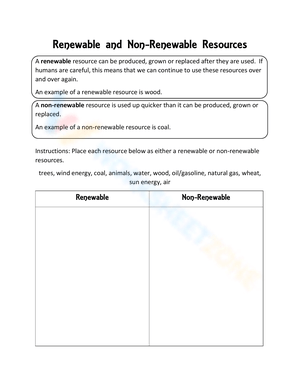
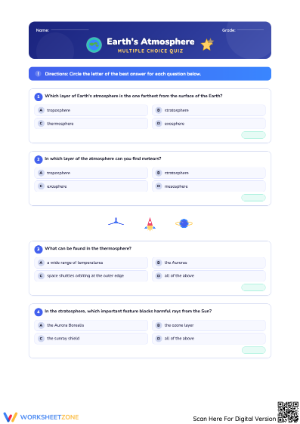
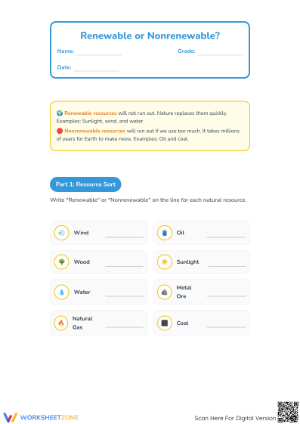
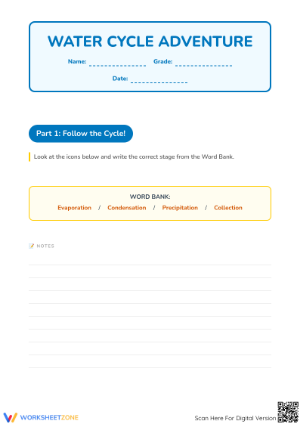
5th grade environment printable worksheets give teachers a fast, low-setup way to check whether students are connecting ecosystems, pollution, and human impact — or just moving vocabulary around. At grade 5, environment content runs across two science tracks simultaneously: life science through food webs, decomposers, and habitat relationships, and Earth science through watersheds, resource use, and conservation. Worksheets that treat those as separate units miss the instructional opportunity. The stronger ones ask students to see the link between a disrupted food web and a polluted watershed, not just name the parts.
What These Worksheets Ask Students to Do
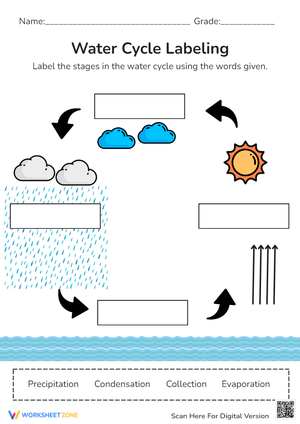
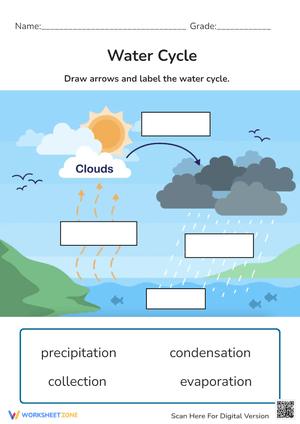
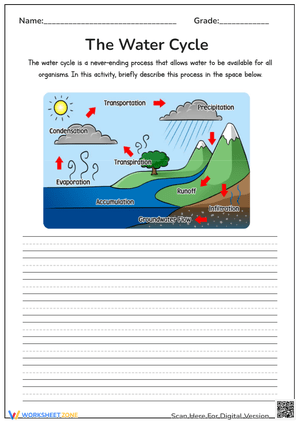
The tasks across this set move students through concrete thinking actions. They label food web diagrams, trace how matter flows from producers to decomposers and back to the soil, sort human activities by environmental impact, annotate watershed maps to show runoff pathways, and write brief evidence-based explanations. Each task type reveals something different: labeling confirms recognition; tracing matter movement confirms whether students understand how the system actually works.
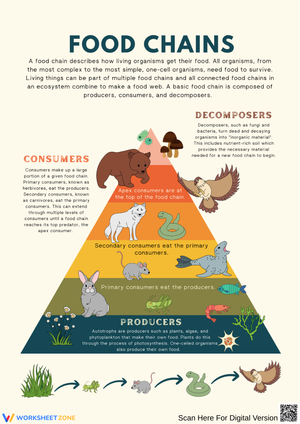
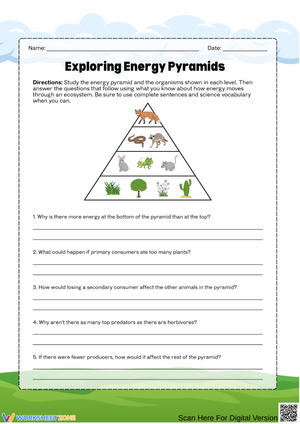
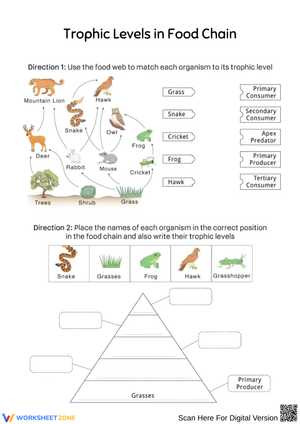
- Food webs and decomposers: Students map relationships among producers, consumers, and decomposers, then explain where matter goes after an organism dies — not just which organism eats which.
- Habitats and ecosystems: Students identify the conditions organisms need and distinguish between a habitat (where an organism lives) and an ecosystem (the full web of relationships in that space).
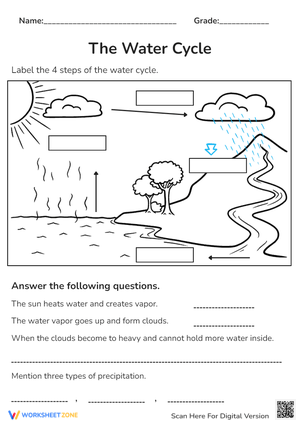
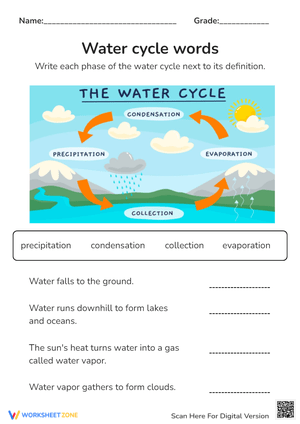
- Pollution and watersheds: Students trace how runoff, chemical waste, or litter enters water systems and identify downstream organisms affected by upstream decisions.
- Conservation and resource protection: Students classify community actions by their effect on land, water, and air — moving past the assumption that conservation means only recycling.
- Human impact: Students connect a specific community decision to measurable effects on local organisms and resources, rather than offering generalized statements about protecting the planet.
Mistakes Students Make That These Worksheets Help You Catch
The most persistent confusion at this grade level is between habitat and ecosystem. Students know both terms by the end of a lesson, but when a short-response prompt asks why two organisms sharing a habitat still have different ecosystem roles, the answers collapse into "they live in the same place." That error surfaces in written explanation tasks and almost never appears on vocabulary matching items — which is exactly why the response prompts in this set carry as much diagnostic weight as the diagrams.
Decomposer placement creates a second consistent problem. Students draw food webs with decomposers at the end of a linear chain rather than cycling matter back to the soil and back to producers. A labeling worksheet makes this visible immediately: when students draw arrows and realize they have stranded the decomposer with nowhere to connect, the misconception becomes a moment of productive confusion they can fix with a pencil. That is far easier to address than correcting an abstract explanation after the lesson has moved on.
On human impact tasks, fifth graders frequently merge pollution with climate change as though they are the same topic. A student who correctly identifies a factory as a local pollution source will still write "the ice caps will melt" as the direct consequence of a stream contamination scenario. That category error tells you the student has absorbed the climate narrative but has not separated it from the local pollution → watershed → habitat cause-and-effect chain. Short-response prompts that require specificity surface this more reliably than any vocabulary drill.
Standard Alignment
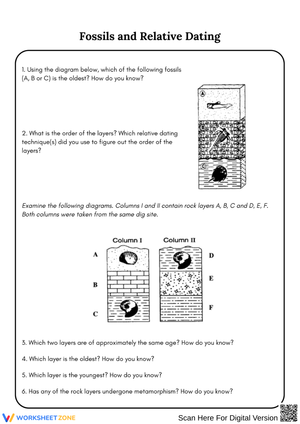
NGSS 5-LS2-1 (Ecosystems: Interactions, Energy, and Dynamics) asks grade 5 students to develop a model describing the movement of matter among plants, animals, decomposers, and the environment. That performance expectation explains why the food web worksheets in this set require drawn arrows and written explanations alongside labels. A worksheet asking students to trace what happens to matter after an organism dies is aligned to that standard in a way a simple word-bank task is not — the standard calls for modeling relationships, and a completed diagram with annotated arrows is a model.
NGSS 5-ESS3-1 (Earth and Human Activity) focuses on how individual communities use science ideas to protect Earth's resources. The human impact and conservation worksheets connect directly here. When a student writes a specific community action and explains its measurable effect on a local watershed, that response provides clearer evidence toward 5-ESS3-1 than any checked box. Teachers using these for formative assessment can track whether students are meeting the standard's expectation to obtain and combine information — not merely recall terms.
Fitting These Worksheets Into Your Planning Week
A food web labeling worksheet placed on desks before formal instruction begins — during the first five minutes of class, while students are settling in — reactivates prior knowledge without any long setup. By the time the lesson opens, you already know who connected decomposers back to the soil and who stranded them at the bottom of a linear chain. That early read shapes the discussion before it starts.
For small-group intervention, one focused worksheet does more work than a full review packet. If a group is still treating pollution and climate change as interchangeable, the human impact sorting worksheet isolates that confusion without loading unrelated content in front of them. For centers, each worksheet in this set holds a single completable task — a labeling diagram, a sorting activity, a scenario response — that fits a ten-minute rotation without trailing off mid-task. 5th grade environment printable worksheets with that kind of self-contained structure also make reliable sub plans: a substitute can distribute them, monitor completion, and return them for the teacher's review without needing prior classroom context.
Adjusting the Worksheets for a Mixed-Ability Classroom
For students still building content vocabulary, the labeling and sorting worksheets provide enough structure to participate without requiring extended writing. Reducing the number of choices on a sorting task — from six items to three — keeps the cognitive demand appropriate without changing the science concept being assessed. Highlighting the key term in a short reading passage before handing it to a struggling reader costs nothing and keeps the science thinking accessible without rewriting the worksheet entirely.
For students who have the core content and need extension, the short-response items carry the most room to push further. A prompt asking a student to explain one conservation action and predict a specific downstream consequence opens into multi-step reasoning for students ready to do that work. Having 5th grade environment printable worksheets that pair a lower-lift task with a written explanation on the same worksheet means teachers are not building two separate sets for two groups — one worksheet handles the range.
Frequently Asked Questions
Which environment topics matter most for grade 5 printable practice?
Food webs, decomposers, habitats, ecosystems, pollution, watersheds, conservation, and human impact on land, water, and air. These appear in most district science pacing guides for grade 5 and recur across different units throughout the year, so worksheets covering them stay useful well beyond a single week of instruction.
Can these replace hands-on science activities?
No — and they should not try to. A worksheet asking students to trace matter through a food web is most effective after students have built a physical food web model or worked through a decomposer discussion. These worksheets consolidate and extend hands-on learning; they do not replace the concrete experience that makes abstract concepts hold.
How do I use these for formative assessment without losing instruction time?
Treat a single short-response item or a labeling task as an exit check rather than running a full quiz. The last eight minutes of a science block is enough time for students to complete one diagram or one written response. Collect them, sort quickly into three groups — solid understanding, partial, confused — and you have a regrouping plan for the next day without grading a full test.
Do these work for test review as well as new instruction?
5th grade environment printable worksheets from this set work for both because the core tasks — labeling, sorting, explaining — can be introduced during a unit and revisited before assessments without feeling like exact repetition. The diagram-based worksheets give students a different entry point than a practice test, which benefits students who consolidate learning better through drawing and annotating than through timed recall formats.












 Interactive Worksheet Maker
 Quiz Maker
 Word Search Maker
 Crossword Puzzle Maker
 Word Scramble Generator
 Sentence Scramble Generator
 Handwriting Worksheet Generator
 Name Tracing Generator
 Fill In The Blank Generator