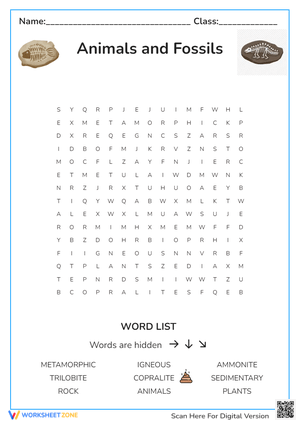
These 5th grade fossils worksheets resources address one of the more conceptually loaded topics in grade 5 Earth science: students must not only name and classify fossils but also read rock strata as evidence and make defensible claims about ancient environments. The set gives teachers structured practice for finding out whether students can do that reasoning — not just recall that fossils exist in old rocks.
The Specific Skills Each Worksheet Targets
Fossil work at this grade covers more ground than a single vocabulary list. Across the set, students practice:
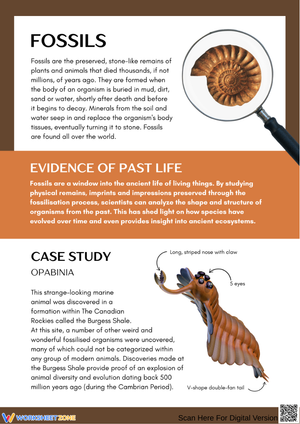
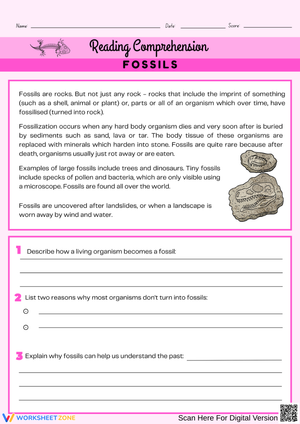
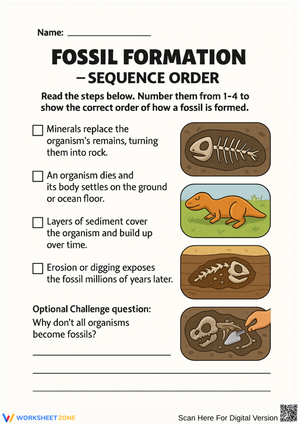
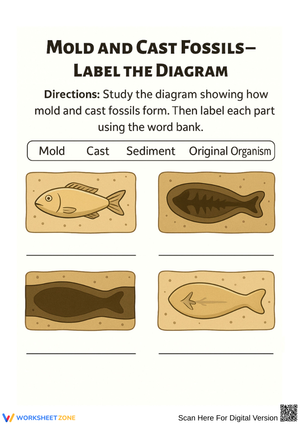
- Labeling a fossil formation sequence — organism death, sediment burial, preservation in rock — using anchor vocabulary in the correct order
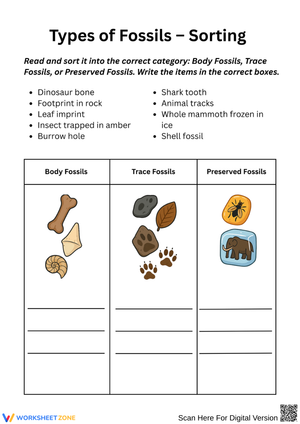
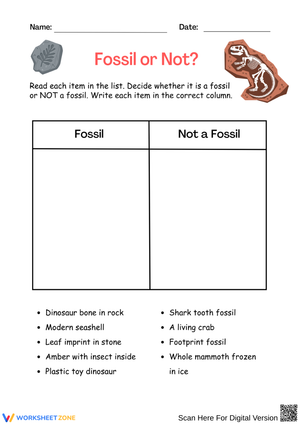
- Sorting fossil examples into body fossils (bones, shells, teeth, leaf impressions preserved in rock) and trace fossils (footprints, burrows, feeding tracks)
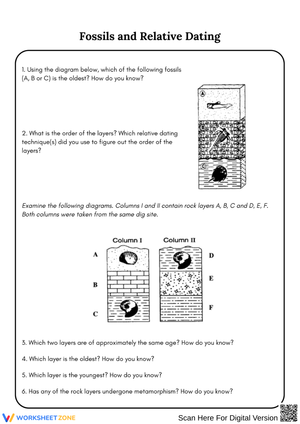
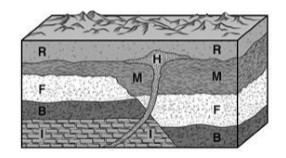
- Reading a labeled rock layer diagram and identifying which fossil is older based on its position in undisturbed strata
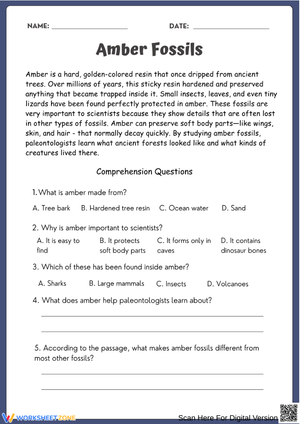
- Writing short evidence-based responses connecting a specific fossil to what it suggests about a past organism or environment
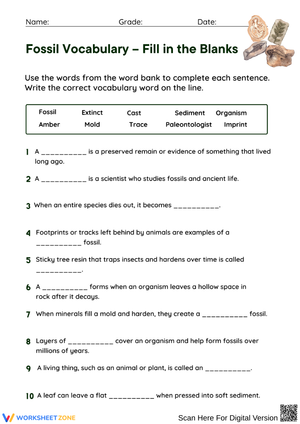
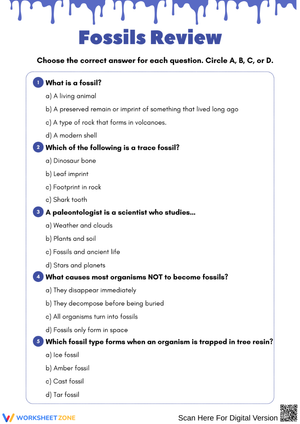
- Matching science terms to student-accessible definitions without relying on memorized phrases pulled from a textbook
The short explanation prompts carry as much diagnostic weight as the identification tasks. A student who correctly checks "trace fossil" next to a footprint example may still write that the footprint "proves animals lived there" rather than "provides evidence that animals moved through that area." That difference in precision — between a scientific claim and an overstatement — is exactly what written responses reveal, and it shapes the feedback worth giving before a formal assessment.
Student Error Patterns Worth Tracking Early
The body fossil / trace fossil distinction produces the most consistent confusion. A student will correctly classify a shell as a body fossil, then mark a leaf impression as a trace fossil because "the leaf isn't there anymore, just the shape." From a student's perspective, that logic has surface plausibility — the original leaf material is gone. But the defining criterion is not whether the original material remains; it is whether the fossil preserves direct structural evidence of the organism's body. Worksheets that ask students to justify their sorting choices, rather than only check a box, catch this specific error before it shows up on a quiz.
Rock layer sequencing generates a different class of mistake. Students generally accept that lower layers are older, but many apply the rule as absolute rather than conditional. Show them a diagram with visibly folded or disrupted strata, and most grade 5 students will still pick the bottom layer as oldest because the rule feels permanent. Most worksheets at this level appropriately stay with undisturbed strata, which is the right instructional choice, but teachers should add a brief qualifier when debriefing: this rule holds for rock layers that have not been disturbed. Students who hear only the simplified version over-generalize it on assessments.
A third persistent issue is the language students use to describe what fossil evidence does. "This fossil proves..." appears constantly in student writing. Science at this grade insists on the weaker, more accurate claim: "This fossil suggests..." or "This fossil provides evidence that...." That is not a cosmetic difference — it reflects whether students understand how evidence functions in scientific reasoning. Addressing it directly when you review the short-answer items together as a class pays off on the next written task.
Fitting These Worksheets Into Your Instructional Week
The most productive placement for a fossils worksheet is immediately after direct instruction, not before it. When students have a class anchor chart, a labeled formation diagram from the lesson, and a shared discussion of body versus trace fossils to draw on, the written tasks become application rather than cold introduction. Five to eight minutes of shared review before distributing the worksheet makes a visible difference in the quality of the short answers students produce — especially on the evidence-based explanation items.
For substitute days or end-of-unit review, a 5th grade fossils worksheets set is a practical choice because the visual diagrams reduce the reading load and the tasks direct themselves well enough that students can work through them with minimal additional instructions. In centers, sorting worksheets work well as partner activities: one student names the fossil type, the other explains the reasoning, and they trade roles for the next example. That verbal step before writing tends to produce stronger explanations than having students write in silence from the start.
For fast formative data, the most informative combination is one labeling task, one sorting task, and one short explanation prompt. You can scan the first two items quickly and read the explanations for evidence of actual reasoning. That three-task structure fits into the last eight to ten minutes of class as a closing check before students pack up.
Standard Alignment
These worksheets align to NGSS 3-LS4-1, which asks students to analyze and interpret data from fossils as evidence of organisms and environments from the past. The standard is introduced in grade 3, but grade 5 revisits fossil concepts with increased demand for evidence-based writing and more complex visual interpretation — particularly diagrams involving multiple rock layers and relative age comparisons. At grade 5, fossil work also connects to the crosscutting concept of Patterns, since students are asked to identify trends in fossil position and distribution rather than simply naming what a fossil is. Teachers working outside NGSS frameworks should check how their state locates fossil evidence within its Earth science progression; the content typically appears in grades 4 through 6 depending on how the state organizes its science strand.
Adjusting the Worksheets Across Student Readiness Levels
For students who need more support entering the content, diagram-based tasks with a word bank are the most accessible starting point. Supplying the formation vocabulary — sediment, buried, preserved, organism — lets students focus on conceptual sequence rather than retrieval. Removing the word bank for students who already have that vocabulary raises the demand without restructuring the task. The same principle applies to sorting worksheets: three to four fossil examples make a manageable task for students still building the underlying concepts, while eight to ten examples extend the same thinking for students who work through the shorter version quickly.
A 5th grade fossils worksheets set distributes well across ability groups when the short-answer component is adjusted by structural support rather than by topic. Students who are still developing confidence with science writing work more successfully with a sentence frame: "This fossil provides evidence that ______ because ______." Students ready to write independently skip the frame entirely. The evidence-based reasoning is the same expectation; only the entry structure differs. For students who have already mastered the core content, the more productive extension is comparing two fossils from different rock layers and making a claim about what environmental change the position difference suggests — a task that moves beyond identification into genuine paleoenvironmental reasoning and keeps fast finishers doing real science thinking.
Frequently Asked Questions
What background knowledge should students have before working through these worksheets?
Students should know that fossils are preserved remains or traces of ancient organisms, that fossilization commonly begins when remains are buried under sediment, and that lower rock layers in undisturbed strata are older than upper layers. Those three anchor ideas are enough to approach the labeling, sorting, and short explanation tasks without needing a full geologic vocabulary first.
How does the body fossil / trace fossil distinction show up in these worksheets, and why does it matter at this grade?
Body fossils preserve direct physical evidence of an organism's structure — bones, shells, teeth, or the rock impression of a leaf's shape. Trace fossils record behavior: footprints, burrows, or feeding marks. At grade 5, the distinction matters because it shifts students from thinking of fossils as generic "old things in rocks" to recognizing two categories of evidence that answer different questions. A footprint tells you something about movement and behavior; a shell tells you about body structure. Sorting tasks in these worksheets make that difference concrete rather than definitional.
Can these worksheets support small-group reteaching after a unit assessment?
Yes, and the diagram-plus-explanation format makes them well suited for that work. A 5th grade fossils worksheets resource that combines visual tasks with short written responses lets you stop mid-worksheet with a group of three or four students to talk through the reasoning before they write. You can identify quickly whether the breakdown is in reading the diagram, recalling the vocabulary, or expressing the concept in writing — and adjust your reteaching to match rather than re-teaching the entire lesson.
How long does each worksheet typically take to complete?
Most fossil worksheets at grade 5 run fifteen to twenty-five minutes depending on the number of short-answer items and whether the worksheet includes a reading passage or works from diagrams alone. Teachers generally use one worksheet per lesson rather than assigning several at once, which lets each task serve a specific instructional purpose — post-lesson review, formative check, or center activity — rather than becoming rushed homework with minimal thinking behind the answers.












 Interactive Worksheet Maker
 Quiz Maker
 Word Search Maker
 Crossword Puzzle Maker
 Word Scramble Generator
 Sentence Scramble Generator
 Handwriting Worksheet Generator
 Name Tracing Generator
 Fill In The Blank Generator