These 5th grade earth s rotation and revolution printable worksheets give teachers a reliable set of resources for one of the trickier conceptual shifts in upper-elementary science — getting students to stop thinking the sun is moving and start recognizing that the ground beneath their feet is what's spinning. Each worksheet targets a specific aspect of planetary motion, from labeling axial tilt diagrams to analyzing daylight-hour data, so teachers can sequence the practice to match where the class actually is in the unit.
The Specific Skills These Worksheets Build
The set works across four areas:
- Comparison charts ask students to record the timeframe, axis or path involved, and observable effect for both rotation and revolution side by side — the contrast is forced, which is the point.
- Diagram-labeling exercises require students to identify Earth's position at each solstice and equinox, mark the incoming sunlight direction, and shade which hemisphere is receiving more direct light.
- Data analysis worksheets present actual sunrise and sunset times across several months; students graph those values and then explain the pattern in a written response.
- Vocabulary exercises establish terms like elliptical orbit, axis, solstice, and equinox before students encounter them in extended writing or end-of-unit assessments.
Patterns in Student Error Worth Anticipating
The most persistent misconception at this grade level is the cause of seasons. Students who can correctly state that Earth revolves around the sun will still write "in summer, Earth is closer to the sun" when asked to explain warm temperatures. The reasoning feels right because it matches everyday experience — moving toward a fire makes you warmer. The diagram worksheets address this directly by showing Earth at its orbital aphelion during Northern Hemisphere summer, then asking students to annotate the incoming sunlight angle. When students draw those arrows themselves, they confront geometry that contradicts the distance explanation in a way that reading a correction in a textbook does not.
A second error shows up on comparison charts: students write "revolution — 24 hours — the axis" without noticing that every piece of information on that row belongs to rotation. It is not careless work; they genuinely have not sorted the two terms yet. The side-by-side format makes this visible to both student and teacher immediately. Running a brief body-model activity before handing out the chart — one student spins in place, then walks a slow orbit around a classroom lamp while still spinning — clears most of this confusion before a pencil touches the worksheet.
Fitting These Worksheets Into Your Week
The vocabulary and comparison chart worksheets belong at the start of the unit, before any physical demonstration. Students who arrive at the body-model activity with the terms already partly sorted can narrate what they are doing — "right now I'm rotating and also revolving" — rather than just moving through the motions. That narration is where the definitions actually settle in, and it shortens the time you spend correcting reversed terms in written work later.
Data analysis worksheets work best as a mid-unit checkpoint. When students graph sunrise and sunset times during week two, teachers get formative evidence about whether students understand why December has less daylight than June — evidence you can still act on. The diagram-labeling worksheets are better placed at the end of the unit because applying axial tilt to four orbital positions at once is a synthesis task, not an introductory one.
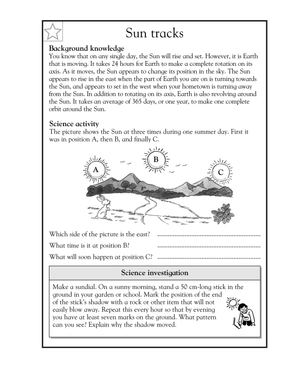
For classes doing shadow-tracking outside, run the playground measurement and the graphing worksheet on the same afternoon. Students measure a flagpole shadow at two or three points during the school day, return inside, and plot those values on the worksheet. Same-day pairing keeps the physical observation vivid during the analysis step.
Standard Alignment
The 5th grade earth s rotation and revolution printable worksheets align to NGSS 5-ESS1-2, which sits under Earth's Place in the Universe and calls on students to represent observational data in graphical displays to reveal patterns in shadow length and direction, day-and-night cycles, and the seasonal appearance of certain stars. The standard does not ask for memorized facts about orbital mechanics — it requires data representation and pattern explanation. That distinction matters for how you deploy the resources. The graphing and diagram activities directly serve the evidence-and-reasoning demand; the vocabulary and comparison charts build the conceptual background students need to write coherent explanations of what they find.
How to Use the Set Across a Mixed-Ability Class
For students still building content vocabulary, the comparison chart works better when the row labels — timeframe, axis or path, observable effect — are pre-filled. Students who already understand that rotation causes day and night can move directly to the data analysis worksheet and add a written justification for each trend they graph, which pushes toward scientific argumentation before the unit ends.
English language learners at this level often handle the diagram-labeling exercises with considerably less difficulty than the prose-heavy data analysis worksheets, so sequencing the diagram work first gives them an accessible entry point before they encounter denser text. For students who work through the set quickly, the 5th grade earth s rotation and revolution printable worksheets extend naturally into a comparison task: students look up another planet's axial tilt — Uranus sits at roughly 98 degrees — and annotate a blank orbital diagram to show what seasonal patterns on that planet might look like.
Frequently Asked Questions
What is the clearest way to explain the difference between rotation and revolution to a 10-year-old?
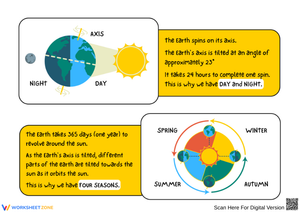
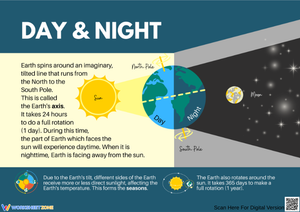
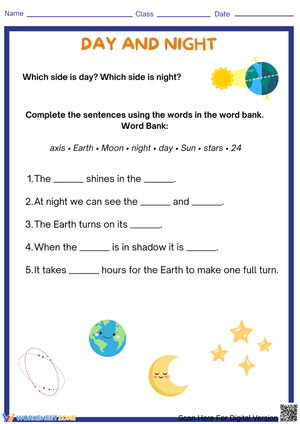
Rotation is what a spinning top does — the object turns around a center point inside itself. Revolution is what a ball on a string does when swung overhead — the object travels around an external center. Pair each term with a specific timeframe and effect: rotation equals 24 hours and produces day and night; revolution equals 365.25 days and, combined with axial tilt, produces the seasons. Having students say both sentences aloud before writing them on the comparison chart lowers the mix-up rate noticeably.
How do these worksheets address the seasons misconception directly?
The diagram-labeling worksheets show Earth at four positions in its orbit while keeping the axial tilt consistent across all four. Students draw incoming sunlight angles and shade the hemisphere receiving more direct light at each position. Because students construct the geometry themselves rather than read a description of it, the tilt-not-distance cause of seasons becomes something they worked out rather than something they were told — which is the difference between a correction that holds and one that doesn't.
Can a teacher use individual worksheets mid-unit rather than the full set at once?
Because the 5th grade earth s rotation and revolution printable worksheets are standalone resources, teachers can use any single worksheet at any point in the unit. The vocabulary worksheet works as a mid-unit review tool. The data analysis worksheet fits naturally as a formative check after a lab. The diagram worksheets are flexible enough to use before the main lesson as a pre-assessment or afterward as confirmation practice.
Do the graphing worksheets require extra materials beyond the worksheet itself?
Students need a pencil and a ruler to plot data points accurately. Graph paper is not required — each worksheet includes pre-drawn axes with labeled scales. For classes also running the shadow-tracking activity, a measuring tape or meter stick is needed outside, but all recording and analysis work happens on the worksheet at students' desks.












 Interactive Worksheet Maker
 Quiz Maker
 Word Search Maker
 Crossword Puzzle Maker
 Word Scramble Generator
 Sentence Scramble Generator
 Handwriting Worksheet Generator
 Name Tracing Generator
 Fill In The Blank Generator