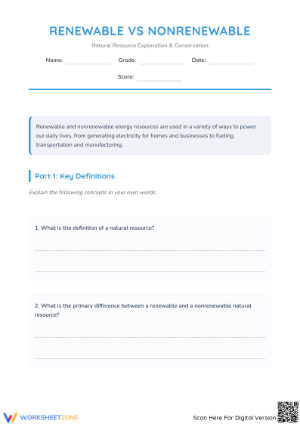
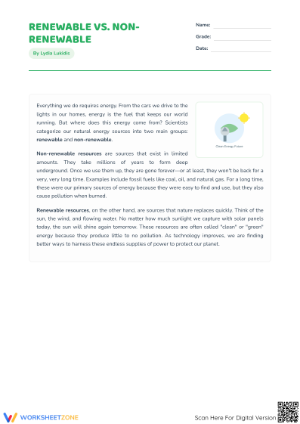
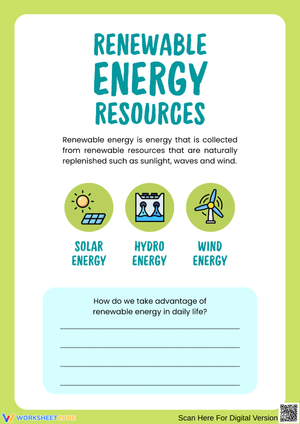
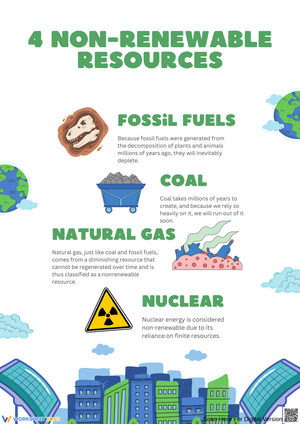
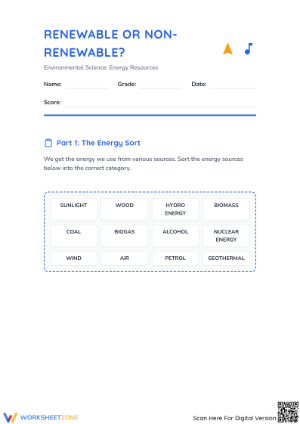
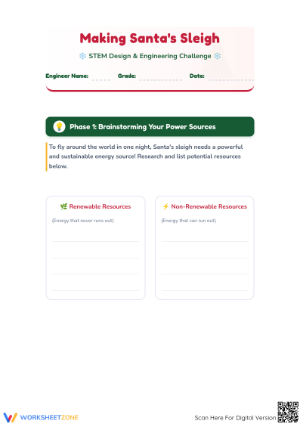
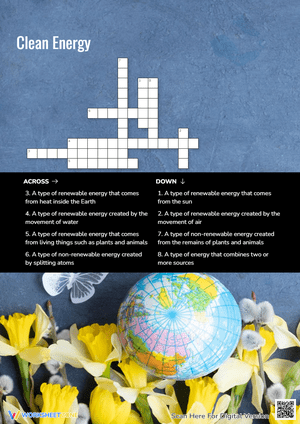
These renewable and nonrenewable resources worksheets for 5th grade give teachers a direct path from vocabulary introduction to explanatory reasoning — sorting, matching, and short-answer tasks that show whether students actually understand why a resource belongs in a category or are simply pattern-matching off a memorized list. Each worksheet stands alone, so the set works across guided practice, center work, homework, and end-of-lesson formative checks without needing to be run in a fixed order.
Student Errors Worth Anticipating Before the Lesson Starts
The most durable misconception at this grade level is that renewable means unlimited. A student who correctly identifies sunlight as renewable will still write "we never have to worry about solar energy running out" — a conclusion that misses how availability depends on conditions: cloud cover, geography, time of day. When a worksheet asks students to explain why a resource is renewable rather than just circle the right column, that error becomes visible. Without the explanation step, teachers have no way to know which students hold this belief until it shows up on a unit assessment.
Gasoline is a reliable problem case. Fifth graders tend to see gasoline as something that comes from a gas station, not as a refined product extracted from a nonrenewable underground deposit. A matching task that traces gasoline back to crude oil — and asks students to explain why gasoline therefore counts as nonrenewable — does more instructional work than a sort-and-circle prompt alone. Teachers who skip this connection often find students confused later when the class moves into discussions of oil spills or community energy decisions.
There is also the nature-equals-renewable assumption. Students classify wood, soil, and living things as renewable without asking how long replenishment actually takes. The category rule — replacement rate relative to human use — needs direct, repeated practice. Familiarity with examples does not substitute for understanding the underlying logic, and worksheets that return to the rule in every prompt help students internalize it rather than fake it.
What Each Worksheet Asks Students to Do
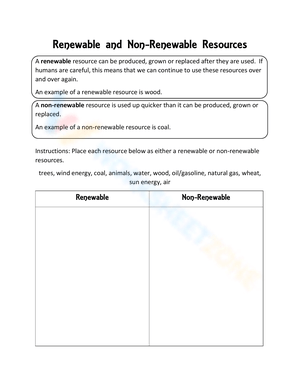
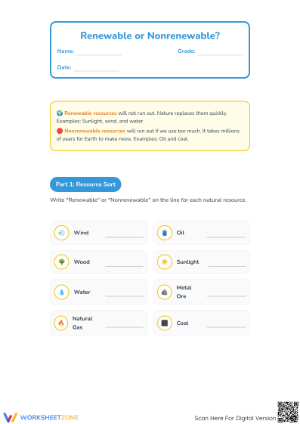
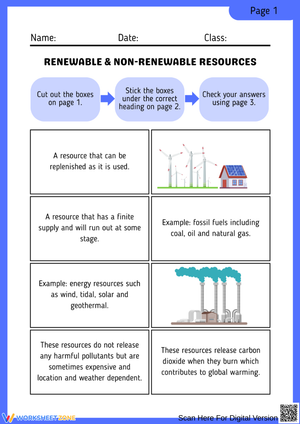
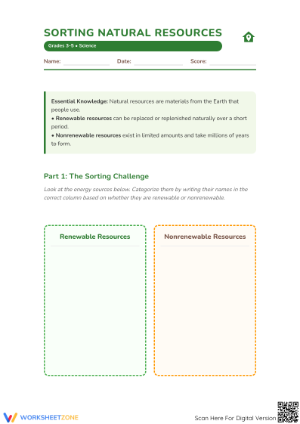
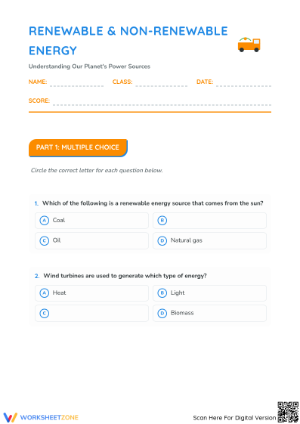
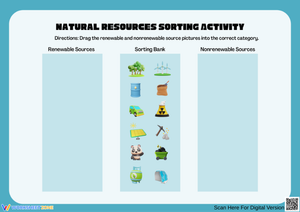
The set targets a progression of thinking. Entry-level tasks ask students to sort a list of common resources — solar, wind, coal, oil, natural gas, geothermal energy, water, uranium, biomass — into the correct category. Those tasks build the baseline vocabulary needed for every later question. Middle-level tasks shift toward matching: connecting a resource to a real-world use, then briefly explaining why the connection holds. The explanation tasks are where thinking becomes measurable — one or two sentences that justify a classification using the category rule, not surface memory.
- Sorting: Classify familiar resources by type, including everyday examples students encounter outside school.
- Matching: Connect resources to real-world uses, including processed fuels like gasoline that students frequently misplace.
- Explaining: Write the reasoning behind a classification in terms of replenishment rate, not just the label.
- Applying: Identify a community or personal choice that supports conservation and explain why it matters for a specific resource.
That application step is worth keeping, even when time is short. Students who can sort and match but cannot connect resource classification to conservation choices are missing the part of the standard that matters most in upper-elementary Earth science.
Standard Alignment
When evaluating a renewable and nonrenewable resources worksheets for 5th grade against NGSS expectations, the relevant performance expectation is 5-ESS3-1 (Earth and Human Activity). That standard asks students to obtain and combine information about the ways communities use science ideas to protect Earth's resources and environment. The key word is "combine" — students are expected to connect resource classification to conservation decisions, not treat them as two separate topics. The worksheets address both layers: sorting and matching tasks build the vocabulary side, while the explanation and conservation prompts target the reasoning the standard actually measures.
How to Fit These Worksheets Into a Science Unit Without Losing Instructional Momentum
At the start of a lesson, a four- or five-item classification task works as a warm-up that activates prior knowledge without consuming the first fifteen minutes. After direct instruction, a worksheet that includes both a sort and a written explanation works for guided practice — the teacher reads the prompt aloud, students draft a response, and the class refines answers together before anyone moves to independent work. That sequence takes about ten minutes and gives teachers a real-time check on whether the mini-lesson actually landed.
Center rotations are where the set holds up best. A sorting-and-explanation worksheet gives students enough structured work to sustain about twelve to fifteen minutes independently while the teacher runs a reteach group. The conservation application question is most useful in that setting, because it surfaces exactly which students are transferring the concept and which are still relying on memorized labels. If a student writes "recycle more to make nonrenewable resources last longer" without connecting recycling to a specific resource, the teacher has a precise correction to make the next day — not a vague sense that the student needs more work.
For homework and sub plans, these worksheets hold up because the directions are self-contained. A substitute unfamiliar with the unit can distribute them and get usable work back. When students return the next day, the written responses function as a formative snapshot: which students sorted correctly but explained poorly, which students made the conservation connection independently, and which students need the underlying rule retaught before the class moves forward.
Differentiating the Set Across a Range of Learners
The same renewable and nonrenewable resources worksheets for 5th grade serves a wider band of learners when teachers adjust the explanation requirement rather than swapping out the examples entirely. Students who are still building science vocabulary benefit from a word bank alongside the explanation prompt — not because the task gets easier, but because cognitive effort stays focused on the reasoning rather than word retrieval. Providing terms like "replenished," "limited," and "human timescale" and asking students to use at least two in their explanation keeps the intellectual demand intact while removing an unnecessary barrier.
For students who move through the sorting and matching tasks quickly, the most productive extension is not more examples — it is harder application. Ask them to evaluate a specific community decision, such as a city switching street lighting from coal-generated electricity to solar panels, and write which resources are affected and why the switch matters. That kind of analysis draws on the same category knowledge but requires students to apply it to a novel situation, which is where the concept actually transfers.
Students who consistently struggle with the written explanation often do better with a sentence frame used across multiple sessions: This resource is [renewable / nonrenewable] because it [is naturally replenished / takes millions of years to form and cannot be replaced on a human timescale]. After three or four uses of that frame, many students begin generating their own phrasing. The frame functions as a temporary support structure, not a permanent substitute for reasoning, and removing it gradually — first from familiar examples, then from new ones — gives teachers a clear picture of when the concept has actually taken hold.
Frequently Asked Questions
What is the difference between renewable and nonrenewable resources for 5th graders?
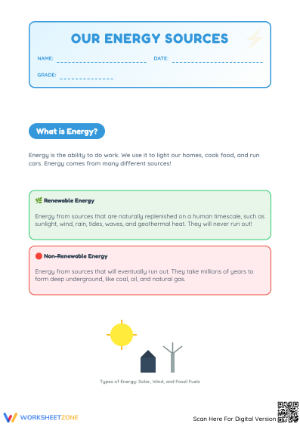
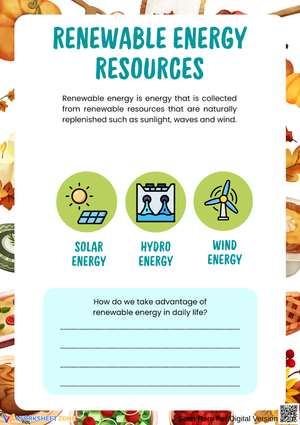
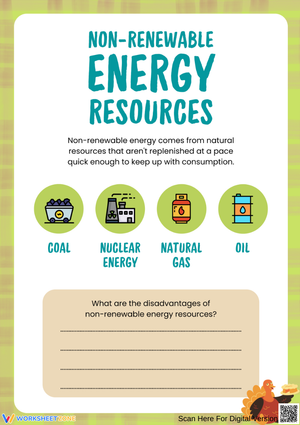
Renewable resources are naturally replenished, though availability can depend on conditions like sunlight, wind, or water flow — which means renewable does not mean unlimited. Nonrenewable resources are limited or form so slowly that human use depletes them faster than they can be replaced. Fifth graders should be able to sort examples into each category and explain the reasoning behind the classification, not just recall names from a list.
Which specific examples should students at this grade level recognize?
Students should recognize renewable examples including solar, wind, water, geothermal energy, and biomass, along with nonrenewable examples including coal, oil, natural gas, and uranium. Gasoline is a useful edge case — it is a processed fuel, but it traces back to crude oil, so students should be able to explain why it belongs with nonrenewable resources. That particular connection is frequently tested and frequently missed.
How does this set connect to the 5-ESS3-1 standard in practical terms?
5-ESS3-1 asks students to combine information about how communities protect Earth's resources and environment — which means classification alone does not fulfill the expectation. Each worksheet in the set builds toward that combination: sorting and matching tasks establish the vocabulary, while explanation and conservation prompts require students to connect resource type to real decisions. A student who can sort examples correctly but cannot explain why a community choice matters has not yet reached what the standard describes.
Can these worksheets work for homework, sub days, and review, or are they only suited for direct instruction?
Teachers reach for a renewable and nonrenewable resources worksheets for 5th grade in a range of settings — unit review, sub plans, science centers, and take-home practice — because the tasks are self-contained and the directions do not require classroom setup or teacher explanation to follow. The most productive results come when at least one explanation prompt is included rather than a sort alone, so that returned work gives teachers something to read and respond to rather than just a completion check.












 Interactive Worksheet Maker
 Quiz Maker
 Word Search Maker
 Crossword Puzzle Maker
 Word Scramble Generator
 Sentence Scramble Generator
 Handwriting Worksheet Generator
 Name Tracing Generator
 Fill In The Blank Generator