




























Views
Downloads

Essential Sun Tracks & Earth Rotation Worksheet | Grade 5

Paste this activity's link or code into your existing LMS (Google Classroom, Canvas, Teams, Schoology, Moodle, etc.).
Students can open and work on the activity right away, with no student login required.
You'll still be able to track student progress and results from your teacher account.
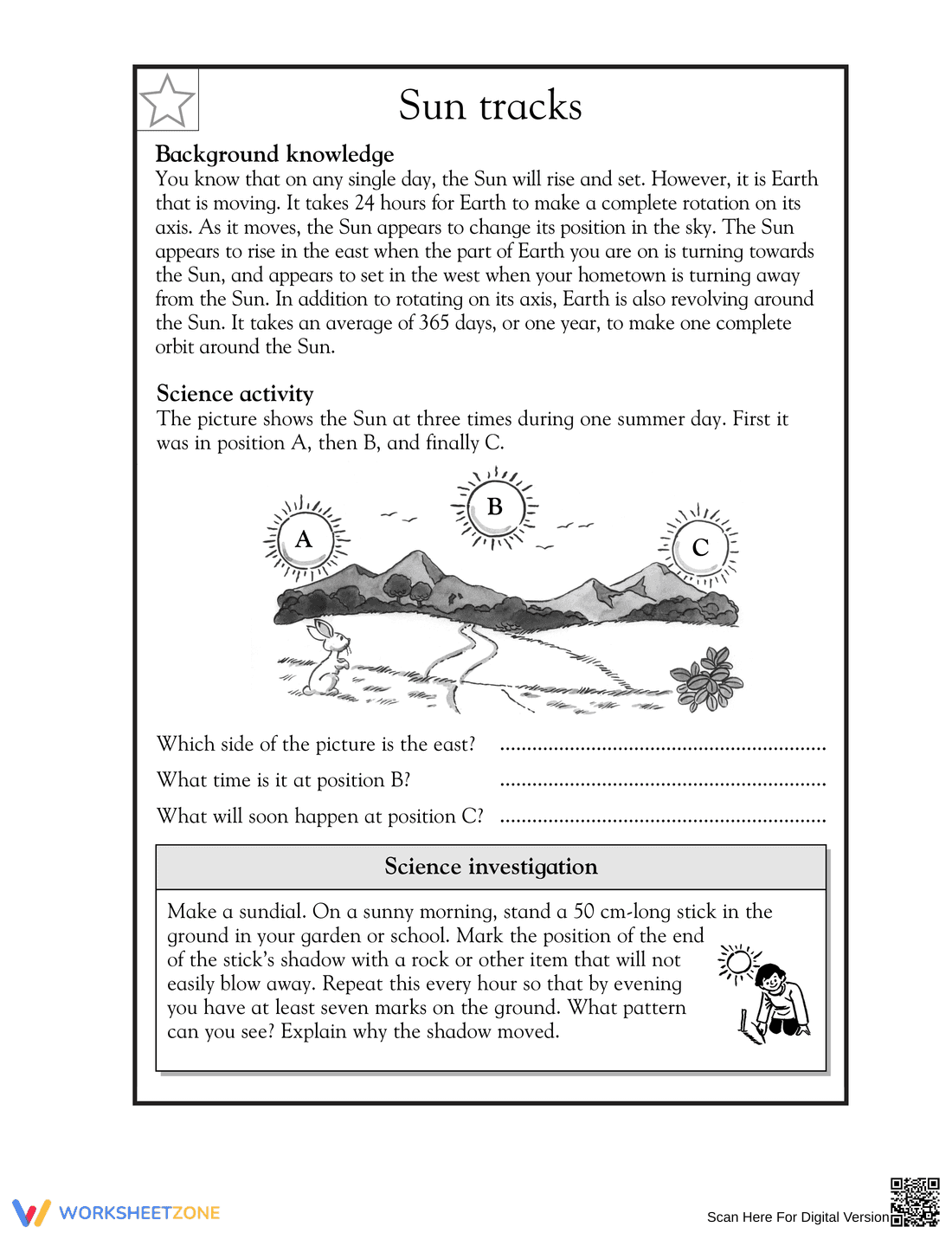
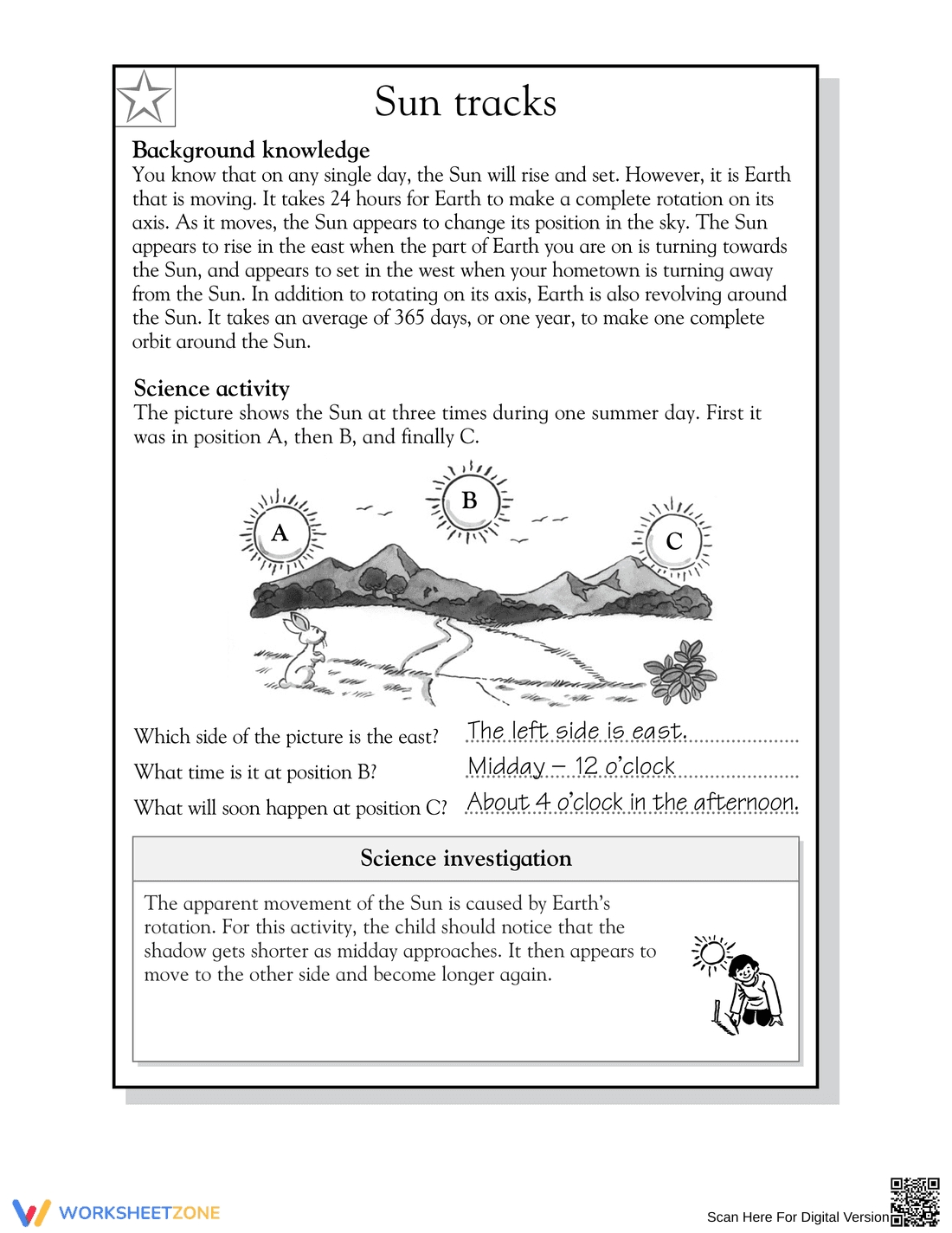
Students master the relationship between Earth’s rotation and the Sun’s apparent movement with this comprehensive Grade 5 science worksheet. By analyzing sun tracks and engaging in a hands-on investigation, learners translate astronomical concepts into observable patterns. This resource ensures students can accurately predict solar positions based on time and cardinal directions.
At a Glance
- Grade: 5 · Subject: Science
- Standard:
5-ESS1-2— Represent data to reveal patterns of daily changes in shadows and day- Skill Focus: Earth's rotation and apparent solar motion
- Format: 1 page · 4 tasks · Answer key included · PDF
- Best For: Earth science introduction or assessment
- Time: 25–35 minutes
This single-page PDF features three instructional segments. It includes a background summary on rotation, a visual diagram of the Sun at three positions (A, B, and C), and three critical-thinking questions. A "Science Investigation" section provides steps for creating a 50 cm stick sundial to track shadow movements throughout the school day.
Print the single-page worksheet for your cohort (1 minute). Distribute materials and allow students to analyze the "Sun tracks" diagram independently (15 minutes). Finally, review the cardinal direction and time answers using the included key (5 minutes). Total teacher preparation time is under 2 minutes, making this an ideal sub-plan or classroom supplement.
This resource aligns with `5-ESS1-2`. Students reveal patterns of daily changes in shadows and day/night cycles. The text addresses Earth’s 24-hour rotation specifically. This standard code can be copied directly into lesson plans, IEP goals, or district curriculum mapping tools to ensure instructional compliance and tracking.
Use this during the "Explain" phase of a science lesson. It bridges direct instruction and physical observation. For a formative assessment tip, watch for students struggling to identify "East" based on solar position; this indicates a need for cardinal direction remediation. Expect completion in 30 minutes, with the investigation occurring throughout the day.
Designed for Grade 5 science, this also suits Grade 4 review or Grade 6 remediation. It accommodates diverse learners through visual aids and hands-on projects. Pair this with a physical globe or a passage about timekeeping history. The investigation allows tactile learners to experience rotation concepts through shadow measurement.
The Sun Tracks worksheet bridges the gap between theoretical astronomy and observable phenomena by focusing on the `5-ESS1-2` standard. Students engage in spatial reasoning to determine the time of day based on the Sun’s arc, a core competency in Earth Science. Research from EdReports 2024 indicates that standards-aligned materials integrating hands-on investigations—like the 50 cm stick sundial project—significantly improve student retention of astronomical cycles. By requiring learners to identify cardinal directions relative to solar position, the activity reinforces the 24-hour rotation period of Earth. This dual-approach of diagram analysis and active experimentation ensures a multi-sensory understanding of how Earth's movement creates the illusion of sun tracks. Educators can utilize these findings to support the transition from basic identification to complex pattern recognition in elementary science curricula, fostering long-term academic success in STEM fields.


