




























Views
Downloads

Grade 5 Earth Rotation — Printable No-Prep Worksheet

Paste this activity's link or code into your existing LMS (Google Classroom, Canvas, Teams, Schoology, Moodle, etc.).
Students can open and work on the activity right away, with no student login required.
You'll still be able to track student progress and results from your teacher account.
This Grade 5 science worksheet provides a solid introduction to Earth's rotation and the day/night cycle. By combining background knowledge with a time-zone scenario and a hands-on modeling investigation, students develop a concrete understanding of how planetary motion affects geographic locations. This resource is perfect for teaching orbital mechanics in a classroom setting.
At a Glance
- Grade: 5 · Subject: Science
- Standard:
5-ESS1-2— Represent data to reveal patterns of daily changes in day and night- Skill Focus: Earth's rotation and day/night cycles
- Format: 1 page · 2 tasks · Answer key included · PDF
- Best For: Classroom science activity or homework assignment
- Time: 30–45 minutes
What's Inside
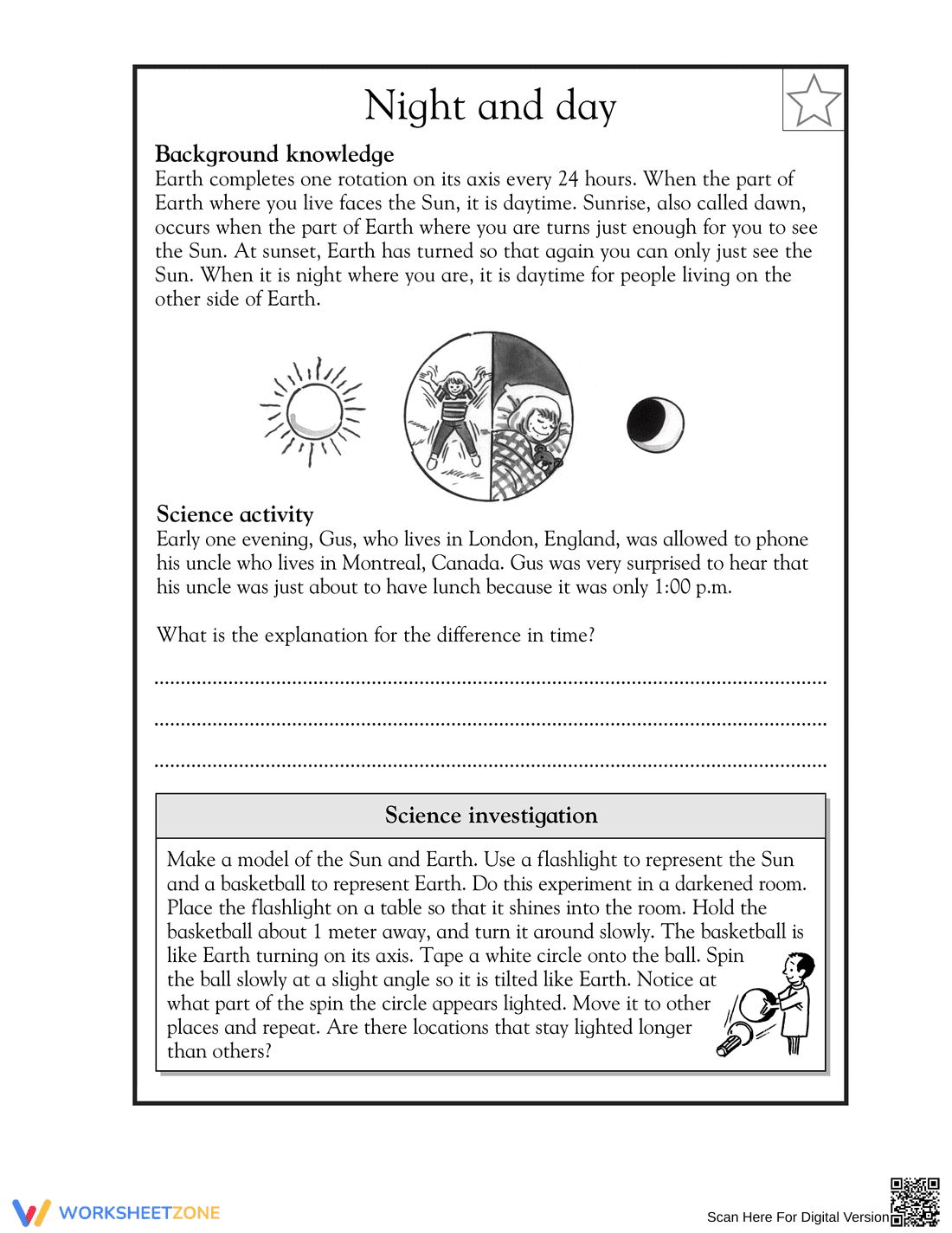
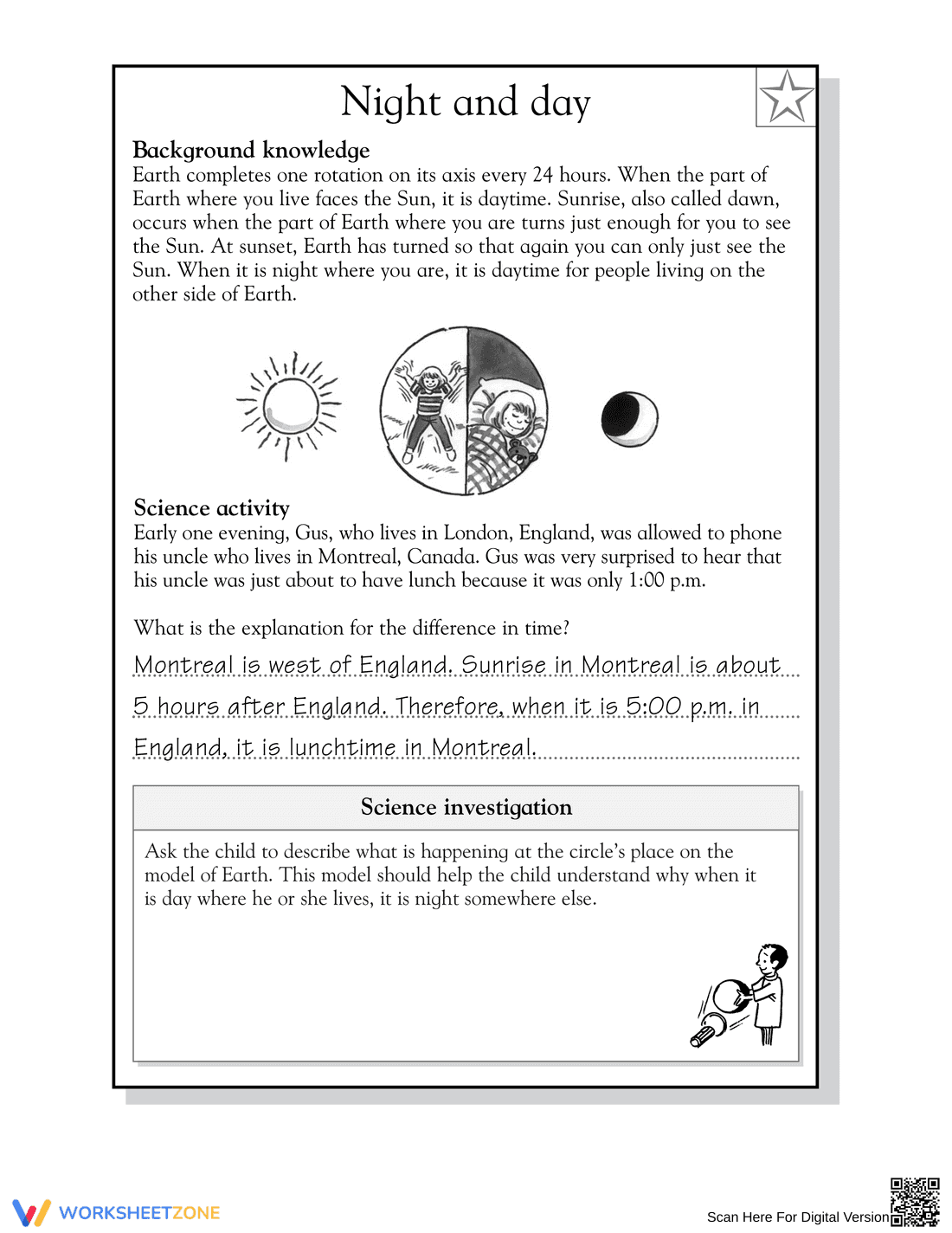
This single-page resource is packed with instructional value. It begins with a clear "Background Knowledge" section that explains the 24-hour rotation cycle. This is followed by a "Science Activity" requiring students to explain why it is 1:00 p.m. in Montreal while it is evening in London. Finally, the "Science Investigation" provides detailed instructions for a flashlight-and-basketball experiment to model the Sun-Earth relationship physically.
Zero-Prep Workflow
This worksheet requires minimal preparation. First, print the single-page PDF (under 1 minute). Second, distribute the sheets for students to read the background text (5 minutes). Third, facilitate the modeling experiment or assign the scenario as independent practice. Total teacher prep time is under 2 minutes, making it ideal for sub plans or quick lesson transitions.
Standards Alignment
Aligned with NGSS 5-ESS1-2, this resource focuses on daily patterns of day and night. Students model and explain the physical causes of light and darkness through rotation. Both standard codes can be copied directly into lesson plans, IEP goals, or district curriculum mapping tools, ensuring your instruction remains focused on mastery of fundamental Earth science concepts.
How to Use It
The best instructional moment for this worksheet is during the "Exploration" phase of a 5E lesson cycle. After a brief hook about time zones, give students the materials for the basketball and flashlight investigation to let them discover the mechanics of rotation themselves. Use the Gus and his uncle scenario as a formative assessment to observe if students can translate their physical model into a conceptual explanation.
Who It's For
This resource is tailored for fifth-grade students beginning their study of Earth and space systems. It is also suitable for fourth-grade enrichment or sixth-grade review. For students requiring more support, the background text serves as a built-in scaffold. It pairs naturally with a classroom globe or a direct instruction lesson on the cardinal directions and Earth's counter-clockwise rotation.
According to the RAND AIRS 2024 analysis of K-5 science curricula, hands-on modeling is a critical predictor of long-term retention in Earth Science domains. This worksheet aligns with the Fisher & Frey (2014) gradual release of responsibility model by providing front-loaded background knowledge before moving into guided application and independent modeling. By requiring students to explain the phenomena of day and night through both a narrative scenario (Gus in London) and a physical experiment, the resource addresses multiple learning modalities. The integration of 5-ESS1-2 standards ensures that students are not just memorizing facts about Earth's rotation but are actively engaging with the scientific patterns that define our 24-hour cycle. Research indicates that such integrated approaches significantly reduce the conceptual gap between observing natural phenomena and understanding their underlying physical causes in the elementary classroom.


