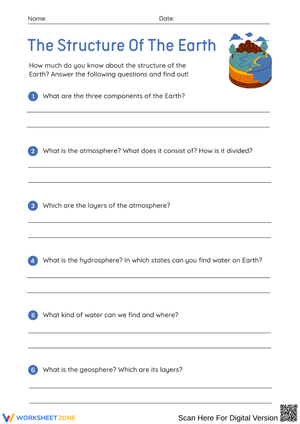
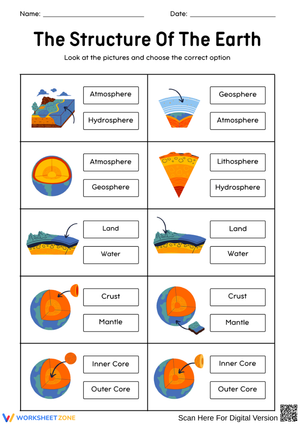
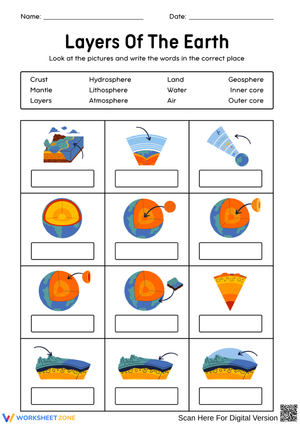
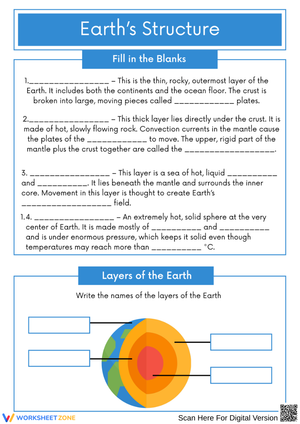
These 5th grade layers of the earth pdf worksheets give science teachers a ready-to-print set of tasks that move students from memorizing layer names to using them accurately within a model-based explanation of Earth's internal structure. The set covers the crust, mantle, outer core, and inner core — the four structures at the center of Grade 5 Earth science — through labeling, vocabulary matching, and short written responses. Each worksheet stands alone, so teachers can pull individual resources into a lesson sequence without redesigning the whole unit.
The Specific Skills Targeted Across the Set
Each worksheet focuses on one or two discrete tasks rather than cramming every learning target into one assignment — which matters at this grade because 5th graders are making a cognitive shift from direct observation to model-based reasoning. They cannot see inside the Earth, so every cross-section they label is an inferential representation built from scientific evidence. Keeping the task scope tight helps students build confidence with that kind of abstract thinking before adding further complexity.
The skills across the set include:
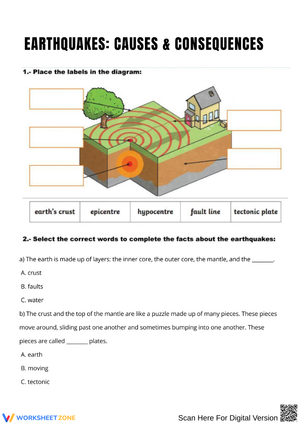
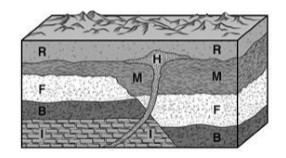
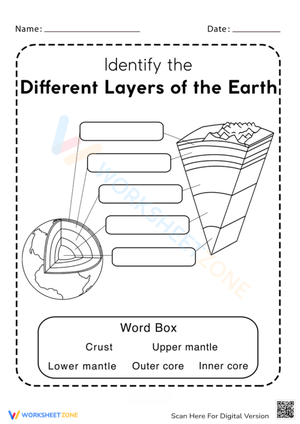
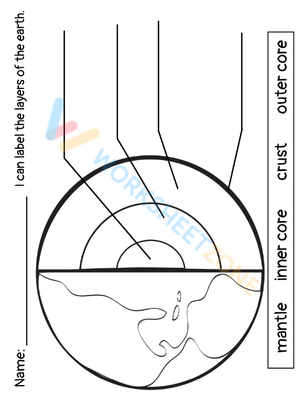
- Labeling a cutaway Earth diagram with all four layer names in correct order, from surface to center
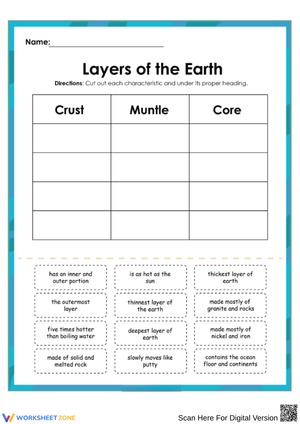
- Matching vocabulary terms to brief descriptions of each layer's composition and behavior
- Sorting facts about state of matter — solid or liquid — by layer
- Using domain terms like crust, mantle, outer core, and inner core in short written explanations
- Explaining in Grade 5 language why scientists rely on models to study Earth's interior
The labeling and matching tasks check recognition — can students place the right name in the right location? The written-response tasks check something harder: whether students can say something true and specific about what the model shows. Those two types of evidence are worth tracking separately in formative assessment because students often perform differently on each.
Error Patterns Worth Anticipating Before Students Start
Student work collected from 5th grade layers of the earth pdf worksheets shows two error patterns consistently enough to treat as anticipated rather than random. The first is layer-order confusion in the core region. Students encountering "outer core" and "inner core" for the first time frequently write inner core on the outermost of the two core layers, reasoning that "inner" describes the one closer to the surface rather than the one at the center. A labeling worksheet surfaces this within the first few minutes of class, before the misconception gets practiced and reinforced through repeated use.
The second pattern appears in state-of-matter questions. Many students apply solid to the outer core and liquid to the inner core — the reverse of the actual relationship — because the logic "deeper means more compressed means more solid" feels intuitively correct. When a worksheet asks students to sort layers by material state, that specific reversal shows up consistently enough that flagging it explicitly during the lesson debrief produces better results than simply marking the answer wrong.
There's also a structural limitation worth naming honestly: diagram-only worksheets can be completed by pattern-matching from a class anchor chart without genuine understanding. A student who copies the spatial arrangement correctly is not necessarily a student who can explain what each layer represents. That's why the written-response portions are not enrichment add-ons — they're the task component that tells you whether the labeling reflects actual comprehension or short-term visual memory.
How to Build These Worksheets Into Your Lesson Plans
These resources work best as checkpoints within a short instructional sequence rather than as standalone tasks. A practical structure across three days: begin with direct instruction and a shared class diagram naming the four layers; close that session with the labeling worksheet as an immediate follow-up. On day two, open with the vocabulary-matching worksheet as a warm-up — this reactivates the previous lesson's language before students encounter new information in a read-aloud or short text on Earth's interior. On day three, use a written-response worksheet as an exit ticket, asking students to explain what the cross-section model shows and why scientists represent Earth's interior that way.
Outside of a multi-day sequence, individual worksheets fit naturally into the twelve minutes at the end of a science block before transitioning to the next subject, Monday warm-ups to recover vocabulary that faded over the weekend, and station rotations during science center time. The PDF format makes it easy to project a worksheet on-screen during whole-class discussion, send individual worksheets home as review, or drop one into a sub plan with minimal setup instructions.
Standard Alignment
The primary standards connection at Grade 5 is NGSS 5-ESS2-1, which asks students to develop a model using an example to describe ways the geosphere, biosphere, hydrosphere, and atmosphere interact. These 5th grade layers of the earth pdf worksheets address that expectation by treating every labeled diagram as a working scientific model — students don't just fill in blanks; they practice using the model to name, describe, and explain Earth's internal structure as part of the geosphere.
In the typical Grade 5 Earth systems sequence, this performance expectation appears after students have built core vocabulary and before they are asked to connect the geosphere to other Earth systems like the hydrosphere or atmosphere. Labeling and vocabulary worksheets fit the model-building phase of that sequence. Written-response worksheets fit the model-using phase — which is where 5-ESS2-1 asks students to actually demonstrate understanding.
Serving Different Learners Without Creating Separate Materials
Because the visual and vocabulary are consistent across each worksheet, teachers can vary what students do with the materials rather than preparing entirely separate resources. Students who need more support can work through the labeling task with a word bank visible, focusing on correct layer placement. Students ready for additional depth can complete the same task and then respond to a further oral or written prompt — "Which layer is associated with Earth's magnetic field, and what in this diagram gives you that information?" — without a different worksheet in front of them.
For students who process more slowly or need two passes at new content, reusing each worksheet across two sessions — labeling in the first, writing a brief explanation in the second — reduces cognitive load without reducing rigor. The familiar diagram removes the "what am I looking at?" processing step that stalls some learners when they encounter an unfamiliar visual, leaving more mental bandwidth for the actual science content.
Frequently Asked Questions
What should 5th graders know about Earth's layers by the end of this unit?
Students should be able to name and order all four layers on a model, correctly identify that the outer core is liquid while the inner core is solid, and explain in Grade 5 terms why scientists use models to represent parts of Earth they cannot directly observe. That combination — layer recall, state-of-matter understanding, and model-based reasoning — reflects what NGSS 5-ESS2-1 asks students to demonstrate at this grade level.
Are these worksheets available as printable PDF files?
Yes. These 5th grade layers of the earth pdf worksheets download as print-ready files formatted for standard paper. Teachers can print class sets, project individual worksheets during whole-group instruction, or send them home as review tasks without any additional formatting work.
Can individual worksheets from the set work as exit tickets or quick formative checks?
They work well in that role. A labeling worksheet takes most 5th graders five to eight minutes to complete, which fits a standard exit-ticket window at the end of a science block. The written-response worksheets take a few more minutes but give clearer evidence of whether a student understands the model or is simply reproducing a memorized label arrangement.
How are these worksheets different from a generic Earth diagram printout?
A generic diagram asks students to copy labels onto a picture. These worksheets ask students to do something with the diagram — sort information by layer, write an explanation, or match vocabulary to meaning — which produces usable formative data rather than completed paperwork. That distinction matters when the goal is to see who understands what the model represents versus who has memorized a spatial pattern.












 Interactive Worksheet Maker
 Quiz Maker
 Word Search Maker
 Crossword Puzzle Maker
 Word Scramble Generator
 Sentence Scramble Generator
 Handwriting Worksheet Generator
 Name Tracing Generator
 Fill In The Blank Generator