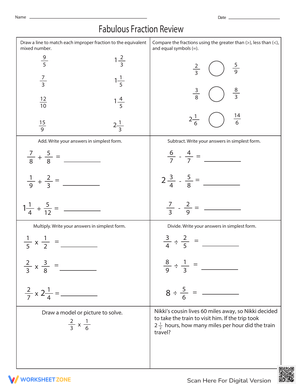
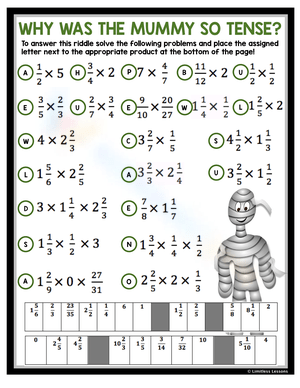
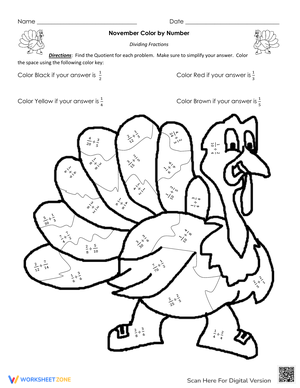
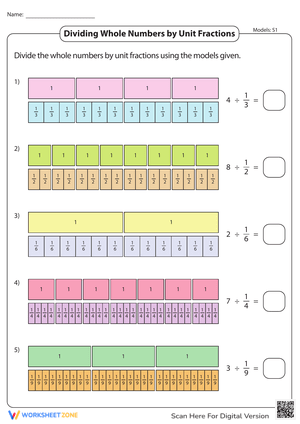
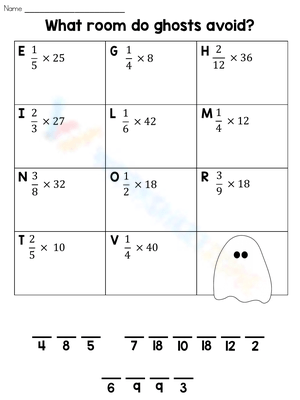
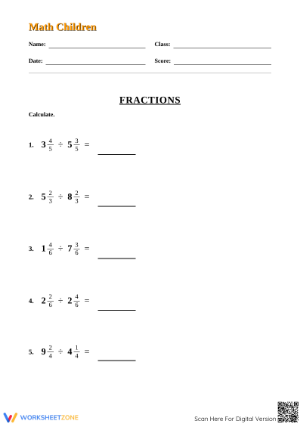
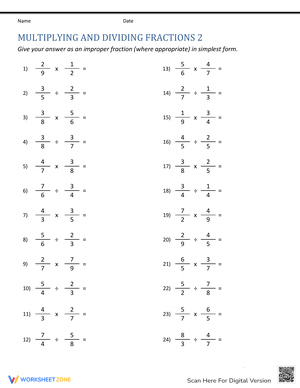
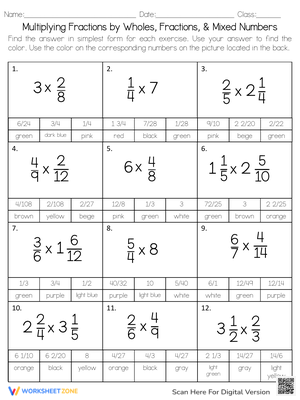
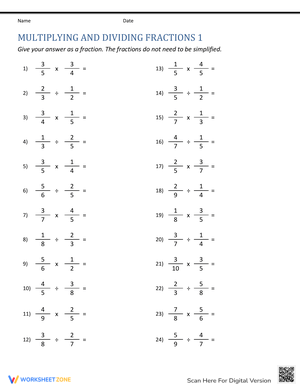
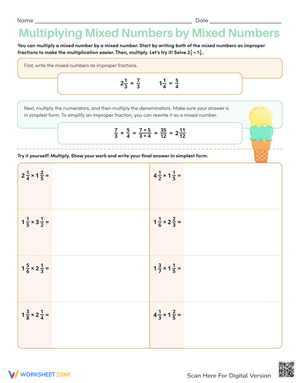
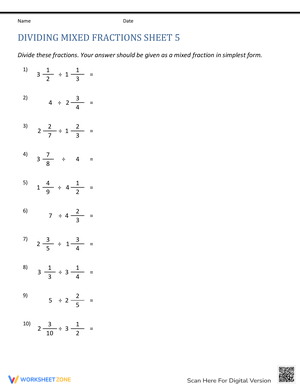
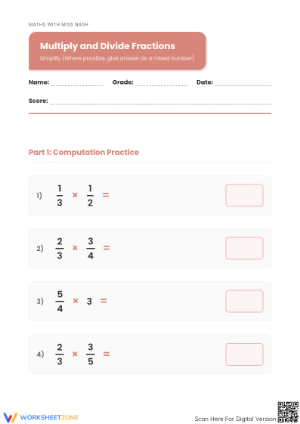
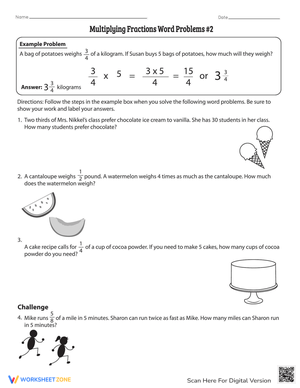
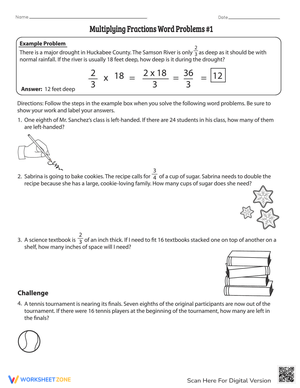
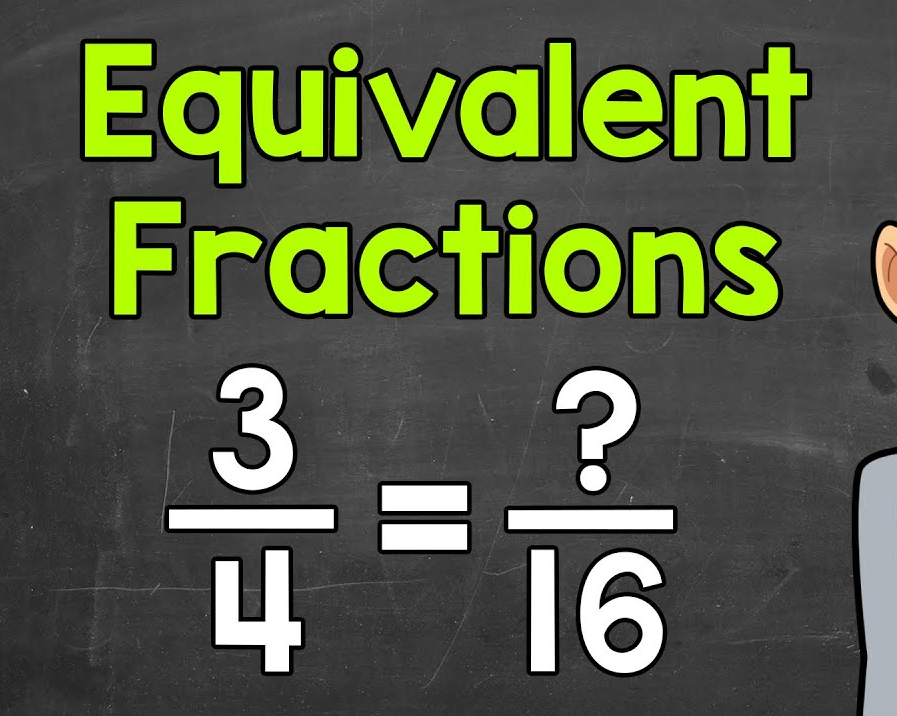
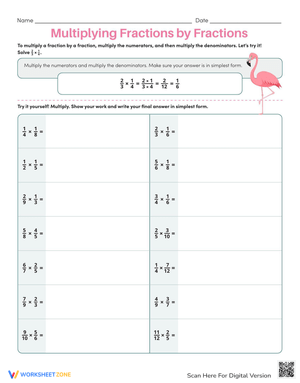
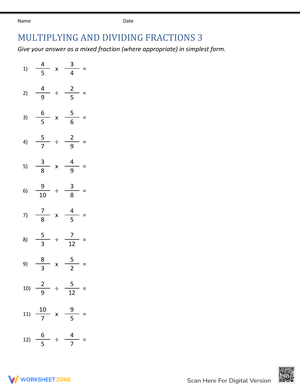
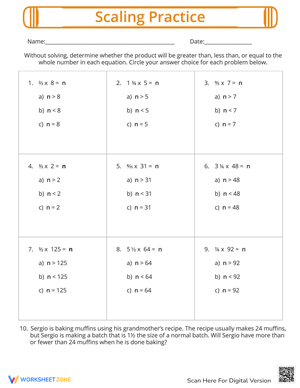
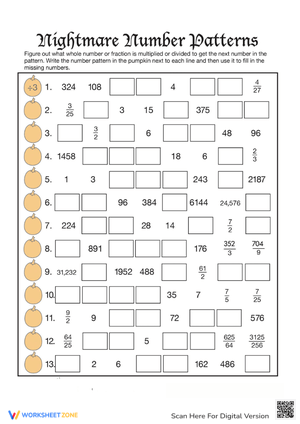
These 5th grade multiplying and dividing fractions worksheets give teachers a printable bank that moves from partitioned shapes and area models through equations and applied word problems — all within the actual Grade 5 scope. The division work stays where the standards place it: unit fractions divided by whole numbers, and whole numbers divided by unit fractions. That boundary is not a limitation; it is the Grade 5 scope, and worksheets that drift past it create problems that look like student errors but are really a planning mismatch.
Skills Targeted Across the Set
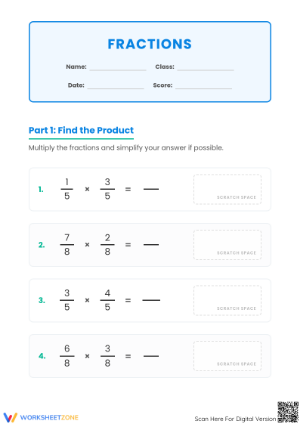
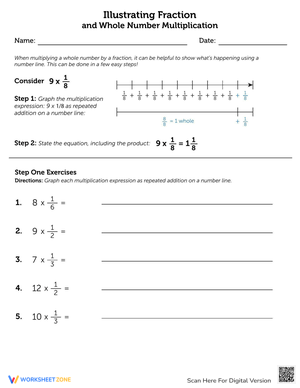
Each worksheet addresses one or more operations from the Grade 5 fraction cluster. The multiplication side moves from fraction times a whole number — the most accessible entry point, because students can connect it to repeated groups — through fraction times a fraction, and into mixed number multiplication where the worksheet provides visual or contextual support rather than presenting it as a straight conversion procedure.
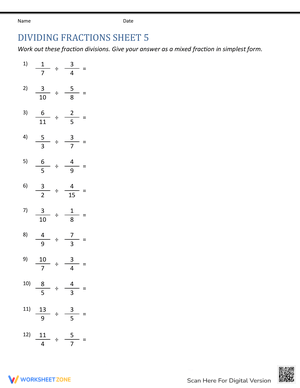
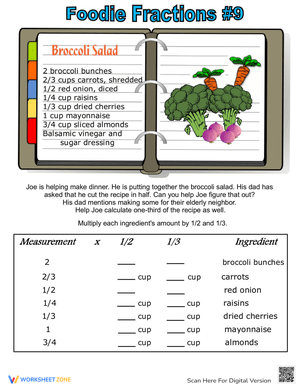
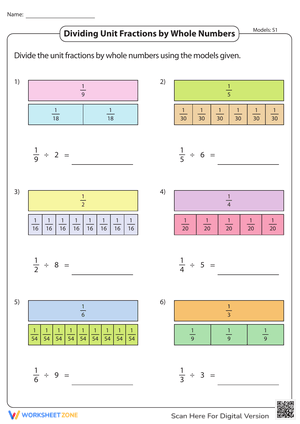
These 5th grade multiplying and dividing fractions worksheets include unit fraction ÷ whole number tasks (sharing contexts work best here — one-half of a pan divided equally among 3 students) and whole number ÷ unit fraction tasks where measurement language, such as cutting a 4-foot board into one-third-foot sections, gives the quotient meaning before students reach the algorithm. Short word problems appear throughout, written so students must choose the correct operation rather than being cued in advance.
Where Area Models and Number Lines Actually Fit
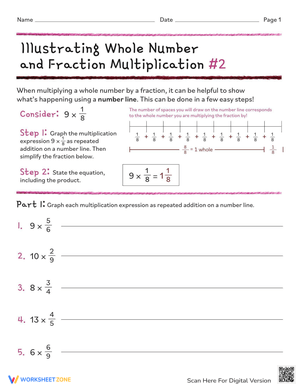
In Grade 5, visual representations are not a warm-up before the real computation — they are the instructional content. The Common Core progression sequences 5.NF.B.4 before 5.NF.B.7 because students need to understand why multiplying by a fraction less than one shrinks the product before they can make sense of dividing by a unit fraction producing a quotient larger than the dividend. An area model for 3/4 × 2/3 is not remediation; it is the justification for the procedure that follows.
The worksheets that do the most instructional work place a modeled item directly before its abstract counterpart. A student who completes the area model correctly but writes the wrong equation has a representational gap — not a computation gap — and those two problems need different responses from a teacher. On the division side, number lines make whole number ÷ unit fraction items visible: students count how many one-fourth jumps fit into 3 wholes, and the quotient stops being an abstract result. That sequencing turns a straightforward worksheet into a diagnostic instrument, which is exactly what a small-group rotation needs when six minutes remain and three students have arrived at three different answers.
Recommended Uses Across a Full Instructional Week
These 5th grade multiplying and dividing fractions worksheets fit different roles depending on where a lesson sits in the unit. Model-heavy worksheets belong in the guided practice portion of the lesson — not as homework, because the visual support is part of the task. A worksheet where students label partitioned shapes and then write the matching equation is asking for two separate cognitive moves, and sending it home without a teacher present removes the moment when a misconception would otherwise surface and be addressed.
- Open the unit with one modeled worksheet during whole-group instruction to establish area model reasoning before moving to equations.
- Use mixed multiplication and unit-fraction division worksheets at centers once students have seen both operation types at least twice.
- Pull 3–4 items from a worksheet for a Friday exit check — one multiplication item, one division item, one word problem gives a reliable formative read on the week.
- Reserve word-problem-heavy worksheets for homework only after the concept is secure, so students apply what they know rather than guess at unfamiliar material without support.
- Keep a targeted unit-fraction division worksheet ready for small-group reteach — those tasks surface as unexpectedly hard during whole-group lessons more often than multiplication tasks do.
Student Mistakes Worth Catching Before They Calcify
Fraction multiplication carries a predictable interference error from prior instruction. Students who spent months adding fractions — correctly keeping denominators the same — arrive at multiplication and write 2/3 × 3/4 = 5/7 with complete confidence. That answer is the strongest possible wrong one because the procedure is internally consistent; they applied the right rule for the wrong operation. The correction requires going back to the area model and showing what 5/7 would look like in a shaded rectangle compared to the actual product — telling students the rule is different is not enough on its own.
The dominant division error is structural: when asked how many one-fourths are in 5, students frequently write 5 × 1/4 = 5/4 because multiplication with fractions has become their default operation for any problem that mixes whole numbers and fractions. Word problem contexts make this error visible because students can check whether the answer holds up against the story — 5/4 sections of a 5-foot rope does not survive a reasonableness check. Abstract division items let the error hide inside a number that looks plausible.
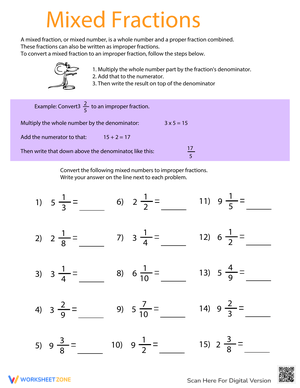
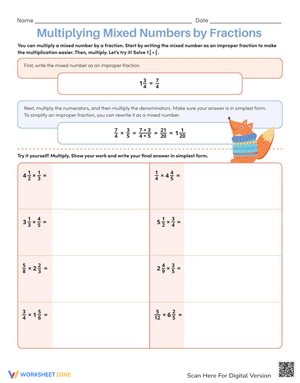
Mixed number multiplication introduces a quieter but consistent mistake: students often drop the whole number part entirely, writing 2 1/3 as 2/3 before multiplying. That error rarely shows up in written work — students write the setup incorrectly and proceed without noticing. Worksheets that include a dedicated step for recording the improper fraction conversion expose the error at the right moment rather than after the answer is already committed to paper.
Standard Alignment
These worksheets address three standards in the 5.NF.B cluster: 5.NF.B.4 (multiply fractions and mixed numbers, supported by area models), 5.NF.B.6 (solve real-world multiplication problems involving fractions and mixed numbers), and 5.NF.B.7 (divide unit fractions and whole numbers, interpret division in contextual situations). The ordering of those standards in the curriculum is intentional — multiplication with representational support comes first, applied multiplication follows, and unit-fraction division comes last because it asks students to reconstruct the meaning of division rather than extend a familiar procedure into new numbers.
Teachers in states using adapted standards — including Texas (TEKS 5.3I, 5.3J, 5.3L) — will find close alignment in task types, denominator ranges, and contextual formats even when the standard codes differ. The Grade 5 expectation that students reason about fraction multiplication using area models and interpret unit-fraction division through equal-sharing and measurement situations is consistent across most current state math frameworks.
Adjusting the Set for Mixed-Readiness Classrooms
For students who need more time with foundational concepts, the most practical adjustment is narrowing the denominator range — halves, thirds, fourths, and eighths — rather than removing problem types. Smaller denominators keep the area model readable and reduce the cognitive demand from fraction equivalence, letting students concentrate on what the operation does to the quantity. Asking these students to verbalize what one part represents before writing anything down often catches confusion that written work alone would conceal.
Students ready to push further within Grade 5 benefit from tasks that raise interpretive demand without leaving the content. A strong challenge item asks students to represent the same problem two ways — area model and equation — then write one sentence explaining why both produce the same product. Another effective option presents three related expressions (3 ÷ 1/4, 1/4 ÷ 3, and 3 × 1/4) and asks students to match each one to a different story context. That task type tells a teacher far more about structural understanding than a longer computation set does.
In mixed-readiness groups, these 5th grade multiplying and dividing fractions worksheets work best when teachers pull different worksheets for different groups rather than modifying one worksheet mid-use. Keeping Grade 5 content intact across all groups — and adjusting representation, number choice, and task complexity instead — avoids assigning lower-expectation work to students who need more time with the concept, not an easier concept altogether.
Frequently Asked Questions
What fraction division skills are actually part of Grade 5 instruction?
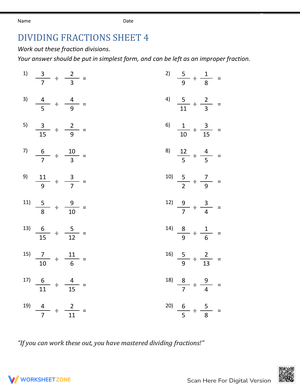
Grade 5 covers two specific division situations: unit fractions divided by whole numbers (1/3 ÷ 4) and whole numbers divided by unit fractions (4 ÷ 1/3). Fraction-by-fraction division — such as 2/3 ÷ 3/4 — belongs in Grade 6 instruction. Any worksheet presenting broader division formats is outside the Grade 5 scope, regardless of its grade-level label.
Do the worksheets include visual models alongside equations, or only at the start of a unit?
The strongest worksheets in the set pair models and equations throughout — not just as an opening step. Area models appear alongside fraction-by-fraction multiplication tasks, and number lines accompany whole number ÷ unit fraction items. That pairing keeps the visual layer available for students who still need it and makes each worksheet more useful for intervention than computation-only versions would be.
How should mixed numbers be handled in Grade 5 fraction multiplication practice?
Mixed numbers belong in Grade 5 multiplication practice, but they work best when visual or contextual support is present rather than appearing as isolated conversion exercises. The goal at this grade is for students to understand why the product makes sense — not to convert and multiply as quickly as possible. Worksheets that show the mixed number decomposed into its whole and fractional parts before the multiplication step align more closely with Grade 5 reasoning expectations than those that treat conversion as a speed skill.
Can one worksheet from the set serve double duty as practice and formative assessment?
Yes. Selecting 3–4 items that span multiplication, unit-fraction division, and a word problem gives a reliable formative snapshot without requiring a separate instrument. The key is choosing items that call for different reasoning moves — a model completion, an equation, and a contextual interpretation. That combination shows whether a student can shift between representations, which is the central demand of 5.NF.B by the end of the unit.














 Interactive Worksheet Maker
 Quiz Maker
 Word Search Maker
 Crossword Puzzle Maker
 Word Scramble Generator
 Sentence Scramble Generator
 Handwriting Worksheet Generator
 Name Tracing Generator
 Fill In The Blank Generator




 BACK TOSCHOOL