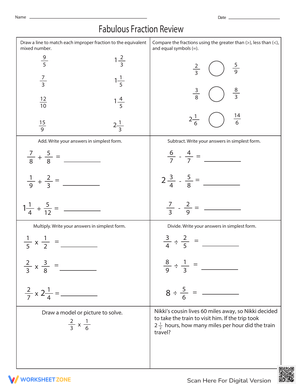
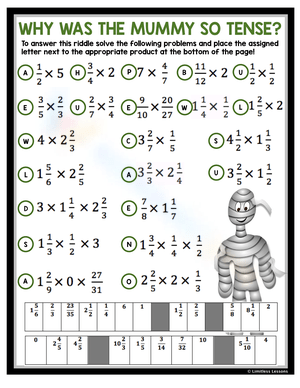
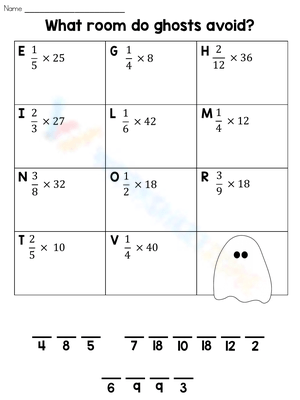
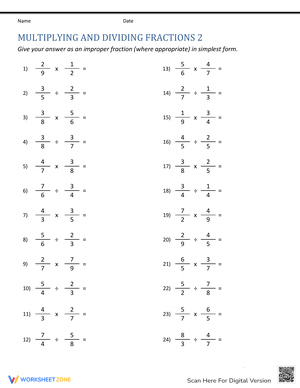
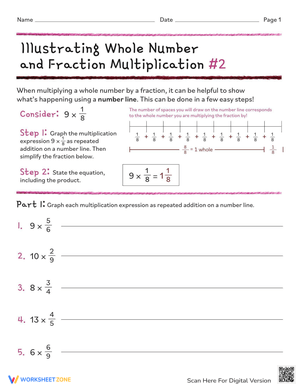
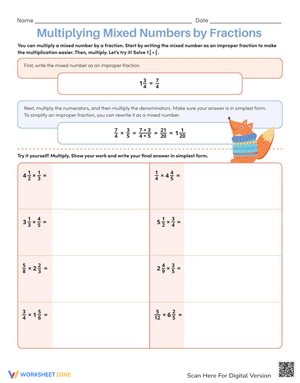
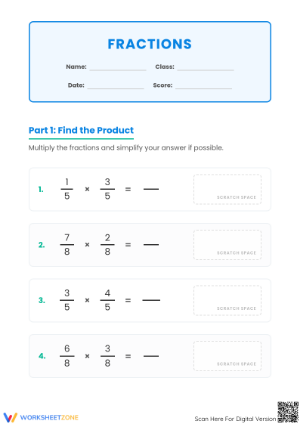
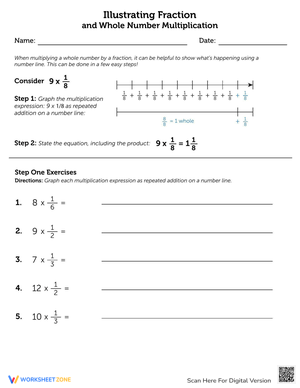
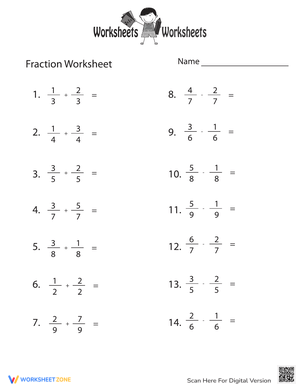
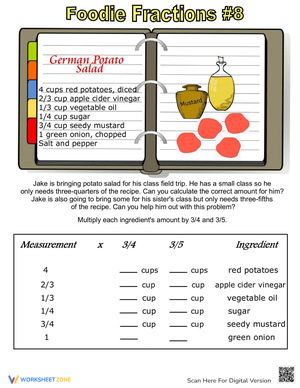
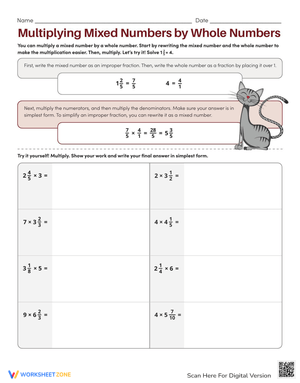
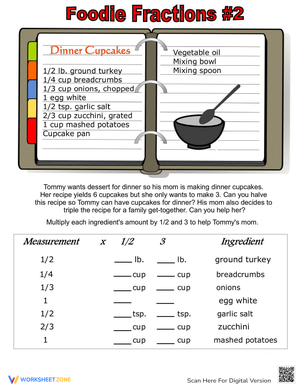
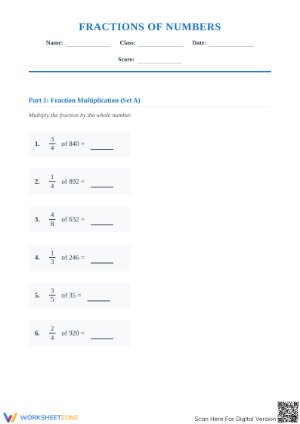
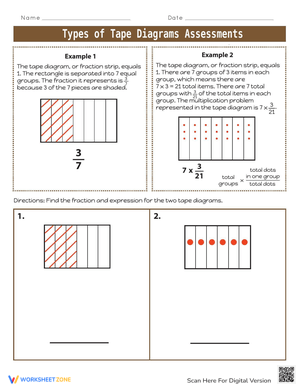
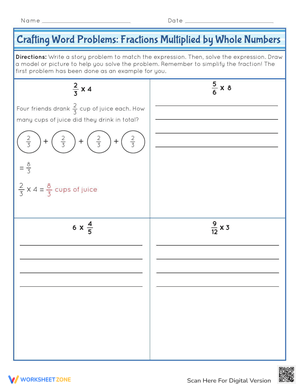
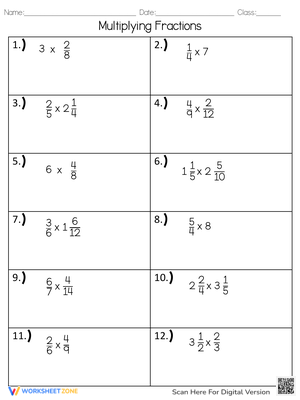
These multiplying fractions printable worksheets for 5th grade give teachers targeted, ready-to-copy practice across the three skills that sit at the center of Grade 5 fraction units: multiplying a whole number by a fraction, multiplying a fraction by a fraction, and reasoning about why the product is sometimes smaller than either factor you started with. Each worksheet pairs model-based items with equation practice and short word problems, so teachers can see not just whether students computed correctly, but whether they understand what the multiplication means.
What Each Worksheet Asks Students to Do
Grade 5 is the first time most students encounter multiplication that produces a result smaller than either factor — and that counterintuitive outcome is worth naming explicitly at the start of the unit. A student who has multiplied whole numbers since second grade arrives expecting that multiplying always makes things bigger. Then she computes 3/4 × 2/3 and gets 1/2, which is less than both fractions she started with. That cognitive disruption is the instructional starting point, and the worksheets in this set address it directly rather than treating the algorithm as the main event.
The skills covered across the set include:
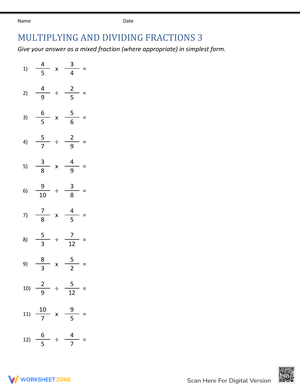
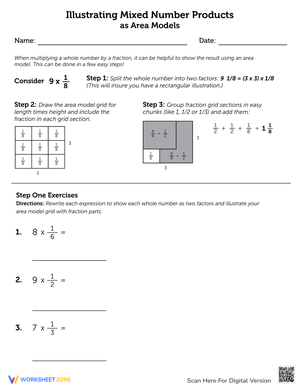
- Multiplying a whole number by a unit fraction — such as 1/4 × 12 — and representing the result with equal-groups models or equations
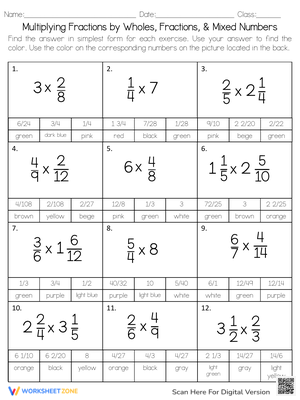
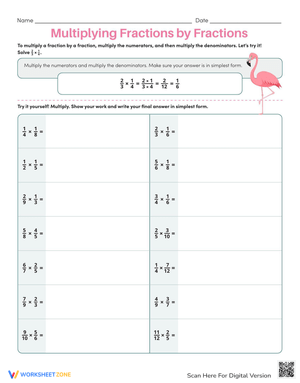
- Multiplying a fraction by a fraction using area models: shade a rectangle in one direction for the first factor, the perpendicular direction for the second, then count the squares in the overlapping region
- Extending that area model approach to non-unit fractions, such as 3/5 × 2/3, where students partition and label the full rectangle before identifying the product
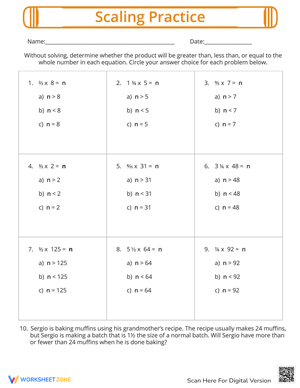
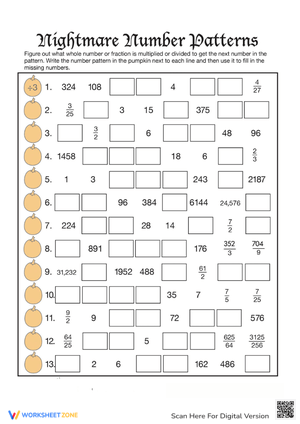
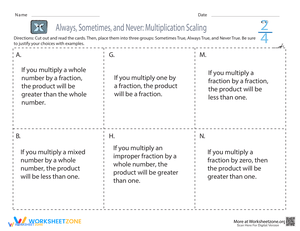
- Reasoning about product size: predicting whether a result will be greater than, less than, or equal to one factor before computing
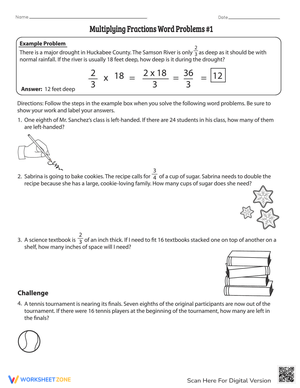
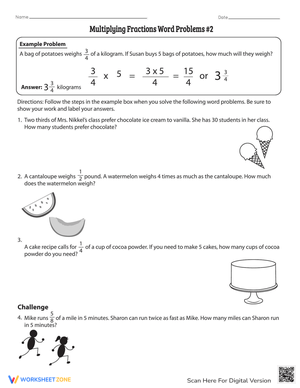
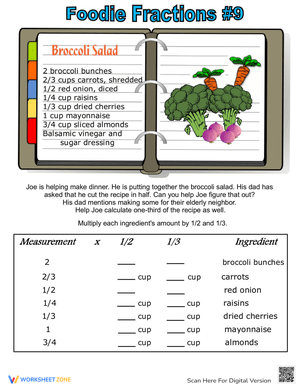
- Solving word problems set in measurement, sharing, and area contexts
Product size reasoning corresponds to 5.NF.B.5, a standalone standard that many computation-heavy practice sets skip entirely. Students who can predict and explain product size are demonstrating fraction sense, not just procedure execution. Including that kind of reasoning item gives teachers a faster read on where conceptual understanding breaks down than a sheet of bare calculation problems ever would.
Student Errors These Worksheets Surface
The most persistent error at this grade level is not a calculation mistake — it is a reasoning gap. Students learn the cross-multiplication procedure quickly: multiply numerators, multiply denominators, simplify. What they do not do automatically is check whether the answer makes sense relative to the factors. A student who writes 3/4 × 1/3 = 1/4 and does not pause to verify that 1/4 is less than both starting fractions is running on procedure alone. Worksheets that require a written prediction before the calculation step interrupt that habit effectively.
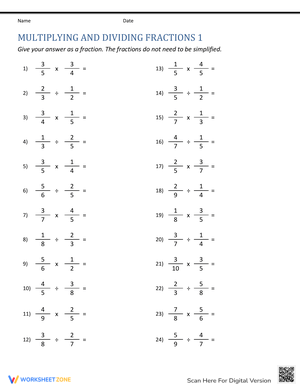
A second error involves commutative confusion. Students who correctly interpret 1/3 × 6 as "one-third of six" often freeze when the problem is written 6 × 1/3. They have multiplication table fluency up to tens but no automatic routine for "six copies of one-third." Pairing both orientations within the same worksheet — so that 1/3 × 6 and 6 × 1/3 appear side by side — makes the equivalence visible and turns a common stumbling point into a discussion anchor.
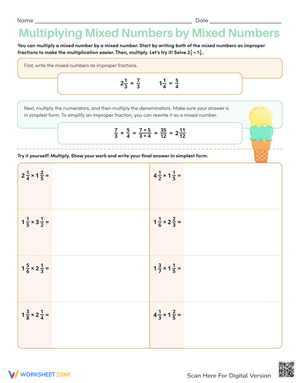
There is also a reliable simplification error that shows up across grade levels: students reduce fractions correctly during fraction addition practice but consistently forget to simplify the final answer after a multiplication problem. Building a labeled final step — Simplify your answer: — directly into the problem structure reduces that omission noticeably, even without a verbal reminder from the teacher. The format of the worksheet does some of the instructional work.
Standard Alignment
These worksheets align to the 5.NF.B cluster of the Common Core State Standards for Mathematics, specifically 5.NF.B.4, 5.NF.B.5, and 5.NF.B.6. These multiplying fractions printable worksheets for 5th grade map directly onto that three-part progression, making them useful at different points across a unit rather than only at one phase of instruction.
5.NF.B.4 establishes the core multiplication skill: students multiply a fraction or whole number by a fraction and represent the product using an area model. 5.NF.B.5 shifts to reasoning — students explain why multiplying by a fraction greater than 1 produces a result larger than the original quantity and why multiplying by a fraction less than 1 produces a smaller result, without computing first. 5.NF.B.6 applies both skills to real-world word problems. In classroom terms, 5.NF.B.4 worksheets fit the first week of the unit when students are building visual models. 5.NF.B.5 worksheets belong in the second week once students have enough procedural familiarity to reason about patterns in products. 5.NF.B.6 worksheets work best as a synthesis task near the end of instruction or as a paired assessment before moving into fraction division.
Building These Worksheets Into Your Lesson Sequence
In practice, fraction multiplication worksheets earn their place in three routine slots. The first is the independent practice block immediately after a mini-lesson — usually 10 to 15 minutes. Assign a model-focused worksheet the day you introduce area model representations; shift to equation-only work once students have drawn enough rectangles that they no longer need the visual to reason through the problem. The second slot is the math center rotation, where the same worksheet a student partially completed during class becomes a self-check tool when answers are made available for comparison. The third is take-home practice on nights following a new skill introduction — when revisiting that day's specific procedure, rather than a mixed review, keeps learning consolidated rather than scattered across too many formats at once.
Exit tickets are where these worksheets pay off most efficiently. A single item — "Is 5/6 × 3/4 greater than or less than 5/6? Explain how you know, then compute to check." — takes under four minutes at the end of a period and immediately tells you which students have product size reasoning and which are still guessing. That evidence sets up the next day's small group directly. Teachers can also annotate a worksheet before copying it: circling the item you plan to discuss whole-class, or writing "Draw your rectangle first" in the margin, carries the lesson language into independent work without adding a separate planning step. That kind of light customization takes about 90 seconds and changes how students approach the task.
Adjusting the Set for Different Learner Levels
For students who are still shaky on basic fraction concepts, start with the area model worksheets. These students often carry over the adding-fractions habit from Grade 4 — they reach for common denominators even when the problem asks for multiplication. The area model breaks that reflex because it requires partitioning a rectangle rather than converting any numbers at all. Once they can shade the model and identify the overlapping region, the equation follows as a record of what they already drew, not as a new procedure to memorize.
Students working at grade level move through model, equation, and word problem worksheets in that order over the course of a unit. Assigning them in sequence keeps the cognitive demand rising in step with instruction rather than asking students to jump between formats unpredictably. The word problem worksheets, in particular, work best after students have built some fluency with the procedure — placing them too early turns a fraction multiplication problem into a reading comprehension problem, and the two challenges compete for attention.
For students who are ahead of the unit pace, the multiplying fractions printable worksheets for 5th grade that focus on product size comparison offer a genuine challenge without pushing into sixth-grade content. Items like "Without computing, order these from least to greatest: 4/5 × 1/3, 4/5 × 1, 4/5 × 4/3, 4/5 × 2/3" demand the kind of relational reasoning 5.NF.B.5 targets but that computation-only worksheets never reach. These students finish the algorithm in 30 seconds; they need tasks where speed gives them no advantage.
Frequently Asked Questions
What fraction multiplication skills are covered in this set?
The worksheets cover multiplying whole numbers by fractions, multiplying fractions by fractions, using area models to represent products, reasoning about product size, and solving word problems. Together those skills span the 5.NF.B.4, 5.NF.B.5, and 5.NF.B.6 standards cluster for Grade 5.
Do these worksheets include visual models or only equations?
Each worksheet includes at least one visual component. Area models and partitioned rectangles appear throughout the set alongside computation problems and word problems. That combination reflects the Grade 5 expectation that students make sense of fraction multiplication through models before relying solely on the numerical procedure.
Can these be used for small-group intervention?
Yes. The model-based worksheets work well in small-group settings where students can draw and label while the teacher asks probing questions. The equation worksheets suit students who have the conceptual foundation but need fluency practice. The word problem worksheets are most appropriate as an extension task or as a synthesis activity toward the end of a unit, once computation fluency is not competing for cognitive space.
Are these worksheets useful for test preparation?
These multiplying fractions printable worksheets for 5th grade align directly to the standards assessed on most Grade 5 fraction benchmarks. The mixed worksheets — covering models, equations, and word problems within a single set — give students practice with the variety of item formats they are likely to encounter on end-of-unit assessments and state benchmark tests, making them a practical choice for the review week before any major fraction assessment.














 Interactive Worksheet Maker
 Quiz Maker
 Word Search Maker
 Crossword Puzzle Maker
 Word Scramble Generator
 Sentence Scramble Generator
 Handwriting Worksheet Generator
 Name Tracing Generator
 Fill In The Blank Generator




 BACK TOSCHOOL