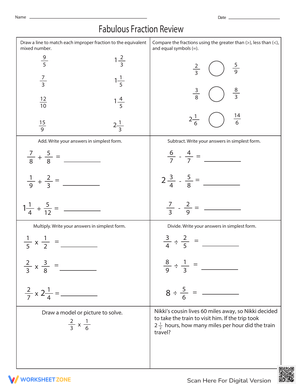
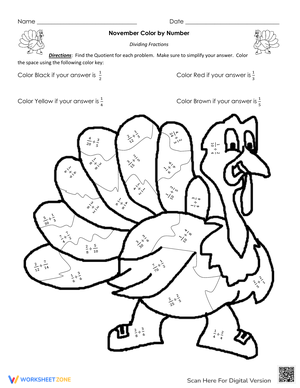
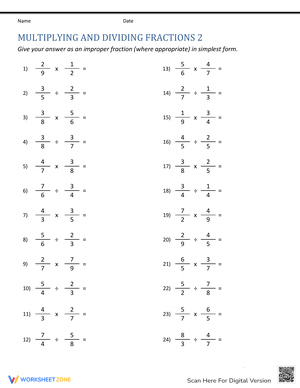
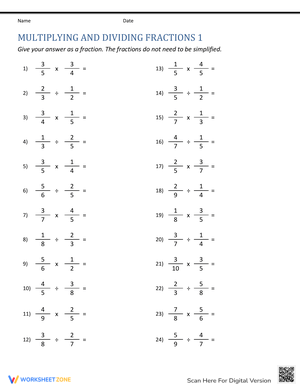
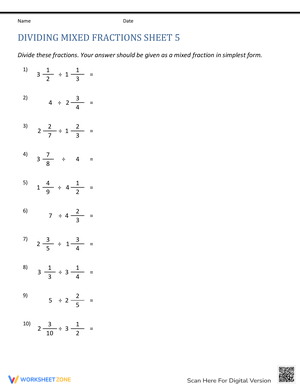
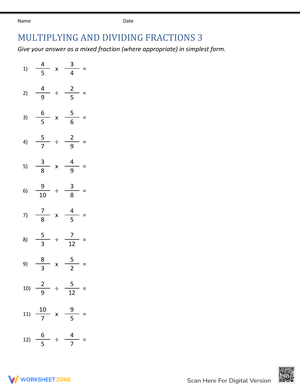
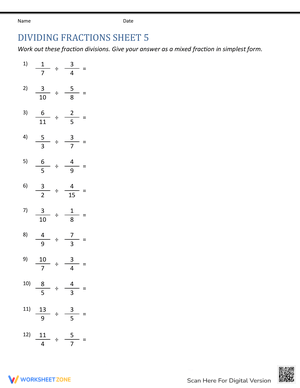
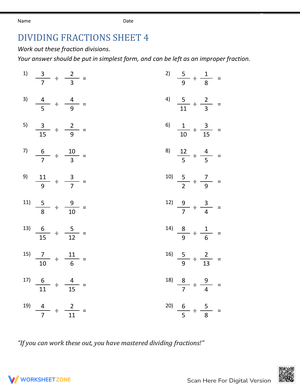
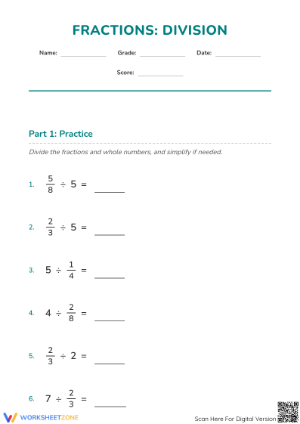
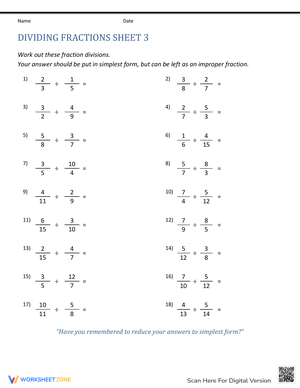
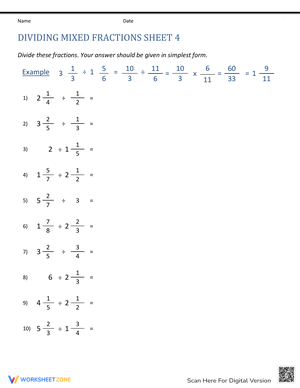
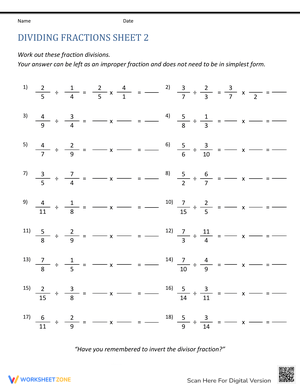
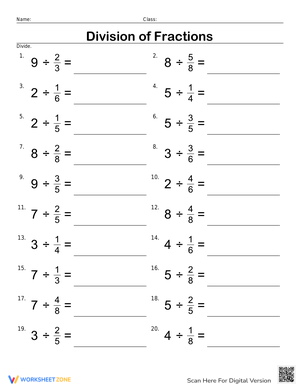
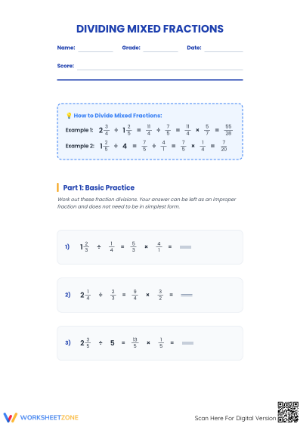
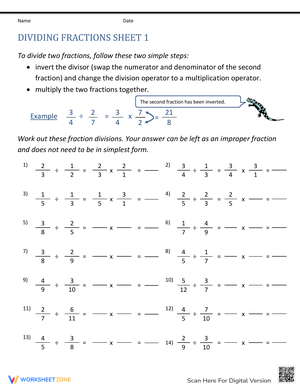
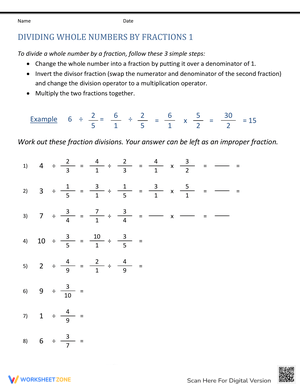
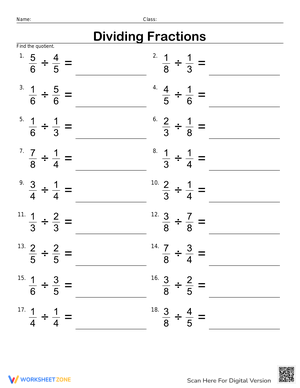
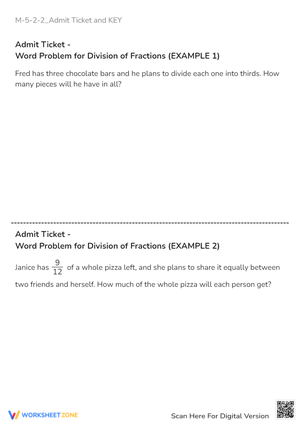
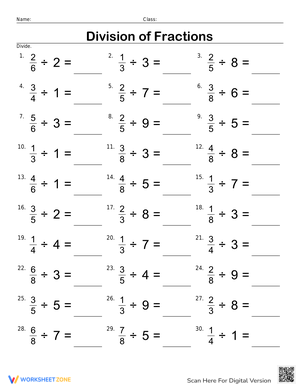
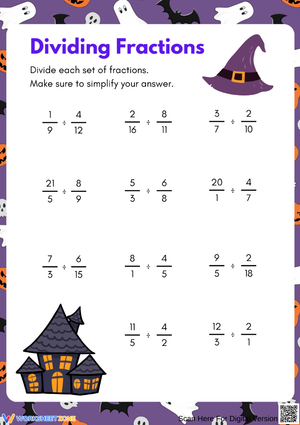
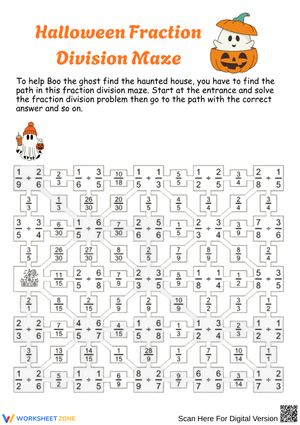
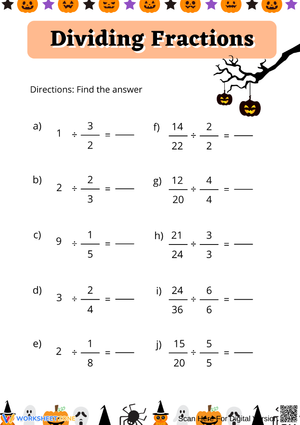
These 5th grade dividing fractions worksheets give teachers a sequenced set of resources for one of the more conceptually demanding stops in the Grade 5 math year: dividing unit fractions by whole numbers and whole numbers by unit fractions. The set moves through three registers — visual models, procedural practice, and contextual word problems — matching the progression most teachers find necessary to reach genuine fluency. Nothing here asks students to divide general fractions by general fractions; the scope stays exactly where the standard sets it.
What Students Practice in Each Worksheet
The two division situations the set addresses look simple on paper but play out very differently in actual student work. Dividing a whole number by a unit fraction — 4 ÷ 1/3, for instance — asks how many one-thirds fit inside four wholes. Dividing a unit fraction by a whole number — 1/2 ÷ 3 — asks for the size of each piece when half is split into three equal parts. Students who conflate these two situations consistently produce wrong answers, not because the procedure fails them, but because they never clearly separated what each question is actually asking.
Across the set, students:
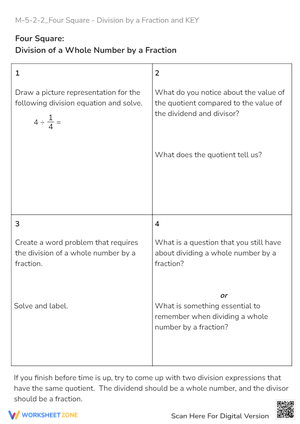
- Partition pre-drawn tape diagrams to represent both types of division before any algorithm is introduced
- Construct their own number line models for given expressions
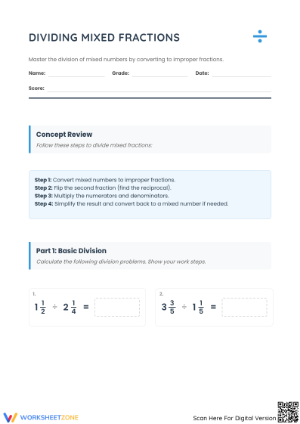
- Apply Keep-Change-Flip to unit fraction problems, then verify each answer by checking it against a diagram
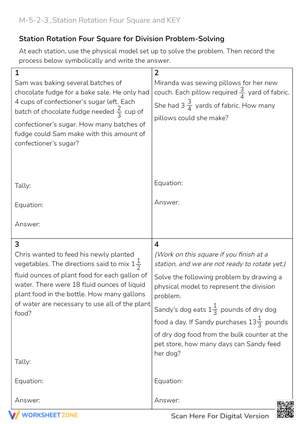
- Write equations to match word problem contexts and label which quantity is the dividend
- Solve multi-step word problems that embed fraction division within a real situation requiring careful reading and equation setup
Moving from Diagrams to the Algorithm
The visual model worksheets come first because students who jump straight to Keep-Change-Flip have no way to judge whether their answer makes sense. A student who gets twelve when computing 4 ÷ 1/3 should be able to confirm that twelve thirds do, in fact, fill four wholes. Without that grounding, the algorithm is just a rule they follow until they misremember a step.
Once students can draw and interpret tape diagrams accurately, the reciprocal method reads as a shortcut rather than an arbitrary series of steps. Each algorithm-focused worksheet pairs computation problems with an occasional prompt asking students to sketch a quick model when a quotient surprises them. This catches the moment — common enough to expect — where a student has executed Keep-Change-Flip correctly but still does not believe the result. Addressing that disbelief directly is worth more than confirming three more correct answers.
Mistakes That Surface Consistently in This Unit
The most reliable error in the Keep-Change-Flip procedure is positional: students identify the unit fraction as "the thing to flip" regardless of which position it occupies. In a problem like 1/4 ÷ 2, the correct rewrite is 1/4 × 1/2 = 1/8 — keep the fraction, change the sign, and express the whole number as its reciprocal. What typically happens instead is 4 × 2 = 8, because students flip the visible fraction and leave the whole number untouched. The answers are so far apart (1/8 versus 8) that diagram verification catches the error immediately, but students rarely reach for a model once they have an algorithm in hand.
Two other patterns appear often enough to name explicitly:
- Forgetting to change the operation. Students flip the divisor correctly but leave the division sign in place. In 1/4 ÷ 2, this produces 1/4 ÷ 1/2 = 1/2 rather than 1/4 × 1/2 = 1/8 — one of the three Keep-Change-Flip steps completed, and the one skipped changes everything about the answer.
- Misassigning dividend and divisor in word problems. When a problem contains both a unit fraction and a whole number, students routinely put the fraction first in their equation regardless of the problem's structure. A question asking how many 1/3-cup servings are in four cups gets written as 1/3 ÷ 4 instead of 4 ÷ 1/3, because the fraction appears earlier in the sentence.
Fitting These Worksheets Into Your Unit
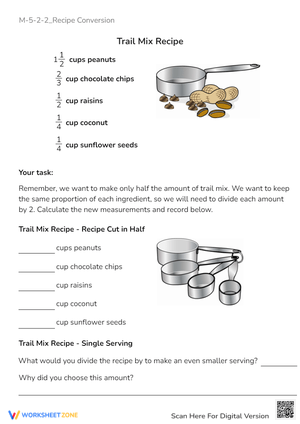
Most teachers spend roughly two weeks on 5.NF.B.7 before moving to mixed operations with fractions. These 5th grade dividing fractions worksheets slot into three distinct phases of that arc. The diagram-focused worksheets run well as whole-class guided practice during the first few days — project one on a shared screen, complete the first problem together, then release students to finish independently or in pairs. The diagram work takes longer than students expect, and that extra time matters; it builds the mental picture that makes the algorithm easier to hold onto later.
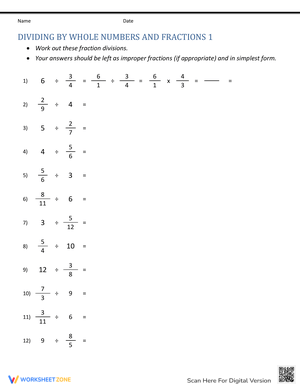
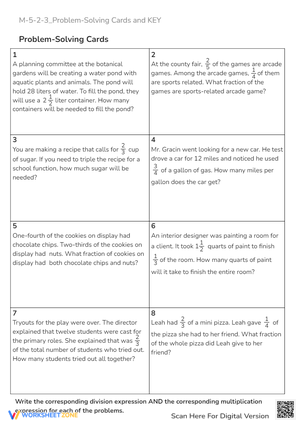
The algorithm practice worksheets hold up as ten-minute warm-ups in the middle of the unit, when students need repetition but not another full lesson. Three or four problems at the start of class, checked immediately, surfaces flipping errors before they calcify into habit. The word problem worksheets work well as Friday review or early-finisher tasks — complex enough to occupy students who have the procedure down but still need practice reading a situation and identifying the right equation. For a quick exit ticket at any point in the unit, pull one problem from a worksheet that places both division types side by side. Which one a student gets wrong tells you exactly what to revisit the next morning.
Standard Alignment
These 5th grade dividing fractions worksheets address CCSS.MATH.CONTENT.5.NF.B.7, which breaks into three sub-standards:
- 5.NF.B.7a — Interpret division of a unit fraction by a non-zero whole number and compute such quotients.
- 5.NF.B.7b — Interpret division of a whole number by a unit fraction and compute such quotients.
- 5.NF.B.7c — Solve real-world and mathematical problems involving division of unit fractions by whole numbers and whole numbers by unit fractions.
Classroom placement note: 5.NF.B.7 sits at the end of the Grade 5 fractions progression, after fraction multiplication (5.NF.B.4 and 5.NF.B.6). Teachers who introduce fraction division before students have solid multiplication fluency find that Keep-Change-Flip creates confusion — students who are unsteady on fraction multiplication cannot check their division answers by working backward, which removes one of the most useful self-correction strategies available at this stage.
Adjusting the Set for a Range of Learners
Students who are still working out what a unit fraction represents benefit from extended time on the diagram worksheets before any algorithm work begins. The concrete goal is for a student to draw an accurate tape diagram for both 1/4 ÷ 3 and 3 ÷ 1/4 from memory and describe in their own words what each expression is asking. Until that foundation is solid, introducing Keep-Change-Flip adds a layer of abstraction that tends to displace the underlying concept rather than build on it.
For students who move through the procedural practice quickly, the right challenge is the word problem worksheets — specifically, asking those students to write their own word problems for a given equation. Turning 1/3 ÷ 5 into a real-world scenario that genuinely makes sense is harder than most fifth graders expect. A student who constructs a correct story for 1/3 ÷ 5 but stumbles on 5 ÷ 1/3 has pointed you directly at the gap still worth addressing.
For students who speak English as a second language, standard cooking and measurement contexts in word problems can introduce friction unrelated to the math itself. Swapping in distance or equal-sharing language — lengths of rope cut into equal pieces, a collection of objects divided into equal groups — keeps the fraction division accessible when kitchen vocabulary adds an unnecessary barrier.
Frequently Asked Questions
Why does dividing a whole number by a unit fraction give a larger result than you started with?
This runs counter to students' division intuition, which is built entirely on whole-number experience where dividing always produces something smaller. The most direct classroom fix is to anchor the idea in counting before any formal explanation: draw a number line from zero to three and ask students to mark every one-fourth along the way. Counting those marks — twelve of them — makes the result concrete before the abstract explanation follows. The phrasing "we're finding how many of this small piece fit inside the whole number" gives students language they can reach for the next time a quotient surprises them.
My students keep flipping the wrong number in Keep-Change-Flip. Is there a reliable fix?
The error is almost always positional — students see a fraction and flip it, whether or not it is the divisor. The most reliable fix is to have students label each number as "dividend" or "divisor" in writing before they touch the algorithm. These 5th grade dividing fractions worksheets include problems that prompt students to write those labels first, which interrupts the automatic reach for the visible fraction. Once students reliably identify which number is the divisor, the flipping error drops off noticeably.
Do students need fraction multiplication fluency before starting these worksheets?
For the diagram-focused worksheets, no — students can partition tape diagrams and count sections without connecting to multiplication at all. For the algorithm worksheets, yes. Keep-Change-Flip converts a division expression into a multiplication expression, and students need to carry out that multiplication step accurately. If most of the class is still unsteady on multiplying a fraction by a whole number, spend more days on the diagram work and hold the algorithm worksheets. The visual pathway produces correct answers on its own; the algorithm is a more efficient route to the same place, not the only one.














 Interactive Worksheet Maker
 Quiz Maker
 Word Search Maker
 Crossword Puzzle Maker
 Word Scramble Generator
 Sentence Scramble Generator
 Handwriting Worksheet Generator
 Name Tracing Generator
 Fill In The Blank Generator




 BACK TOSCHOOL