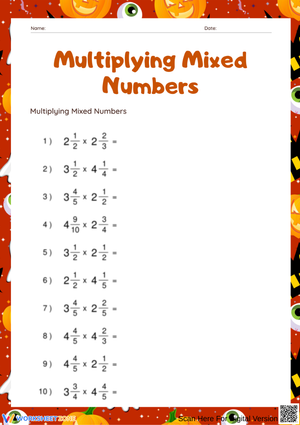
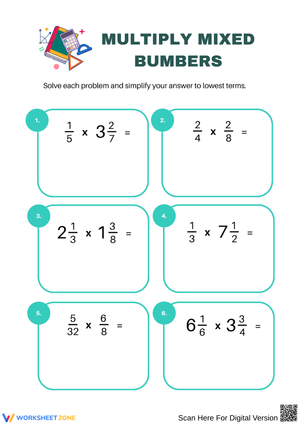
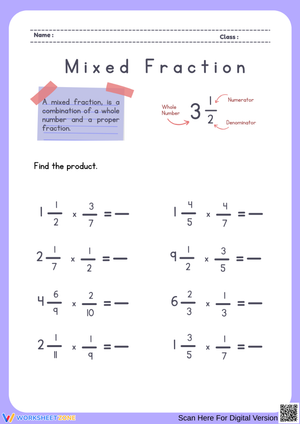
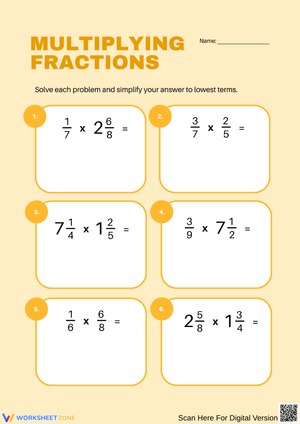
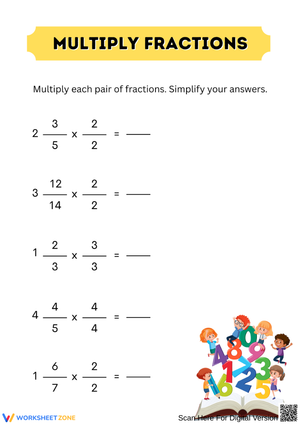
5th Grade Multiplying Mixed Numbers worksheets
These 5th grade multiplying mixed numbers worksheets resources give teachers a direct path to one of Grade 5's trickiest procedural skills — the point where fraction multiplication expands to include mixed numbers and students suddenly have more steps to track. Each worksheet in this set delivers targeted practice on converting, multiplying, simplifying, and expressing answers in the form the directions require.
The Specific Skills Targeted
The core procedure students practice is convert-multiply-simplify-rewrite: turn each mixed number into an improper fraction, multiply numerators together and denominators together, simplify the result, and rewrite as a mixed number when needed. That sequence sounds linear on paper, but in student work it breaks down at several distinct points, which is why each worksheet isolates particular stages of the process.
The set progresses deliberately. Early worksheets pair a whole number with a mixed number — a gentler entry point that lets students practice conversion without managing two improper fractions simultaneously. Later worksheets move to mixed number times mixed number, which requires both fractions to be converted before any multiplication happens. A few worksheets include area models as well, for the visual-to-procedural bridge that matters before students rely entirely on the algorithm.
- Converting mixed numbers to improper fractions — repeated across every worksheet because this is where errors concentrate most
- Multiplying improper fractions — numerator times numerator, denominator times denominator
- Simplifying products — including cases where both numerator and denominator share a factor larger than 2
- Expressing final answers as mixed numbers — which requires a division step students frequently skip
- Checking for reasonableness — a few worksheets prompt students to estimate before computing so they notice when an answer is wildly off
Student Mistakes Worth Catching Before They Become Habits
The most persistent error lives inside the conversion step. When a student converts 3 2/5 to an improper fraction, the typical mistake is multiplying 3 × 5 to get 15 and stopping there — writing 15/5 rather than 17/5. The first half of the procedure runs correctly, but adding the numerator disappears. Teaching students to write the full expression (3 × 5 + 2) before simplifying puts that addition step on paper where it cannot be skipped mentally.
A different error surfaces once students have conversion right: they produce an unsimplified answer and consider the problem finished. A product like 36/24 feels complete to a student who just executed the multiplication correctly — the numerator and denominator read as distinct numbers, and no alarm goes off. Worksheets that ask explicitly "Is this fully simplified?" after the multiplication step force that pause. Students who factor out only 2 or 3 but miss a shared factor of 12 need that prompt to keep going.
There is also a category error worth addressing directly. Some students multiply 2 1/3 × 1 3/4 by treating it as (2 × 1) + (1/3 × 3/4), arriving at 2 1/4 — a plausible-looking answer that is wrong because the cross-product terms are missing. Students who do this are not being careless; they are extending a partial-products logic that works in whole-number multiplication and applying it incorrectly here. Pointing out why that reasoning fails — and why conversion first is the fix — addresses the underlying thinking rather than just patching the procedure.
Building These Worksheets Into Your Fraction Unit
The most effective entry point is a short conversion warm-up before any multiplication problems appear. Five minutes of turning mixed numbers into improper fractions — without any multiplication yet — surfaces fluency gaps early. Students who stall at that step will stall on every subsequent problem, so catching it before the first 5th grade multiplying mixed numbers worksheets session saves reteaching time later in the week.
From there, a few placement strategies hold up well across different lesson formats:
- Day-of independent practice: Assign the first six problems on a worksheet immediately after direct instruction. If that check-in reveals a gap, stop and address it as a group before assigning the remainder.
- Math centers: Pair a worksheet with fraction tiles or a dry-erase area model so students can build the multiplication visually before working through the algorithm on paper.
- Exit tasks: The final two or three problems on each worksheet work cleanly as a formative check — collected, sorted by error type, and used to shape the next day's grouping decisions.
- Spiral review: Reintroduce one or two problems from this set two weeks after the fraction unit ends. Mixed number multiplication fades quickly without spaced retrieval, and a brief warm-up revisit prevents reteaching from scratch before the assessment.
- Intervention blocks: Pull students who scored below the class median, use a worksheet with fewer problems and more writing space, and work one problem at a time — saying each step aloud before writing it down.
One classroom routine worth trying: before students solve anything, ask them to circle the space on the worksheet where they will write each converted improper fraction. That physical mark makes the conversion step visible from across the room, and it lets a teacher scanning the class catch students who skipped it before they work through an incorrect problem.
Fitting the Set to Where Students Actually Are
For students who are not yet fluent with simplification, the worksheets are still usable — assign problems where the product simplifies by a small, obvious factor (dividing by 2 or 3). Reserve problems that require finding a common factor larger than 5 for students who are ready to handle that additional step. Keeping simplification manageable at the start means students can direct their attention toward the conversion and multiplication procedure without stalling at the end of every problem.
Students who have the procedure down can work through the set with one added constraint: cross-cancel before multiplying. That means identifying common factors across numerators and denominators before computing, which produces smaller working numbers and makes simplification at the end unnecessary. Students who do this consistently have moved from procedural execution to something closer to numerical reasoning — they are seeing relationships between values, not just running through steps.
For class members still building whole-number multiplication fluency, assign worksheets that start with a whole number times a mixed number. That removes one conversion step, cutting the procedure from four stages to three without changing the core skill being practiced. When those students are consistent there, the move to mixed number times mixed number is a smaller jump.
Standard Alignment
These worksheets address CCSS 5.NF.B.6: "Solve real world and mathematical problems involving multiplication of fractions and mixed numbers." In the fifth-grade fraction sequence, this standard typically lands mid-unit — after students have multiplied simple fractions and before the class moves into fraction division. Most pacing guides place it in the third or fourth quarter of fifth grade, once earlier units have built the number sense with fractions that this procedure depends on. The worksheets stay within the numerical problem frame that belongs to the introductory phase of this standard, rather than adding real-world contexts that teachers introduce once the procedure is stable. Teachers building a unit around 5th grade multiplying mixed numbers worksheets materials will find this set aligns directly to 5.NF.B.6 without adjustment.
Frequently Asked Questions
Can these worksheets be used across multiple days, or are they meant for one lesson?
Each worksheet stands alone, so teachers can distribute them across however many days the unit requires. One worksheet works as same-day practice after direct instruction; another works as a next-day review; a third can reappear a week later as a spiral check. Nothing about the format requires the worksheets to be used in sequence or on back-to-back days.
Do students need to know how to find a GCF before starting this set?
Not for every worksheet. The earlier worksheets include products that simplify by small, obvious factors — students can simplify by inspection without formal GCF work. The later worksheets do require finding a greatest common factor, so teachers should confirm that skill is in place before assigning those particular worksheets.
How do these worksheets work for a student returning from an absence who missed the initial instruction?
Worksheets that include a worked example at the top give an absent student a reference model to follow independently — useful for reconstruction, but not a substitute for instruction. A brief one-on-one review of the conversion step before independent work is still the better approach. A set of 5th grade multiplying mixed numbers worksheets materials works best when students have at least seen the procedure modeled once, even if their initial practice was limited.
Are answer keys included?
Yes. Answer keys make it faster to sort completed work by error type rather than by score alone. If several students made the same conversion error on the same problem, that grouping takes ten seconds with a key in hand — and it points directly to exactly what reteaching is needed next.
Clear All