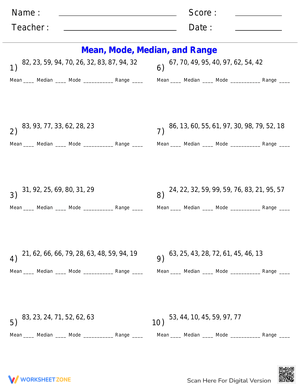
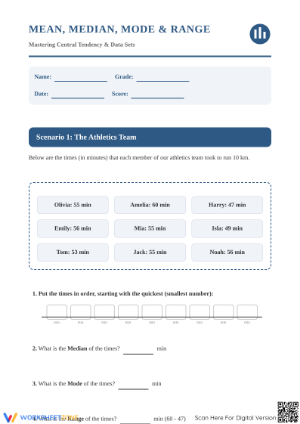
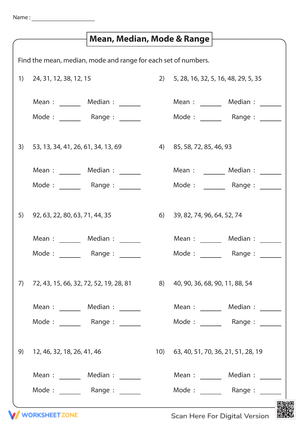
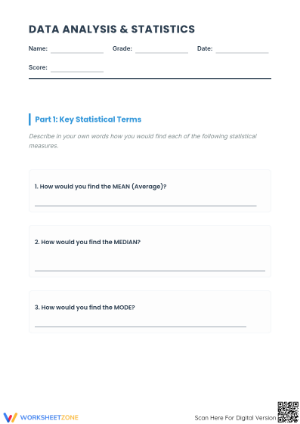
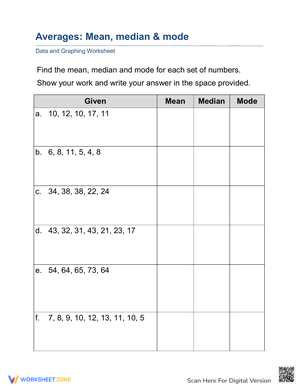
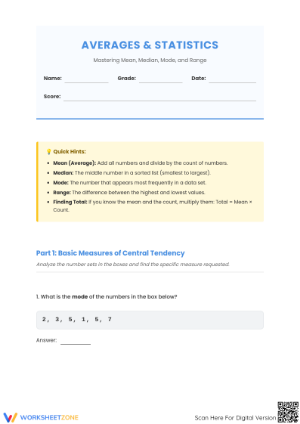
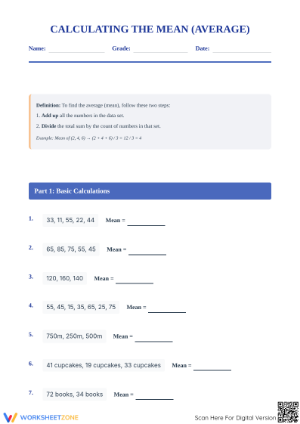
Mean median and mode printable worksheets for 5th grade give teachers ready-to-use practice that fits directly into data lessons already underway — the three measures of center, structured for independent work, without requiring a new unit or a new vocabulary sequence. Across the week, these worksheets cover whole-class seatwork after a mini-lesson, small-group reteach folders, substitute plans, and take-home review before a unit assessment.
What Students Practice in Each Worksheet
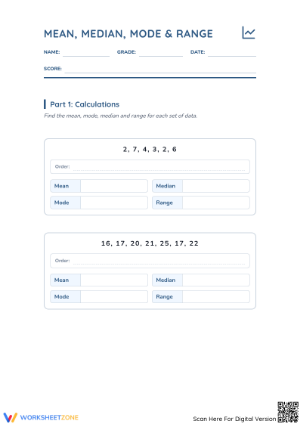
The core routine students need when working with mean, median, and mode is consistent: sort the data set from least to greatest, identify which measure the problem asks for, then compute or locate it. Upper-elementary errors cluster around that first step more than any other. Students who skip the ordering phase end up pulling the wrong median or misidentifying the mode — not because they don't understand the vocabulary, but because they went straight to calculating.
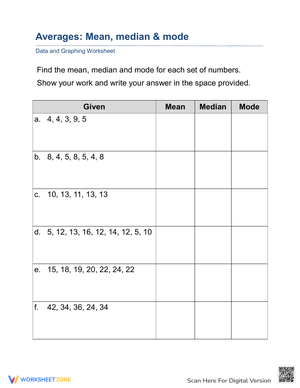
Each worksheet in the set targets a specific collection of skills:
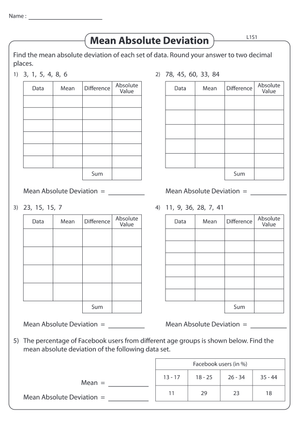
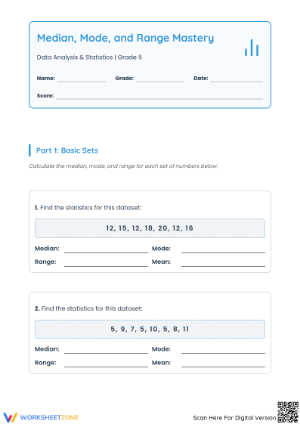
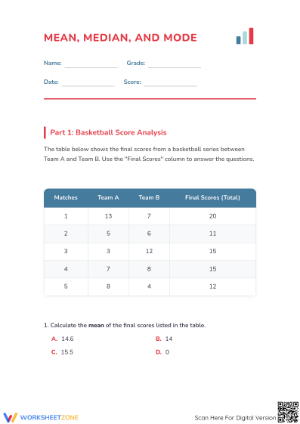
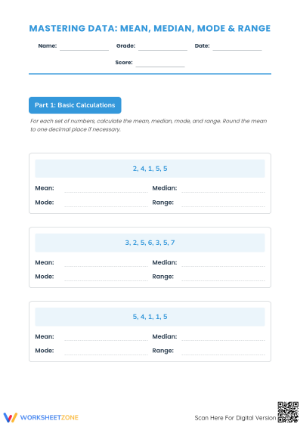
- Calculating the mean by adding all values and dividing by the count of data points
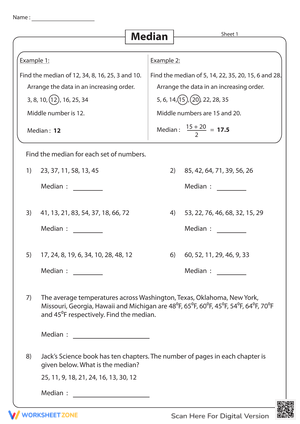
- Finding the median after reordering the set from least to greatest, including even-numbered sets where students average the two middle values
- Identifying the mode — or recognizing when no value repeats and no mode exists
- Solving short word problems set in survey, measurement, or classroom-data contexts
- Explaining in writing which measure of center best represents a given data set
That last task separates procedural fluency from conceptual understanding. A student who can compute all three measures but can't explain why a single outlier skews the mean hasn't fully absorbed what any of these numbers actually describe.
Data Contexts That Hold Up for Upper-Elementary Learners
Numbers taken from familiar classroom situations — step counts from a PE day, plant height measurements from a science lab, reading log entries, quiz score records — reduce the cognitive friction that abstract lists create. When students have to puzzle over what the numbers represent before they can work with them, attention drifts away from the math. Concrete contexts keep the focus on ordering, calculating, and interpreting.
Sets running from 8 to 12 values work well for 5th grade instruction. That range produces visible outliers, repeated values, and a median position that isn't trivially obvious — but stays small enough for students to sort by hand in roughly two minutes during a center rotation. Lists longer than 15 values tend to produce arithmetic fatigue at this age: students start making addition errors midway through the sum and never reach the interpretation step.
Frequent Student Errors Teachers Should Anticipate and Address
The most predictable mistake in median problems is choosing the middle position of the unsorted list. A student counts to the fifth number in a nine-item set — as the data appears on the worksheet — rather than the fifth number of the reordered set. The answer looks plausible, no alarm goes off, and the student moves on. Scanning median answers first when reviewing student work tells you quickly who is actually sorting and who is not.
Even-numbered data sets catch a second consistent error. Students locate the two middle values correctly but write one of them as the final answer instead of averaging both. This usually means the student has only practiced odd-numbered sets. Adding a few even-numbered problems early in the practice sequence — with a direction that explicitly says "there are two middle values" — closes that gap before it shows up on an assessment.
For mean, the issue is almost always the division step. Students add values accurately but divide by the largest number in the set, or by a count they estimated rather than confirmed. A brief annotation prompt — how many values are in this set? — placed before the calculation step reduces this error noticeably in practice.
Standard Alignment
Mean, median, and mode are formalized in the Common Core State Standards for Mathematics beginning in Grade 6 under 6.SP.A.3, which asks students to recognize that a measure of center summarizes an entire data set with a single number. At the 5th grade level, the anchor standard for this content area is 5.MD.B.2, which requires students to represent and interpret fractional measurement data on line plots and solve problems using that data. Teachers who use these worksheets in 5th grade are typically doing so as enrichment tied to 5.MD.B.2 line plot lessons, as bridge content building toward the Grade 6 statistics strand, or as review for students with prior exposure. Students who arrive in 6th grade already fluent with all three measures of center move through 6.SP.A.3 instruction significantly faster than students who encounter the vocabulary there for the first time.
Building These Worksheets Into Your Lesson Plans
The most productive pattern inside a full-class lesson is gradual release: model one data set, solve a second together with the class guiding each step, then assign one worksheet for independent work. That independent piece functions as immediate formative data — students who replicate the process without the worked example still visible have consolidated the lesson; students who can't have told you exactly what to address in the next small group.
Mean median and mode printable worksheets for 5th grade hold up especially well in situations where direct instruction isn't available. The directions are self-contained, which makes these worksheets viable for substitute plans, math bins in a workshop rotation, and early-finisher folders. That's not a small detail — materials that require teacher explanation to function create problems on coverage days and during center time when the teacher is pulled to another group.
Spaced retrieval matters for this content. Students who practice mean, median, and mode once and then don't revisit it for three weeks often cannot reconstruct the procedure. Running one worksheet as Monday morning review, another mid-week after a related data lesson, and a third as a Friday exit check produces stronger retention than three worksheets assigned in one sitting.
Adjusting the Worksheets for a Range of Learners
Students who need extra support benefit most from worksheets where the ordering step is separated from the calculation. Ask them to rewrite the data set in sorted order before attempting any computation. That single requirement surfaces the real source of most errors — if a student sorts correctly but computes wrong, the problem is arithmetic; if the sort itself is wrong, the problem is the ordering routine. Those are different things to address, and the sorted-first format makes the distinction visible.
On-level practice works well with worksheets that rotate through all three measures across a problem set, then end with a context question asking which measure best represents the data. That closing question requires students to think about what they calculated, not just whether they arrived at a numerical answer.
For students ready for harder analytical work, mean median and mode printable worksheets for 5th grade that pair two comparable data sets — temperatures from two different months, scores from two different class assessments — ask students to calculate both, compare the means, and decide whether the median or mode tells a more honest story. The calculation demand stays well within 5th grade range, but the reasoning required is meaningfully more complex than finding one measure from one set.
Frequently Asked Questions
Are mean, median, and mode formally required in 5th grade standards?
Under most current frameworks, including the Common Core State Standards for Mathematics, explicit instruction in all three measures of center begins in Grade 6 under 6.SP.A.3. Teachers who use these worksheets in 5th grade are typically connecting them to line plot work under 5.MD.B.2, using them as bridge content toward Grade 6, or offering them as enrichment for students with prior exposure. Students who arrive in 6th grade already comfortable with mean, median, and mode move through the statistics strand faster than students encountering the vocabulary for the first time.
How do these worksheets fit into a math workshop model?
One worksheet per rotation works well for a 10- to 15-minute independent center. A short direction card in the bin reminding students to order the data before finding the median is usually all the support the center needs. Teachers who run workshop models often rotate through several different worksheets across a two-week data unit rather than assigning the full set at once — that pacing keeps the content fresh and allows different problems to surface different student error patterns.
What's the most effective way to use these for formative assessment?
Mean median and mode printable worksheets for 5th grade work as exit tickets when collected at the close of a lesson. Focus the review on median answers first — students who report the unordered middle value need another pass at the sorting step before moving forward. Mean errors typically cluster around the division step, so incorrect but plausible quotients tell you whether students are dividing by the correct count. A teacher can extract actionable instructional information from a single worksheet without scoring every problem on it.














 Interactive Worksheet Maker
 Quiz Maker
 Word Search Maker
 Crossword Puzzle Maker
 Word Scramble Generator
 Sentence Scramble Generator
 Handwriting Worksheet Generator
 Name Tracing Generator
 Fill In The Blank Generator




 BACK TOSCHOOL