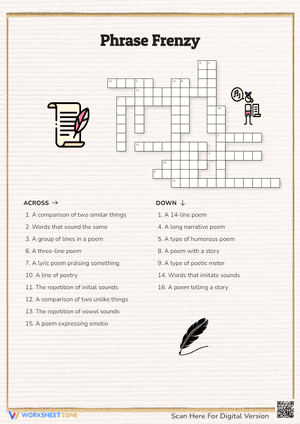
These poems printable worksheets for 5th grade give teachers a set of short-text resources built around close reading, structural analysis, and evidence-based written response. Each worksheet pairs a poem with text-dependent questions that push students past surface identification and toward explanation — why a stanza shifts in tone, how a repeated image builds meaning, what the speaker's word choices reveal. The format works because the text is compact enough to read twice in a single lesson and dense enough to sustain a full written discussion.
The Specific Skills Targeted in Each Worksheet
Fifth graders are expected to explain how stanzas, lines, and other structural features fit together — not just name them. Each worksheet addresses that expectation directly, asking students to connect parts of the poem to the whole before moving toward theme or tone.
- Stanza structure: Students examine how each stanza contributes to the poem's shape and how the relationship between sections builds meaning across the whole poem.
- Theme development: Questions move students from topic identification toward the message the poet constructs — a distinction that requires explicit instruction at this grade.
- Figurative language: Simile, metaphor, personification, and imagery appear across the set with questions that ask students to explain what each comparison reveals, not just label it.
- Vocabulary in context: Because poems are dense, a single loaded word can shift tone across a full stanza. Each worksheet draws attention to that kind of language.
- Speaker and point of view: Students identify whose perspective shapes the poem and how that perspective affects what the reader understands.
- Evidence-based written response: Every worksheet includes at least one prompt where students must cite a specific line or phrase before making a claim about meaning or theme.
Mistakes Students Make That Teachers Should Anticipate and Address
The most consistent error in 5th grade poetry work is theme drift. Students identify the topic — "this poem is about a river" — and stop there, never moving toward what the poet claims about that topic. A written response that reads "the poem is about nature and how beautiful it is" is a topic summary, not a theme statement. The questions in each worksheet interrupt that drift by asking students to explain what the final stanza adds before they attempt a broader claim about meaning.
A second pattern shows up in figurative language tasks: students name the device correctly but cannot explain its effect. Identifying "the world is a stage" as a metaphor is one skill. Explaining what that comparison reveals about the speaker's view of human life is a harder one. These worksheets push toward the second question. Teachers who look closely at student work at this grade often see the labeling task treated as mastery when the actual standard requires analytical explanation — and that gap is exactly where a strong written prompt does its most useful work.
How to Build These Worksheets Into Your Lesson Week
One approach that produces strong student evidence is using the same worksheet across three days with a shifting focus. On the first day, students complete a cold read, mark unfamiliar vocabulary, and answer the literal comprehension questions. On the second day, they return to the same poem to annotate for structure — bracketing stanzas, underlining figurative language, marking where the tone shifts. The written response question works best on the third day, once students have spent real time with the text and have something specific to say.
For the 8–10 minutes before dismissal or the Friday review block, a single short-response question from one of these worksheets functions as an exit ticket without requiring a full lesson setup. Teachers post the question, give students five minutes to write, and collect the responses as formative data with almost no prep. These poems printable worksheets for 5th grade are short enough that students who finish early can reread the poem rather than sit waiting — a small detail that keeps the whole class inside the text longer than most other resource formats allow.
In small-group instruction, the short text creates space to slow down and model annotation explicitly. Teachers can think aloud about why a particular line break matters, demonstrate how to embed a quotation in a written response, and give students immediate corrective feedback — all within a single reading block. For stations or sub plans, each worksheet is clear enough that students can work through it independently and still produce written evidence worth reviewing.
Standard Alignment
The primary standard addressed is RL.5.5, which requires students to explain how a series of chapters, scenes, or stanzas fits together to provide the overall structure of a story, drama, or poem. At grade 5, that standard moves beyond recognition tasks — students must explain relationships between parts, which is precisely what the structural and theme questions in each worksheet require. In classroom terms, a question that asks students to circle the rhyme scheme does not satisfy the standard; a question that asks how the final stanza complicates what the first two established is much closer to what RL.5.5 actually demands.
Vocabulary and figurative language questions connect to RL.5.4, which asks students to determine the meaning of words and phrases as they are used in a text and to consider how word choice affects meaning and tone. Written response prompts support W.5.9b, the standard that calls for students to apply grade 5 reading standards to literature when producing written analysis — making these worksheets useful for both reading and writing instruction within the same task.
Adjusting the Set for Mixed-Ability Classrooms
For students who need more support, narrowing the task to a single stanza works well. Instead of asking a student to analyze the whole poem for theme, direct them to the final stanza, provide two vocabulary definitions in advance, and offer a sentence frame for the written response: "The poet shows ___ when the speaker says '___'." That structure keeps the cognitive demand meaningful without letting the student bypass the thinking entirely. Prereading the poem aloud as a group before students work independently is another adjustment that requires no additional materials.
For students ready for a greater challenge, the same worksheet generates richer work when the question shifts from explaining what the poet does to comparing how two stanzas approach the same idea differently, or examining whether the poem's structure supports or complicates its stated message. No separate materials are needed — the text and one additional written prompt do the work. Poems printable worksheets for 5th grade are well-suited to this kind of within-class adjustment because the short text stays constant while the analytical demand changes.
Frequently Asked Questions
What should 5th graders be able to explain about a poem, beyond naming its features?
At grade 5, the expectation is explanation, not identification. Students should be able to say how a stanza contributes to the poem's overall structure, why a specific word choice shifts tone, and what the poet builds toward across the text. Naming a simile is a starting point; explaining what the comparison shows about the speaker's attitude is the grade-level target. The questions in each worksheet are sequenced to move students from the first task to the second.
Can I use one worksheet across multiple days, or is each worksheet meant for a single lesson?
Each worksheet works in a single sitting or spread across two to three days with a shifting focus. Many teachers get the most value from poems printable worksheets for 5th grade by treating one worksheet as a short reading cycle: cold read, annotation, discussion, and finally written response. That sequence gives students genuine exposure to the text and produces written evidence that shows far more than a quick first-read answer would.
How do these worksheets connect to what appears on state ELA assessments?
State assessments at grade 5 regularly include poetry passages paired with questions about structure, figurative language, and theme — and they almost always require students to cite evidence in a written response. The text-dependent questions and written response prompts in each worksheet mirror that format closely enough that students who work through several of these arrive at assessment situations already familiar with what the question type demands from them.
What if my students have had very little poetry instruction before 5th grade?
The short text format helps considerably. Students who freeze on long passages typically engage with poems more readily because the text feels manageable. Starting with the literal comprehension and vocabulary questions before moving to structure and theme gives students a way into the analysis without requiring prior poetry knowledge. The annotation space on each worksheet also provides a place for students to record thinking in a low-stakes way before they commit to a written response.















 Interactive Worksheet Maker
 Quiz Maker
 Word Search Maker
 Crossword Puzzle Maker
 Word Scramble Generator
 Sentence Scramble Generator
 Handwriting Worksheet Generator
 Name Tracing Generator
 Fill In The Blank Generator