




























Views
Downloads

Back-to-School Poetry Analysis | Essential Grade 5 ELA

Paste this activity's link or code into your existing LMS (Google Classroom, Canvas, Teams, Schoology, Moodle, etc.).
Students can open and work on the activity right away, with no student login required.
You'll still be able to track student progress and results from your teacher account.
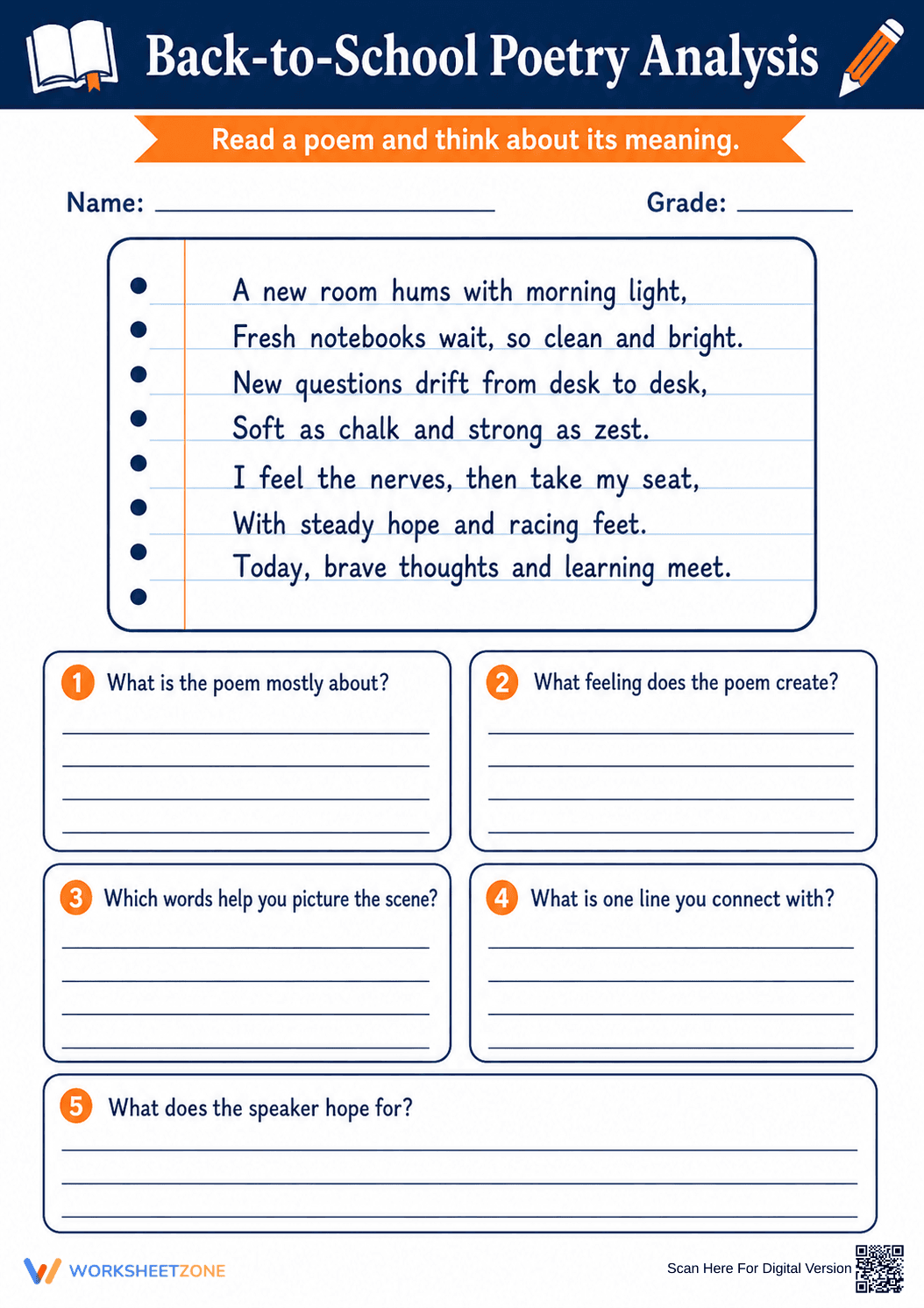
This Grade 5 poetry analysis worksheet helps students identify central themes and emotional resonance within a back-to-school context. By engaging with a short, accessible poem, learners practice extracting evidence to support their interpretations of mood and imagery. It provides a structured framework for students to articulate their personal connections to the text while building foundational literary analysis skills.
At a Glance
- Grade: 5 · Subject: ELA
- Standard:
CCSS.ELA-LITERACY.RL.5.2— Determine a theme of a poem from details in the text- Skill Focus: Poetry Analysis & Theme
- Format: 1 page · 5 problems · Answer key included · PDF
- Best For: First week of school ELA assessment
- Time: 15–25 minutes
What's Inside
The worksheet features a single-page layout containing an original 7-line poem focused on the transition back to the classroom. Below the text, five distinct response boxes provide ruled lines for student writing. The tasks cover summary, emotional identification, sensory imagery, personal connection, and inferring the speaker's intent. A clean, professional design with navy and orange accents ensures high legibility for photocopied distribution.
Zero-Prep Workflow
- Print: Select the single-page PDF and print enough copies for your class (30 seconds).
- Distribute: Hand out the sheets as a quiet bell-ringer or warm-up activity to start the period (1 minute).
- Review: Use the included answer key to facilitate a quick whole-class discussion on imagery and theme (10 minutes).
Total teacher preparation time is under 2 minutes, making this an ideal resource for sub-plans or emergency lesson fillers.
Standards Alignment
The primary focus is `CCSS.ELA-LITERACY.RL.5.2`, which requires students to determine a theme of a poem from details in the text, including how characters respond to challenges. Additionally, it supports RL.5.4 by asking students to identify specific words that create imagery and mood. Both standard codes can be copied directly into lesson plans, IEP goals, or district curriculum mapping tools.
How to Use It
Use this worksheet during the first week of school as a formative assessment to evaluate students' ability to analyze figurative language and tone. It works effectively as an independent practice activity following a brief review of poetic elements. Teachers should observe how students handle the "connection" question to identify those who may need additional support with abstract literary concepts. Completion typically takes 20 minutes.
Who It's For
This resource is tailored for Grade 5 students but is highly adaptable for Grade 4 or Grade 6 learners needing a refresher. It is particularly useful for English Language Learners (ELLs) due to the clear, structured response boxes and accessible vocabulary. Pair this worksheet with a classroom anchor chart on "Elements of Poetry" or a short video on identifying mood in literature.
Research from Fisher & Frey (2014) emphasizes the importance of close reading and text-dependent questions in developing student literacy. This worksheet applies these principles by requiring students to return to the text of the poem to identify specific imagery and emotional cues. By focusing on CCSS.ELA-LITERACY.RL.5.2, the resource ensures that students are not merely summarizing but are actively determining theme through textual evidence. Studies from the RAND AIRS 2024 report indicate that structured, single-page analysis tasks significantly improve student engagement in middle-grade ELA settings by reducing cognitive load during the initial phases of a new school year. This worksheet provides the necessary scaffolding to move students from literal comprehension to inferential thinking. The inclusion of a personal connection prompt aligns with NAEP frameworks that value the reader's ability to relate text to self, fostering a deeper interest in poetic forms and literary expression.


