




























Views
Downloads
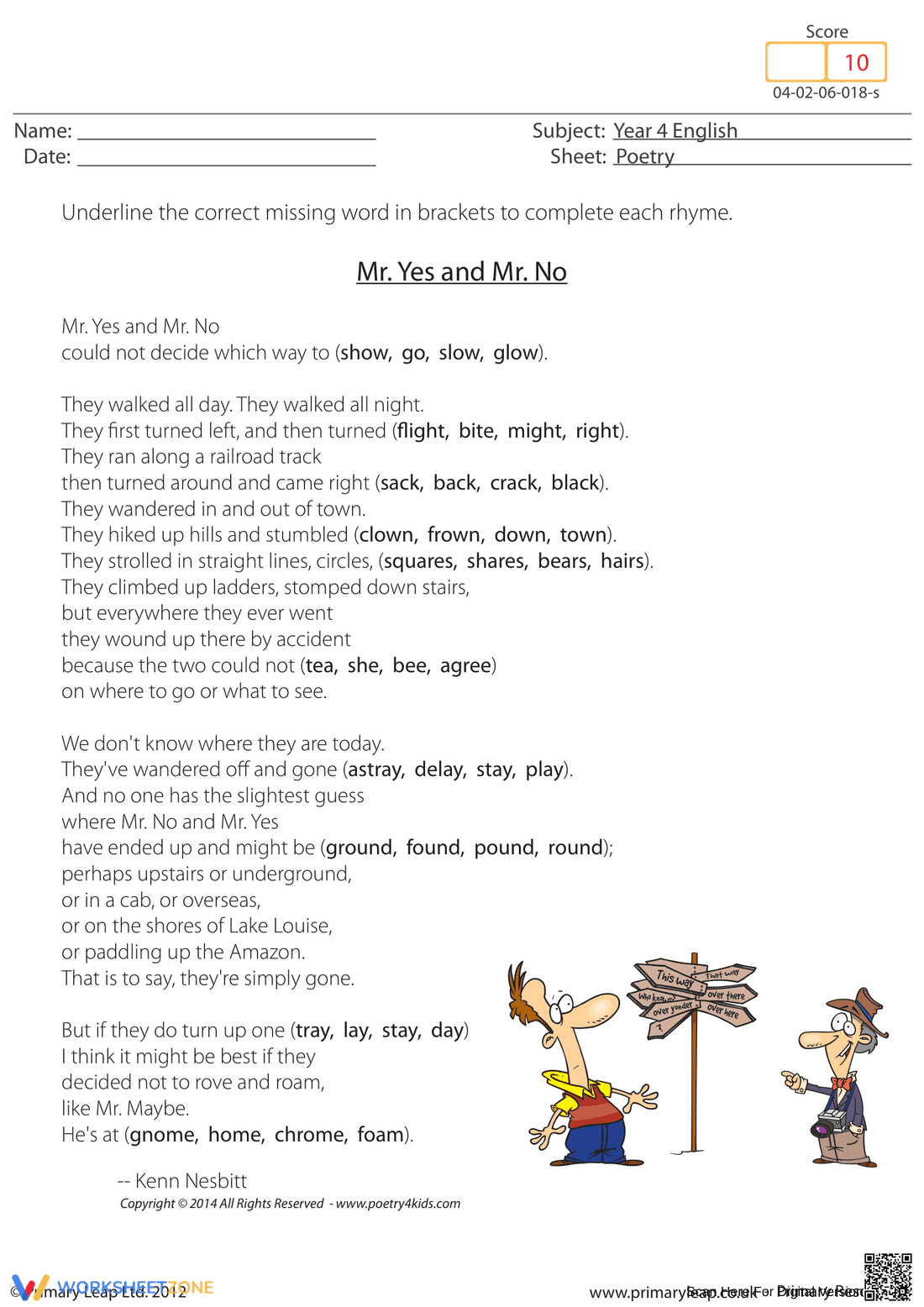

Grade 4 Poetry Rhymes — Printable No-Prep Worksheet

Paste this activity's link or code into your existing LMS (Google Classroom, Canvas, Teams, Schoology, Moodle, etc.).
Students can open and work on the activity right away, with no student login required.
You'll still be able to track student progress and results from your teacher account.
This Grade 4 poetry worksheet provides targeted practice in identifying rhyming words and understanding poetic structure. By reading a humorous poem and selecting correct missing end-rhymes from multiple-choice brackets, learners actively engage with rhythm and verse. This activity strengthens phonological awareness and reading comprehension.
At a Glance
- Grade: 4 · Subject: ELA
- Standard:
CCSS.ELA-LITERACY.RL.4.5— Identify structural elements of poems including rhythm and rhyme- Skill Focus: Rhyming words and poetic structure
- Format: 1 page · 10 problems · PDF
- Best For: Independent practice or sub plans
- Time: 10–15 minutes
This single-page resource features a complete poem titled "Mr. Yes and Mr. No" by Kenn Nesbitt. Embedded within the stanzas are ten missing end-of-line words. For each missing word, students get four options in brackets. They must read the preceding lines, determine the rhyme scheme, and underline the correct word to complete the verse. The layout is clean and includes a dedicated score box for easy grading.
Zero-Prep Workflow
This resource requires zero teacher setup.
- Print (1 minute): Generate copies directly from the PDF. The black-and-white format ensures fast printing.
- Distribute (1 minute): Hand out the single-page activity. Instructions are explicitly stated, allowing students to begin immediately.
- Review (3 minutes): Read the completed poem aloud as a class to verify correct rhyming words.
Total teacher prep time is under two minutes, making this an ideal sub plan.
Standards Alignment
This activity aligns with CCSS.ELA-LITERACY.RL.4.5, requiring students to explain differences between poems, drama, and prose, and refer to structural elements of poems (e.g., verse, rhythm, meter). By selecting words that fit the rhyme scheme, students demonstrate practical knowledge of these elements. Both standard codes can be copied directly into lesson plans, IEP goals, or district curriculum mapping tools.
How to Use It
Deploy this worksheet during independent literacy centers or as a whole-group guided reading exercise. Used before direct instruction on poetry writing, it serves as a mentor text modeling how end-rhymes function. As a formative assessment observation tip, listen to students read aloud; if they struggle to select the correct word, they may need support with auditory processing of rhythm. Expected completion time ranges from 10 to 15 minutes.
Who It's For
This material is designed for third, fourth, and fifth-grade general education students. The humorous tone makes it accessible for English Language Learners and students receiving Tier 2 reading interventions. For differentiation, pair this worksheet with a visual anchor chart explaining rhyme schemes to provide extra scaffolding for struggling readers.
Mastering the structural elements of poetry, such as rhythm and rhyme, plays a critical role in developing broader reading fluency and phonological awareness in elementary classrooms. According to a recent RAND AIRS 2024 report on literacy development, explicit practice with poetic structures significantly improves students' ability to decode complex texts and recognize morphological patterns. When students engage with CCSS.ELA-LITERACY.RL.4.5 to identify structural elements of poems including rhythm and rhyme, they actively reinforce the neural pathways associated with auditory word recognition. This targeted practice ensures learners can transition from basic decoding to fluent, expressive reading. By analyzing verse and selecting appropriate rhyming vocabulary within a structured context, students build the foundational language skills necessary for advanced reading comprehension and creative writing tasks across all elementary grade levels.


