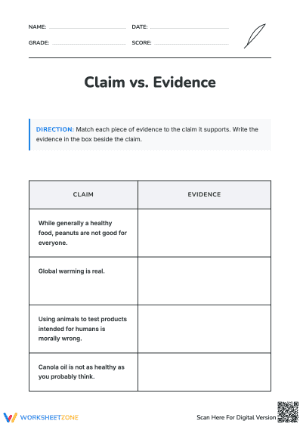
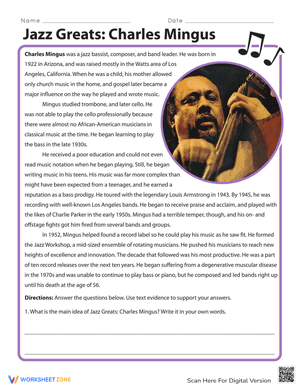
These 5th grade text evidence worksheets resources give teachers a ready set of print-and-go tasks that send students back into passages to locate, quote, and explain supporting details — the exact work RL.5.1 and RI.5.1 demand. Each worksheet pairs a grade-appropriate reading passage with text-dependent questions that require students to prove answers rather than respond from memory. The set covers both literary and informational text, which matters because the evidence-citing habit needs to transfer across genres before standardized reading assessments arrive.
Skills Built Across the Set
Fifth grade is the year that implicit evidence work stops being an extension and becomes the grade-level floor. Students are expected to distinguish between a direct quote, a paraphrased detail, and an inference drawn from multiple sentences — and to explain, in writing, why a chosen detail actually supports the claim being made. These worksheets address that full range rather than stopping at retrieval.
- Locating explicit details — students mark facts, events, and descriptions that directly answer a question without interpretation
- Drawing and supporting inferences — students pull implied meaning from the text and cite the lines that led them there
- Quoting and paraphrasing accurately — students practice both formats, which mirrors how evidence appears on constructed-response tasks
- Explaining the connection — students write a sentence showing how their chosen evidence answers the question, not just restating it
- Working across text types — literary passages and informational passages (articles, biographies, science texts) appear throughout the set
The explanatory step — "how does this detail prove your answer?" — is where fifth graders most often stall. Each worksheet builds that step into the response format so it becomes habitual rather than optional.
Standard Alignment
RL.5.1 and RI.5.1 both require students to quote accurately from a text when explaining what it says explicitly and when drawing inferences. These standards sit at the core of fifth-grade reading instruction because they gate more complex skills: literary analysis, author's purpose, central idea, and comparative reading all depend on a student's ability to return to the text and pull specific support. A teacher who waits until spring to address evidence citation will find that everything else — summarizing, comparing, arguing from text — is harder to build on top of an unstable foundation.
A well-structured 5th grade text evidence worksheets set addresses both standards in a paired way. Some questions ask for direct retrieval — finding what the author states plainly — while others ask students to infer and then identify which lines in the passage led them to that conclusion. That dual demand matches what students face during district assessments and most state-level standardized tests, where evidence-based short responses account for a significant portion of the reading score.
Mistakes Students Make That These Worksheets Help You Catch
The most common error in fifth-grade text evidence work is not that students choose the wrong paragraph — it is that they choose a sentence that feels right because it is in the correct scene or topic area, but does not actually prove the claim. If a question asks what evidence shows a character felt proud, a student will often write "She walked up to the stage" rather than "She stood up straight and smiled at the audience." The first sentence establishes setting; the second supports the inference. Students who make this error have learned to gesture toward the text without truly anchoring there.
A second pattern shows up in the explanation step. Students who find genuinely strong evidence will then write explanations that simply restate it: "The text says 'his hands were shaking.' This shows his hands were shaking." They have quoted accurately but have not explained the connection to the question. Catching this early in the year, before it calcifies into a fixed habit, is one of the most valuable things consistent text evidence practice accomplishes. These worksheets make the explanation step explicit — students cannot skip it because the response format requires a separate sentence for it.
Fitting These Worksheets Into Daily Reading Instruction
The most natural fit is the independent practice block at the close of a reading mini-lesson — roughly 10 to 15 minutes when students work on their own after a think-aloud or guided annotation. One worksheet, one passage, two or three text-dependent questions: that is enough for a focused session that gives teachers a quick read on who can apply the skill without support.
Beyond that window, the set works well as a bell ringer during the first five minutes of class. Teachers can project a short passage and one question, have students write a response before morning meeting ends, and use it as a launch point for accountable talk. That routine is especially useful in the first trimester when the expectation of "prove it from the text" is still being established as a norm. For small-group reteach, the same 5th grade text evidence worksheets tasks can be used with guided rereading — the teacher marks up the passage alongside students before anyone writes, which separates the finding step from the explaining step and makes each one more visible and teachable.
Sub plans are another reliable use. Because each worksheet stands alone and requires only a passage and questions — no setup, no background unit knowledge — a substitute can run the session without understanding where the class is in a novel or content unit. Leave a note about whether students work individually or with a partner, and the task is self-sustaining.
Reaching Different Learners With the Same Set
For students who struggle to get started, the most effective adjustment is narrowing the search zone. Before students read the passage independently, highlight or bracket the two paragraphs most likely to contain the answer. This does not give anything away — students still decide which sentence proves the claim — but it eliminates the paralysis of scanning an entire passage without knowing where to look. Sentence frames for the explanation step ("This detail proves ___ because ___") help students who understand the answer but cannot yet put the reasoning into writing on their own.
Students who move quickly through standard text-dependent questions need a different challenge. Ask them to find a second piece of evidence that also supports the answer, then evaluate which is stronger and explain why. That comparison task is genuinely harder because it requires weighing details against each other rather than locating and citing one. Another option is asking advanced readers to find a sentence that seems relevant but actually does not prove the claim — an intentional false-evidence hunt that sharpens their understanding of what counts as real textual support.
Frequently Asked Questions
Do these worksheets work for both literary and informational reading units?
Yes. The set includes passages from both genres so teachers can use the same format across a fiction unit and a nonfiction reading block without switching between different resource systems. That consistency helps students see evidence-citing as a transferable reading habit rather than a genre-specific task.
How do these worksheets fit into a test-prep review sequence?
Many state and district reading assessments include short constructed-response questions that require students to quote or paraphrase evidence and explain how it supports an answer. Using a 5th grade text evidence worksheets set in the weeks before testing gives students repeated practice with that response format under low-stakes conditions. The familiarity reduces test anxiety around the format itself — a real and separate obstacle from the reading skill.
Can completed worksheets be used for formative assessment?
They work well for that purpose. A stack of completed worksheets sorted into three groups — strong evidence with clear explanation, correct evidence with weak explanation, and off-target or memory-based answers — gives teachers a fast and visible map of where the class needs more work. Because the format stays stable, teachers can track whether a student's evidence quality is improving across different texts over time without creating new assessment materials each week.
What do early finishers do when they complete a worksheet quickly?
Each worksheet is self-contained, so early finishers can annotate the passage a second time — circling one additional detail that supports the same answer, or underlining a sentence that seems related but does not actually prove the claim. That extension deepens the same skill without requiring a separate handout and keeps the focus squarely on how evidence works.















 Interactive Worksheet Maker
 Quiz Maker
 Word Search Maker
 Crossword Puzzle Maker
 Word Scramble Generator
 Sentence Scramble Generator
 Handwriting Worksheet Generator
 Name Tracing Generator
 Fill In The Blank Generator