


























Views
Downloads

Grade 5 Bald Eagles — Printable No-Prep Worksheet
Paste this activity's link or code into your existing LMS (Google Classroom, Canvas, Teams, Schoology, Moodle, etc.).
Students can open and work on the activity right away, with no student login required.
You'll still be able to track student progress and results from your teacher account.
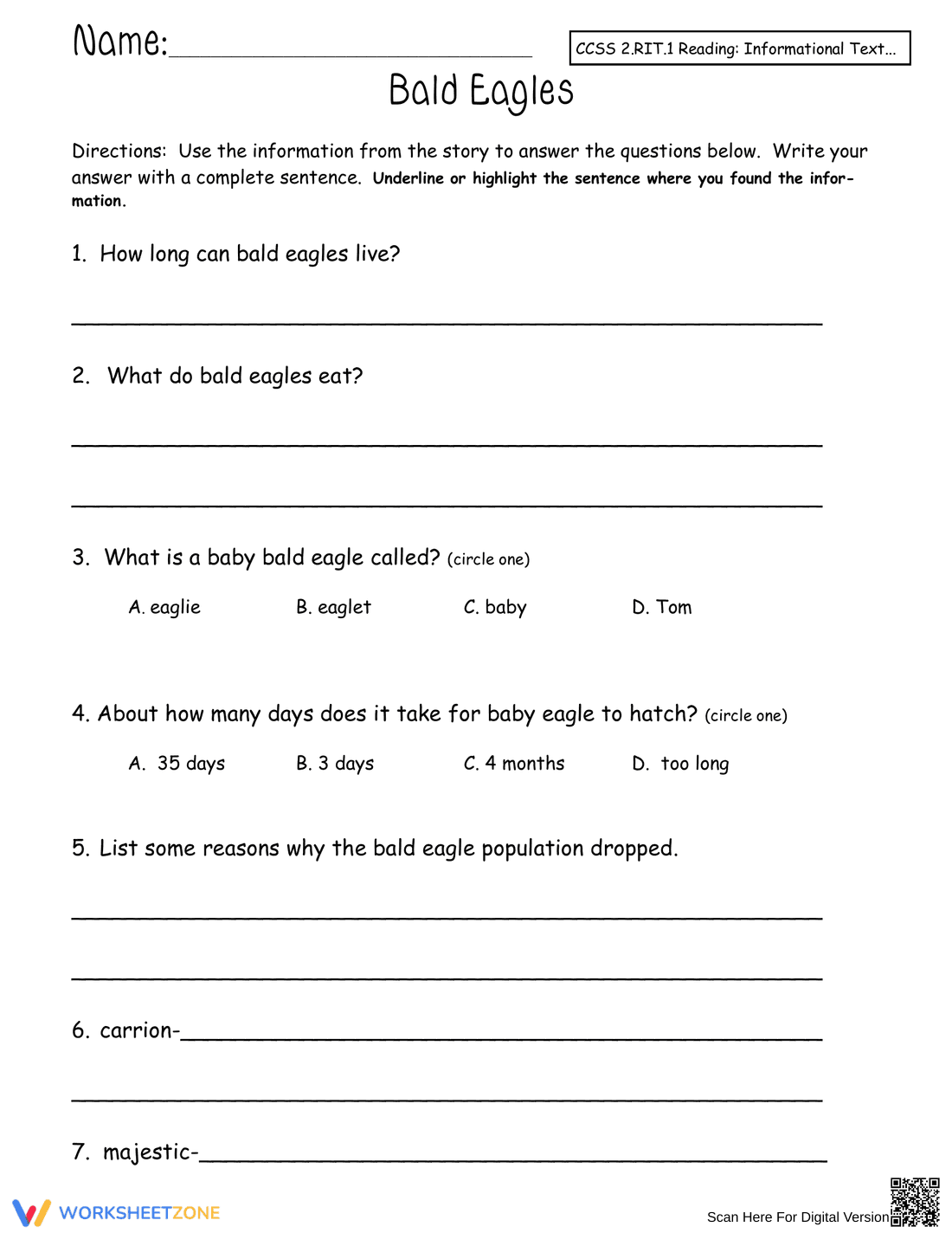
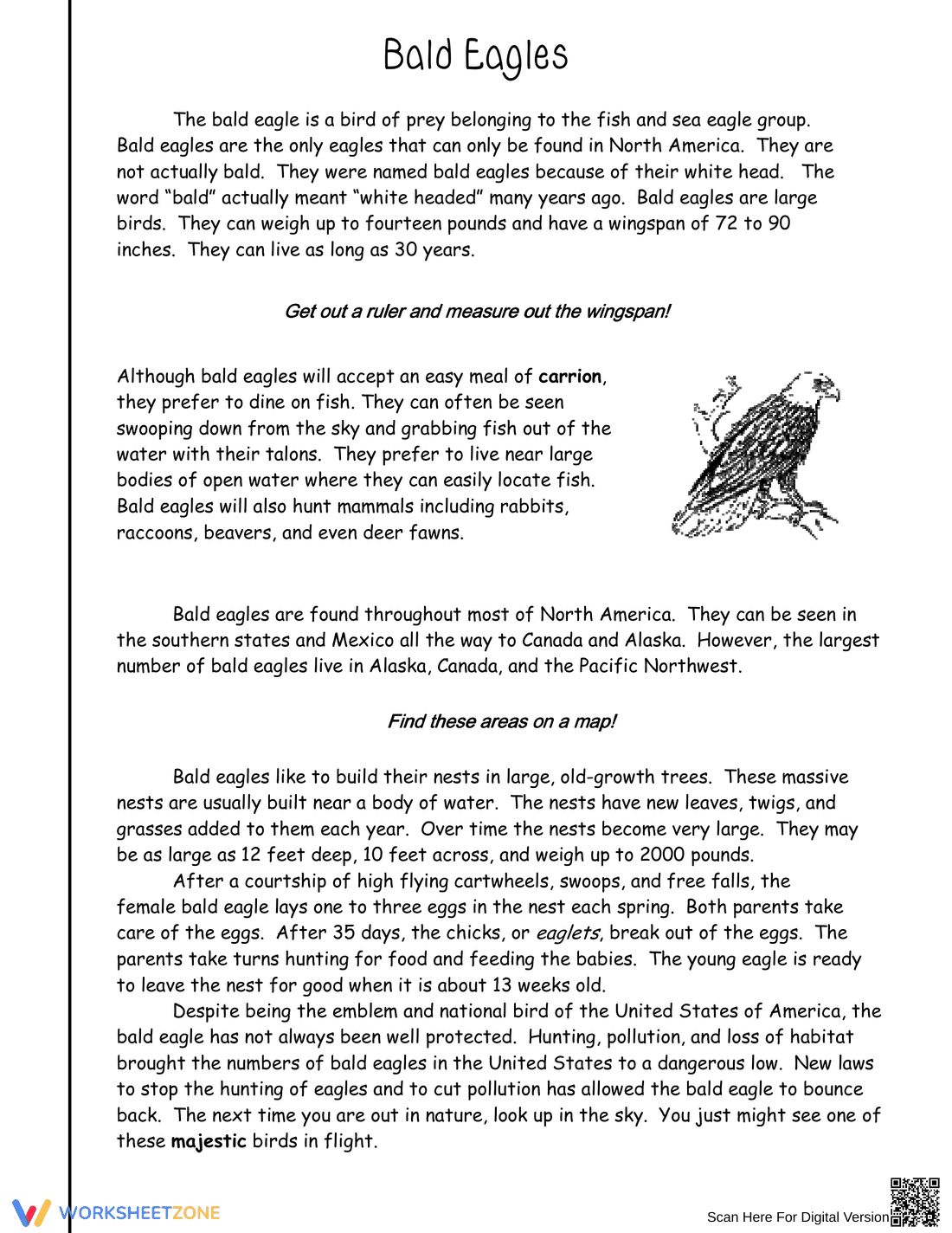
This informational text worksheet builds reading comprehension skills by having students analyze a passage about bald eagles. Students read a detailed text and extract specific evidence to answer questions, strengthening their ability to locate facts, understand vocabulary in context, and write complete sentences based on informational sources.
At a Glance
- Grade: 5 · Subject: ELA
- Standard:
CCSS 2.RIT.1— Ask and answer questions to demonstrate understanding of key details.- Skill Focus: Reading comprehension and text evidence
- Format: 2 pages · 7 problems · PDF
- Best For: Independent practice and reading centers
- Time: 15–20 minutes
This resource includes a one-page informational reading passage about bald eagles and a corresponding question sheet. The passage covers the eagle's habitat, diet, nesting habits, and conservation history. The assessment page features seven tasks, including short-answer questions, multiple-choice questions, and vocabulary identification. Directions explicitly prompt students to underline or highlight the sentence where they found the information, reinforcing evidence-based reading habits.
Designed for immediate classroom implementation, this resource requires under two minutes of teacher preparation.
- Print (1 minute): Generate copies of the two-page PDF.
- Distribute (1 minute): Hand out the passage and question sheet. No additional materials are needed.
- Review (5 minutes): Go over the text evidence requirements before independent work.
The self-explanatory format makes this an excellent option for emergency sub plans.
This worksheet aligns directly with CCSS 2.RIT.1: "Ask and answer such questions as who, what, where, when, why, and how to demonstrate understanding of key details in a text." The foundational skill of locating explicit evidence remains critical across grades. The standard code can be copied directly into lesson plans, IEP goals, or district curriculum mapping tools.
Deploy this worksheet during independent reading blocks to assess students' ability to cite text evidence. It works well as a follow-up activity after direct instruction on informational text structures. As a formative assessment tip, observe whether students actively highlight the passage before writing answers; this indicates successful application of the text-evidence strategy. Expected completion time is 15 to 20 minutes.
This resource is ideal for upper elementary students needing targeted practice with informational texts. The straightforward layout supports students who benefit from clear formatting. For differentiation, teachers can read the passage aloud to below-level readers while requiring them to locate answers independently. Pair this worksheet with an anchor chart on finding text evidence.
Mastering the ability to extract information from nonfiction texts is a fundamental requirement for academic success across all core subjects. This worksheet targets CCSS 2.RIT.1, requiring students to ask and answer questions to demonstrate understanding of key details in a text. According to a 2024 report by EdReports, consistent practice with text-dependent questions significantly improves students' reading comprehension and analytical skills. When students are explicitly taught to return to the text to find evidence, as prompted by this specific activity, they develop stronger critical thinking habits and better retention of informational content. By combining a high-interest topic like bald eagles with structured evidence-gathering tasks, educators can effectively build these essential literacy skills. Regular engagement with such targeted reading materials ensures students are fully prepared for more complex analytical tasks in higher grade levels.


