Reading A Chart Worksheets for Grade 5
These reading a chart printable worksheets for 5th grade give teachers a focused set of standalone practice materials for one of the more undertaught comprehension skills in upper-elementary informational reading — making sense of bar graphs, line graphs, pie charts, and data tables as independent sources of information, not as decorations alongside a written passage. Each worksheet isolates chart reading as its own task, which is how students build fluency before they're expected to synthesize visual and written information together. The question sets move beyond simple data retrieval; every worksheet includes at least one inference prompt so students practice both what the chart shows and what it means.
The Specific Skills Targeted in Each Worksheet
Each worksheet concentrates on a single chart format, so students work through the complete skill set for that format — reading the structure, locating specific values, comparing data points, and making an inference — before moving to the next type. The set covers four formats:
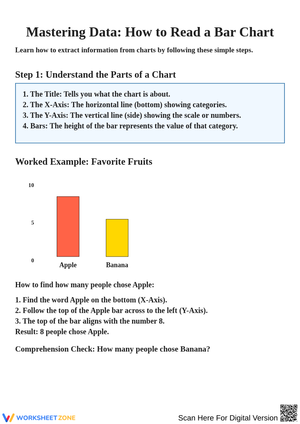
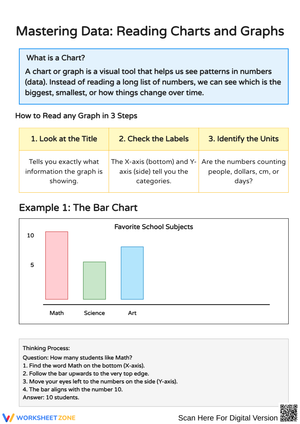
- Bar graphs (single-series and multi-series). Students mark specific values, compare categories, and explain in writing what the data reveals. Topics include seasonal rainfall totals, population by region, or species counts by habitat — contexts recognizable enough that the chart feels meaningful rather than arbitrary.
- Line graphs tracking change over time. Students identify peaks and low points, describe the direction of a trend in their own words, and answer at least one question about what the pattern would logically predict next.
- Pie charts showing parts of a whole. Tasks include matching percentages to labeled segments, identifying the largest and smallest portions, and distinguishing between "roughly half" and "exactly half" — a distinction that looks obvious until students work through it in writing.
- Data tables with labeled rows and columns. Students locate intersections, calculate differences between values, and rank entries. Many fifth graders find tables more demanding than graphs because there's no visual shape to anchor the search — they have to hold a row label and a column label in mind simultaneously while scanning.
Frequent Mistakes That Show Up in Student Work
The most predictable error is skipping the chart title and jumping straight to the first bar or biggest slice. Students who do this often answer questions about the wrong variable entirely — they describe what the tallest bar shows without registering that the y-axis measures millimeters of rainfall rather than degrees of temperature. Requiring students to write the chart title at the top of their answer section before touching any question is a low-effort intervention that noticeably raises accuracy.
Scale misreading is the second pattern to watch for. On a bar graph where the y-axis increments by 25, a bar landing halfway between 50 and 75 gets read as "60" by students who are eyeballing the height instead of calculating the midpoint. The root problem is that they haven't stopped to ask what each gridline represents — they assume the axis counts up in ones from zero. A quick whole-class question at the start of a work session ("What does each horizontal line on this graph stand for?") catches most of these before they become entrenched habits.
Pie chart errors take a different form. If a chart shows that 35% of surveyed families prefer one option, and the survey included 200 families, a meaningful number of fifth graders will write "35 families" in their answer. They've read the number and the percent sign but haven't processed the percent as a rate applied to a total. These worksheets surface that error quickly, often within the first pie chart task.
Standard Alignment
CCSS.ELA-LITERACY.RI.5.7 is the anchor standard here. It requires fifth graders to draw on information from multiple sources and to integrate information presented in different formats — charts, graphs, and other visual elements — with written text. Reading a chart printable worksheets for 5th grade address the prerequisite that standard assumes: students can't integrate what they can't read independently. Isolating the visual-reading task is what makes the integration work later.
Grade 5 is the right developmental placement for this kind of practice. Fourth-grade standards ask students to interpret visual elements within a text, but Grade 5 is the first year the synthesis demand becomes explicit — students are expected to pull information from two different formats and use both to answer a single question. That's a qualitatively different task than noticing a chart is present, and it doesn't happen reliably without focused practice on the chart-reading layer first.
Fitting These Worksheets Into Your Weekly Plan
The most effective classroom use I've seen is a brief silent observation before students touch the questions. Students cover the question portion with a blank sheet and spend two minutes recording three things: what the title tells them, what the axis labels or legend identify, and one pattern they notice independently. Then they uncover the questions. Inference questions in particular get more accurate answers when students have already processed the chart's structure rather than reading it for the first time while simultaneously parsing a question. Once this becomes a classroom routine, students carry it into assessments without prompting.
For Monday morning warm-ups, a bar graph worksheet fits inside eight minutes — two minutes of silent observation, four minutes of independent work, two minutes of whole-class debrief on the inference question. The debrief is where student reasoning surfaces and where genuine disagreements about what the data means tend to happen, which makes it the most productive part of the session. Pairing a chart worksheet with whatever informational text the class is already reading also removes the need for separate planning — a line graph on temperature change over decades fits naturally inside a weather-and-climate reading unit without adding complexity to the lesson design.
Adjusting the Set for a Range of Learners
For students still building basic graph literacy, start with single-series bar graphs where all bars land exactly on scale lines and the interval is simple. These students need the title-first, axes-second habit before they can manage any comparative task. A brief verbal walkthrough before independent work — naming each element of the chart together before students work alone — removes the paralysis that comes from not knowing where to start.
For students who move through retrieval questions quickly, the right challenge isn't a more complicated chart — it's a harder question. Prompt them to write one question the chart raises but doesn't answer, or to explain what a reader would misunderstand by skipping the chart and reading only the accompanying article. That task separates students who can retrieve data from students who understand what the data is for. Reading a chart printable worksheets for 5th grade build in inference questions at every level precisely to make this kind of upward adjustment possible without additional preparation.
For the middle range — students who answer retrieval questions accurately but stall at inference — having partners talk through the chart before writing individually often produces stronger answers than silent independent work from the start. The discussion stage surfaces interpretive confusion before it gets committed to paper, where it's harder to address.
Frequently Asked Questions
What chart types does the set include?
Each worksheet covers one of four formats: bar graphs (both single- and multi-series), line graphs, pie charts, and data tables. Questions across the set address retrieval, comparison, trend identification, and inference, so students practice the full range of tasks a chart might require inside an actual informational text.
How do these connect to ELA standards rather than math standards?
Reading a chart printable worksheets for 5th grade align with RI.5.7, an ELA informational text standard. The difference from a math approach shows up in how the questions are written: rather than asking students to calculate or plot, the worksheets ask them to extract information, explain what data means in context, and draw logical conclusions — the same comprehension moves they apply to a written paragraph.
Can these worksheets serve as formative assessment tools?
Yes, and they give specific diagnostic information rather than a general accuracy score. If a student answers retrieval questions correctly but misses every inference question, the literal reading is solid but synthesis isn't automatic yet. If a student misreads the scale on two or three worksheets in a row, that's a specific gap worth addressing directly. The question structure makes the breakdown point visible rather than burying it in a single score.
How long does a typical worksheet take to complete?
Most fifth graders finish in 10 to 12 minutes. Data table worksheets run slightly longer — closer to 14 or 15 minutes — because students scan the table more times before committing to an answer. The two-minute silent observation built into the routine keeps total time predictable and tends to reduce the back-and-forth of students rereading the chart mid-question.
Clear All