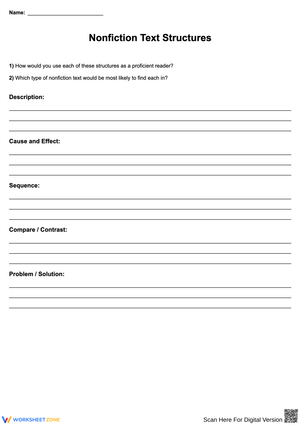
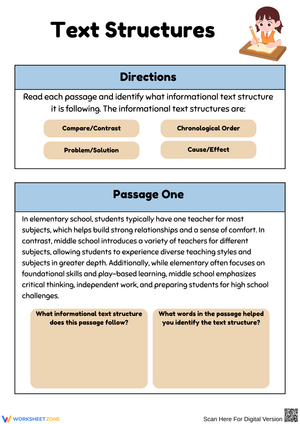
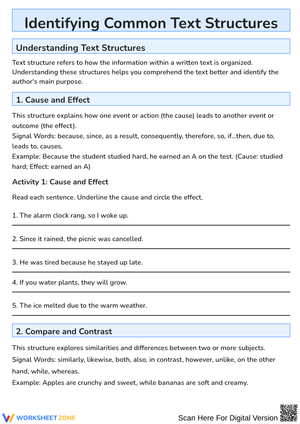
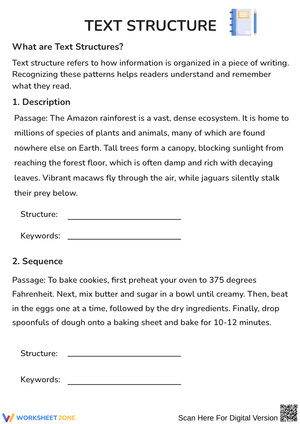
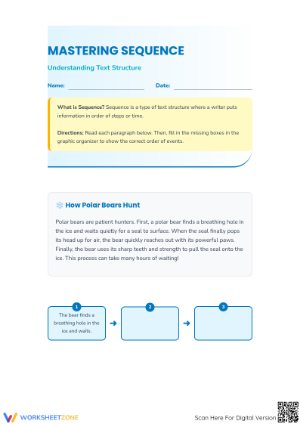
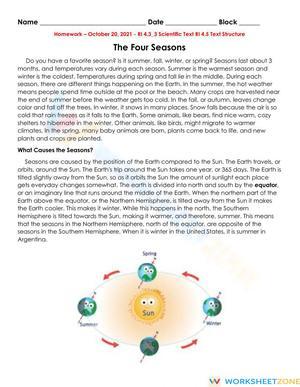
These analyzing text structure printable worksheets for 5th grade give teachers passage-based practice where students name the organizational pattern, annotate signal words directly in the text, and write a short evidence-backed explanation — not just circle an answer from a list. Each worksheet stays focused on one reading move, which makes the resources easy to slot into instruction at multiple points across the week.
What Students Do on Each Worksheet
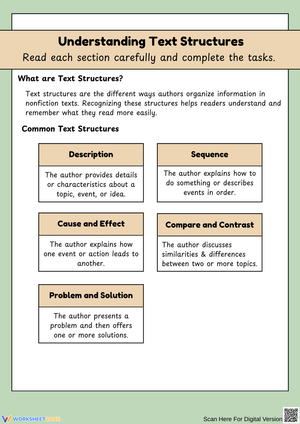
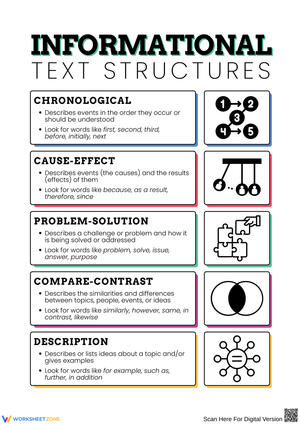
Grade 5 is the point where identifying a text structure stops being the goal and explaining why the author used it becomes the standard. The five patterns students are expected to recognize and analyze are compare and contrast, cause and effect, sequence or chronology, problem and solution, and description. The set moves from single-structure passages to mixed review — students who need clear pattern practice build confidence before they face a passage where they must discriminate between two plausible structures.
- Compare and contrast — students track similarities and differences and note which signal words mark each relationship within the passage.
- Cause and effect — students connect an event to its outcome, often in a chain where one effect triggers the next cause.
- Sequence or chronology — students follow steps or events in order and explain why the sequence matters to the author's argument or point.
- Problem and solution — students identify the issue, any partial fixes, and the resolution; this structure is harder than it looks when a passage presents several attempted solutions before the final one.
- Description — students gather traits or features around a central subject and identify how supporting details are organized outward from that center.
Each worksheet asks students to mark signal words in context rather than pull them from a separate isolated list. That distinction matters. A student who can circle therefore in a sentence is different from a student who understands that therefore signals a consequence inside a passage built around a chain of causes.
Mistakes Students Make That These Worksheets Help You Catch
The most persistent confusion at this grade level is between sequence and cause and effect. Both patterns use time-order language — first, then, next, finally — so students trained to hunt for signal words will mark almost any paragraph as sequence. The real distinction is that sequence tracks order while cause and effect tracks consequence. A passage about how a wildfire spreads might be chronological on the surface, but the author's organizational purpose is cause and effect: one dry condition leads to the next, and the order only matters because it shows escalation. Students who miss that tend to write "it goes in order" as their explanation — technically accurate, structurally wrong.
Description passages produce a different error. Students treat description as the fallback when no other pattern is recognizable — the "I don't see any signal words" response. But description is a deliberate organizational choice where an author builds outward from a central topic through attributes and examples. When a prompt asks students to show how the structure helps a reader understand the main idea, description passages reveal this guessing habit quickly. Those responses become a teaching moment rather than just a wrong answer to mark.
A third pattern worth tracking: students who correctly label the structure on a recognition task often cannot justify the label in writing. They have the answer but not the reasoning. The explanation prompts on these worksheets are built specifically to expose that gap before it shows up on a reading assessment.
Building These Worksheets Into Your Week's Lesson Plans
The strongest use of analyzing text structure printable worksheets for 5th grade is a deliberate progression rather than isolated practice. Start Monday with a mini-lesson on a single structure — cause and effect, for example. Immediately after modeling, use one worksheet as whole-group guided practice, projecting the passage and marking it together before students complete the written prompt on their own. On Tuesday, the same format becomes a literacy center task while you pull a small group for intervention. By Thursday, a mixed-structure worksheet works as a quick instructional check: distribute it at the start of class, collect it before the next transition, and sort the responses into three piles — solid explanation, partial reasoning, wrong label. That sort takes about four minutes and tells you exactly what Friday's warm-up should address.
These worksheets also hold up in substitute plans because the task is self-contained: read the passage, mark the signal words, name the structure, explain the choice. A sub does not need to understand the current reading unit to hand out a worksheet and collect it. That practical reality matters more than most resource descriptions acknowledge.
For homework, keep the ask narrow. One passage with three or four focused questions returns more instructional information than a longer review worksheet assigned at the end of a full school day. When students bring a short homework worksheet back the next morning, it becomes warm-up discussion material rather than something to grade in isolation.
Standard Alignment
These worksheets align to CCSS ELA-Literacy RI.5.5, which asks fifth graders to compare and contrast the overall structure — chronology, comparison, cause and effect, or problem and solution — of events, ideas, concepts, or information in two or more texts. In classroom terms, this standard sits within the informational text strand for grades 4 and 5 and directly supports adjacent standards like RI.5.6 (author's point of view) and RI.5.8 (argument and evidence). Teachers working through an informational reading unit find that text structure practice sharpens the evidence-gathering thinking both of those standards require — students who understand how ideas are organized are better positioned to identify an author's perspective and evaluate the reasoning behind a claim.
Adjusting the Work for Different Readers in the Same Room
The most useful differentiation move is keeping the structure goal constant while changing the response support around it. Every student in a mixed-ability class can work on cause and effect at the same time; what varies is how much language help each student receives before writing. Some students benefit from a signal-word bank printed at the top of the worksheet. Others need a sentence stem to start their explanation — something like "This passage is organized by cause and effect because..." Advanced readers can respond to an additional prompt asking why a different structure, such as sequence, would be incorrect for the same passage. Analyzing text structure printable worksheets for 5th grade that allow for those kinds of response adjustments keep the reading demand high for every student while removing procedural barriers for those who need them.
Passage complexity is another adjustment point. Students reading below grade level work with shorter, more clearly structured passages while still completing the same three-part task: identify the structure, cite two textual clues, explain how the organization helps the reader follow the main idea. Students reading above grade level benefit from passages where two structures seem plausible, which requires a judgment call and a written defense — a harder and more transferable skill than clean identification.
Rotating nonfiction and fiction passages across the set matters here too. Nonfiction makes organizational patterns more visible, especially for cause and effect and problem and solution, because academic authors rely on those patterns explicitly. Fiction is harder — a short story may have a clear sequence of events, but explaining the author's structural choice still requires close reading — and that difficulty is appropriate for students who have already mastered the nonfiction patterns. Using both text types builds the transfer that shows up in content-area reading, not just on skills checks.
Frequently Asked Questions
Which text structure causes the most trouble for 5th graders?
Cause and effect is the most commonly misidentified pattern, almost always because students confuse it with sequence. Both rely on time-order signal words, so direct instruction needs to address the distinction explicitly: sequence tracks the order of events or steps, while cause and effect tracks consequences. Side-by-side passage comparisons during whole-group instruction — one clearly sequential, one clearly causal — make the difference stick better than definitions alone.
Can these worksheets serve as formative assessment?
Yes, and the explanation prompt is what makes that possible. A student who labels the structure correctly but writes "the author uses cause and effect because things happen in order" has the wrong reasoning even if the label is technically right. Sorting explanation responses into categories — strong reasoning, partial reasoning, mislabeled — takes three or four minutes and gives a clearer picture of where instruction needs to go next than any multiple-choice score does.
Do the passages cover nonfiction only, or is fiction included?
Both text types are in the set. Nonfiction is the primary context for RI.5.5, and students tend to find organizational patterns easier to spot in informational writing. Fiction passages ask students to apply the same thinking in a different context — a useful challenge once students are secure with the nonfiction patterns. Using both text types builds the kind of transfer that matters for independent reading and content-area work, not just for the skills section of a reading assessment.
Where do these fit in test preparation?
Analyzing text structure printable worksheets for 5th grade appear in the informational reading section of most state ELA assessments, so the instructional and test-prep value overlap significantly. The most effective approach is to use these worksheets as regular instructional tools throughout the unit, then pull a mixed-structure worksheet from the set in the two or three weeks before the assessment. Students who practiced identifying and explaining structure during regular instruction do not need a separate drill cycle; they need a low-stakes reminder that the same thinking they applied on Tuesday applies to the passage in front of them on test day.












 Interactive Worksheet Maker
 Quiz Maker
 Word Search Maker
 Crossword Puzzle Maker
 Word Scramble Generator
 Sentence Scramble Generator
 Handwriting Worksheet Generator
 Name Tracing Generator
 Fill In The Blank Generator