When using text features printable worksheets for 5th grade, teachers bring students structured practice that moves them from simply naming features to explaining how those features contribute to meaning — exactly what grade-level informational reading demands. By fifth grade, students encounter diagrams, maps, sidebars, glossaries, and charts not just in ELA but in science and social studies as well. The gap between being able to label a feature and being able to use it to answer a question is wide, and these worksheets help close it.
The Specific Skills These Worksheets Build
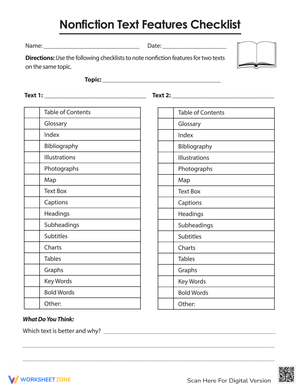
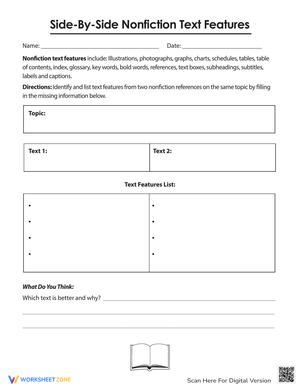
Grade 5 text feature work splits into two layers: recognition and application. Students still need to identify what a feature is, but the stronger instructional goal is explaining what that feature adds. Each worksheet focuses students on working with headings, captions, diagrams, charts, maps, glossaries, and sidebars — and then asks the harder question: what does this feature add that the body text does not?
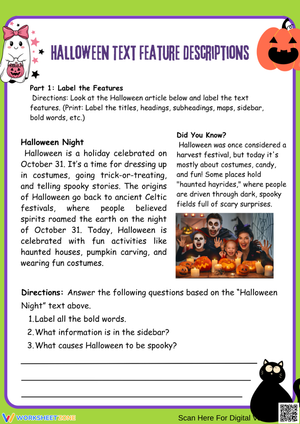
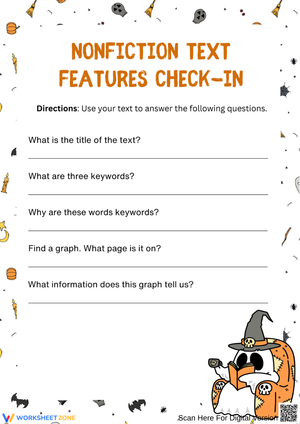
A useful internal benchmark is whether a student can answer two questions in sequence. First: What kind of feature is this? Second: How did it help me understand this passage better? Students who can only answer the first have completed a recognition task. Students who can answer both are doing the reading work the standard expects. Worksheets that include short written response space — rather than only matching or multiple-choice formats — make that second answer visible and assessable in real time.
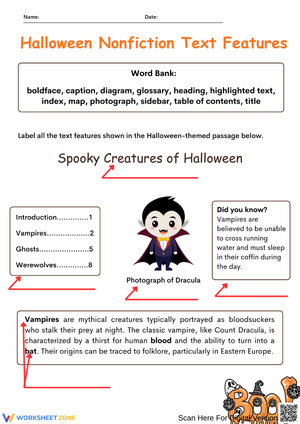
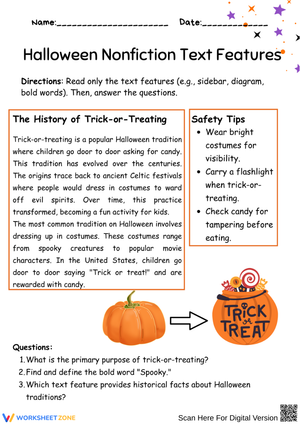
One useful task format: a worksheet presents a short nonfiction passage about an earth science or social studies topic, includes a labeled diagram, and then asks students to explain what the diagram shows that the paragraph alone does not. That cross-reference task reflects the real demands of upper elementary informational reading more closely than isolated labeling exercises do.
Where Fifth Graders Tend to Go Wrong With Text Features
The most common error at this grade level is not failing to identify a feature — it is ignoring the feature when answering a comprehension question. A student who correctly underlines a diagram label will still write an answer drawn entirely from the body text, leaving the visual untouched. That pattern appears regularly in student work and signals that identification practice alone is not enough.
A second error: students treat headings as titles rather than as predictive tools. They read past a heading the way they skip a chapter title — as decoration rather than as a cue that reorganizes what they are about to read. Worksheets that ask students to write what they predict a section will cover based on its heading, then compare that prediction to what the paragraph actually says, help break that habit with direct practice.
A third confusion that surfaces consistently is between text features and text structure. Students write "cause and effect" when asked to name a diagram, or write "caption" when asked to identify how ideas are organized in a passage. These are related but distinct concepts. The confusion eases when teachers pair using text features printable worksheets for 5th grade with dedicated text structure lessons — students begin to see that features are visible, physical elements in a text, while structure is something they read for in the writing itself.
Fitting These Worksheets Into the Week
The practical value of a well-made worksheet is flexibility — it fits multiple spots in the school day without requiring a full lesson redesign. During a mini-lesson, the teacher models reading a nonfiction passage and thinking aloud about which feature answers a specific question, then assigns the worksheet for immediate independent practice. In a literacy center, the same worksheet holds students accountable without requiring the teacher to be present. At the end of a whole-group lesson, it serves as a formative exit ticket: score for the written reasoning, not just for whether the student circled the correct feature name.
These worksheets also work as bell ringers in the 5 to 8 minutes before the ELA block settles. A short nonfiction passage with two or three text features gives students a clear entry point that reactivates prior learning without demanding too much before instruction begins. Other practical uses include:
- Reteach sessions after a comprehension quiz reveals that students missed feature-based questions.
- Intervention work where students need shorter passages and direct written prompts.
- Homework that revisits a familiar strategy rather than introducing something new.
- Sub plans, since the format is structured enough to run without additional teacher explanation.
Reading Text Features Across Content Areas
Text feature instruction pays dividends beyond the reading block. In grade 5 science, students encounter labeled diagrams of life cycles, cross-sections of the earth's layers, and food web illustrations — and the information inside those visuals is essential to understanding the main text, not supplemental to it. In social studies, maps and timelines often hold details that cannot be found in the paragraph text at all. When students have practiced using captions and diagrams in ELA, they bring that habit to content-area reading without needing the skill retaught from scratch.
For literacy coaches and curriculum leads, this transfer is one of the stronger arguments for keeping text feature practice active across the year rather than treating it as a unit to check off once. When a fifth-grade team uses consistent language across ELA, science, and social studies — "What does this feature tell you that the paragraph doesn't?" — students internalize the strategy more durably. Using text features printable worksheets for 5th grade gives that team a shared, low-prep resource for maintaining that consistency without requiring separate planning time from every teacher on the team.
Standard Alignment
These worksheets align most directly to CCSS.ELA-LITERACY.RI.5.7, which asks students to draw on information from multiple print or digital sources and demonstrate the ability to locate an answer to a question quickly. In classroom terms, that standard expects students to treat text features as one of several sources of information within and across texts — not as bonus material to notice after reading is finished.
The skill also builds on RI.4.7, the grade 4 standard for interpreting information presented visually — in charts, diagrams, timelines, and similar elements — and explaining how that information contributes to understanding. Many fifth graders benefit from revisiting that reasoning work with more complex texts, particularly students who moved through fourth grade without enough practice explaining why a visual feature matters. Teachers using these worksheets with intervention groups often find that returning to the grade 4 reasoning language accelerates progress toward the grade 5 expectation.
How to Use These Worksheets With Students at Different Readiness Levels
For students who need more support, the most effective adjustment is narrowing scope. Rather than presenting a worksheet that covers five or six feature types, limit the task to two — a heading and a caption, for example — and offer sentence frames such as The caption helped me understand... because... That constraint keeps the task manageable while still requiring students to produce a reason, not just a label.
For students ready for more challenge, add an evaluation layer. Instead of asking which feature helped them answer a question, ask which feature gave stronger evidence and why. That task requires comparing across features — the chart against the body text, the diagram against the sidebar — and pushes toward the source analysis that matters in middle school informational reading. Rubric scoring on the written response, rather than checking for completion, gives the most useful picture of where each student actually is.
Frequently Asked Questions
What text features should 5th graders know how to use in informational texts?
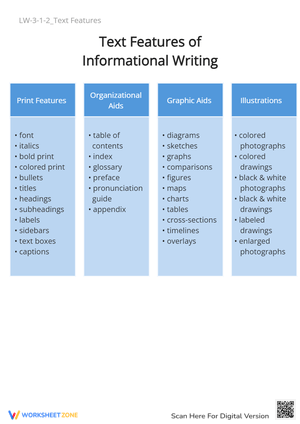
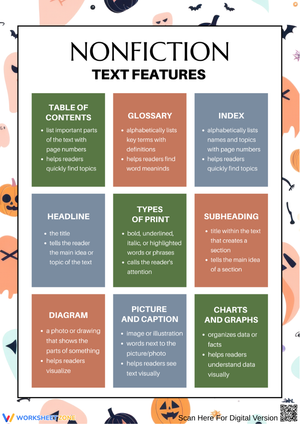
Grade 5 students should be able to work with headings, captions, diagrams, charts or graphs, maps, glossaries, indexes, and sidebars. The expectation goes beyond identification — students should explain how each feature helps them find information or understand the surrounding text more accurately.
How do these worksheets support reading comprehension specifically?
They train students to draw meaning from the full text — diagrams, charts, captions, and structural elements — rather than reading only the paragraph text. Each worksheet directs students to a specific feature, connects it to the passage, and asks them to explain the contribution. That builds the habit of looking across the full text for evidence rather than scanning sentences and hoping an answer turns up.
Can these worksheets be used in small-group or intervention settings?
They work well in both. In small groups, teachers can model the thinking aloud, narrow the number of features in focus, and listen to students explain their reasoning — which gives much better information than a completed matching task does. In intervention, shorter passages with direct written prompts make the skill accessible without overwhelming students who are reading below grade level.
How is a text feature different from text structure?
Text features are the visual and organizational elements you can point to in a text — captions, headings, charts, diagrams. Text structure is how ideas are arranged inside the writing — cause and effect, compare and contrast, problem and solution, sequence. Students conflate the two often enough that the distinction is worth naming directly. The concepts clarify each other quickly: teachers using text features printable worksheets for 5th grade alongside explicit text structure instruction watch students begin to sort them out — features are things to look at, structure is something to read for.












 Interactive Worksheet Maker
 Quiz Maker
 Word Search Maker
 Crossword Puzzle Maker
 Word Scramble Generator
 Sentence Scramble Generator
 Handwriting Worksheet Generator
 Name Tracing Generator
 Fill In The Blank Generator