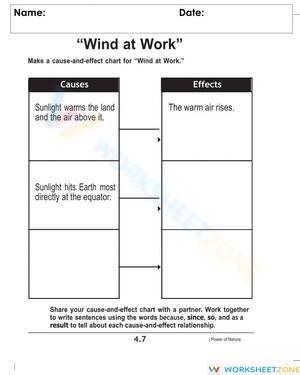
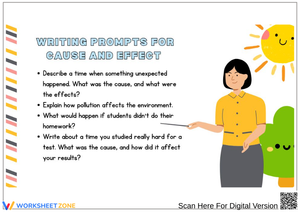
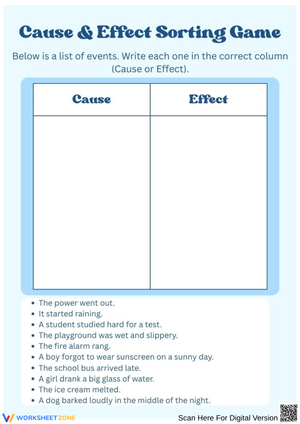
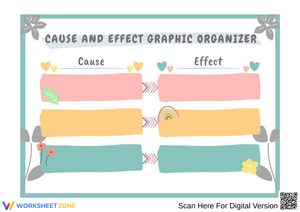
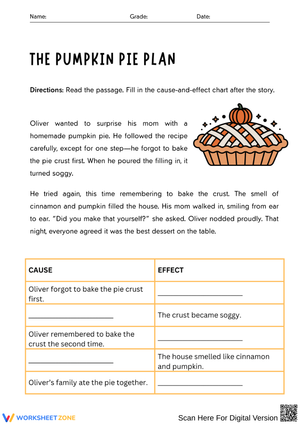
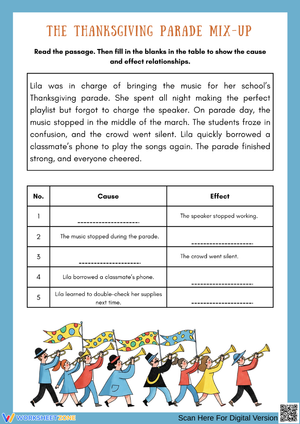
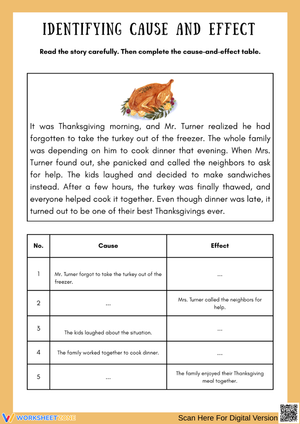
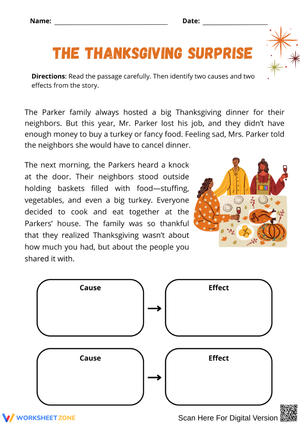
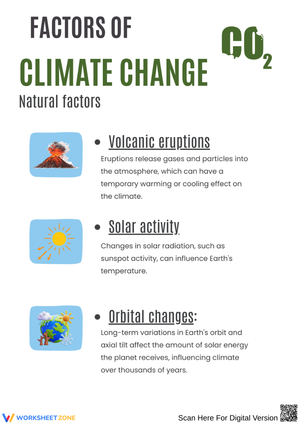
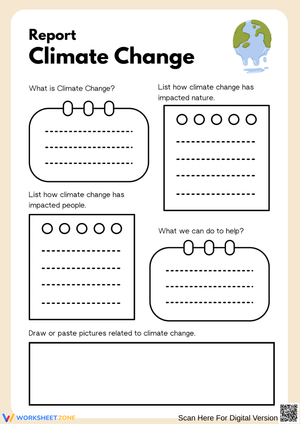
These 5th grade cause and effect printable worksheets resources give teachers ready-to-use reading practice that fits into whole-group lessons, small-group reteaching, and independent work without any additional prep. The set covers the moves fifth graders actually need: tracing cause-and-effect chains across multiple paragraphs, recognizing implied relationships, and grounding answers in text evidence rather than background knowledge. That scope puts the work exactly where Grade 5 instruction belongs — past the single-sentence matching tasks that serve earlier grades and into the kind of close reading that informs informational text comprehension all year.
What Students Practice in This Set
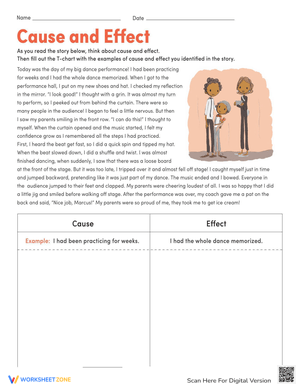
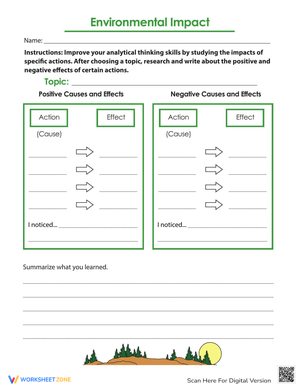
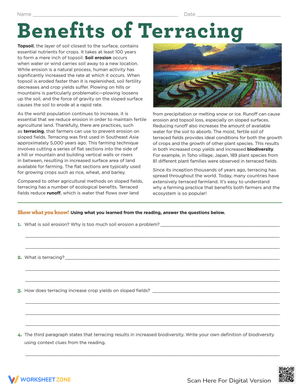
Fifth graders are no longer identifying one cause and one obvious effect. By this grade, students are expected to describe relationships among events and ideas, recognize when a single cause produces a chain of effects, and explain how a passage's structure shapes meaning. Each worksheet targets those specific demands through short informational passages, graphic organizers, or written explanation prompts — not all three at once, which keeps the cognitive load manageable and makes it easier to pinpoint exactly what a student understands.
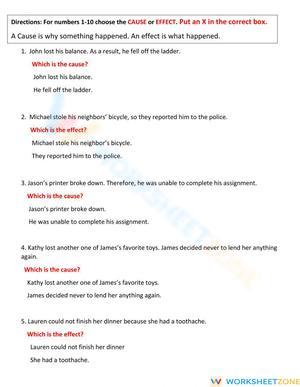
- Identifying explicit causes and effects stated directly in a passage
- Inferring implied relationships when signal words are absent
- Selecting the most relevant cause when a passage offers several competing details
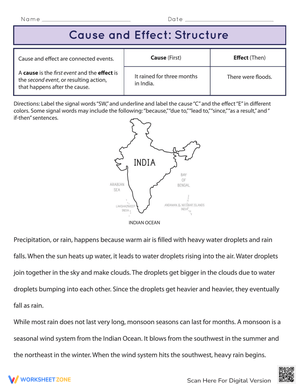
- Using signal words — because, therefore, as a result, consequently, due to — to locate relationships
- Writing one or two sentences that explain the relationship using text evidence
- Distinguishing cause-and-effect text structure from chronological sequence and problem-solution organization
Student Errors These Worksheets Help You Catch
The most consistent error in fifth-grade cause-and-effect work is proximity bias: students name whatever sentence sits closest to the question as the cause, regardless of where the actual cause appears. A student can read a paragraph about a prolonged drought reducing crop yields and still point to the sentence about rising food prices — the last thing they processed — as the cause, skipping over the earlier sentences that explain why the drought occurred in the first place. That error means the student is matching to sentence position rather than tracking the logic of the text.
A second pattern surfaces in passages with causal chains. Students who identify the first cause and the final effect miss the middle links entirely. In a science article tracing deforestation to population decline in a species, a student might write "logging causes fewer animals" without naming food scarcity or nesting disruption as the connecting mechanisms. Worksheets that require students to complete a multi-step chain — rather than fill in two blank boxes — expose that gap quickly. Those are the worksheets worth pulling for small-group reteaching when a comprehension check returns vague, surface-level answers.
Building These Worksheets Into Your Lesson Sequence
The natural entry point for most teachers is the warm-up slot before reading block — six or seven minutes of focused practice before launching a new text. One worksheet at that point anchors the skill in working memory before students encounter it in longer reading. That low-stakes repetition builds comprehension automaticity faster than a mini-lesson every few weeks.
Small-group instruction is where these worksheets do their most precise work. When a formative check shows a cluster of students missing implied cause-and-effect questions, pulling them with a focused worksheet the next day is more efficient than re-teaching to the whole class. The short passages make teacher questioning more targeted: "Where did you look first? What word told you something had changed?" That conversation is harder to have without a shared text in front of the group.
The resources also transfer cleanly to science and social studies. Articles about weather systems, ecosystems, historical decisions, and migration routes all carry cause-and-effect logic. Using 5th grade cause and effect printable worksheets exercises alongside content-area reading reinforces the skill and gives students a second context in which to apply it — exactly the kind of transfer practice that shows up on standardized assessments.
Standard Alignment
The worksheets address CCSS.ELA-LITERACY.RI.5.3, which asks fifth graders to explain the relationships or interactions between two or more individuals, events, ideas, or concepts in a text, including how those elements affect one another. In classroom terms, that standard appears in nearly every informational reading assignment — students are not asked to recall isolated facts but to explain why things happened and what changed as a result. The written-response items in this set make that expectation concrete by requiring text-based justification, not summary or opinion.
Several worksheets also support CCSS.ELA-LITERACY.RI.5.5, which asks students to compare and contrast the overall structure of events, ideas, concepts, or information in two or more texts. Worksheets that ask students to identify whether a passage uses cause-and-effect versus chronological or problem-solution organization connect directly to that standard. According to Teaching Text Structure — Reading Rockets, students who receive explicit instruction in how texts are organized demonstrate stronger comprehension because they can predict where key relationships are likely to appear — a habit that pays off across every subject area where students read to learn.
Matching the Set to Different Learners
Students who need more support should begin with the matching-format worksheets. These reduce the writing demand and let students focus on locating the relationship before they have to articulate it. During instruction, a quick walk-through of signal words gives those students a concrete search strategy they can apply independently without relying on teacher prompts.
Students ready for more challenge belong on the written-response worksheets. The useful extension question isn't just "what is the cause and effect?" — it's "why did the author organize the passage this way, and what does that structure do for the reader?" A student who can answer that second question is demonstrating text-structure awareness that feeds directly into their own informational writing.
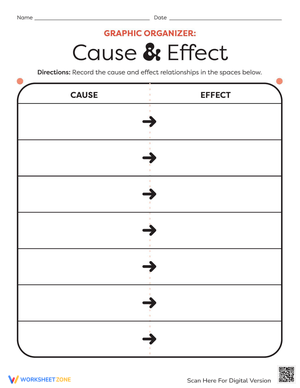
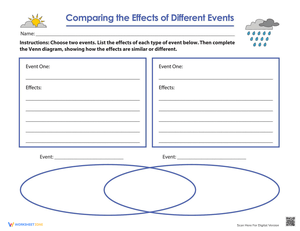
The graphic organizer worksheets in this 5th grade cause and effect printable worksheets set sit between those two entry points and hold up well across ability levels as a partner discussion tool. Two students completing the same organizer and then comparing their chains often surface reasoning gaps more efficiently than a teacher explanation — and they do it without the social risk of being visibly wrong in front of the whole class.
Frequently Asked Questions
Are these worksheets better for homework or in-class practice?
Format determines fit. Matching tasks and short multiple-choice passages work well as homework because students can complete them independently. Graphic organizers and written-response worksheets stay in class, where you can ask students to return to the text before finalizing an answer. Sending a written-response worksheet home before students have practiced that format in class typically produces answers driven by background knowledge rather than evidence — which defeats the point of the exercise.
How do these worksheets fit alongside a class novel or whole-class read-aloud?
They work as parallel practice rather than direct text extensions. If students are reading a class novel, a worksheet built around a separate informational passage gives them another context for the same skill without mixing the two texts. That separation helps students see that cause-and-effect thinking applies across different reading situations, not just the current unit. After students demonstrate the skill on a worksheet, returning to the novel to identify cause-and-effect relationships there becomes a natural transfer activity.
What should I do when students finish quickly and get most of the answers right?
Ask them to add one sentence explaining what would have happened if the cause had not occurred. That question requires counterfactual reasoning — the kind of thinking that separates students who genuinely understand the relationship from those who are pattern-matching to surface features. It adds no prep time and gives useful information about the depth of a student's understanding beyond what a completed worksheet alone reveals.
How does the set handle implied cause-and-effect relationships versus explicit ones?
Some worksheets use passages where signal words are present and the relationship is stated directly. Others deliberately remove those signals and require students to infer the connection from sequence and context. When teachers work through 5th grade cause and effect printable worksheets exercises in a sequence that moves from explicit to implied, most students' understanding either consolidates or reveals a gap — and that distinction in the design is where the diagnostic value actually lives.












 Interactive Worksheet Maker
 Quiz Maker
 Word Search Maker
 Crossword Puzzle Maker
 Word Scramble Generator
 Sentence Scramble Generator
 Handwriting Worksheet Generator
 Name Tracing Generator
 Fill In The Blank Generator