




























Views
Downloads

Multiple Meaning Words Worksheet | Grade 5 Essential

Paste this activity's link or code into your existing LMS (Google Classroom, Canvas, Teams, Schoology, Moodle, etc.).
Students can open and work on the activity right away, with no student login required.
You'll still be able to track student progress and results from your teacher account.
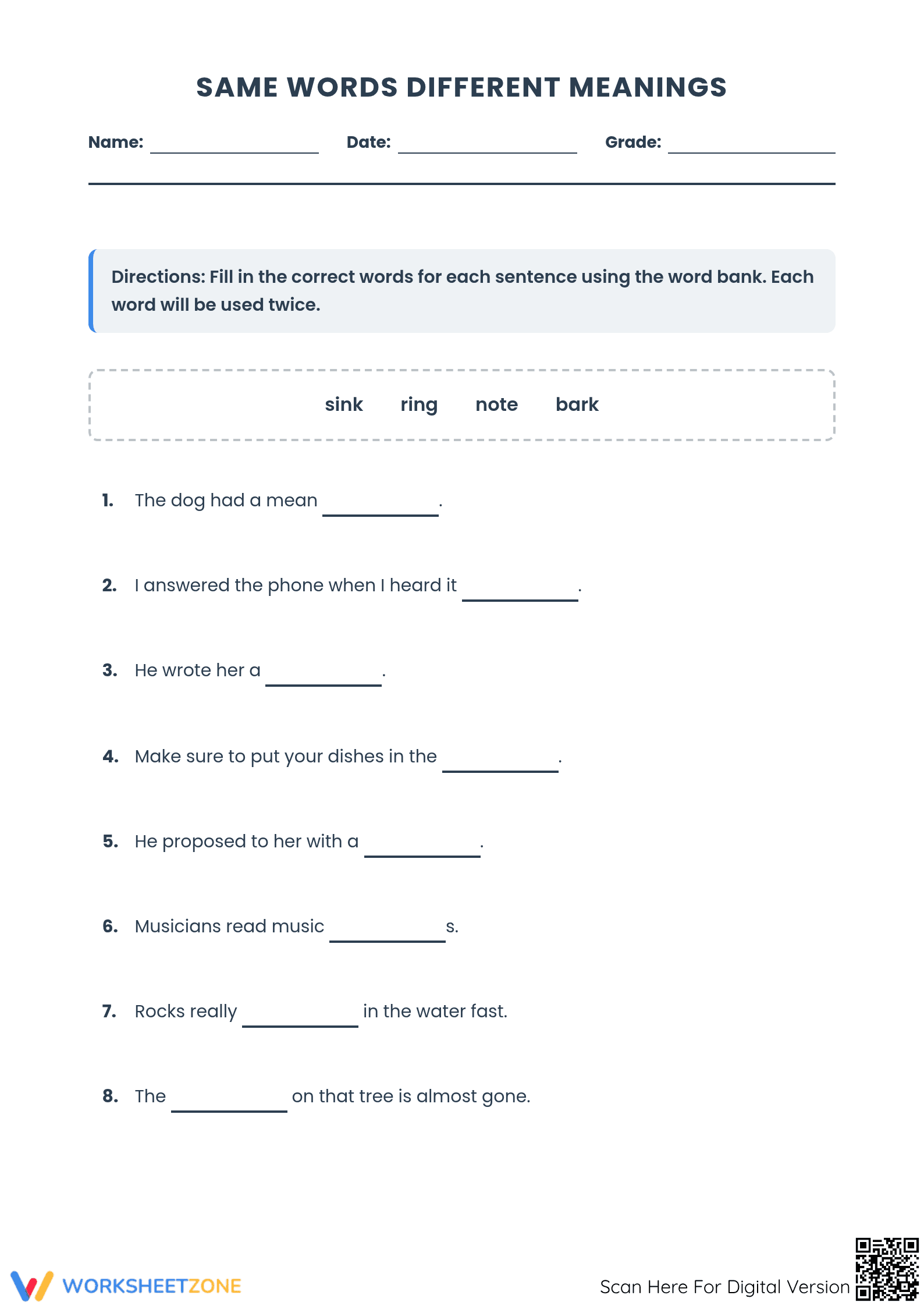
This Grade 5 vocabulary worksheet helps students master homonyms by applying the same word to two distinct contexts. By completing these sentences, learners develop a deeper understanding of how context clues dictate word meaning. It is an effective tool for improving reading comprehension and linguistic flexibility in upper elementary and middle school settings.
At a Glance
- Grade: 5 · Subject: English Language Arts
- Standard:
CCSS.ELA-LITERACY.L.5.4— Determine or clarify the meaning of unknown and multiple-meaning words and phrases- Skill Focus: Multiple Meaning Words (Homonyms)
- Format: 1 page · 8 problems · Answer key included · PDF
- Best For: Independent practice or quick formative assessment
- Time: 10–15 minutes
What's Inside: This single-page PDF features a clear, focused layout designed for student success. It includes a word bank containing four high-frequency homonyms: sink, ring, note, and bark. Below the bank are 8 fill-in-the-blank sentences. Each word from the bank must be used exactly twice, challenging students to recognize different semantic applications. A full answer key is provided for rapid grading.
Zero-Prep Workflow
- Print: Generate the single-page PDF for your class in under 30 seconds.
- Distribute: Hand out the sheets and explain that each word in the bank has two different meanings (1 minute).
- Review: Use the included answer key to review responses as a whole group or for individual grading (2 minutes).
Total teacher preparation time is under two minutes, making this an ideal resource for sub plans or unexpected schedule changes.
Standards Alignment: The primary focus is `CCSS.ELA-LITERACY.L.5.4`, which requires students to determine or clarify the meaning of unknown and multiple-meaning words. By requiring students to use the same word in two different ways, the worksheet reinforces the role of context in decoding meaning. This standard code can be copied directly into lesson plans, IEP goals, or district curriculum mapping tools.
How to Use It: Use this worksheet as a "bell ringer" at the start of a vocabulary unit to gauge prior knowledge of homonyms. Alternatively, assign it as a quick formative assessment after a lesson on context clues. Teachers should observe if students struggle with specific words like "note" or "bark," which may indicate a need for more direct instruction on non-literal meanings. Completion typically takes 10 to 15 minutes.
Who It's For: This resource is ideal for Grade 5 students but remains highly relevant for Grade 6-8 students needing vocabulary intervention. It supports English Language Learners (ELLs) by providing concrete examples of polysemy. Pair this worksheet with a dictionary activity or a short reading passage that features these specific homonyms to reinforce the concept across different media.
Research from Fisher & Frey (2014) emphasizes that vocabulary acquisition is most effective when students encounter words in varied contexts rather than through isolated memorization. This worksheet aligns with that evidence by presenting 8 distinct sentence environments for 4 core homonyms. By requiring students to map one word to two different semantic roles, the activity strengthens the mental lexicon and improves the ability to use context clues as defined by CCSS.ELA-LITERACY.L.5.4. Studies in the RAND AIRS 2024 report suggest that targeted, short-form practice on multiple-meaning words significantly aids reading fluency and comprehension for upper elementary learners. This printable resource provides the structured repetition necessary for students to move from surface-level recognition to deep conceptual understanding of English homonyms. It serves as a reliable bridge between direct instruction and independent reading mastery in any standard-aligned ELA curriculum.


