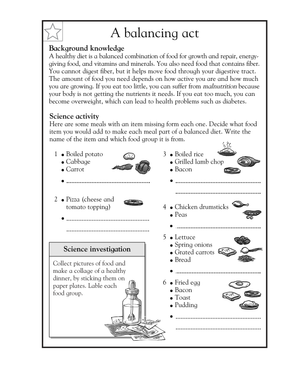
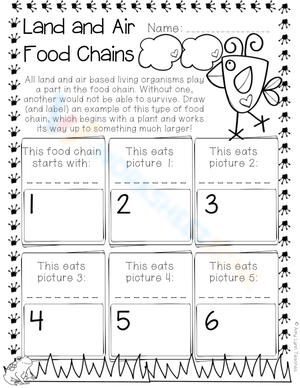
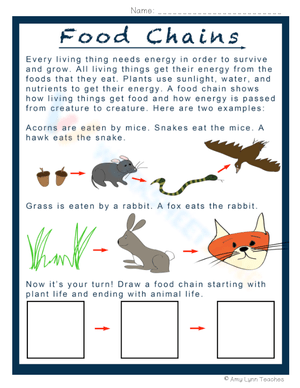
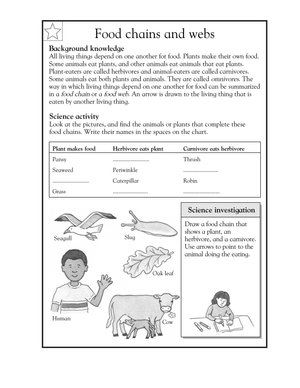
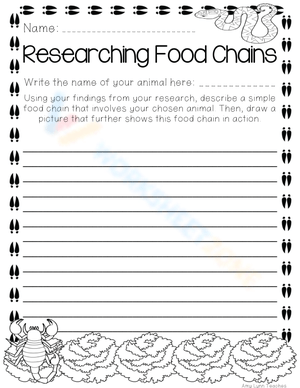
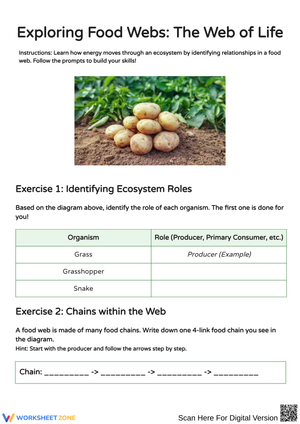
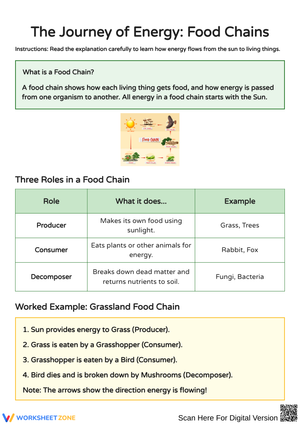
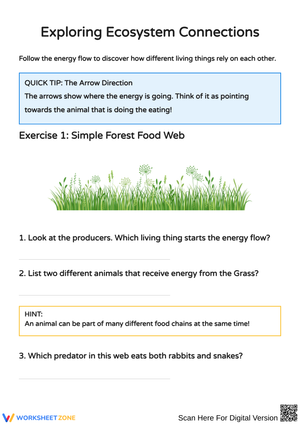
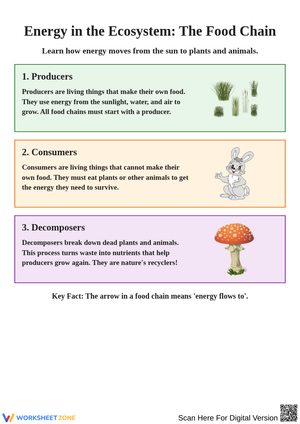
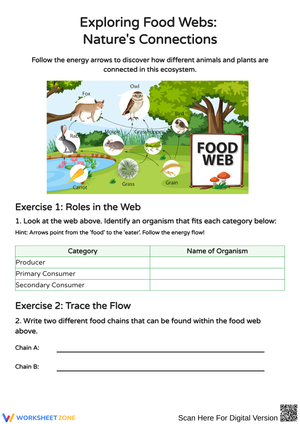
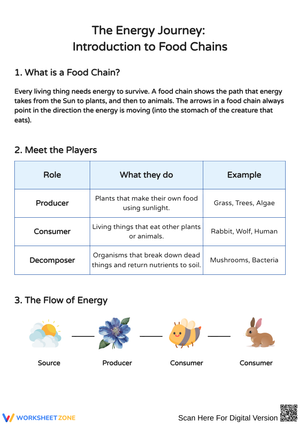
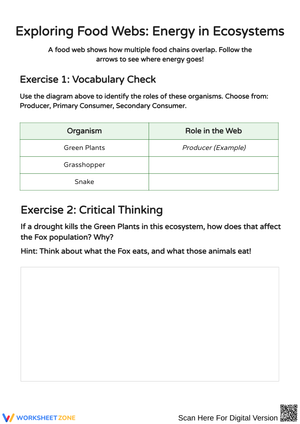
These food webs and food chains printable worksheets for 4th grade give teachers a ready-built sequence for moving students from simple linear energy diagrams to the more realistic, interconnected webs that 4th grade ecosystems work requires. Each worksheet targets one skill — labeling producers and consumers, drawing energy-transfer arrows, categorizing organisms by trophic level, predicting population shifts after a species is removed — so students build understanding in steps rather than facing every concept at once.
Concepts Each Worksheet Addresses
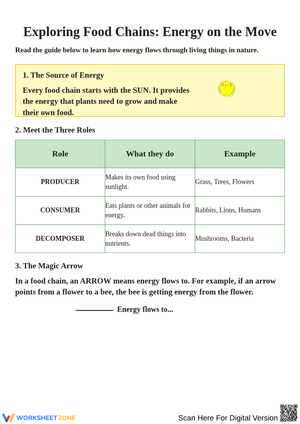
The set opens with foundational vocabulary: producers, consumers, and decomposers. Students label organisms in a diagram, match definitions to terms, and sort real-world plants and animals into the correct category. These worksheets also establish the sun as the entry point for energy before any organism is introduced — a detail that matters when students later encounter ocean ecosystems where phytoplankton, not grass, sits at the base of the chain. Students who assume a food chain "just starts with a plant" get confused by ocean webs, and explicitly building the sun-to-photosynthesis-to-producer connection early closes that gap.
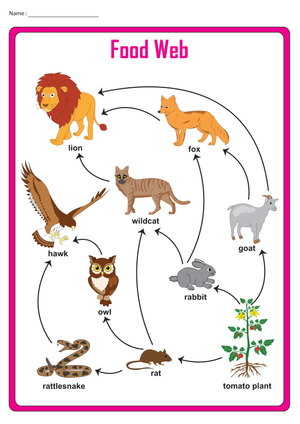
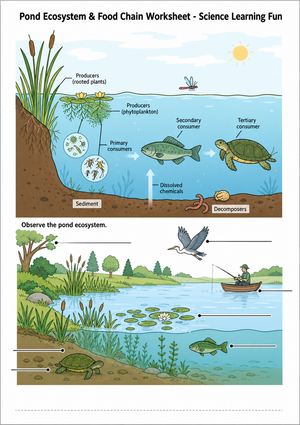
Later worksheets move into food webs, asking students to draw multiple overlapping chains onto a single diagram and identify which organisms appear in more than one chain. One worksheet type focuses entirely on trophic levels — primary, secondary, and tertiary consumers — using the same web at different points so students can trace several paths through it. A separate worksheet asks students to remove one species and annotate the diagram to show which populations would increase, which would collapse, and why. The food webs and food chains printable worksheets for 4th grade also include decomposer-focused exercises that many comparable sets skip entirely; students who can diagram energy flow from producer to apex predator but cannot correctly place decomposers are missing the second half of the nutrient cycle.
Arrow Direction and Other Predictable Errors Worth Catching Early
The arrow direction error shows up in every class, every year. Students draw the arrow pointing from predator to prey — the hawk points toward the snake — because they are thinking about the act of eating rather than the movement of energy. The correction is straightforward but needs explicit, repeated practice: the arrow reads "gives energy to," so it points from the organism being eaten toward the one doing the eating. Having students say that phrase aloud while tracing a path on the worksheet drops the error rate sharply within the same lesson. What persists is a subtler version of the same problem: students who correctly reverse the arrow on a food chain will still flip it on a food web because the denser diagram makes them revert to instinct. Catching that during guided practice — before independent work begins — is faster than correcting finished diagrams afterward.
A second consistent pattern: students conflate "consumer" with "animal" and either leave decomposers out of their webs entirely or add them as a floating label without drawing any connections. Decomposers close the nutrient loop — removing them from the diagram is like stopping a cycle midway through. Worksheets that require students to draw the decomposer connections before they can mark the diagram complete fix this faster than any amount of verbal instruction.
Working These Worksheets Into Your Science Block
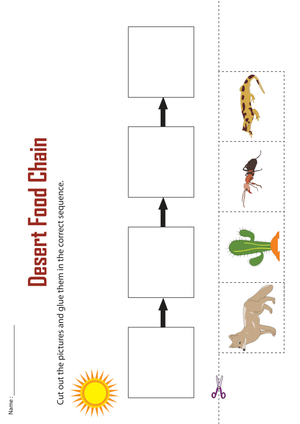
The worksheets work best when sequenced deliberately, not handed out as interchangeable practice. Start with the food chain worksheet before any food web material — not because food chains are simpler, but because students need the arrow convention solid before the diagram gets crowded. Introducing a food web before students are comfortable reading arrow direction produces diagrams where arrows are technically present but their meaning has vanished.
The cause-and-effect species-removal exercise is the strongest closing activity in the set. It lands well on a Thursday or Friday, after two or three days of web-building work, when students have a diagram they constructed themselves and are invested in it. Asking them to annotate their own food web with two colored pencils — one color for populations that grow, another for those that collapse — creates a concrete, checkable product. The format also shows at a glance which students are reasoning through the relationships and which are guessing.
For biome variety, the food webs and food chains printable worksheets for 4th grade include desert, forest, and ocean ecosystem contexts. Running these across three consecutive lessons — one biome per day — shows students that the producer-consumer structure holds even when the specific organisms are completely different. A student who recognizes that phytoplankton and grass play the same functional role in their respective ecosystems has grasped something that transfers into middle school life science without much additional instruction.
Standard Alignment
The NGSS anchor standard most directly addressed here is 5-LS2-1: "Develop a model to describe the movement of matter among plants, animals, decomposers, and the environment." Many districts address this standard during fourth grade rather than waiting until fifth, especially in units where ecosystems serve as the year's anchor topic. Each worksheet supports the modeling practice described in 5-LS2-1 — students are not answering questions about a diagram someone else built; they are constructing, annotating, and revising their own. The species-removal exercises connect directly to NGSS Crosscutting Concept 2, Cause and Effect, requiring students to reason about how changing one element of a system changes the behavior of others throughout the web.
Adjusting the Set for Different Student Readiness Levels
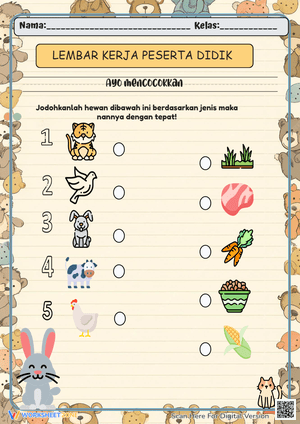
Students who are still consolidating vocabulary — who swap "producer" and "consumer" even with a word bank in front of them — do better beginning with the matching and sorting worksheets before attempting any diagramming. These exercises use the same organisms that appear in the chain and web worksheets later, so there is real continuity. Students are not learning a new cast of characters each time they move to a harder task.
For students who move through the diagramming work quickly, the species-removal worksheet extends further: remove a second species and reason about whether the ecosystem is now more or less stable than after the first removal. That question has no clean answer, and that is the point. Students who can hold ambiguity and defend a position using evidence from their own diagram are demonstrating the kind of reasoning NGSS expects by the end of elementary school.
Students who process language slowly — including many English language learners — benefit most from worksheet versions that pair organism names with images. Holding the meanings of "grasshopper" and "phytoplankton" in working memory while simultaneously reasoning about trophic levels is real cognitive load. Pairing labels with pictures reduces that vocabulary burden and lets students direct their attention toward the ecosystem logic itself.
Frequently Asked Questions
Why do students keep reversing the arrow direction even after being corrected?
The reversal is driven by mental imagery, not by confusion about the rule. Students picture the predator attacking, so the arrow follows the action. The fix that holds is physical and verbal together: have students point to each arrow and read it aloud as "gives energy to" while tracing it on the worksheet. Doing this across three or four arrows in a row — not just one correction — converts it into a habit. The food webs and food chains printable worksheets for 4th grade include a short printed reminder at the top of each diagramming worksheet so the cue is visible every time students pick up a pencil.
Can any of these worksheets serve as a formative check?
The unlabeled food web diagram worksheet — where students add organism names and draw all connections without any pre-filled labels — works well as a formative check at the end of the web unit. It strips away the hints present in the guided practice versions and shows which students have internalized the structure. Used the day before a formal assessment, it gives teachers enough time to address what is still shaky rather than discovering gaps during the test itself.
What do I do when students are unfamiliar with the organisms shown in a diagram?
Unfamiliar organisms are actually useful. A student who does not know what krill is has to classify it from context — is it a producer or a consumer? What eats it? That reasoning process is exactly what ecosystem modeling requires. When every organism in a diagram is already familiar, some students fill it in from memory rather than from understanding the relationships. A two-minute organism preview at the start of class handles genuine confusion without removing the productive reasoning that unfamiliar names introduce.












 Interactive Worksheet Maker
 Quiz Maker
 Word Search Maker
 Crossword Puzzle Maker
 Word Scramble Generator
 Sentence Scramble Generator
 Handwriting Worksheet Generator
 Name Tracing Generator
 Fill In The Blank Generator