


























Views
Downloads
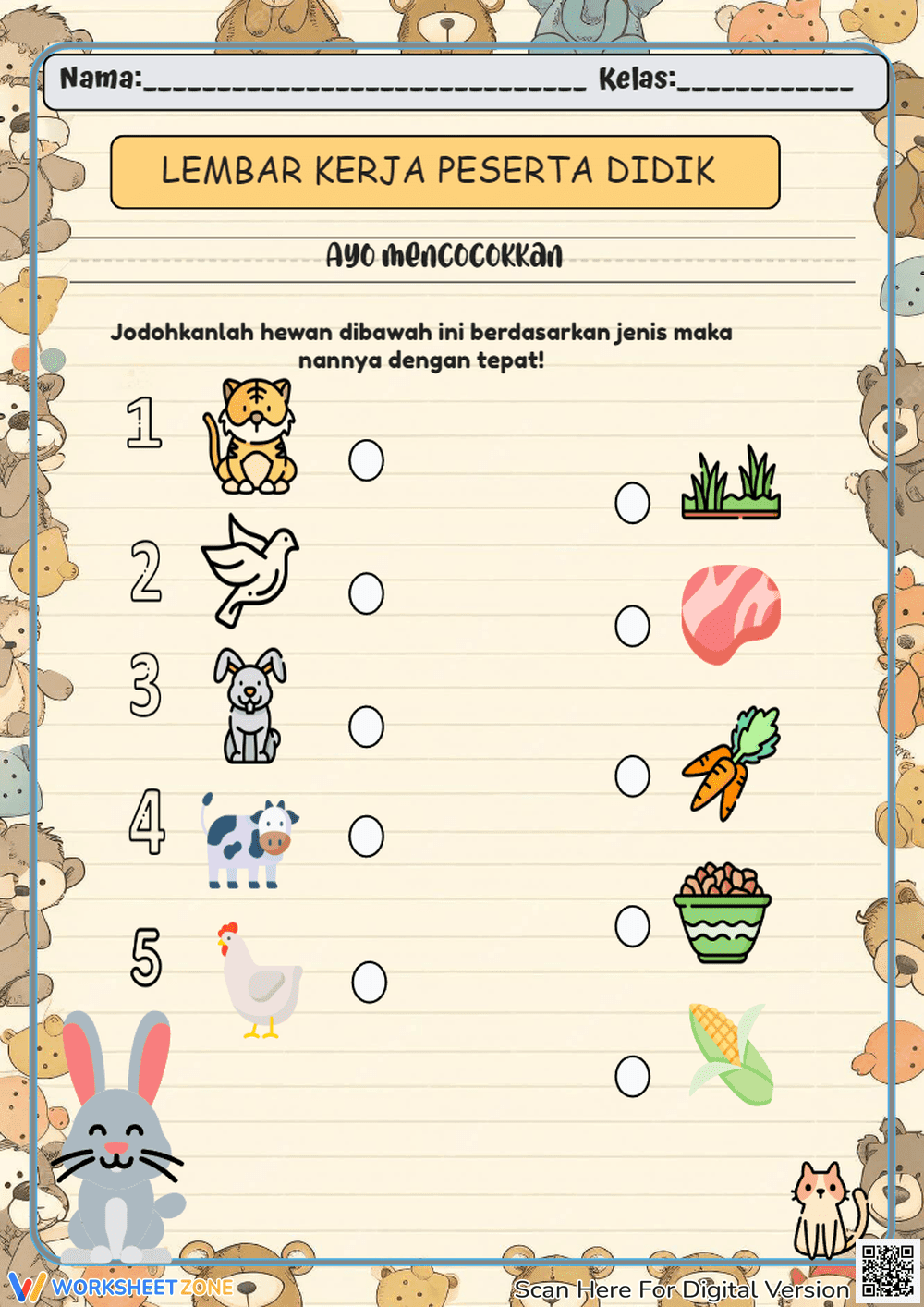

Animal Diets Worksheet | Grade 4 Science Essential
Paste this activity's link or code into your existing LMS (Google Classroom, Canvas, Teams, Schoology, Moodle, etc.).
Students can open and work on the activity right away, with no student login required.
You'll still be able to track student progress and results from your teacher account.
This Grade 4 science worksheet helps students identify the relationship between animals and their specific dietary needs. By matching common animals like tigers and rabbits to their primary food sources, learners develop a foundational understanding of biological classification and survival needs. It provides a clear, visual-heavy approach to life science concepts.
At a Glance
- Grade: 4 · Subject: Science
- Standard:
4-LS1-1— Construct an argument that plants and animals have internal and external structures- Skill Focus: Animal Diet Classification
- Format: 1 page · 5 problems · Answer key included · PDF
- Best For: Quick formative assessment or bell ringer
- Time: 5–10 minutes
This single-page PDF features 5 distinct matching tasks. Students are presented with high-quality illustrations of a tiger, bird, rabbit, cow, and chicken. On the opposite side, they must identify the correct food source, ranging from meat and grass to carrots and corn. The layout is clean, with large circular targets for drawing lines, making it accessible for various motor skill levels.
Teachers can integrate this resource into their daily routine in under 2 minutes. First, print the required number of copies (30 seconds). Second, distribute the sheets as a hook at the start of a life science lesson (1 minute). Finally, review the answers as a whole group to clarify the difference between herbivores and carnivores (5 minutes). This makes it an ideal choice for substitute folders or unexpected schedule changes.
The primary focus is 4-LS1-1, which requires students to understand how animal structures and behaviors support survival. Understanding what an animal eats is critical to explaining its role in an ecosystem. This worksheet also supports literacy by integrating visual information with text. Both standard codes can be copied directly into lesson plans, IEP goals, or district curriculum mapping tools.
Use this as a pre-assessment before starting a unit on food chains to gauge prior knowledge. Alternatively, use it as an exit ticket to confirm students can distinguish between different consumer types. Observe if students can explain why a tiger matches with meat based on its physical traits like teeth or claws. Completion typically takes 5 to 10 minutes.
This resource is designed for general education 4th-grade students, but the heavy reliance on visual icons makes it excellent for English Language Learners (ELL) and students receiving special education services. It pairs naturally with an anchor chart showing the Herbivore, Carnivore, and Omnivore categories or a short reading passage about animal habitats.
According to the RAND AIRS 2024 report on elementary science instruction, visual matching tasks are highly effective for reinforcing categorical knowledge in middle childhood. This worksheet targets the 4-LS1-1 standard by focusing on the essential survival behavior of feeding. By requiring students to link specific animals to their biological fuel sources, the activity builds the cognitive scaffolding necessary for more complex food web modeling. Research from Fisher & Frey (2014) suggests that these types of brief, focused interactions with content help solidify vocabulary acquisition in the science classroom. The 5 tasks included here provide a statistically significant sample for a quick formative check, allowing educators to identify misconceptions about animal diets immediately. This resource serves as a reliable tool for ensuring students meet the foundational requirements of the Next Generation Science Standards while maintaining high engagement through clear, recognizable imagery.


