


























Views
Downloads



Essential Perimeter of Squares Worksheet | Printable Grade 4
Paste this activity's link or code into your existing LMS (Google Classroom, Canvas, Teams, Schoology, Moodle, etc.).
Students can open and work on the activity right away, with no student login required.
You'll still be able to track student progress and results from your teacher account.
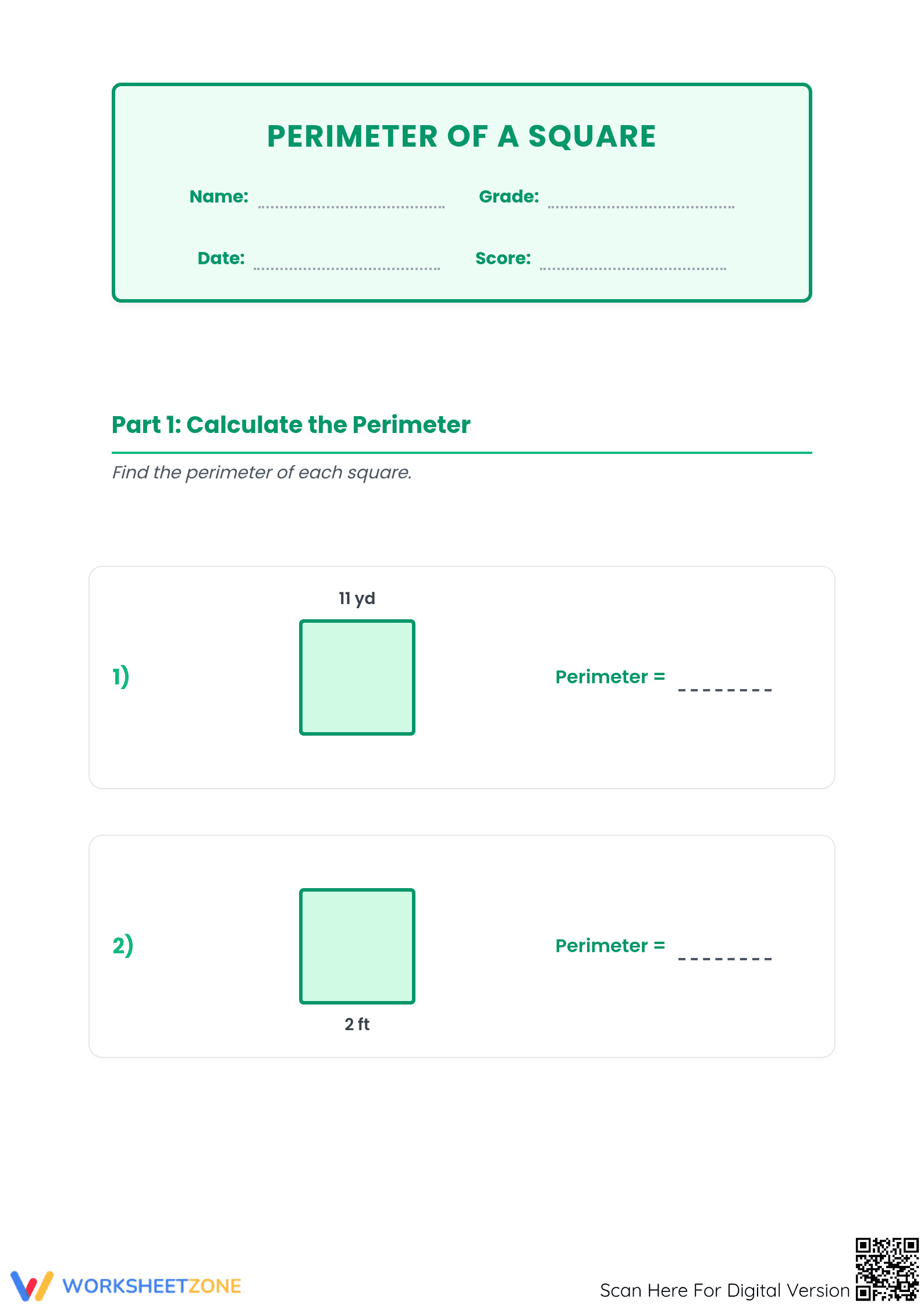
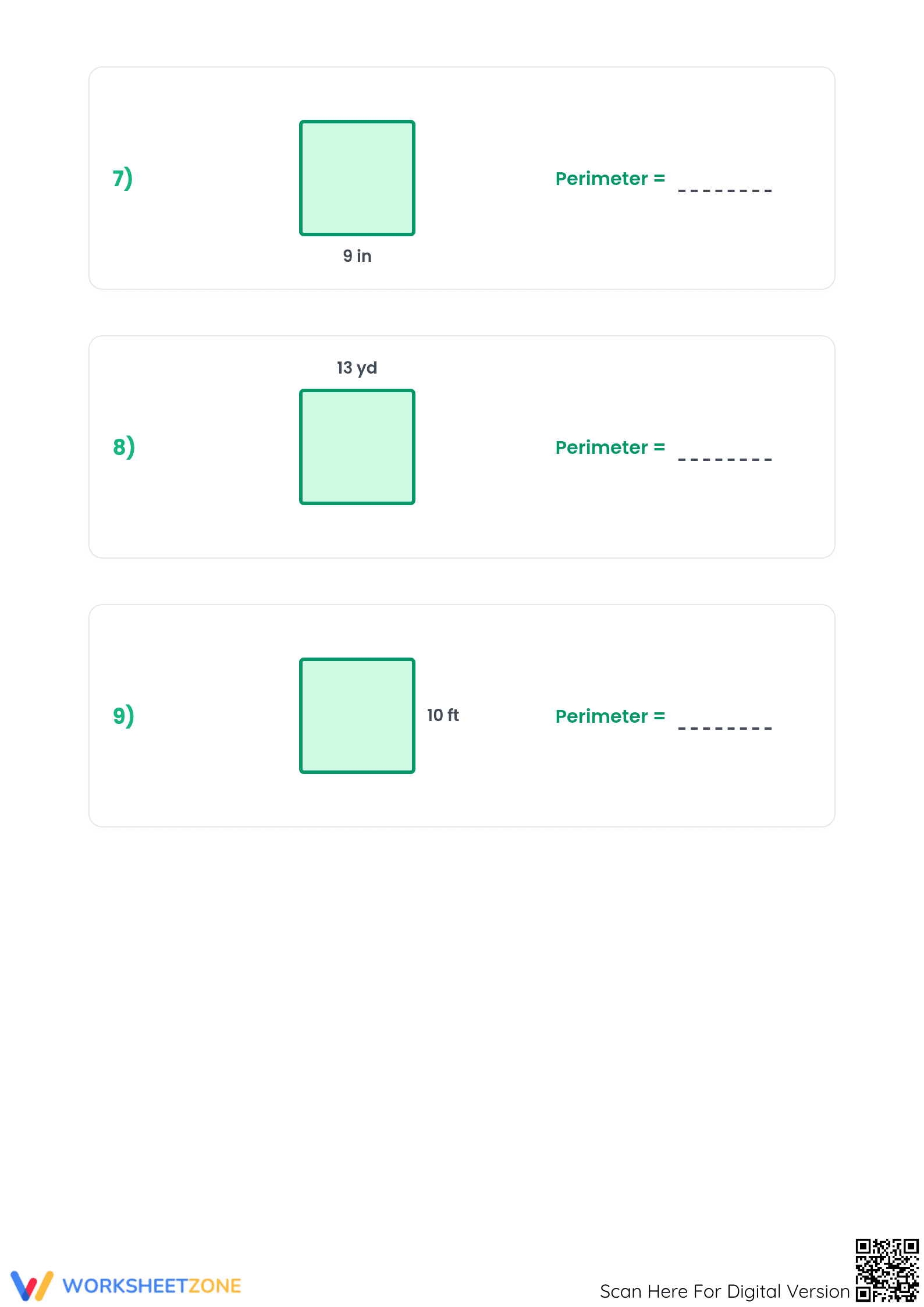
This Grade 4 math worksheet focuses on calculating the perimeter of squares. Students engage in 24 targeted problems designed to solidify their understanding of the relationship between a square's side length and its total boundary. By practicing both direct and inverse calculations, learners achieve mastery of the square perimeter formula and its practical mathematical applications.
At a Glance
- Grade: 4 · Subject: Math
- Standard:
CCSS.MATH.CONTENT.4.MD.A.3— Apply the area and perimeter formulas for rectangles in mathematical problems.- Skill Focus: Square Perimeter Calculations
- Format: 4 pages · 24 problems · Answer key included · PDF
- Best For: Geometry skill reinforcement and independent practice
- Time: 20–30 minutes
This resource includes two activity pages and two answer keys. Each worksheet features 12 problems in a clean layout to minimize distractions. Tasks alternate between providing side lengths to find perimeters and providing perimeters to find side lengths. This balanced approach ensures students understand geometric properties rather than just memorizing a single operation.
Skill Progression
- Guided Practice: 6 problems use side lengths with units (cm, m) to apply the P=4s formula, linking addition to multiplication.
- Supported Practice: 12 problems alternate between finding perimeter and finding side length (s=P/4), building fluency with inverse operations.
- Independent Practice: 6 problems require students to solve without scaffolds, demonstrating mastery in switching between geometric operations.
Standards Alignment
Aligned to CCSS.MATH.CONTENT.4.MD.A.3, requiring students to "Apply the area and perimeter formulas for rectangles in mathematical problems." As a square is a special rectangle, these exercises provide necessary scaffolding. This code can be copied into lesson plans, IEP goals, or curriculum mapping tools.
How to Use It
Use the first page as a formative assessment after teaching polygons. Circulate to see if students multiply or add; those adding may need prompts toward multiplication. Alternatively, use the "find the side" problems for small group remediation to model inverse relationships.
Who It's For
Designed for Grade 4, it also suits Grade 5 review or Grade 3 enrichment. The structure supports ELL students and those with IEPs by focusing on numerical relationships. It pairs well with anchor charts on regular polygons.
According to the RAND AIRS 2024 study on mathematics instruction, high-repetition practice of fundamental formulas is a key predictor of success in middle school algebraic thinking. This worksheet provides the "deliberate practice" recommended by ScienceDirect analysis to facilitate the gradual release of responsibility. By focusing on square perimeters, the material prevents cognitive overload, allowing students to internalize multiplicative properties of regular quadrilaterals. The 24-task count is optimized to provide variety for mastery without inducing fatigue. Furthermore, the inclusion of inverse operations—calculating side length from a known perimeter—aligns with NAEP guidelines for conceptual depth. Educators can confidently integrate this resource into their curriculum knowing it meets the rigorous demands of modern standards while supporting the diverse needs of the contemporary classroom.


