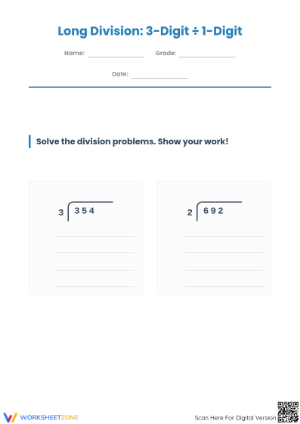
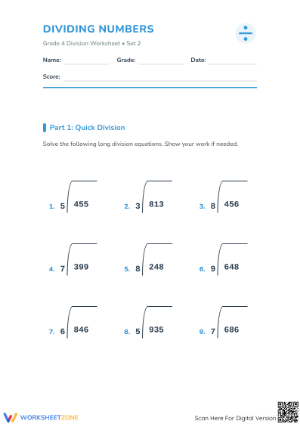
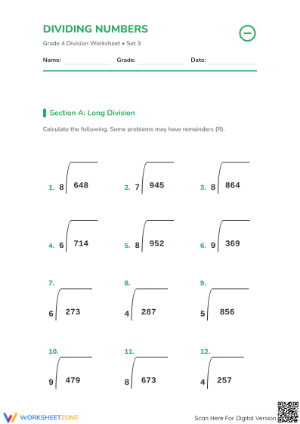
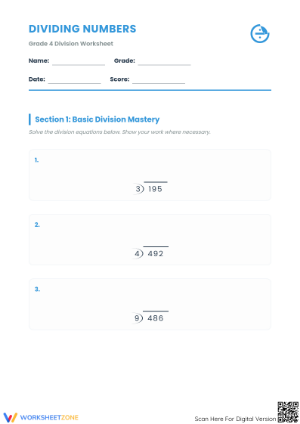
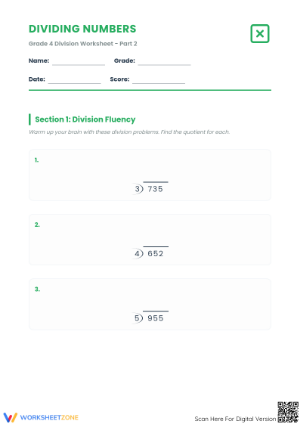
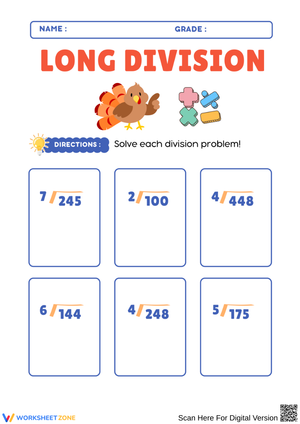
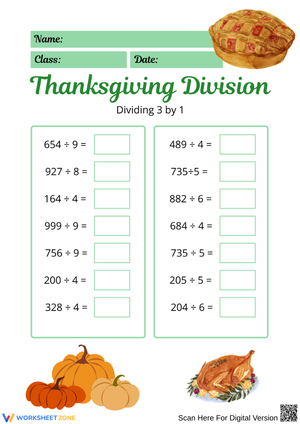
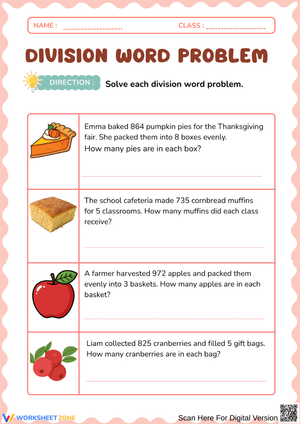
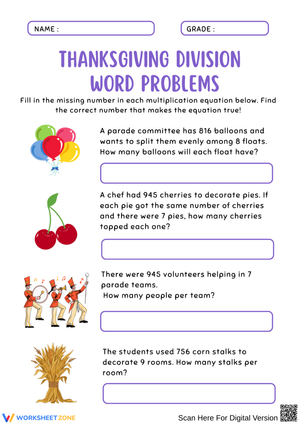
Grade 4 3 digit by 1 digit division worksheets help students take an important step from basic division facts to more advanced long division. At this level, learners are no longer only solving simple facts like 24 ÷ 6. They begin working with larger numbers, such as 426 ÷ 3 or 735 ÷ 5, which requires stronger place value understanding, multiplication recall, subtraction accuracy, and careful step-by-step thinking.
For many 4th graders, the biggest challenge is learning how to stay organized through each part of the division process. Students need to divide hundreds, tens, and ones in order while checking whether each step makes sense. Worksheets give them repeated practice with clear problem layouts, helping them build fluency without rushing. Some problems may divide evenly, while others introduce remainders so students can understand what happens when a number cannot be shared equally.
Division becomes easier when students can connect the numbers to real meaning. A problem like 648 ÷ 4 can be introduced as sharing 648 stickers among 4 students or placing 648 books equally on 4 shelves. These examples help learners see division as equal sharing or equal grouping, not just a written algorithm. Teachers who want to make the concept more interactive can use division math activities to pair worksheet practice with hands-on models, partner games, and classroom problem-solving tasks.
As students gain confidence, grade 4 3 digit by 1 digit division worksheets can prepare them for long division with remainders, multi-step word problems, fractions, and later decimal work. Students should also learn how to check their answers by multiplying the quotient by the divisor and adding any remainder. For learners ready to practice uneven division more deeply, division with remainders worksheets can help reinforce this next level of understanding.
Whether used during math centers, small-group lessons, homework review, tutoring, or homeschool practice, these worksheets give 4th graders the structure they need to improve accuracy and confidence. With consistent practice, students become more comfortable solving larger division problems, explaining their steps, and recognizing the connection between multiplication and division. This foundation supports stronger problem-solving across many future math topics.
Frequently Asked Questions
Question 1: What skills do grade 4 3 digit by 1 digit division worksheets help students practice?
These worksheets help students practice long division, place value, multiplication facts, subtraction, estimation, and checking answers. Students learn how to break a 3-digit number into hundreds, tens, and ones while dividing by a 1-digit number. They also strengthen their understanding of equal groups and remainders, which are important for solving word problems and preparing for more advanced division.
Question 2: Why is 3 digit by 1 digit division important in 4th grade?
Three-digit by one-digit division is important because it helps students move beyond memorized division facts and into multi-step reasoning. Fourth graders need to understand how larger numbers can be divided accurately and how each step relates to place value. This skill also prepares students for fractions, ratios, decimals, and more complex problem-solving in later grades.
Question 3: How can teachers help students who struggle with this type of division?
Teachers can support struggling students by using place-value charts, base-ten blocks, partial quotients, and guided examples before asking students to work independently. It also helps to review multiplication facts because division and multiplication are closely connected. Students should be encouraged to estimate first, solve step by step, and check their answers. Short, consistent practice is usually more effective than long sessions that cause frustration.
Question 4: How can students check their answers in 3 digit by 1 digit division?
Students can check their answers by multiplying the quotient by the divisor. If there is a remainder, they add the remainder after multiplying. For example, if 739 ÷ 4 = 184 remainder 3, students can check by calculating 184 × 4 = 736, then adding 3 to get 739. This method helps students catch mistakes and better understand the relationship between multiplication and division.













 Interactive Worksheet Maker
 Quiz Maker
 Word Search Maker
 Crossword Puzzle Maker
 Word Scramble Generator
 Sentence Scramble Generator
 Handwriting Worksheet Generator
 Name Tracing Generator
 Fill In The Blank Generator