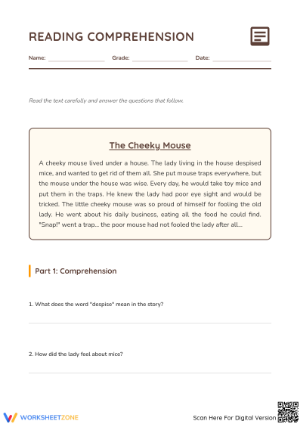
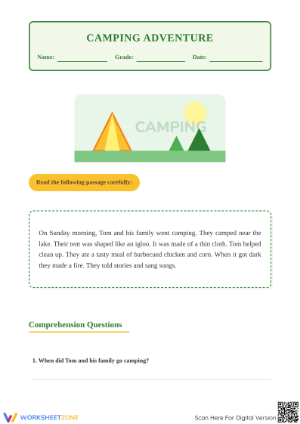
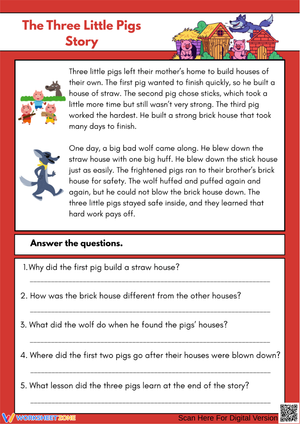
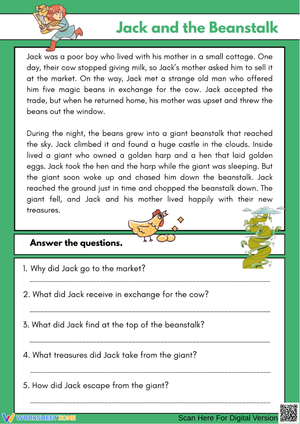
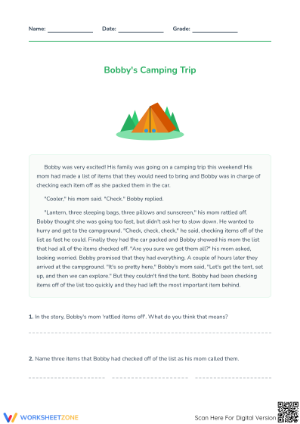
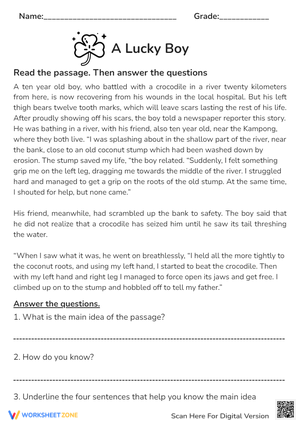
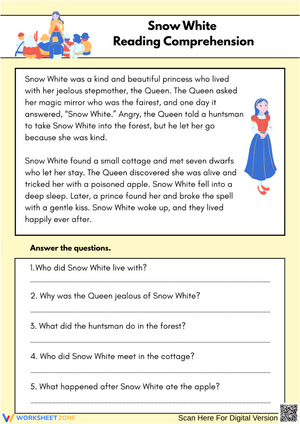
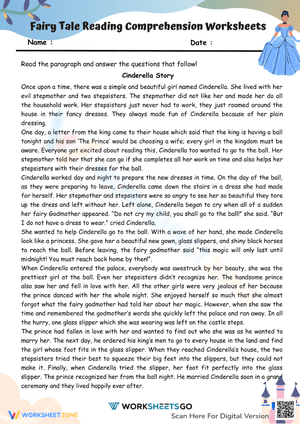
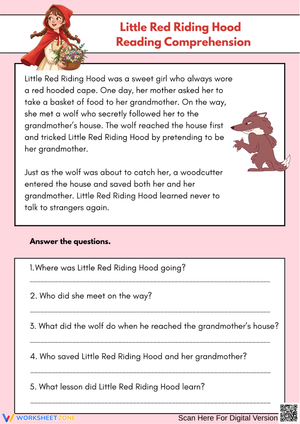
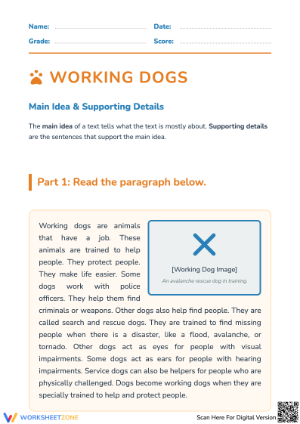
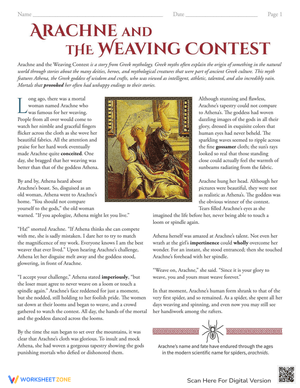
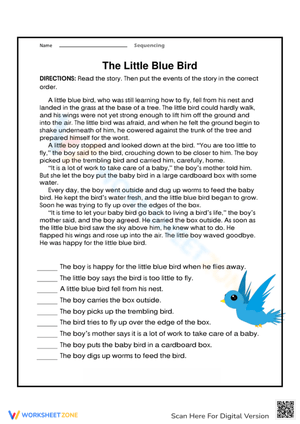
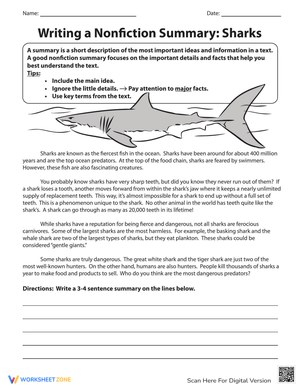
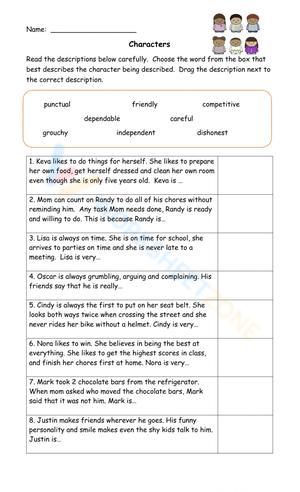
These short story worksheets for 4th grade give teachers a focused way to target the comprehension skills students are expected to demonstrate during the pivot year — when fluent decoding is largely in place and the real instructional work shifts to interpretation. Each worksheet pairs a complete short narrative with a structured question set that moves students from recall toward analysis. The set addresses theme identification, text evidence citation, character motivation, and summary construction — four areas where 4th-grade reading instruction concentrates and where assessment gaps first become visible.
Skills Each Worksheet Builds
Narratives across the set span realistic fiction, fables, and tall tales, with Lexile levels in the 740L-to-940L range — the band where most fourth graders find productive challenge without hitting a wall. Within each worksheet, questions build deliberately: students first locate and mark key details, then use those details to respond to higher-order prompts about character motivation or the author's message. That internal progression keeps cognitive demand organized so students are not asked to analyze theme before they have done the foundational reading work.
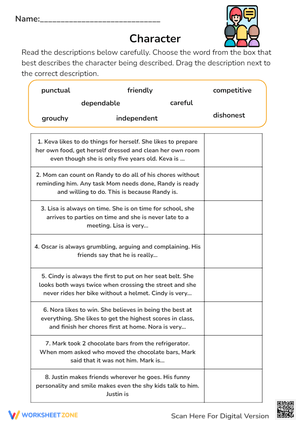
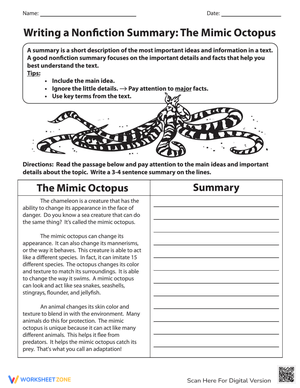
Character analysis worksheets ask students to move beyond naming feelings and instead identify traits — drawing on specific actions, dialogue, and internal thoughts from the text. Summarizing worksheets ask students to write summaries of five sentences or fewer, which forces real decisions about which events matter. Theme worksheets require students to write the theme as a complete sentence rather than a single word or phrase — a format choice that directly targets the most common error at this level.
Mistakes Students Make That These Worksheets Help You Catch
The most persistent error at this level is collapsing theme into topic. A student who reads a story about a girl who keeps trying after failing will write "The theme is perseverance" — a topic word, not a message. These worksheets address this by requiring students to write the theme as a full sentence before moving to the evidence questions. The format makes the error visible rather than leaving it buried in vague, acceptable-looking answers.
Text evidence questions surface a second pattern worth watching. Fourth graders frequently paraphrase broadly — "the character showed he was brave because of his actions" — instead of locating a specific line. Worksheets that require students to copy the exact sentence from the text change that habit quickly; the act of returning to the story rather than working from memory is itself a skill these resources build. In summary tasks, the opposite problem appears: students include everything, listing events in order rather than prioritizing by importance. A five-sentence cap forces the selection decision, and that decision is where the actual comprehension work happens.
How to Build These Worksheets Into Your Lesson Plans
The strongest single use in a weekly routine is the Monday cold read. Before any discussion, assign one worksheet and let students work through it independently. Cold reads reveal what students have internalized versus what they can produce only after the class has talked through a text together. A teacher using short story worksheets for 4th grade in this way three or four times per quarter builds a clear longitudinal record of skill development — which is far more useful at parent conferences or intervention meetings than a single test score.
For literacy centers, a rotation works cleanly. While you lead a small guided reading group, other students work through a short story worksheet independently or in pairs. Pairing students works especially well for character motivation and theme worksheets — one student underlines evidence while the other drafts the written response, then they trade for the next question. The short narrative format means a center group can finish in 12 to 15 minutes, which fits most center block lengths without the story running into transition time.
Standard Alignment
These worksheets address three anchor standards directly. RL.4.1 — referring to details and examples from the text when drawing inferences — is covered in any worksheet that requires students to quote specific lines before writing an analytical response. RL.4.2 drives the theme and summarizing worksheets: students determine a theme without importing personal opinions and write summaries that stay inside the text. RL.4.3, which asks students to describe characters in depth using specific textual details, is the target of the character analysis worksheets. These three standards carry significant weight on most 4th-grade ELA assessments, so consistent practice here addresses both classroom skill-building and standardized test preparation at once.
Adjusting the Set for a Range of Learners
For students reading below grade level, the most useful adjustment is reducing written-response demand on a given worksheet while keeping the skill target in place. Adding a sentence frame — "The character felt ___ because ___" — allows a struggling student to practice inference without being blocked by the writing production piece. Resist the impulse to assign a simpler story if the same skill concept is the goal; students who have not yet grasped theme identification need more time with the concept, not an easier text that shifts the target.
Strong readers who finish a worksheet quickly benefit from a follow-up prompt: write a paragraph arguing whether the character made the right decision, citing at least two specific lines as support. That extension turns each short story worksheet into a brief analytical writing task — the kind of work these students will be expected to produce independently in 5th grade. Short story worksheets for 4th grade work as the shared text for that writing extension even when students' independent reading levels vary widely across a class.
Frequently Asked Questions
Can these be used as cold-read assessments rather than practice tools?
Yes, and that is one of their cleaner uses. A cold read — assigning the worksheet without pre-reading discussion, vocabulary preview, or teacher guidance — shows what students apply independently. The short story format makes this practical in a single class period, which longer passages do not allow. Reserve the cold-read format for assessment purposes; use the same skill type during instructional cycles with guided discussion so students have adequate support before working alone.
What do I do when a student completes the worksheet but all the answers are thin?
Thin answers at this level almost always mean the student is working from memory of the story rather than rereading it. A two-minute check — ask the student to find the sentence in the text that best supports one of their answers — usually reveals whether they went back to the story at all. Students who cannot locate supporting text need explicit instruction in re-reading strategy, which short stories make more manageable than longer texts because returning to a brief narrative is far less daunting than hunting for your place in a chapter book.
Are these appropriate for ELL students at the intermediate level?
The short story worksheets for 4th grade in this set work well with ELL students when vocabulary support is added before the reading. Pre-teach three to five key words from the story — not a full glossary, just the terms without which the central conflict or character motivation becomes unclear. ELL students at the intermediate level participate fully in the comprehension and analysis questions once that vocabulary barrier is removed. The analytical skills being targeted are not language-specific, and building them alongside content-area vocabulary is productive practice at this stage.












 Interactive Worksheet Maker
 Quiz Maker
 Word Search Maker
 Crossword Puzzle Maker
 Word Scramble Generator
 Sentence Scramble Generator
 Handwriting Worksheet Generator
 Name Tracing Generator
 Fill In The Blank Generator